General Mathematics/Mathematics (Core) Essay (Theory)
The Joy of the Teacher is the Success of the Students. – Samuel Chukwuemeka
Welcome to Our Site
I greet you this day,
These are the solutions to the General Mathematics (Core Mathematics) essay questions.
The TI-84 Plus CE shall be used for applicable questions.
Please review the Formulas, rules/laws, and theorems on the website for each topic as applicable.
If time permits and there is sufficient interest, video solutions may be provided. Please subscribe to the
YouTube channel to be notified
of upcoming livestreams.
You are welcome to ask questions during the video livestreams.
If you find these resources valuable and if any of these resources were helpful in your passing the
Mathematics tests/exams, please consider making a donation:
Cash App: $ExamsSuccess or
cash.app/ExamsSuccess
PayPal: @ExamsSuccess or
PayPal.me/ExamsSuccess
Venmo: @ExamsSuccess or
Venmo.com/u/ExamsSuccess
Your donation is appreciated.
Comments, ideas, areas of improvement, questions, and constructive
criticisms are welcome.
Feel free to contact me. Please be positive in your message.
I wish you the best.
Thank you.
The foot of the lighthouse and the sea level are on the same horizontal and the two speed boats are on the same side of the lighthouse.
(a.) Illustrate the information in a diagram.
(b.) Find, correct to the nearest metre, the distance between the two speed boats.
(a.) The diagram is drawn as shown:
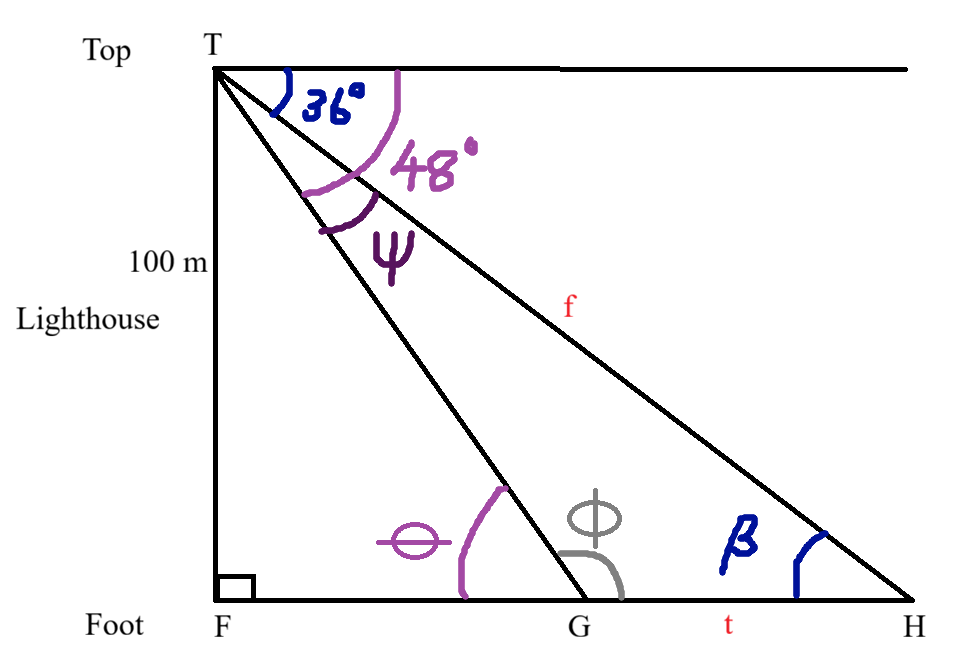
Not Drawn to Scale
(b.)
Let the:
Distance between the two speed boats = |GH| = t
|TH| = f
$ (b.) \\[3ex] \text{Alternate angles are congruent} \\[3ex] \beta = 36^\circ \\[3ex] \theta = 48^\circ \\[5ex] 36^\circ + \psi = 48^\circ \quad\dots\text{diagram} \\[3ex] \psi = 48 - 36 \\[3ex] \psi = 12^\circ \\[5ex] \theta + \phi = 180^\circ \quad\dots\text{angles on a straight line} \\[3ex] 48^\circ + \phi = 180^\circ \\[3ex] \phi = 180 - 48 \\[3ex] \phi = 132^\circ \\[5ex] \triangle TFH \\[3ex] \dfrac{f}{\sin 90^\circ} = \dfrac{100}{\sin\beta} \quad\dots\text{Sine Law} \\[5ex] \dfrac{f}{1} = \dfrac{100}{\sin 36^\circ} \\[5ex] f = \dfrac{100}{\sin 36^\circ}...eqn.(1) \\[5ex] \triangle TGH \\[3ex] \dfrac{t}{\sin\psi} = \dfrac{f}{\sin\phi} \quad\dots\text{Sine Law} \\[5ex] \dfrac{t}{\sin 12^\circ} = \dfrac{f}{\sin 132^\circ} \\[5ex] t = \dfrac{f\sin 12^\circ}{\sin 132^\circ} \\[5ex] \text{From eqn. (1), susbtitute for } f \\[3ex] t = \dfrac{100}{\sin 36^\circ} * \dfrac{\sin 12^\circ}{\sin 132^\circ} \\[5ex] t = 47.59778762 \\[3ex] t \approx 48\;m \quad\dots\text{to the nearest metre} $
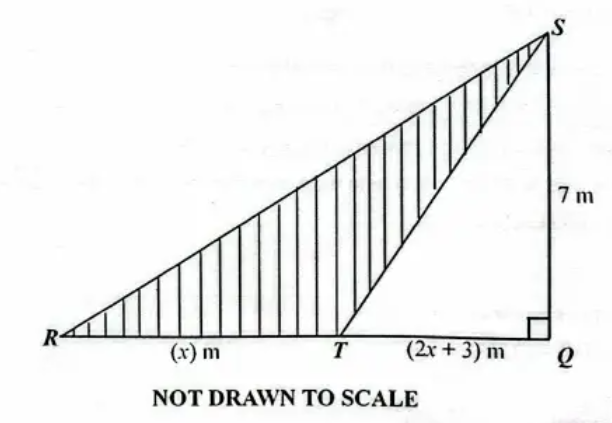
The shaded region of the figure is a pattern to be produced in a steel casting shop.
If the area of $\triangle QRS$ is 98 m², calculate to one decimal place, the:
(a.) value of x;
(b.) area of the pattern;
(c.) perimeter of the pattern.
$ (a.) \\[3ex] \underline{\triangle QRS} \\[3ex] \text{Area} = 98\;m^2 \\[3ex] \perp\text{height} = 7\;m \\[3ex] \text{base} = |TR| + |TQ| \\[3ex] x + (2x + 3) \\[3ex] = x + 2x + 3 \\[3ex] = 3x + 3 \\[3ex] = 3(x + 1)\;m \\[3ex] \text{Area} = \dfrac{1}{2} * \text{base} * \perp\text{height} \\[5ex] 98 = \dfrac{1}{2} * 3(x + 1) * 7 \\[5ex] 98 * 2 * \dfrac{1}{3} * \dfrac{1}{7} = x + 1 \\[5ex] x + 1 = 9.\bar{3} \\[3ex] x = 9.\bar{3} - 1 \\[3ex] x = 8.\bar{3} \\[3ex] x \approx 8.3 \;m\quad\dots\text{to one decimal place} \\[5ex] (b.) \\[3ex] \underline{\triangle QTS} \\[3ex] \text{base} = 2x + 3 \\[3ex] = 2(8.\bar{3}) + 3 \\[3ex] = 19.\bar{6}\;m \\[3ex] \perp\text{height} = 7\;m \\[3ex] \text{Area} = \dfrac{1}{2} * 19.\bar{6} * 7 \\[5ex] = 68.8\bar{3}\;m^2 \\[5ex] \underline{\text{Pattern: } \triangle TRS} \\[3ex] \text{Area of the pattern} = \text{Area of } \triangle QRS - \text{Area of } \triangle QTS \\[3ex] = 98 - 68.8\bar{3} \\[3ex] = 29.1\bar{6} \\[3ex] \approx 29.2\;m^2 \\[5ex] (c.) \\[3ex] \underline{\triangle QTS} \\[3ex] \text{hyp} = |ST| \\[3ex] \text{leg} = \text{base} = 19.\bar{6}\;m \\[3ex] \text{leg} = \perp\text{height} = 7\;m \\[3ex] \text{hyp}^2 = \text{leg}^2 + \text{leg}^2 \quad\dots\text{Pythagorean Theorem} \\[3ex] |ST|^2 = 19.\bar{6}^2 + 7^2 \\[3ex] |ST| = \sqrt{435.7777779} \\[3ex] |ST| = 20.87529109\;m \\[5ex] \underline{\triangle QRS} \\[3ex] \text{hyp} = |SR| \\[3ex] \text{leg} = \text{base} = 3(x + 1) \\[3ex] = 3(8.\bar{3} + 1) \\[3ex] = 28\;m \\[3ex] \text{leg} = \perp\text{height} = 7\;m \\[3ex] |SR|^2 = 28^2 + 7^2 \quad\dots\text{Pythagorean Theorem} \\[3ex] |SR| = \sqrt{833} \\[3ex] |SR| = 28.86173938\;m \\[5ex] \underline{\text{Pattern: } \triangle TRS} \\[3ex] \text{Perimeter} = |TR| + |SR| + |ST| \\[3ex] = 8.\bar{3} + 28.86173938 + 20.87529109 \\[3ex] = 58.0703638 \\[3ex] \approx 58.1\;m $
From the midpoint, O, betwee the foot of the pillar, C, and the foot of the mast, D, the angle of elevation of the top of the mast, P, is 70°.
From the point, O, the angle of elevation of the top of the pillar, R, is 28°.
If the pillar is 10m high:
(a.) represent the information in a diagram;
(b.) calculate, correct to the nearest whole number:
(i.) the height of the mast;
(ii.) |RP|.
(a.) The diagram that represents the information is drawn as shown:
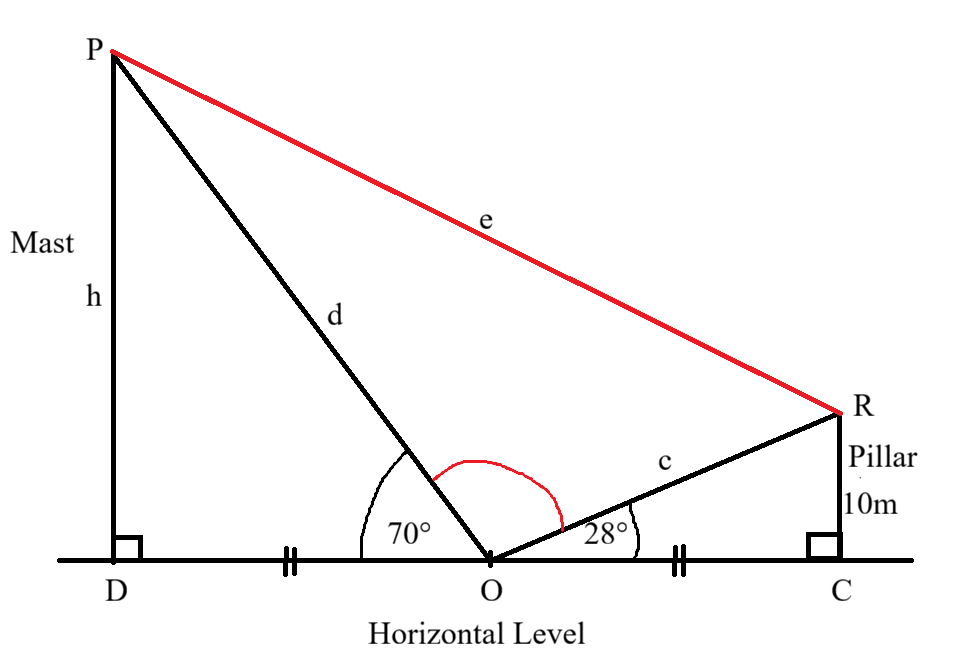
Not Drawn to Scale
$ \underline{\text{Diagram}} \\[3ex] |OD| = |OC| = k \quad\dots\text{midpoint, }O \\[3ex] |PD| = h \\[3ex] |PO| = d \\[3ex] |RO| = c \\[3ex] |RC| = 10m \\[3ex] |RP| = e \\[3ex] (b.) \\[3ex] \underline{\triangle ROC} \\[3ex] \tan 28^\circ = \dfrac{10}{k} \quad\dots\text{SOHCAHTOA} \\[5ex] k\tan 28 = 10 \\[3ex] k = \dfrac{10}{\tan 28} \\[5ex] \sin 28^\circ = \dfrac{10}{c} \quad\dots\text{SOHCAHTOA} \\[5ex] c\sin 28 = 10 \\[3ex] c = \dfrac{10}{\sin 28} \\[5ex] c = 21.30054468\;m \\[5ex] \underline{\triangle POD} \\[3ex] (i.) \\[3ex] \tan 70^\circ = \dfrac{h}{k} \quad\dots\text{SOHCAHTOA} \\[5ex] h = k\tan 70 \\[3ex] h = \dfrac{10}{\tan 28} * \tan 70 \\[5ex] h = 51.67253496 \\[3ex] h \approx 52\;m \\[5ex] \cos 70^\circ = \dfrac{k}{d} \quad\dots\text{SOHCAHTOA} \\[5ex] d\cos 70 = k \\[3ex] d = \dfrac{k}{\cos 70} \\[5ex] d = \dfrac{10}{\tan 28} * \dfrac{1}{\cos 70} \\[5ex] d = 54.98876315\;m \\[5ex] \underline{\triangle POR} \\[3ex] (ii.) \\[3ex] \angle POD + \angle POR + \angle ROC = 180^\circ \quad\dots\text{sum of angles on a straight line} \\[3ex] 70^\circ + \angle POR + 28^\circ = 180 \\[3ex] \angle POR = 180 - 70 - 28 \\[3ex] \angle POR = 82^\circ \\[5ex] e^2 = c^2 + d^2 - 2cd \cos\angle POR \quad\dots\text{Cosine Law} \\[3ex] e^2 = 21.30054468^2 + 54.98876315^2 - 2(21.30054468)(54.98876315) \cos 82^\circ \\[3ex] e^2 = 3151.452985 \\[3ex] e = \sqrt{3151.452985} \\[3ex] e = 56.13780353 \\[3ex] e \approx 56\;m $
An angle subtended at the centre by the minor arc AB is 88°.
(i.) Illustrate the information in a diagram.
(ii.) If C is a point on the minor arc, determine the value of the angle subtended by the chord AB at C.
Applications of Measurements and Units: (b.) A carpenter, Kwaw, is able to make 400 kitchen stools each day in 8 hours.
Another carpenter, Danso, works at $\dfrac{3}{2}$ times Kwaw's rate when making same kind of kitchen stools.
(i.) How many kitchen stools can Danso make in 8 hours?
(ii.) If both Kwaw and Danso decide to work together, determine the time required to make 2000 kitchen stools.
(a.)(i.) The diagram that Illustrates the information is drawn as shown:
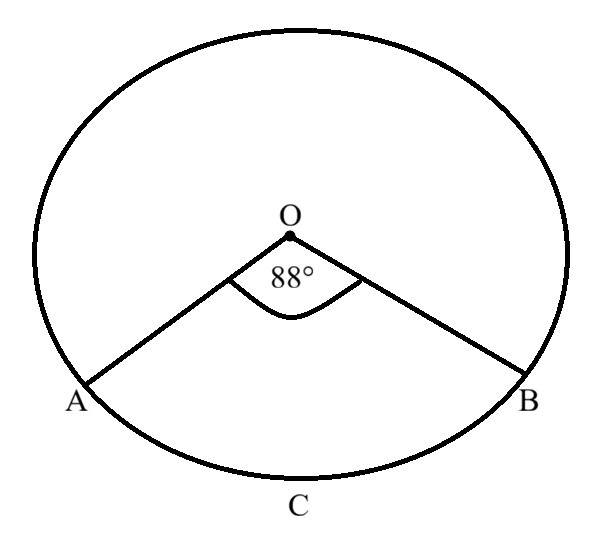
Not Drawn to Scale
(ii.) The diagram that Illustrates the updated information is drawn as shown:
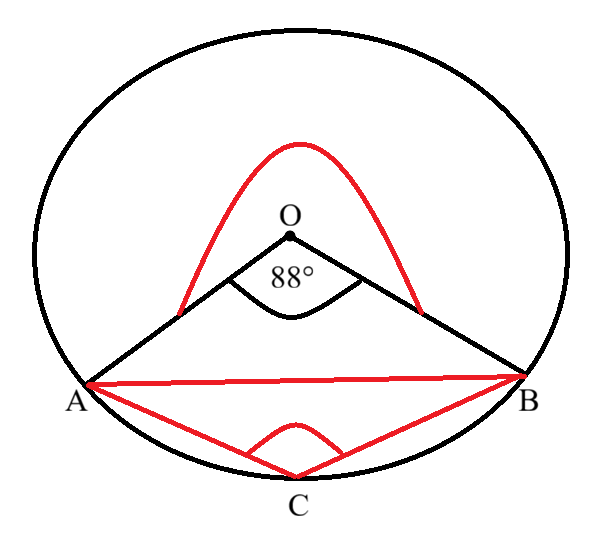
Not Drawn to Scale
$ \text{Reflex } \angle AOB + \text{Acute } \angle AOB = 360^\circ \quad\dots\text{sum of angles at a point} \\[3ex] \text{Reflex } \angle AOB + 88 = 360 \\[3ex] \text{Reflex } \angle AOB = 360 - 88 \\[3ex] \text{Reflex } \angle AOB = 272^\circ \\[5ex] \text{Reflex } \angle AOB = 2 * \angle ACB \quad\dots\text{angle at centre is twice angle at circumference} \\[3ex] 2 * \angle ACB = 272 \\[3ex] \angle ACB = \dfrac{272}{2} \\[5ex] \angle ACB = 136^\circ \\[3ex] $ (b.)
A carpenter, Kwaw, is able to make 400 kitchen stools each day in 8 hours.
How many stools can Kwaw make in an hour?
This implies that the:
$ \text{Kwaw's rate of work} = \dfrac{400\;stools}{8\;hours} = 50\;stools/hour \\[5ex] $ Another carpenter, Danso, works at $\dfrac{3}{2}$ times Kwaw's rate when making same kind of kitchen stools.
$ \text{Danso's rate of work} = \dfrac{3}{2} * \dfrac{50\;stools}{1\;hour} = 75\;stools/hour \\[5ex] \text{In 8 hours, Danso can make:} \\[3ex] 8\;hours * \dfrac{75\;stools}{1\;hour} = 600\;stools\quad\dots\text{Unity Fraction Method} \\[5ex] $ (ii.)
Kwaw can make 50 stools in 1 hour.
Danso can make 75 stools in 1 hour.
If both Kwaw and Danso decide to work together,
50 + 75 = 125
they can make 125 stools in 1 hour.
Determine the time required to make 2000 kitchen stools.
| Number of kitchen stools | Time (hours) |
|---|---|
| 125 | 1 |
| 2000 | what |
$ 125 * what = 1 * 2000 \\[3ex] what = \dfrac{2000}{125} \\[5ex] what = 16 \\[3ex] $ If they work together, they can make 2000 kitchen stools in 16 hours.
$|SD| = |SR| = (2a + b)\;m, \hspace{1em} |DR| = (3a + 5)\;m$ and the perimeter of the floor is $(7b + 3)\;m$.
(a.) Illustrate the information in a diagram.
(b.) Given that $a : b = 2 : 3$, find, correct to one decimal place, the:
(i.) value of a and b;
(ii.) area of the floor.
(a.) The diagram that Illustrates the information is drawn as shown:
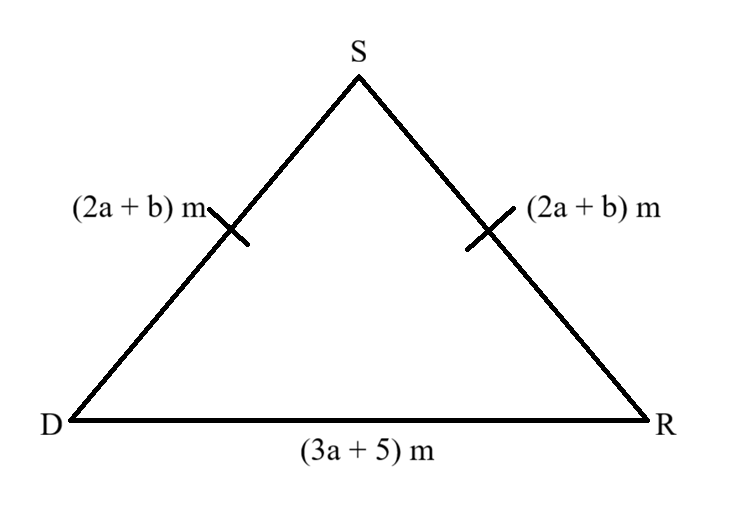
Not Drawn to Scale
$ (b.) \\[3ex] a : b = 2 : 3 \quad\dots\text{Given} \\[3ex] \dfrac{a}{b} = \dfrac{2}{3} \\[5ex] a = \dfrac{2b}{3} ...eqn.(1) \\[5ex] (i.) \\[3ex] \text{Perimeter} = 2(2a + b) + (3a + 5) \quad\dots\text{Formula} \\[3ex] = 4a + 2b + 3a + 5 \\[3ex] = 7a + 2b + 5 \\[5ex] \text{Also}: \\[3ex] \text{Perimeter} = 7b + 3 \quad\dots\text{Given} \\[3ex] \implies \\[3ex] 7b + 3 = 7a + 2b + 5 \\[3ex] 7b - 2b - 7a = 5 - 3 \\[3ex] 5b - 7a = 2 \\[3ex] \text{From eqn.(1), substitute for } a \\[3ex] 5b - 7\left(\dfrac{2b}{3}\right) = 2 \\[5ex] 5b - \dfrac{14b}{3} = 2 \\[5ex] LCD = 3 \\[3ex] 3(5b) - 3\left(\dfrac{14b}{3}\right) = 3(2) \\[5ex] 15b - 14b = 6 \\[3ex] b = 6\;m \\[5ex] \text{Substitute for } b \text{ in eqn.(1)} \\[3ex] a = \dfrac{2(6)}{3} \\[5ex] a = 4\;m \\[5ex] (ii.) \\[3ex] \underline{\text{Sides of the Isosceles Triangle}} \\[3ex] 2a + b \\[3ex] = 2(4) + 6 \\[3ex] = 14\;m \\[3ex] 3a + 5 \\[3ex] = 3(4) + 5 \\[3ex] = 17\;m \\[3ex] $ The updated diagram is:
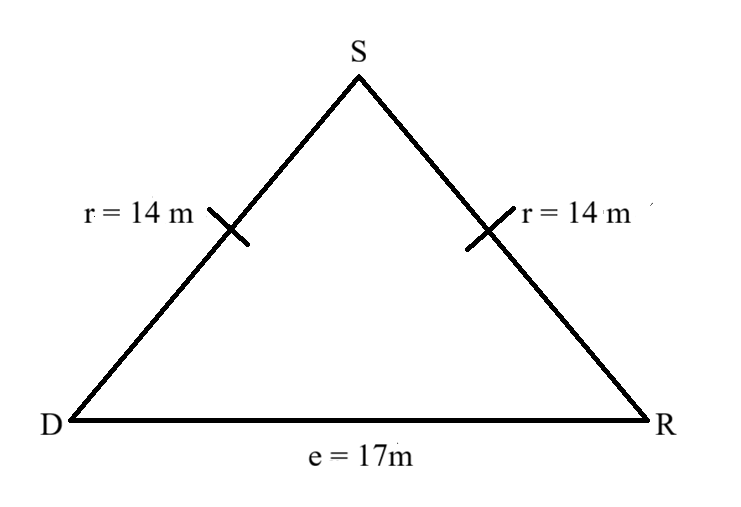
Not Drawn to Scale
$ \underline{\text{Sides}} \\[3ex] |DS| = |RS| = r = 14\;m \\[3ex] |DR| = e = 17\;m \\[5ex] \underline{\text{SemiPerimeter}} \\[3ex] s = \dfrac{2(14) + 17}{2} \\[5ex] s = 22.5\;m \\[5ex] \underline{\text{Difference between the semiperimeter and the sides}} \\[3ex] s - r = 22.5 - 14 = 8.5\;m\;\;(twice) \\[3ex] s - e = 22.5 - 17 = 5.5\;m \\[5ex] \underline{\text{Product of the semiperimeter and the differences}} \\[3ex] s(s - r)(s - r)(s - e) \\[3ex] = 22.5(8.5)^2(5.5) \\[3ex] = 8940.9375\;m^4 \\[3ex] \text{Area} = \sqrt{s(s - r)(s - r)(s - e)} \quad\dots\text{Heron's Formula} \\[3ex] = \sqrt{8940.9375} \\[3ex] = 94.55653071 \\[3ex] \approx 94.6\;m^2 \quad\dots\text{to one decimal place} $
|
27 17 52 18 61 |
31 41 61 35 16 |
35 30 43 9 50 |
52 94 68 74 45 |
81 23 56 59 41 |
50 38 57 46 45 |
48 40 62 71 28 |
15 70 82 4 22 |
59 76 54 74 26 |
6 18 25 33 45 |
(a.) Using the class interval, 1 — 10, 11 — 20, 21 — 30, ..., construct a cumulative frequency table for the distribution.
(b.) Draw a cumulative frequency curve for the distribution.
(c.) Use the curve to find the upper quartile.
(d.) If only 10% of the students passed the test, use the curve to determine the pass mark.
(a.) The cumulative frequency table is shown:
| Class Interval | Tally | Frequency | Upper Class Boundary | Cumulative Frequency |
|---|---|---|---|---|
| 1 — 10 | III | 3 | $ \dfrac{10 + 11}{2} = 10.5 $ | 3 |
| 11 — 20 | 5 | $ \dfrac{20 + 21}{2} = 20.5 $ | 3 + 5 = 8 | |
| 21 — 30 | 7 | $ \dfrac{30 + 31}{2} = 30.5 $ | 8 + 7 = 15 | |
| 31 — 40 | 6 | $ \dfrac{40 + 41}{2} = 40.5 $ | 15 + 6 = 21 | |
| 41 — 50 | 10 | $ \dfrac{50 + 51}{2} = 50.5 $ | 21 + 10 = 31 | |
| 51 — 60 | 7 | $ \dfrac{60 + 61}{2} = 60.5 $ | 31 + 7 = 38 | |
| 61 — 70 | 5 | $ \dfrac{70 + 71}{2} = 70.5 $ | 38 + 5 = 43 | |
| 71 — 80 | IIII | 4 | $ \dfrac{80 + 81}{2} = 80.5 $ | 43 + 4 = 47 |
| 81 — 90 | II | 2 | $ \dfrac{80 + 81}{2} = 80.5 $ | 47 + 2 = 49 |
| 91 — 100 | I | 1 | $ \dfrac{90 + 91}{2} = 90.5 $ | 49 + 1 = 50 |
| $\Sigma Frequency = 50$ | ||||
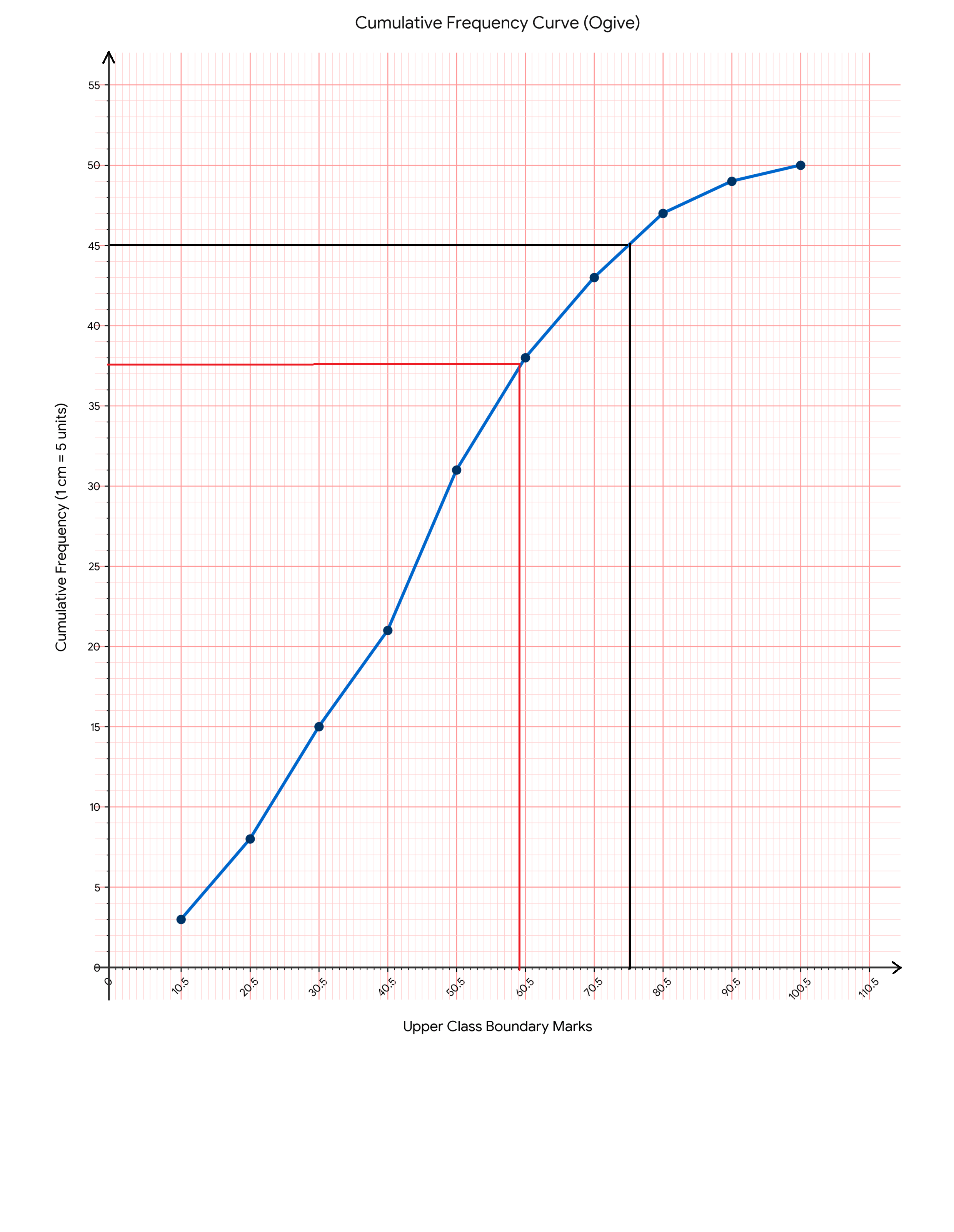
(b.) The coordinates to plot on the graph are:
(Upper Class Boundary, Cumulative Frequency)
(10.5, 3)
(20.5, 8)
(30.5, 15)
(40.5, 21)
(50.5, 31)
(60.5, 38)
(70.5, 43)
(80.5, 47)
(90.5, 49)
(100.5, 50)
The cumulative frequency curve for the distribution is drawn as shown:
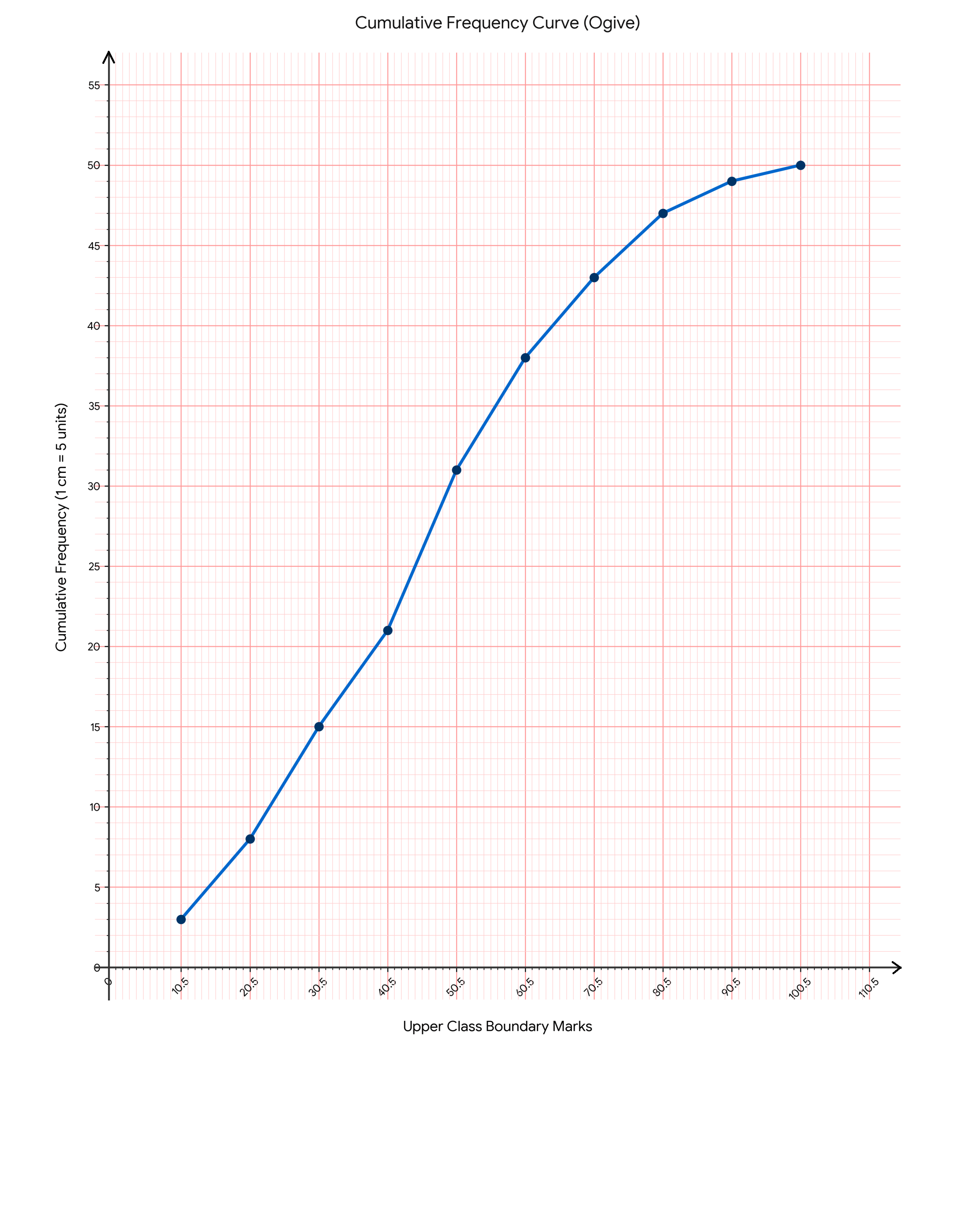
$ \text{From the Ogive}: \\[3ex] (c.) \\[3ex] N = \Sigma Frequency = 50 \\[3ex] \text{Upper Quartile position} = \dfrac{3N}{4}th \\[5ex] = \dfrac{3 * 50}{4}th \\[5ex] = 37.5th \\[5ex] \text{Upper Quartile} = 37.5th\;\;value \\[3ex] = 59.5 \quad\dots\text{red line on the Ogive} \\[3ex] (d.) \\[3ex] \text{Passed} = 10\%\;\;of\;\;N \\[3ex] = \dfrac{10}{100} * 50 \\[5ex] = 5\text{ students} \\[3ex] \text{Failed} = 50 - 5 \\[3ex] = 45\text{ students} \\[3ex] \text{5 students passed implies that 45 students failed} \\[3ex] \text{Pass Mark} = 45th\;\;value \\[3ex] = 79.5 \quad\dots\text{black line on the Ogive} \\[3ex] $
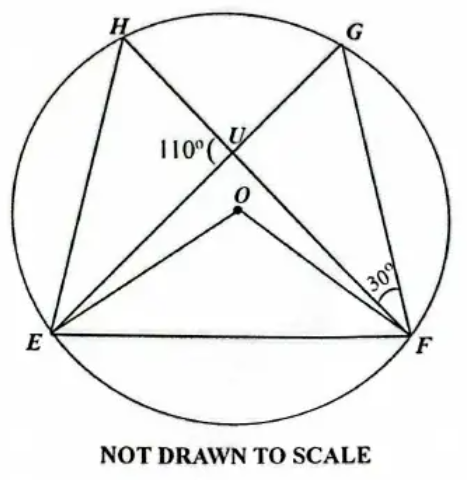
In the diagram, E, F, G and H lie on the circumference of the circle centre O.
$\overline{EG}$ and $\overline{FH}$ intersect at U such that $\angle GFH = 30^\circ$ and $\angle HUE = 110^\circ$.
Calculate:
(i.) $\angle EOF$;
(ii.) $\angle UEH$.
(b.) Arguments:Consider the following statements.
q: Most Art students are good at French.
r: Some Non-Arts students are also good at French.
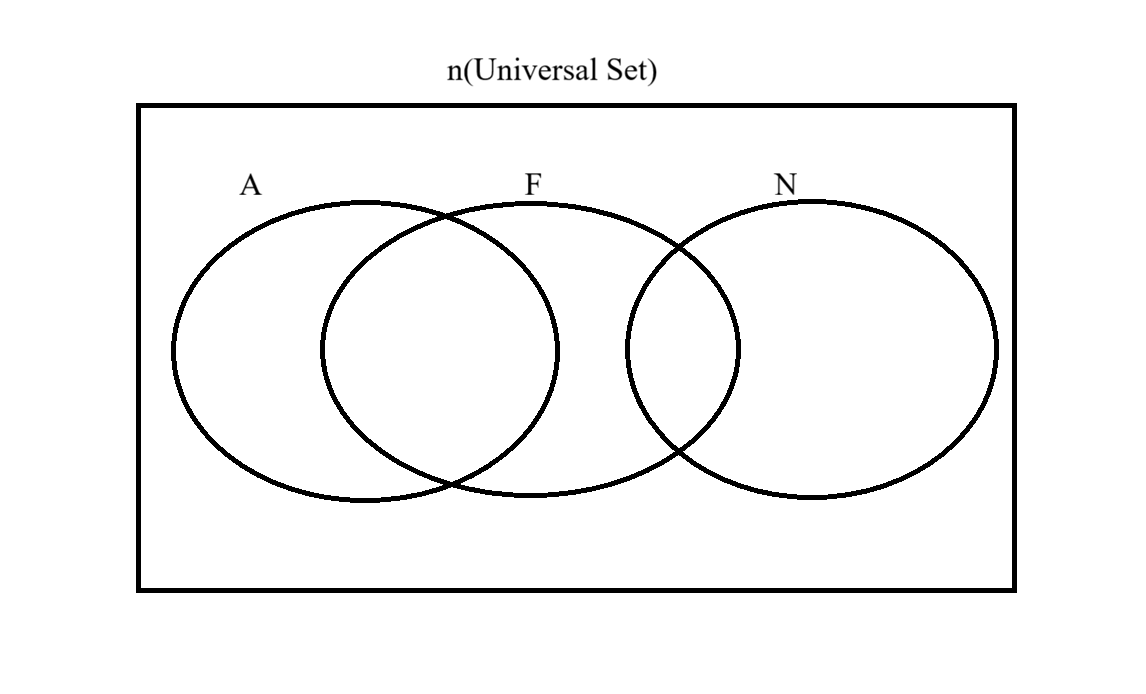
(i.) Illustrate the information in a Venn diagram.
(ii.) Determine from the diagram whether the following conclusions are Valid or Not Valid.
(α.) Dennis is a non-Arts student so he is not good at French.
(β.) Rose is an Arts student so she is good at French.
$ \angle GUF = \angle HUE = 110^\circ \quad\dots\text{vertical angles} \\[3ex] \angle GFU = \angle GFH = 30^\circ \quad\dots\text{diagram} \\[3ex] \underline{\triangle GUF} \\[3ex] \angle UGF + \angle GUF + \angle GFU = 180^\circ \quad\dots\text{sum of angles in a triangle} \\[3ex] \angle UGF + 110^\circ + 30^\circ = 180^\circ \\[3ex] \angle UGF = 180 - 110 - 30 \\[3ex] \angle UGF = 40^\circ \\[3ex] \angle EGF = \angle UGF = 40^\circ \quad\dots\text{diagram} \\[5ex] (i.) \\[3ex] \angle EOF = 2 * \angle EGF \quad\dots\text{angle at centre = twice the angle at circumference} \\[3ex] = 2 * 40 \\[3ex] = 80^\circ \\[5ex] (ii.) \\[3ex] \angle UEH = 30^\circ \quad\dots\text{angles in the same segment} \\[3ex] $ Let the set of:
Arts students = A
Students who are good at French = F
Non-Arts students = N
The Venn Diagram illustration of the information is drawn as shown:
The Venn Diagram illustrating the conclusions is drawn as shown:
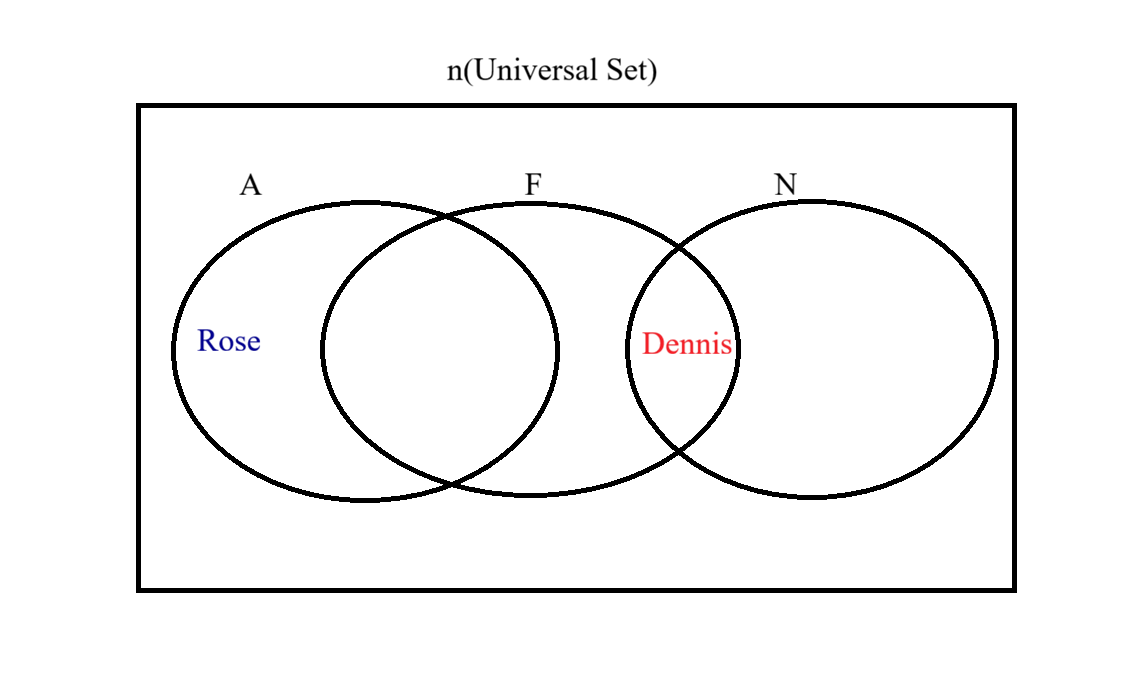
As seen from the diagram:
(α.) Dennis is a non-Arts student who is good at French.
Because of this possibility, the conclusion is not valid.
(β.) Rose is an Arts student who is not good at French.
Because of this possibility, the conclusion is not valid.


