Further Mathematics (Elective) Essay for Private Candidates
The Joy of the Teacher is the Success of the Students. – Samuel Chukwuemeka
Welcome to Our Site
I greet you this day,
These are the solutions to the Further Mathematics (Elective) essay questions for private candidates.
The TI-84 Plus CE shall be used for applicable questions.
Please review the Formulas, rules/laws, and theorems on the website for each topic as applicable.
If time permits and there is sufficient interest, video solutions may be provided. Please subscribe to the
YouTube channel to be notified
of upcoming livestreams.
You are welcome to ask questions during the video livestreams.
If you find these resources valuable and if any of these resources were helpful in your passing the
Mathematics tests/exams, please consider making a donation:
Cash App: $ExamsSuccess or
cash.app/ExamsSuccess
PayPal: @ExamsSuccess or
PayPal.me/ExamsSuccess
Venmo: @ExamsSuccess or
Venmo.com/u/ExamsSuccess
Your donation is appreciated.
Comments, ideas, areas of improvement, questions, and constructive
criticisms are welcome.
Feel free to contact me. Please be positive in your message.
I wish you the best.
Thank you.
Given that M and N are commutative under matix multiplication, find the positive value of x.
Given that M and N are commutative under matix multiplication ⇒ M * N = N * M
$ M * N = \begin{pmatrix} 4 & 8 \\ 2 & x \end{pmatrix} * \begin{pmatrix} x^2 & 4 \\ 1 & 4x \end{pmatrix} \\[7ex] = \begin{bmatrix} 4(x^2) + 8(1) & 4(4) + 8(4x) \\[3ex] 2(x^2) + x(1) & 2(4) + x(4x) \end{bmatrix} \\[7ex] = \begin{bmatrix} 4x^2 + 8 & 16 + 32x \\[3ex] 2x^2 + x & 8 + 4x^2 \end{bmatrix} $
$ N * M = \begin{pmatrix} x^2 & 4 \\ 1 & 4x \end{pmatrix} * \begin{pmatrix} 4 & 8 \\ 2 & x \end{pmatrix} \\[7ex] = \begin{bmatrix} x^2(4) + 4(3) & x^2(8) + 4(x) \\[3ex] 1(4) + 4x(2) & 1(8) + 4x(x) \end{bmatrix} \\[7ex] = \begin{bmatrix} 4x^2 + 8 & 8x^2 + 4x \\[3ex] 4 + 8x & 8 + 4x^2 \end{bmatrix} $
For this particular case, $MN = NM$
This implies that:
$ 2x^2 + x = 4 + 8x \\[3ex] 2x^2 + x - 8x - 4 = 0 \\[3ex] 2x^2 - 7x - 4 = 0 \\[3ex] .................................. \\[3ex] 2x^2(-4) = -8x^2 \\[3ex] \text{Factors are: } x \text{ and } -8x \\[3ex] \implies \\[3ex] 2x^2 + x - 8x - 4 = 0 \\[3ex] x(2x + 1) - 4(2x + 1) = 0 \\[3ex] (2x + 1)(x - 4) = 0 \\[3ex] .................................. \\[3ex] \text{To find the positive value of }x: \\[3ex] x - 4 = 0 \\[3ex] x = 4 $
The gradient of the tangent to the curve at a point is the derivative of the curve at that point.
$ (x^2 - y^2 + 16)^2 - 2x = 46 \\[3ex] \text{Differentiating each term with respect to } x \\[3ex] .............................................. \\[3ex] \text{For } (x^2 - y^2 + 16)^2 \\[3ex] \text{Let } p = x^2 - y^2 + 16 \hspace{3em} y = p^2 \\[3ex] \dfrac{dp}{dx} = 2x - 2y\dfrac{dy}{dx} \hspace{3.5em} \dfrac{dy}{dp} = 2p \\[5ex] \dfrac{dy}{dx} = \dfrac{dp}{dx} * \dfrac{dy}{dp}\quad\dots\text{Chain Rule} \\[5ex] = 2x - 2y\dfrac{dy}{dx} * 2p \\[5ex] = \left(2x - 2y\dfrac{dy}{dx}\right)[2(x^2 - y^2 + 16)] \\[5ex] .............................................. \\[3ex] \implies \\[3ex] 2(x^2 - y^2 + 16)\left(2x - 2y\dfrac{dy}{dx}\right) - 2 = 0 \\[5ex] 2(x^2 - y^2 + 16)\left(2x - 2y\dfrac{dy}{dx}\right) = 2 \\[5ex] (x^2 - y^2 + 16)\left(2x - 2y\dfrac{dy}{dx}\right) = 1 \\[5ex] 2x - 2y\dfrac{dy}{dx} = \dfrac{1}{x^2 - y^2 + 16} \\[5ex] 2x - \dfrac{1}{x^2 - y^2 + 16} = 2y\dfrac{dy}{dx} \\[5ex] \dfrac{2x(x^2 - y^2 + 16) - 1}{x^2 - y^2 + 16} = 2y\dfrac{dy}{dx} \\[5ex] 2y\dfrac{dy}{dx} = \dfrac{2x(x^2 - y^2 + 16) - 1}{x^2 - y^2 + 16} \\[5ex] \dfrac{dy}{dx} = \dfrac{2x(x^2 - y^2 + 16) - 1}{2y(x^2 - y^2 + 16)} \\[5ex] \text{At } (1, -2) \\[3ex] x = 1 \hspace{3em} y = -2 \\[3ex] \dfrac{dy}{dx} = \dfrac{2(1)[1^2 - (-2)^2 + 16] - 1}{2(-2)[1^2 - (-2)^2 + 16]} \\[5ex] = \dfrac{2(1 - 4 + 16) - 1}{-4(1 - 4 + 16)} \\[5ex] = \dfrac{2(13) - 1}{-4(13)} \\[5ex] = \dfrac{26 - 1}{-52} \\[5ex] = \dfrac{25}{-52} \\[5ex] = -\dfrac{25}{52} $
Differentiating a function from first principles can also be done by taking the limit of the difference quotient.
$ \underline{\text{Diiference Quotient, DQ}} \\[3ex] DQ = \dfrac{f(x + h) - f(x)}{h} \\[5ex] ................................................. \\[3ex] f(x) = 5 - 4x - 3x^2 \\[5ex] f(x + h) = 5 - 4(x + h) - 3(x + h)^2 \\[3ex] = 5 - 4x - 4h - 3[(x + h)(x + h)] \\[3ex] = 5 - 4x - 4h - 3(x^2 + hx + hx + h^2) \\[3ex] = 5 - 4x - 4h - 3(x^2 + 2hx + h^2) \\[3ex] = 5 - 4x - 4h - 3x^2 - 6hx - 3h^2 \\[5ex] f(x + h) - f(x) \\[3ex] = (5 - 4x - 4h - 3x^2 - 6hx - 3h^2) - (5 - 4x - 3x^2) \\[3ex] = 5 - 4x - 4h - 3x^2 - 6hx - 3h^2 - 5 + 4x + 3x^2 \\[3ex] = -4h - 6hx - 3h^2 \\[3ex] = h(-4 - 6x - 3h) \\[5ex] DQ = \dfrac{f(x + h) - f(x)}{h} \\[5ex] = \dfrac{h(-4 - 6x - 3h)}{h} \\[5ex] = -4 - 6x - 3h \\[3ex] ................................................. \\[3ex] \underline{\text{Derivative}} \\[3ex] \dfrac{dy}{dx} = \displaystyle{\lim_{h \to \infty}} DQ \\[5ex] = \displaystyle{\lim_{h \to \infty}} (-4 - 6x - 3h) \\[5ex] = -4 - 6x - 3(0) \\[3ex] = -4 - 6x $
$ 2^{3x + 1} - 3(2^{2x}) + 2^{x + 1} = 2^x \\[3ex] (2^{3x} \cdot 2^1) - 3(2^x)^2 + (2^x \cdot 2^1) = 2^x \quad\dots\text{Law 5...Exp} \\[3ex] [(2^x)^3 \cdot 2] - 3(2^x)^2 + (2^x \cdot 2) = 2^x \\[3ex] \text{Let } 2^x = p \\[3ex] (p^3 \cdot 2) - 3p^2 + (p \cdot 2) = p \\[3ex] 2p^3 - 3p^2 + 2p - p = 0 \\[3ex] 2p^3 - 3p^2 + p = 0 \\[3ex] p(2p^2 - 3p + 1) = 0 \\[3ex] p = 0 \text{ OR } 2p^2 - 3p + 1 = 0 \\[3ex] ......................................... \\[3ex] 2p^2 - 3p + 1 = 0 \\[3ex] 2p^2(1) = 2p^2 \\[3ex] \text{Factors are: } -2p \text{ and } -p \\[3ex] 2p^2 - 2p - p + 1 = 0 \\[3ex] 2p(p - 1) - 1(p - 1) = 0 \\[3ex] (p - 1)(2p - 1) = 0 \\[3ex] p - 1 = 0 \text{ OR } 2p - 1 = 0 \\[3ex] p = 1 \text{ OR } 2p = 1 \\[3ex] p = 1 \text{ OR } p = \dfrac{1}{2} \\[5ex] p = 0, \dfrac{1}{2}, 1 \\[5ex] ......................................... \\[3ex] \text{But } 2^x = p \\[3ex] \text{When } p = 0 \\[3ex] 2^x = 0 \\[3ex] \text{Introducing Logarithms to both sides} \\[3ex] \log 2^x = \log 0 \\[3ex] x \log 2 = undefined \quad\dots\text{The argument of a logarithm must be positive} \\[5ex] \text{When } p = \dfrac{1}{2} \\[5ex] 2^x = \dfrac{1}{2} \\[5ex] 2^x = 2^{-1} \\[3ex] x = -1 \\[5ex] \text{When } p = 1 \\[3ex] 2^x = 1 \\[3ex] 2^x = 2^{0} \quad\dots\text{Law 3...Exp} \\[3ex] x = 0 \\[5ex] x = -1, 0 \\[3ex] $ Check (If you have time)
| LHS | RHS |
|---|---|
|
$
2^{3x + 1} - 3(2^{2x}) + 2^{x + 1} \\[3ex]
\text{When } x = -1 \\[3ex]
2^{3(-1) + 1} - 3(2^{2(-1)}) + 2^{-1 + 1} \\[3ex]
2^{-2} - 3(2^{-2}) + 2^0 \\[3ex]
\dfrac{1}{2^2} - 3\left(\dfrac{1}{2^2}\right) + 1 \\[5ex]
\dfrac{1}{4} - \dfrac{3}{4} + \dfrac{4}{4} \\[5ex]
\dfrac{2}{4} \\[5ex]
\dfrac{1}{2}
$
$ \text{When } x = 0 \\[3ex] 2^{3(0) + 1} - 3(2^{2(0)}) + 2^{0 + 1} \\[3ex] 2^{1} - 3(2^0) + 2^(1) \\[3ex] 2 - 3(1) + 2 \\[3ex] 1 $ |
$
2^x \\[3ex]
\text{When } x = -1 \\[3ex]
2^{-1} \\[3ex]
\dfrac{1}{2}
$
$ \text{When } x = 0 \\[3ex] 2^0 \\[3ex] 1 $ |
$ \text{Dataset 1} \\[3ex] 2, 9, 7m, 3n, 21, 24 \\[3ex] \text{Median} = \dfrac{7m + 3n}{2} = 16 \\[5ex] 7m + 3n = 2(16) \\[3ex] 7m + 3n = 32...eqn.(1) \\[5ex] \text{Dataset 2} \\[3ex] 4, 8, 6, 4m, 19, 2n \\[3ex] \text{Mean} = \dfrac{4 + 8 + 6 + 4m + 19 + 2n}{6} = 9\dfrac{1}{2} \\[5ex] \dfrac{4m + 2n + 37}{6} = \dfrac{19}{2} \\[5ex] 4m + 2n + 37 = 6\left(\dfrac{19}{2}\right) \\[5ex] 4m + 2n = 3(19) - 37 \\[3ex] 4m + 2n = 20 \\[3ex] 2m + n = 10 ...eqn.(2) \\[5ex] \text{From } eqn.(2) \\[3ex] n = 10 - 2m...eqn.(3) \\[3ex] \text{Substitute for } n \text{ in } eqn.(1) \\[3ex] 7m + 3(10 - 2m) = 32 \\[3ex] 7m + 30 - 6m = 32 \\[3ex] m = 32 - 30 \\[3ex] m = 2 \\[5ex] \text{Substitute for } m \text{ in } eqn.(3) \\[3ex] n = 10 - 2(2) \\[3ex] n = 6 $
If four mangoes are selected at random from the basket, find the probability that:
(a.) one is bad;
(b.) not more than two are bad.
$ \underline{\text{Binomial Probability Distribution}} \\[3ex] S = \text{Sample Space} \\[3ex] n(S) = 10 \\[3ex] n(good) = 3 \\[3ex] n(bad) = 10 - 3 = 7\quad\dots\text{word of reference} \\[3ex] p = P(bad) = \dfrac{7}{10} \\[5ex] q = P(good) = \dfrac{3}{10} \\[5ex] P(x) = C(n, x) * p^x * q^{n - x} \\[5ex] n = 4 \quad\dots\text{four mangoes are selected} \\[3ex] (a.) \\[3ex] \text{one is bad} \implies x = 1 P(x = 1) \\[3ex] = C(4, 1) * \left(\dfrac{7}{10}\right)^1 * \left(\dfrac{3}{10}\right)^{4 - 1} \\[5ex] = \dfrac{189}{2500} \\[5ex] = 0.0756 \\[5ex] (b.) \\[3ex] \text{not more than two are bad} \implies \text{at most 2} \implies \le 2 \\[3ex] P(x \le 2) \\[3ex] = P(x = 0) + P(x = 1) + P(x = 2) \\[3ex] ................................................................. \\[3ex] P(x = 0) \\[3ex] = C(4, 0) * \left(\dfrac{7}{10}\right)^0 * \left(\dfrac{3}{10}\right)^{4 - 0} \\[5ex] = 0.0081 \\[5ex] P(x = 1) = 0.0756 \\[5ex] P(x = 2) \\[3ex] = C(4, 2) * \left(\dfrac{7}{10}\right)^2 * \left(\dfrac{3}{10}\right)^{4 - 2} \\[5ex] = \dfrac{1323}{5000} \\[5ex] = 0.2646 \\[3ex] ................................................................. \\[3ex] = 0.0081 + 0.0756 + 0.2646 \\[3ex] = 0.3483 $
Find the:
(a.) velocity of the particle at t = 3 seconds;
(b.) acceleration of the particle at t = 3 seconds.
$ velocity = v \\[3ex] acceleration = a \\[5ex] r = t^4 + 3t^3 - t^2 + 2t \\[3ex] (a.) \\[3ex] v = \dfrac{dr}{dt} = 4t^3 + 9t^2 - 2t + 2 \quad\dots\text{Power Rule} \\[5ex] \text{At } t = 3 \\[3ex] v(3) = 4(3)^3 + 9(3)^2 - 2(3) + 2 \\[3ex] v(3) = 185\;m/s \\[5ex] (b.) \\[3ex] a = \dfrac{dv}{dt} = 12t^2 + 18t - 2 \quad\dots\text{Power Rule} \\[5ex] \text{At } t = 3 \\[3ex] a(3) = 12(3)^2 + 18(3) - 2 \\[3ex] a(3) = 160\;m/s^2 $
Find the magnitude and direction of $F_3$, correct to the nearest whole number.
$ F_1 = (6\;N, 030^\circ) \\[3ex] F_{1x} = 6\cos 30^\circ = 5.196152423\;N \\[3ex] F_{1y} = 6\sin 30^\circ = 3\;N \\[5ex] F_2 = (8\;N, 075^\circ) \\[3ex] F_{2x} = 8\cos 75^\circ = 2.070552361\;N \\[3ex] F_{2y} = 8\sin 75^\circ = 7.72740661\;N \\[5ex] F_3 = (x\;N, \theta^\circ) \\[5ex] \underline{\text{At Equilibrium}} \\[3ex] \Sigma F_x = 0 \\[3ex] F_{1x} + F_{2x} + F_{3x} = 0 \\[3ex] 5.196152423 + 2.070552361 + F_{3x} = 0 \\[3ex] F_{3x} = 0 - 5.196152423 - 2.070552361 \\[3ex] F_{3x} = -7.266704784\;N \\[5ex] \Sigma F_y = 0 \\[3ex] F_{1y} + F_{2y} + F_{3y} = 0 \\[3ex] 3 + 7.72740661 + F_{3y} = 0 \\[3ex] F_{3y} = 0 - 3 - 7.72740661 \\[3ex] F_{3y} = -10.72740661\;N \\[5ex] \underline{\text{Magnitude of } F_3} \\[3ex] F_3 = \sqrt{F_{3x}^2 + F_{3y}^2} \\[3ex] F_3 = \sqrt{(-7.266704784)^2 + (-10.72740661)^2} \\[3ex] = 12.95693833 \\[3ex] \approx 13\;N\quad\dots\text{to the nearst whole number} \\[5ex] \underline{\text{Direction of } F_3, \theta} \\[3ex] \theta = \tan^{-1}\left(\dfrac{F_y}{F_x}\right) \\[5ex] \theta = \tan^{-1}\left(\dfrac{F_{3y}}{F_{3x}}\right) \\[5ex] = \tan^{-1}\left(\dfrac{-10.72740661}{-7.266704784}\right) \\[5ex] = 55.8864353^\circ \\[3ex] \text{But: } \\[3ex] F_{3x} = -7.266704784\;N\quad\dots\text{negative} \\[3ex] F_{3y} = -10.72740661\;N\quad\dots\text{negative} \\[3ex] \implies F_3 \text{ is in the 3rd Quadrant} \\[3ex] \therefore \theta = 180^\circ + 55.8864353^\circ \\[3ex] = 235.8864353 \\[3ex] \approx 236^\circ \quad\dots\text{to the nearest whole number} $
Relations and Functions: (b.) Given that two functions f and g are defined by $f:x \rightarrow \dfrac{x}{5} - 3$ and $g:x \rightarrow \dfrac{7x - 5}{2}$, find:
$ (i.)\;\; f^{-1} \circ g(x) \\[3ex] (ii.)\;\; f^{-1} \circ g(-2) \\[3ex] $
$ (a.) \\[3ex] \underline{\text{Given Equation}} \\[3ex] 5x^2 - 9x - 4 = 0 \\[3ex] \text{Compare to: } ax^2 + bx + c = 0 \\[3ex] a = 5 \\[3ex] b = -9 \\[3ex] c = -4 \\[3ex] \text{Roots} = \alpha \text{ and } \beta \\[3ex] \text{Sum of roots, } \alpha + \beta \\[3ex] = -\dfrac{b}{a} \\[5ex] = \dfrac{-(-9)}{5} \\[5ex] = \dfrac{9}{5} \\[5ex] \text{Product of roots, } \alpha\beta \\[3ex] = \dfrac{c}{a} \\[5ex] = -\dfrac{4}{5} \\[5ex] \underline{\text{New Equation}} \\[3ex] \text{Roots} = (\alpha^2 - 3) \text{ and } (\beta^2 - 3) \\[3ex] \text{Sum of roots} \\[3ex] = (\alpha^2 - 3) + (\beta^2 - 3) \\[3ex] = \alpha^2 - 3 + \beta^2 - 3 \\[3ex] = \alpha^2 + \beta^2 - 6 \\[3ex] ................................................ \\[3ex] \text{But: } (\alpha + \beta)^2 \\[3ex] = (\alpha + \beta)(\alpha + \beta) \\[3ex] = \alpha^2 + \alpha\beta + \alpha\beta + \beta^2 \\[3ex] = \alpha^2 + 2\alpha\beta + \beta^2 \\[3ex] \text{So, } (\alpha + \beta)^2 = \alpha^2 + \beta^2 + 2\alpha\beta \\[3ex] \implies \\[3ex] \alpha^2 + \beta^2 = (\alpha + \beta)^2 - 2\alpha\beta \\[3ex] = \left(\dfrac{9}{5}\right)^2 - 2\left(-\dfrac{4}{5}\right) \\[5ex] = \dfrac{81}{25} + \dfrac{8}{5} \\[5ex] = \dfrac{81 + 40}{25} \\[5ex] \therefore \alpha^2 + \beta^2 = \dfrac{121}{25} \\[5ex] ................................................ \\[3ex] = \dfrac{121}{25} - 6 \\[5ex] = \dfrac{121 - 150}{25} \\[5ex] = -\dfrac{29}{25} \\[5ex] \text{Product of roots} \\[3ex] = (\alpha^2 - 3)(\beta^2 - 3) \\[3ex] = \alpha^2\beta^2 - 3\alpha^2 - 3\beta^2 + 9 \\[3ex] = (\alpha\beta)^2 - 3(\alpha^2 + \beta^2) + 9 \\[3ex] = \left(-\dfrac{4}{5}\right)^2 - 3\left(\dfrac{121}{25}\right) + 9 \\[5ex] = \dfrac{16}{25} - \dfrac{363}{25} + \dfrac{225}{25} \\[5ex] = -\dfrac{122}{25} \\[5ex] \underline{\text{Quadratic Equation if the Sum and Product of Roots is given}} \\[3ex] x^2 - \text{(Sum of roots) } x + \text{Product of roots} = 0 \\[3ex] x^2 - \left(-\dfrac{29}{25}\right)x + -\dfrac{122}{25} = 0 \\[5ex] x^2 + \dfrac{29}{25}x -\dfrac{122}{25} = 0 \\[5ex] LCD = 25 \\[3ex] 25x^2 + 29x - 122 = 0 $
$ (b.) \\[3ex] f(x) = \dfrac{x}{5} - 3 \hspace{3em} g(x) = \dfrac{7x - 5}{2} \\[5ex] \underline{\text{Inverse of} f(x)} \\[3ex] y = \dfrac{x}{5} - 3 \\[5ex] x = \dfrac{y}{5} - 3 \\[5ex] x + 3 = \dfrac{y}{5} \\[5ex] y = 5(x + 3) \\[3ex] f^{-1}(x) = 5(x + 3) \\[5ex] (i.) \\[3ex] f^{-1}(x) \circ g(x) \\[3ex] = f^{-1}[g(x)] \\[3ex] = f^{-1}\left(\dfrac{7x - 5}{2}\right) \\[5ex] = 5\left(\dfrac{7x - 5}{2} + 3\right) \\[5ex] = 5\left(\dfrac{7x - 5 + 6}{2}\right) \\[5ex] = 5\left(\dfrac{7x + 1}{2}\right) \\[5ex] (ii.) \\[3ex] f^{-1} \circ g(-2) \\[3ex] = 5\left(\dfrac{7(-2) + 1}{2}\right) \\[5ex] = -\dfrac{65}{2} $
If the 12th term of the linear sequence (A.P.) is –12, calculate the:
(a.) common difference;
(b.) first term;
(c.) sum of the first fourteen terms of the linear sequence (A.P.).
$ a = \text{first term} \\[3ex] d = \text{common difference} \\[3ex] r = \text{common ratio} \\[5ex] \underline{\text{Linear Sequence}} \hspace{7em} \underline{\text{Exponential Sequence}} \\[3ex] \text{1st term} = a \hspace{8.5em} \text{1st term} = a \\[3ex] \text{4th term} = a + 3d \hspace{6em} \text{2nd term} = ar = a + 3d \\[3ex] \text{6th term} = a + 5d \hspace{6em} \text{3rd term} = ar^2 = a + 5d \\[3ex] \text{12th term} = a + 11d = -12 \\[5ex] \text{For Linear Sequence: 12th term} \\[3ex] a = -12 - 11d ...eqn.(1) \\[5ex] \text{Exponential Sequence: r} \\[3ex] r = \dfrac{a + 3d}{a} = \dfrac{a + 5d}{a + 3d} \\[5ex] (a + 3d)(a + 3d) = a(a + 5d) \\[3ex] a^2 + 3ad + 3ad + 9d^2 = a^2 + 5ad \\[3ex] 6ad - 5ad = -9d^2 \\[3ex] ad = -9d^2 \\[3ex] a = -\dfrac{9d^2}{d} \\[5ex] a = -9d ...eqn.(2) \\[5ex] (a.) \\[3ex] eqn.(1) = eqn.(2) \quad\dots\text{Because } a = a \\[3ex] -12 - 11d = -9d \\[3ex] -12 = -9d + 11d \\[3ex] 2d = -12 \\[3ex] d = -\dfrac{12}{2} \\[5ex] d = -6 \\[5ex] (b.) \\[3ex] \text{Substitute for } d \text{ in } eqn.(2) \\[3ex] a = -9(-6) \\[3ex] a = 54 \\[5ex] (c.)\; \underline{\text{Sum of the first n terms of a Linear Sequence}, S_{n}} \\[3ex] S_n = \dfrac{n}{2}[2a + d(n - 1)] \\[5ex] \text{For } n = 14 \\[3ex] S_{14} = \dfrac{14}{2}[2(54) + -6(14 - 1)] \\[5ex] = 7[108 - 6(13)] \\[3ex] = 7(108 - 78) \\[3ex] = 210 $
Radical Equations: (b.) Solve $3(\sqrt{4x - 3}) - \sqrt{5x + 1} = 5$, where x is an integer.
$ (a.) \\[3ex] \cos 2x - 5\sin^2 x = \dfrac{1}{9} \\[5ex] ................................................... \\[3ex] \sin^2 x + \cos^2 x = 1 \quad\dots\text{Pythagorean Identity} \\[3ex] \sin^2 x = 1 - \cos^2 x \\[5ex] \cos 2x \\[3ex] = \cos(x + x) \\[3ex] = \cos x \cos x - \sin x \sin x \quad\dots\text{Double-Angle Formula} \\[3ex] = \cos^2 x - \sin^2 x \\[3ex] = \cos^2 x - (1 - \cos^2 x)\quad\dots\text{based on Pythagorean Identity} \\[3ex] = \cos^2 x - 1 + \cos^2 x \\[3ex] = 2\cos^2 x - 1 \\[3ex] ................................................... \\[3ex] \implies \\[3ex] 2\cos^2 x - 1 - 5(1 - \cos^2 x) = \dfrac{1}{9} \\[5ex] 2\cos^2 x - 1 - 5 + 5\cos^2 x = \dfrac{1}{9} \\[5ex] 7\cos^2 x = \dfrac{1}{9} + 1 + 5 \\[5ex] 7\cos^2 x = \dfrac{1}{9} + 6 \\[5ex] 7\cos^2 x = \dfrac{1 + 54}{9} \\[5ex] 7\cos^2 x = \dfrac{55}{9} \\[5ex] \cos^2 x = \dfrac{55}{9} * \dfrac{1}{7} \\[5ex] \cos^2 x = \dfrac{55}{63} \\[5ex] \cos x = \pm\sqrt{\dfrac{55}{63}} \\[5ex] \cos x = \pm 0.9343531843 \\[5ex] x = \cos^{-1} (-0.9343531843) \\[3ex] x = 159.1238974 \\[3ex] x \approx 159^\circ\quad\dots\text{2nd Quadrant} \\[5ex] x = \cos^{-1} (0.9343531843) \\[3ex] x = 20.8761026 \\[3ex] x \approx 21^\circ\quad\dots\text{1st Quadrant} \\[5ex] \text{cosine is also positive or negative in the rest of the quadrants} \\[3ex] \underline{\text{3rd Quadrant}} \\[3ex] 180^\circ + 159.1238974^\circ \\[3ex] = 339.1238974 \\[3ex] \approx 339^\circ \\[5ex] 180^\circ + 20.8761026^\circ \\[3ex] = 200.8761026 \\[3ex] \approx 201^\circ \\[5ex] \underline{\text{4th Quadrant}} \\[3ex] 360^\circ - 159.1238974^\circ \\[3ex] = 200.8761026 \\[3ex] \approx 201^\circ \\[5ex] 360^\circ - 20.8761026^\circ \\[3ex] = 339.1238974 \\[3ex] \approx 339^\circ \\[5ex] x \approx 21^\circ, 159^\circ, 201^\circ, 339^\circ \\[3ex] $ Check
| LHS | RHS |
|---|---|
|
$
\cos 2x - 5\sin^2 x \\[3ex]
\cos 2(20.8761026) - 5 * \sin^2(20.8761026) \\[3ex]
0.1111111112
$
$ \cos 2x - 5\sin^2 x \\[3ex] \cos 2(159.1238974) - 5 * \sin^2(159.1238974) \\[3ex] 0.1111111112 $ $ \cos 2x - 5\sin^2 x \\[3ex] \cos 2(200.8761026) - 5 * \sin^2(200.8761026) \\[3ex] 0.1111111112 $ $ \cos 2x - 5\sin^2 x \\[3ex] \cos 2(339.1238974) - 5 * \sin^2(339.1238974) \\[3ex] 0.1111111112 $ |
$ \dfrac{1}{9} \\[5ex] 0.1111111111 $ |
$ (b.) \\[3ex] 3(\sqrt{4x - 3}) - \sqrt{5x + 1} = 5 \\[3ex] 3\sqrt{4x - 3} = 5 + \sqrt{5x + 1} \\[3ex] \text{Square both sides} \\[3ex] (3\sqrt{4x - 3})^2 = (5 + \sqrt{5x + 1})^2 \\[3ex] 3^2 \cdot (\sqrt{4x - 3})^2 = (5 + \sqrt{5x + 1})(5 + \sqrt{5x + 1}) \\[3ex] 9(4x - 3) = 25 + 5\sqrt{5x + 1} + 5\sqrt{5x + 1} + (\sqrt{5x + 1})^2 \\[3ex] 36x - 27 = 25 + 10\sqrt{5x + 1} + 5x + 1 \\[3ex] 36x - 5x - 27 - 25 - 1 = 10\sqrt{5x + 1} \\[3ex] 31x - 53 = 10\sqrt{5x + 1} \\[3ex] \text{Square both sides again} \\[3ex] (31x - 53)^2 = (10\sqrt{5x + 1})^2 \\[3ex] (31x - 53)(31x - 53) = 10^2 \cdot (\sqrt{5x + 1})^2 \\[3ex] 961x^2 - 1643x - 1643x + 2809 = 100(5x + 1) \\[3ex] 961x^2 - 3286x + 2809 = 500x + 100 \\[3ex] 961x^2 - 3286x - 500x + 2809 - 100 = 0 \\[3ex] 961x^2 - 3786x + 2709 = 0 \\[3ex] \text{Compare to the standard form of a Quadratic Equation: } ax^2 + bx + c = 0 \\[3ex] a = 961 \\[3ex] b = -3786 \\[3ex] c = 2709 \\[3ex] x = \dfrac{-b \pm \sqrt{b^2 - 4ac}}{2a} \\[5ex] x = \dfrac{-(-3786) \pm \sqrt{(-3786)^2 - 4(961)(2709)}}{2(961)} \\[5ex] x = \dfrac{3786 \pm \sqrt{14333796 - 10413396}}{1922} \\[5ex] x = \dfrac{3786 \pm \sqrt{3920400}}{1922} \\[5ex] x = \dfrac{3786 \pm 1980}{1922} \\[5ex] x = \dfrac{3786 + 1980}{1922} \hspace{2em}\text{OR}\hspace{2em} x = \dfrac{3786 - 1980}{1922} \\[5ex] x = 3 \hspace{2em}\text{OR}\hspace{2em} x = 0.9396462019 \\[3ex] \text{Because } x \text{ is an integer, } x = 3 \\[3ex] $ Check
| LHS | RHS |
|---|---|
| $ 3(\sqrt{4x - 3}) - \sqrt{5x + 1} \\[3ex] 3(\sqrt{4(3) - 3}) - \sqrt{5(3) + 1} \\[3ex] 3(\sqrt{9}) - \sqrt{16} \\[3ex] 3(3) - 4 \\[3ex] 9 - 4 \\[3ex] 5 $ | $5$ |
| Marks | 11 — 15 | 16 — 20 | 21 — 25 | 26 — 30 | 31 — 35 | 36 — 40 |
| Number of students | p | 4 | 11 | k | 6 | 1 |
If the mean mark is 24.75, find the values of p and k.
Let us represent the table as:
| Marks | Mid-Mark, $X$ | Number of Students (Frequency), $F$ | $FX$ |
|---|---|---|---|
| 11 — 15 | $ \dfrac{11 + 15}{2} = 13 $ | p | 13p |
| 16 — 20 | $ \dfrac{16 + 20}{2} = 18 $ | 4 | 72 |
| 21 — 25 | $ \dfrac{21 + 25}{2} = 23 $ | 11 | 253 |
| 26 — 30 | $ \dfrac{26 + 40}{2} = 28 $ | k | 28k |
| 31 — 35 | $ \dfrac{31 + 35}{2} = 33 $ | 6 | 198 |
| 36 — 40 | $ \dfrac{36 + 40}{2} = 38 $ | 1 | 38 |
| $\Sigma F = p + k + 22 = 40$ | $\Sigma FX = 13p + 28k + 561$ | ||
$ \underline{\text{Frequency}} \\[3ex] \Sigma F = p + k + 22 = 40 \\[3ex] p + k = 40 - 22 \\[3ex] p + k = 18 ...eqn.(1) \\[5ex] \underline{\text{Mean}} \\[3ex] \text{Mean} = \dfrac{\Sigma FX}{\Sigma F} \\[5ex] 24.75 = \dfrac{13p + 28k + 561}{40} \\[5ex] 13p + 28k + 561 = 24.75(40) \\[3ex] 13p + 28k = 990 - 561 \\[3ex] 13p + 28k = 429 ...eqn.(2) \\[5ex] \underline{\text{Substitution Method}} \\[3ex] \text{From } eqn.(1) \\[3ex] p = 18 - k ...eqn.(3) \\[3ex] \text{Substitute for } p \text{ in } eqn.(2) \\[3ex] 13(18 - k) + 28k = 429 \\[3ex] 234 - 13k + 28k = 429 \\[3ex] 15k = 429 - 234 \\[3ex] k = \dfrac{195}{15} \\[5ex] k = 13 \\[3ex] \text{Substitute for } k \text{ in } eqn.(3) \\[3ex] p = 18 - 13 \\[3ex] p = 5 $
The probabilities that John will secure a job is 70% and that Ngozi will secure a job is 60%.
Given that the probability of only one of the three friends securing a job is 29%.
Find, correct to two decimal places, the probability of:
(a.) Ade;
(b.) two of them;
(c.) all of them,
securing a job.
Let the probability that:
John secures a job = P(J) = 70% = 0.7
Ngozi secures a job = P(N) = 60% = 0.6
Ade secures a job = P(A) = a
Assuming the three events (John, Ngozi, Ade securing jobs) are independent.
$ (a.) \\[3ex] \underline{\text{Complementary Rule}} \\[3ex] P(J) + P(J') = 1 \\[3ex] 0.7 + P(J') = 1 \\[3ex] P(J') = 1 - 0.7 = 0.3 \\[5ex] P(N) + P(N') = 1 \\[3ex] 0.6 + P(N') = 1 \\[3ex] P(N') = 1 - 0.6 = 0.4 \\[5ex] P(A) + P(A') = 1 \\[3ex] a + P(A') = 1 \\[3ex] P(A') = 1 - a \\[5ex] $ Only one secures a job implies:
JN'A': John secures a job, Ngozi does not, Ade does not
J'NA': John does not, Ngozi does, Ade does not
J'N'A: John does not, Ngozi does not, Ade does
$ P(\text{only one secures a job}) = 0.29 \quad\dots\text{Given} \\[3ex] But: \\[3ex] P(\text{only one secures a job}) \\[3ex] = P(JN'A') + P(J'NA') + P(J'N'A) \quad\dots\text{Addition Rule for Mutually Exclusive Events} \\[3ex] $
$ \underline{\text{Multiplication Rule for Independent Events}} \\[3ex] P(JN'A') = 0.7(0.4)(1 - a) = 0.28(1 - a) = 0.28 - 0.28a \\[3ex] P(J'NA') = 0.3(0.6)(1 - a) = 0.18(1 - a) = 0.18 - 0.18a \\[3ex] P(J'N'A) = 0.3(0.4)(a) = 0.12a \\[3ex] \implies \\[3ex] (0.28 - 0.28a) + (0.18 - 0.18a) + 0.12a = 0.29 \\[3ex] 0.28 - 0.28a + 0.18 - 0.18a + 0.12a = 0.29 \\[3ex] -0.34a = 0.29 - 0.28 - 0.18 \\[3ex] a = \dfrac{-0.17}{-0.34} \\[5ex] a = 0.5 \\[3ex] P(A) = a = 0.5 \\[3ex] P(A') = 1 - 0.5 = 0.5 \\[3ex] $ Two of them secures a job implies:
JNA': John and Ngozi secure jobs, Ade does not
J'NA: Ngozi and Ade secure jobs, John does not
JN'A: John and Ade does secure jobs, Ngozi does not
$ (b.) \\[3ex] P(\text{two of them secure jobs}) \\[3ex] = P(JNA') + P(J'NA) + P(JN'A) \quad\dots\text{Addition Rule for Mutually Exclusive Events} \\[3ex] ............................................................... \\[3ex] \underline{\text{Multiplication Rule for Independent Events}} \\[3ex] P(JNA') = 0.7(0.6)(0.5) = 0.21 \\[3ex] P(J'NA) = 0.3(0.6)(0.5) = 0.09 \\[3ex] P(JN'A) = 0.7(0.4)(0.5) = 0.14 \\[3ex] ............................................................... \\[3ex] = 0.21 + 0.09 + 0.14 \\[3ex] = 0.44 \\[5ex] (c.) \\[3ex] P(\text{all of them secure jobs}) \\[3ex] = P(J) * P(N) * P(A) \quad\dots\text{Multiplication Rule for Independent Events} \\[3ex] = 0.7(0.6)(0.5) \\[3ex] = 0.21 $
Calculate the:
(a.) distance of the car from O at the start of the journey;
(b.) time the car is momentarily at rest;
(c.) acceleration with which the car starts;
(d.) distance covered by the car in the 5th second.
$ S = \text{distance} \\[3ex] t = \text{time} \\[3ex] v = \text{velocity} \\[3ex] a = \text{acceleration} \\[5ex] S(t) = 8t^3 - 7t^2 - 13t + 11 \\[3ex] (a.) \\[3ex] \text{At the start of the journey, } t = 0 \\[3ex] S(0) = 8(0)^3 - 7(0)^2 - 13(0) + 11 \\[3ex] = 0 - 0 - 0 + 11 \\[3ex] = 11\;m \\[5ex] (b.) \\[3ex] \text{When the car is momentarily at rest, } v = 0 \\[3ex] v = \dfrac{dS}{dt} \\[5ex] v = 24t^2 - 14t - 13 \quad\dots\text{Power Rule} \\[3ex] ................................................ \\[3ex] 24t^2 - 14t - 13 = 0 \\[3ex] 24t^2(-13) = -312t^2 \\[3ex] \text{Factors are: } -26t \text{ and } 12t \\[3ex] 24t^2 - 26t + 12t - 13 = 0 \\[3ex] 2t(12t - 13) + 1(12t - 13) = 0 \\[3ex] (12t - 13)(2t + 1) = 0 \\[3ex] 12t - 13 = 0 \hspace{2em}OR\hspace{2em} 2t + 1 = 0 \\[3ex] 12t = 13 \hspace{2em}OR\hspace{2em} 2t = -1 \\[3ex] t = \dfrac{13}{12} \hspace{2em}OR\hspace{2em} t = -\dfrac{1}{2} \\[5ex] ................................................ \\[3ex] \text{Because the time cannot be negative, } t = \dfrac{13}{12}\;s \\[5ex] (c.) \\[3ex] a = \dfrac{dv}{dt} \\[5ex] a(t) = 48t - 14 \\[3ex] \text{At the start of the journey, } t = 0 \\[3ex] a(0) = 48(0) - 14 \\[3ex] a = -14\;m/s^2 \\[5ex] $ (d.) Distance covered in the 5th second
= Distance covered in 5 seconds — Distance covered in 4 seconds
$ S(5) = 8(5)^3 - 7(5)^2 - 13(5) + 11 \\[3ex] = 8(125) - 7(25) - 65 + 11 \\[3ex] = 1000 - 175 - 65 + 11 \\[3ex] = 771\;m \\[5ex] S(4) = 8(4)^3 - 7(4)^2 - 13(4) + 11 \\[3ex] = 8(64) - 7(16) - 52 + 11 \\[3ex] = 512 - 112 - 52 + 11 \\[3ex] = 359\;m \\[5ex] \text{Distance covered in the 5th second} \\[3ex] = S(5) - S(4) \\[3ex] = 771 - 359 \\[3ex] = 412\;m $
The beam is supported at D and E where $|PD| = 10\;cm$ and $|QE| = 32\;cm$.
A mass of x kg is attached 15 cm from P and another mass of y kg is attached 18 cm from Q.
If the reactions at D and E are 320 N and 430 N respectively, find, correct to two decimal places, the values of x and y.
[Take $g = 10\;ms^{-2}$]
$ \underline{\text{Beam } PQ} \\[3ex] |PQ| = 80\;cm \\[5ex] \underline{\text{Weight}} \\[3ex] \text{The weight acts downwards at the center of the beam} \\[3ex] \text{Weight, }W = \text{Mass, }m * \text{Acceleration due to gravity, } g \\[3ex] W = m * g \\[3ex] W = 30 * 10 \\[3ex] W = 300\;N \\[3ex] \text{Centre of Beam} = \dfrac{|PQ|}{2} = \dfrac{80}{2} = 40\;cm \\[5ex] \text{Other Lengths } (cm) \\[3ex] 15 - 10 = 5 \\[3ex] 40 - 15 = 25 \\[3ex] 40 - 32 = 8 \\[3ex] 32 - 18 = 14 \\[5ex] \text{Other Weights } (N = kg * m/s^2) \\[3ex] x * 10 = 10x \\[3ex] y * 10 = 10y \\[3ex] $ Let us represent the information diagrammatically as shown:
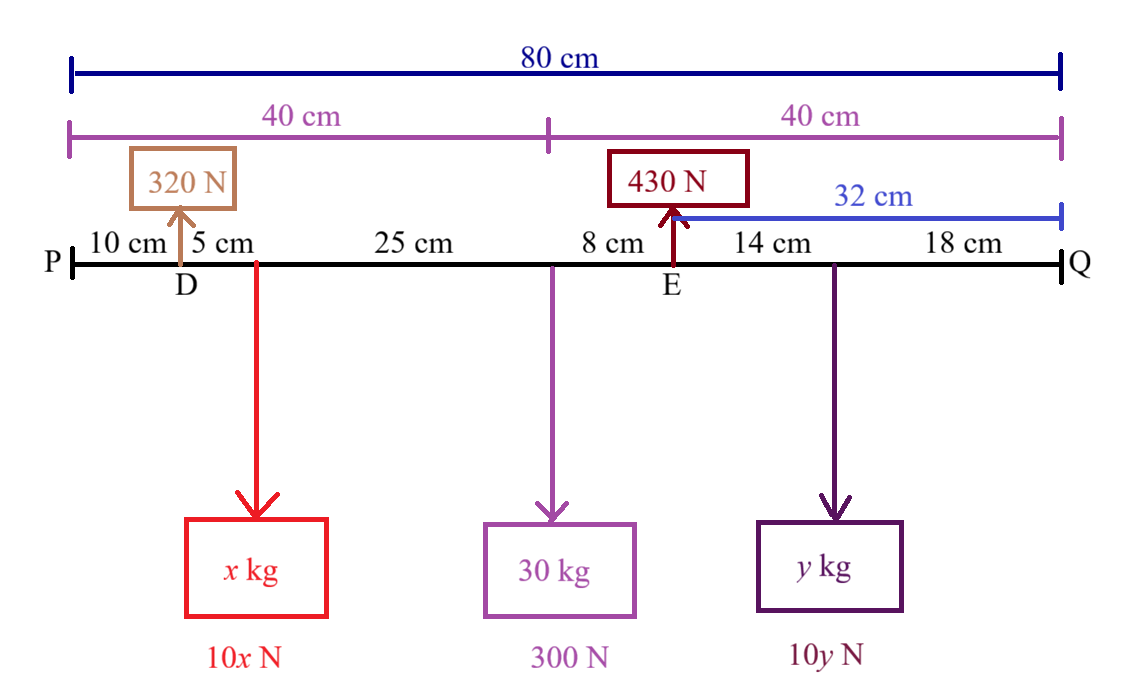
$ \underline{\text{Vertical Forces Equilibrium}} \\[3ex] \text{Upward Forces } (N) \\[3ex] 320 + 430 = 750 \\[5ex] \text{Downward Forces } (N) \\[3ex] 10x + 10y + 300 \\[5ex] \text{Downward Forces} = \text{Upward Forces} \\[3ex] 10x + 10y + 300 = 750 \\[3ex] 10x + 10y = 750 - 300 \\[3ex] 10(x + y) = 450 \\[3ex] x + y = \dfrac{450}{10} \\[5ex] x + y = 45 ...eqn.(1) \\[5ex] \underline{\text{Moments Equilibrium about Point E}} \\[3ex] \text{Clockwise Moments } (Ncm) \\[3ex] 320(5 + 25 + 8) + 10y(14) \\[3ex] 320(38) + 140y \\[3ex] 12160 + 140y \\[5ex] \text{AntiClockwise Moments } (Ncm) \\[3ex] 300(8) + 10x(25 + 8) \\[3ex] 2400 + 10x(33) \\[3ex] 2400 + 330x \\[5ex] \text{AntiClockwise Moments} = \text{Clockwise Moments} \\[3ex] 2400 + 330x = 12160 + 140y \\[3ex] 330x - 140y = 12160 - 2400 \\[3ex] 10(33x - 14y) = 9760 \\[3ex] 33x - 14y = \dfrac{9760}{10} \\[5ex] 33x - 14y = 976 ...eqn.(2) \\[5ex] \underline{\text{Substitution Method}} \\[3ex] \text{From } eqn.(1) \\[3ex] x = 45 - y ...eqn.(3) \\[3ex] \text{Substitute for } x \text{ in } eqn.(2) \\[3ex] 33(45 - y) - 14y = 976 \\[3ex] 1485 - 33y - 14y = 976 \\[3ex] -47y = 976 - 1485 \\[3ex] y = \dfrac{-509}{-47} \\[5ex] y = 10.82978723 \\[3ex] y \approx 10.83\;kg \quad\dots\text{to 2 decimal places} \\[5ex] \text{Substitute for } y \text{ in } eqn.(3) \\[3ex] x = 45 - 10.82978723 \\[3ex] x = 34.17021277 \\[3ex] x \approx 34.17\;kg \quad\dots\text{to 2 decimal places} $


