Linear Algebra
The Joy of the Teacher is the Success of the Students. – Samuel Chukwuemeka
Welcome to Our Site
I greet you this day,
These are the solutions to the WASSCE Further Mathematics past questions on Linear Algebra.
When applicable, the TI-84 Plus CE calculator (also applicable to TI-84 Plus calculator) solutions are provided
for some questions.
If time permits and there is sufficient interest, video solutions may be provided. Please
subscribe to the YouTube channel to be notified of upcoming livestreams. You are welcome to ask questions during
the video livestreams.
If you find these resources valuable and helpful in your passing the Further Mathematics test of the WASSCE,
please consider making a donation:
Cash App: $ExamsSuccess or
cash.app/ExamsSuccess
PayPal: @ExamsSuccess or
PayPal.me/ExamsSuccess
Venmo: @ExamsSuccess or
Venmo.com/u/ExamsSuccess
Your donation is appreciated.
Comments, ideas, areas of improvement, questions, and constructive
criticisms are welcome.
Feel free to contact me. Please be positive in your message.
I wish you the best.
Thank you.
Linear Transformation to Matrix
For a linear transformation $T:(x, y) \rightarrow (ax + by, cx + dy)$,
the corresponding matrix is:
$
T = \begin{bmatrix}
a & b \\[3ex]
c & d
\end{bmatrix}
$
2 by 2 Matrix
Let:
$
A = \begin{bmatrix}
a_{11} & a_{12} \\[3ex]
a_{21} & a_{22}
\end{bmatrix} = \begin{bmatrix}
\color{red}{a} & \color{darkblue}{b} \\[3ex]
\color{darkblue}{c} & \color{red}{d}
\end{bmatrix} \\[10ex]
(1.)\;\; minor\:\: A = \begin{bmatrix}
d & c \\[3ex]
b & a
\end{bmatrix} \\[10ex]
\text{The signs to remember cofactors when determining the determinant of a matrix is}: \\[3ex]
\begin{vmatrix}
+ & - \\[3ex]
- & +
\end{vmatrix} \\[10ex]
(2.)\;\; cofactor\:\: A = \begin{bmatrix}
d & -c \\[3ex]
-b & a
\end{bmatrix} \\[10ex]
(3.)\;\; adj\:\: A = \begin{bmatrix}
d & -b \\[3ex]
-c & a
\end{bmatrix} \\[10ex]
(4.)\;\; det\;A = ad - cb \\[3ex]
(5.)\;\; A^{-1} = \dfrac{adj\;A}{det\;A}
$
3 by 3 Matrix
Let:
$
A = \begin{bmatrix}
a_{11} & a_{12} & a_{13} \\[3ex]
a_{21} & a_{22} & a_{23} \\[3ex]
a_{31} & a_{32} & a_{33}
\end{bmatrix} =
\begin{bmatrix}
a & b & c \\[3ex]
d & e & f \\[3ex]
g & h & i
\end{bmatrix} \\[15ex]
(1.)\;\; minor\:\: A = \begin{bmatrix}
ei - hf & di - gf & dh - ge \\[3ex]
bi - hc & ai - gc & ah - gb \\[3ex]
bf - ec & af - dc & ae - db
\end{bmatrix} \\[15ex]
\text{The signs to remember cofactors when determining the determinant of a matrix is}: \\[3ex]
\begin{vmatrix}
+ & - & + \\[3ex]
- & + & - \\[3ex]
+ & - & +
\end{vmatrix} \\[10ex]
(2.)\;\; cofactor\:\: A = \begin{bmatrix}
ei - hf & gf - di & dh - ge \\[3ex]
hc - bi & ai - gc & gb - ah \\[3ex]
bf - ec & dc - af & ae - db
\end{bmatrix} \\[15ex]
(3.)\;\; adj\: A = \begin{bmatrix}
ei - hf & hc - bi & bf - ec \\[3ex]
gf - di & ai - gc & dc - af \\[3ex]
dh - ge & gb - ah & ae - db
\end{bmatrix} \\[15ex]
(4.)\;\; det\: A = aei + bgf + cdh - ahf - bdi - cge \\[3ex]
(5.)\;\; A^{-1} = \dfrac{adj\;A}{det\;A} \\[5ex]
$
(6.) If transformation $A$ is followed by transformation $B$, the combined matrix is $B \times A$.
$ \begin{vmatrix} 3 & 5 & -4 \\[3ex] 6 & -3 & -5 \\[3ex] -2 & 2 & 1 \end{vmatrix} \\[10ex] $ (b.) Using your result in (a.), solve the simultaneous equation
$ 3x + 5y - 4z = 1 \\[3ex] 6x - 3y - 5z = -15 \\[3ex] -2x + 2y + z = 5 \\[3ex] $
The question is asking us to use the Method of Determinants (also known as Cramer's Rule)
$ \begin{bmatrix} 3 & 5 & -4 \\[3ex] 6 & -3 & -5 \\[3ex] -2 & 2 & 1 \end{bmatrix} \begin{bmatrix} x \\[3ex] y \\[3ex] z \end{bmatrix} = \:\:\: \begin{bmatrix} 1 \\[3ex] -15 \\[3ex] 5 \end{bmatrix} \\[15ex] (a.) \\[3ex] \underline{\text{Denominator}} \\[3ex] \begin{vmatrix} + & - & + \\[3ex] - & + & - \\[3ex] + & - & + \end{vmatrix} \hspace{3em} \begin{vmatrix} 3 & 5 & -4 \\[3ex] 6 & -3 & -5 \\[3ex] -2 & 2 & 1 \end{vmatrix} \\[12ex] \underline{\text{1st Row}} \\[3ex] = 3\begin{vmatrix} -3 & -5 \\[3ex] 2 & 1 \end{vmatrix} -5\begin{vmatrix} 6 & -5 \\[3ex] -2 & 1 \end{vmatrix} + -4\begin{vmatrix} 6 & -3 \\[3ex] -2 & 2 \end{vmatrix} \\[12ex] = 3(-3 + 10) - 5(6 - 10) - 4(12 - 6) \\[3ex] = 3(7) - 5(-4) - 4(6) \\[3ex] = 21 + 20 - 24 \\[3ex] = 17 $
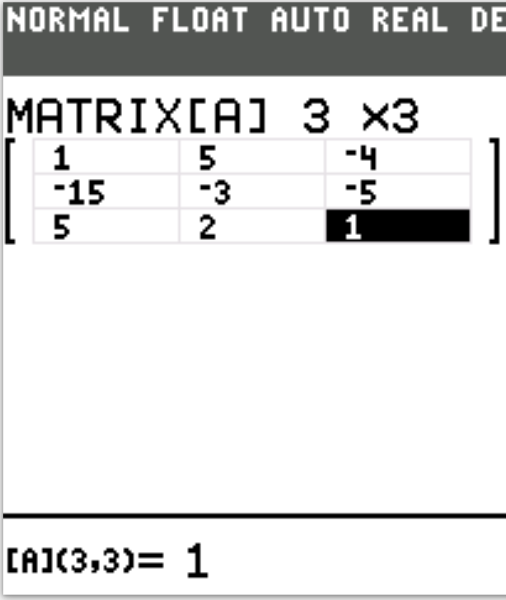
$ \underline{\text{Numerator for }x} \\[3ex] \begin{vmatrix} 1 & 5 & -4 \\[3ex] -15 & -3 & -5 \\[3ex] 5 & 2 & 1 \end{vmatrix} \\[12ex] \underline{\text{1st Row}} \\[3ex] = 1\begin{vmatrix} -3 & -5 \\[3ex] 2 & 1 \end{vmatrix} -5\begin{vmatrix} -15 & -5 \\[3ex] 5 & 1 \end{vmatrix} + -4\begin{vmatrix} -15 & -3 \\[3ex] 5 & 2 \end{vmatrix} \\[10ex] = (-3 + 10) - 5(-15 + 25) - 4(-30 + 15) \\[3ex] = 7 - 5(10) - 4(-15) \\[3ex] = 7 - 50 + 60 \\[3ex] = 17 $
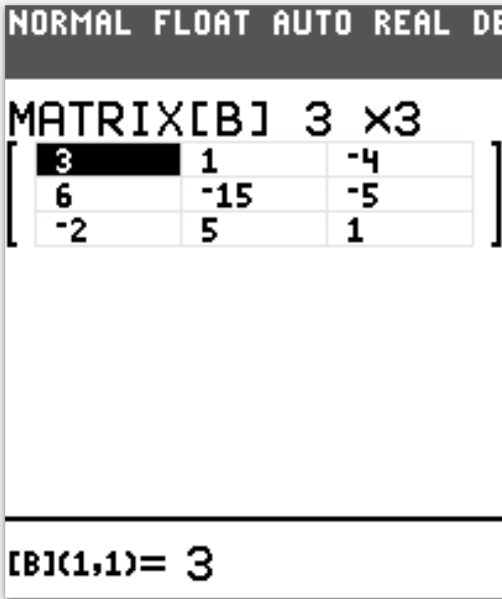
$ \underline{\text{Numerator for }y} \\[3ex] \begin{vmatrix} 3 & 1 & -4 \\[3ex] 6 & -15 & -5 \\[3ex] -2 & 5 & 1 \end{vmatrix} \\[12ex] \underline{\text{3rd Row}} \\[3ex] = -2\begin{vmatrix} 1 & -4 \\[3ex] -15 & -5 \end{vmatrix} -5\begin{vmatrix} 3 & -4 \\[3ex] 6 & -5 \end{vmatrix} + 1\begin{vmatrix} 3 & 1 \\[3ex] 6 & -15 \end{vmatrix} \\[10ex] = -2(-5 - 60) - 5(-15 + 24) + (-45 - 6) \\[3ex] = -2(-65) -5(9) + -51 \\[3ex] = 130 - 45 - 51 \\[3ex] = 34 $
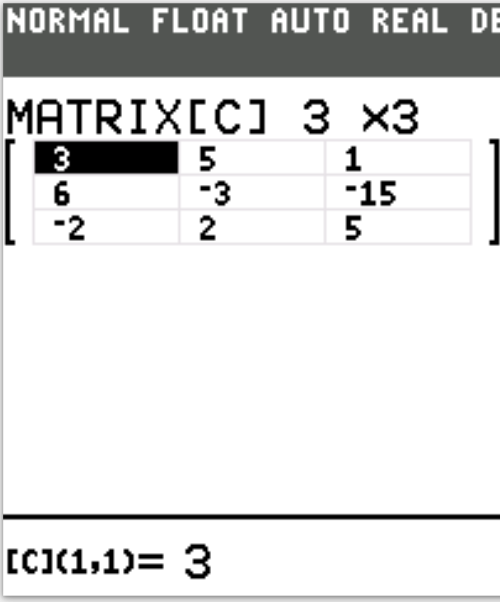
$ \underline{\text{Numerator for }z} \\[3ex] \begin{vmatrix} 3 & 5 & 1 \\[3ex] 6 & -3 & -15 \\[3ex] -2 & 2 & 5 \end{vmatrix} \\[12ex] \underline{\text{2nd Row}} \\[3ex] = -6\begin{vmatrix} 5 & 1 \\[3ex] 2 & 5 \end{vmatrix} + -3\begin{vmatrix} 3 & 1 \\[3ex] -2 & 5 \end{vmatrix} - -15\begin{vmatrix} 3 & 5 \\[3ex] -2 & 2 \end{vmatrix} \\[10ex] = -6(25 - 2) - 3(15 + 2) + 15(6 + 10) \\[3ex] = -6(23) - 3(17) + 15(16) \\[3ex] = -138 - 51 + 240 \\[3ex] = 51 $
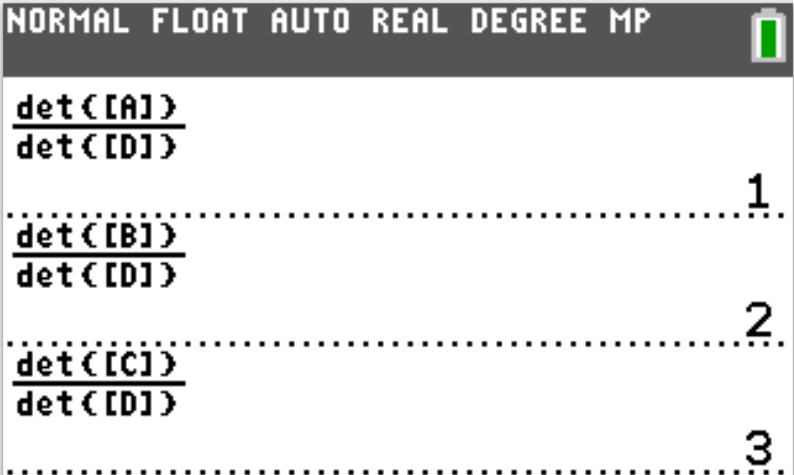
$ x = \dfrac{17}{17} = 1 \\[5ex] y = \dfrac{34}{17} = 2 \\[5ex] z = \dfrac{51}{17} = 3 \\[5ex] $ Check
| LHS | RHS |
|---|---|
| $ 3x + 5y - 4z \\[3ex] 3(1) + 5(2) - 4(3) \\[3ex] 3 + 10 - 12 \\[3ex] 1 $ | 1 |
| $ 6x - 3y - 5z \\[3ex] 6(1) - 3(2) - 5(3) \\[3ex] 6 - 6 - 15 \\[3ex] -15 $ | −15 |
| $ -2x + 2y + z \\[3ex] -2(1) + 2(2) + 3 \\[3ex] -2 + 4 + 3 \\[3ex] 5 $ | 5 |
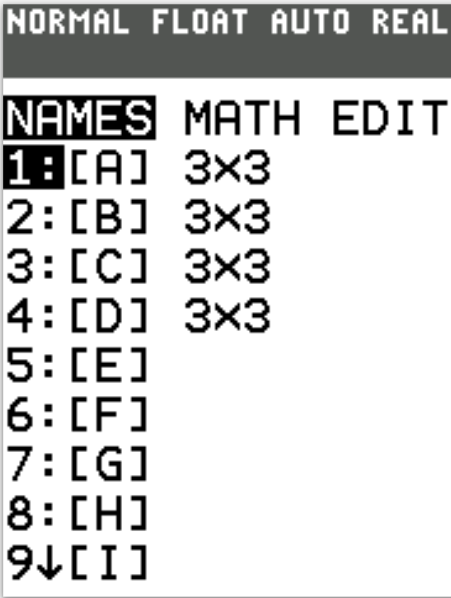
$ Let: \\[3ex] \text{Numerator for}\;x = Matrix\;A \\[3ex] \text{Numerator for}\;y = Matrix\;B \\[3ex] \text{Numerator for}\;z = Matrix\;C \\[3ex] \text{Denominator} = Matrix\;D \\[3ex] $
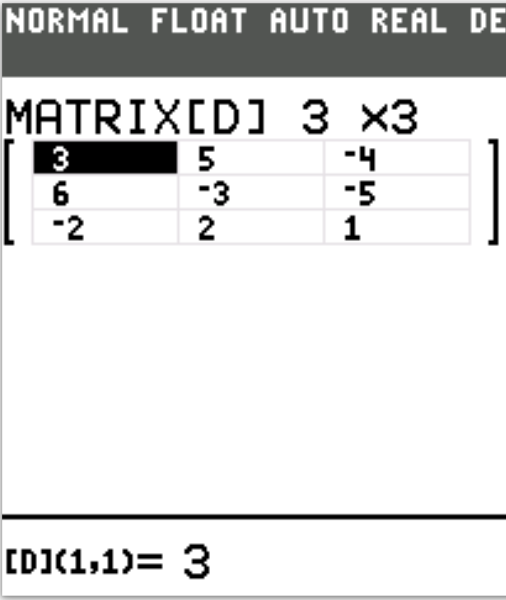
$ P: (x, y) \rightarrow (-4x - y, 2x) \\[3ex] Q: (x, y) \rightarrow (y, 6x - 9y) \\[3ex] R: (x, y) \rightarrow (x - 2y, 3x + 5y) \\[3ex] $ (a.) Write down the matrices of P, Q and R.
(b.) Find:
(i.) 2P − 3R + Q;
(ii.) QR;
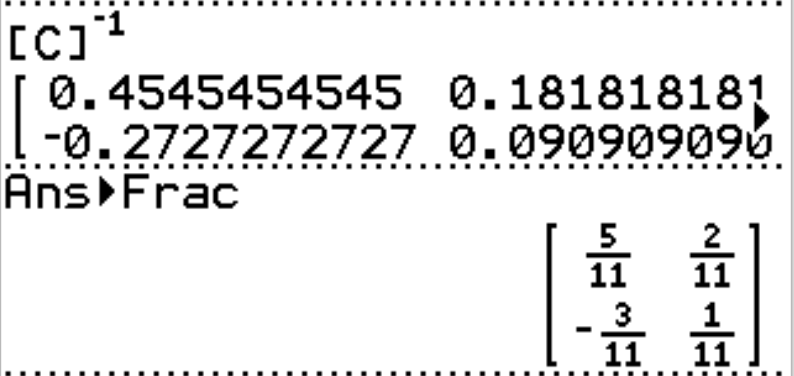
(iii.) the inverse of the matrix R.
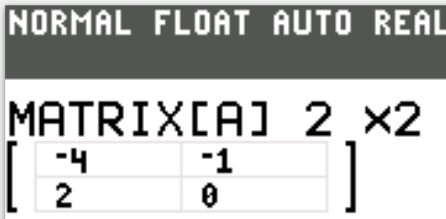
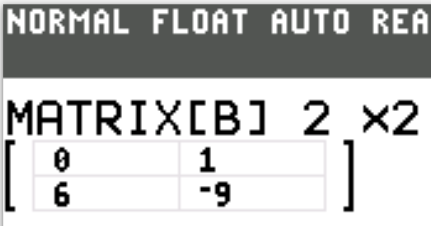
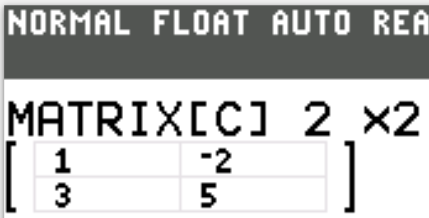
$ (a.) \\[3ex] P: (x, y) \rightarrow (-4x - y, 2x) \rightarrow (-4x - y, 2x + 0y) \\[3ex] Q: (x, y) \rightarrow (y, 6x - 9y) \rightarrow (0x + y, 6x - 9y) \\[3ex] R: (x, y) \rightarrow (x - 2y, 3x + 5y) \\[5ex] \underline{\text{Corresponding Matrices}} \\[3ex] P = \begin{bmatrix} -4 & -1 \\[3ex] 2 & 0 \end{bmatrix} \hspace{3em} Q = \begin{bmatrix} 0 & 1 \\[3ex] 6 & -9 \end{bmatrix} \hspace{3em} R = \begin{bmatrix} 1 & -2 \\[3ex] 3 & 5 \end{bmatrix} $
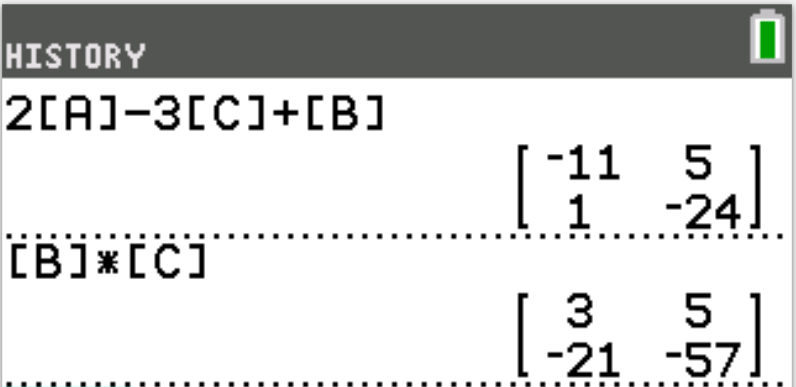
$ (b.) (i.) \\[3ex] 2P = \begin{bmatrix} 2(-4) & 2(-1) \\[3ex] 2(2) & 2(0) \end{bmatrix} = \begin{bmatrix} -8 & -2 \\[3ex] 4 & 0 \end{bmatrix} \\[7ex] 3R = \begin{bmatrix} 3(1) & 3(-2) \\[3ex] 3(3) & 3(5) \end{bmatrix} = \begin{bmatrix} 3 & -6 \\[3ex] 9 & 15 \end{bmatrix} \\[7ex] 2P - 3R + Q = \begin{bmatrix} -8 - 3 + 0 & -2 - (-6) + 1 \\[3ex] 4 - 9 + 6 & 0 - 15 + (-9) \end{bmatrix} = \begin{bmatrix} -11 & 5 \\[3ex] 1 & -24 \end{bmatrix} \\[10ex] (ii.) \\[3ex] QR = \begin{bmatrix} 0 & 1 \\[3ex] 6 & -9 \end{bmatrix}\begin{bmatrix} 1 & -2 \\[3ex] 3 & 5 \end{bmatrix} \\[7ex] = \begin{bmatrix} 0(1) + 1(3) & 0(-2) + 1(5) \\[3ex] 6(1) + -9(3) & 6(-2) + -9(5) \end{bmatrix} \\[7ex] = \begin{bmatrix} 0 + 3 & 0 + 5 \\[3ex] 6 - 27 & -12 - 45 \end{bmatrix} \\[7ex] = \begin{bmatrix} 3 & 5 \\[3ex] -21 & -57 \end{bmatrix} $
(ii.) To find the inverse of matrix R, we can use at least two methods.
Use any method you prefer.
$ \underline{\text{1st Approach: By Formula}} \\[3ex] R = \begin{bmatrix} 1 & -2 \\[3ex] 3 & 5 \end{bmatrix} \\[8ex] adj\;R = \begin{bmatrix} 5 & -(-2) \\[2ex] -3 & 1 \end{bmatrix} = \begin{bmatrix} 5 & 2 \\[2ex] -3 & 1 \end{bmatrix} \\[8ex] det\;R = \begin{vmatrix} 1 & -2 \\[3ex] 3 & 5 \end{vmatrix} \\[8ex] = 1(5) - 3(-2) \\[3ex] = 5 + 6 \\[3ex] = 11 \\[5ex] R^{-1} = \dfrac{adj\;R}{det\;R} \\[5ex] = \dfrac{\begin{bmatrix} 5 & 2 \\[2ex] -3 & 1 \end{bmatrix}}{11} \\[7ex] = \begin{bmatrix} \dfrac{5}{11} & \dfrac{2}{11} \\[5ex] -\dfrac{3}{11} & \dfrac{1}{11} \end{bmatrix} \\[12ex] \underline{\text{2nd Approach: Row Reduction Method}} \\[3ex] R \ \ | \ \ I = I \ \ | \ \ R^{-1} \\[3ex] \left[ \begin{array}{cc|cc} 1 & -2 & 1 & 0 \\[3ex] 3 & 5 & 0 & 1 \end{array} \right] \underrightarrow{-3R_1 + R_2} \left[ \begin{array}{cc|cc} 1 & -2 & 1 & 0 \\[3ex] 0 & 11 & -3 & 1 \end{array} \right] \\[10ex] \underrightarrow{2R_2 + 11R_1} \left[ \begin{array}{cc|cc} 11 & 0 & 5 & 2 \\[3ex] 0 & 11 & -3 & 1 \end{array} \right] \\[10ex] \underrightarrow{\dfrac{R_1, R_2}{11}} \left[ \begin{array}{cc|cc} 1 & 0 & \dfrac{5}{11} & \dfrac{2}{11} \\[5ex] 0 & 1 & -\dfrac{3}{11} & \dfrac{1}{11} \end{array} \right] \\[10ex] \implies \\[3ex] R^{-1} = \begin{bmatrix} \dfrac{5}{11} & \dfrac{2}{11} \\[5ex] -\dfrac{3}{11} & \dfrac{1}{11} \end{bmatrix} $
Let Matrices P, Q, R be Matrices A, B, C respectively.