Integral Calculus
The Joy of the Teacher is the Success of the Students. – Samuel Chukwuemeka
Welcome to Our Site
I greet you this day,
These are the solutions to the WASSCE Further Mathematics past questions on Integral Calculus.
The TI-84 Plus CE shall be used for applicable questions.
If time permits and there is sufficient interest, video solutions may be provided. Please
subscribe to the YouTube channel to be notified of upcoming livestreams. You are welcome to ask questions during
the video livestreams.
If you find these resources valuable and helpful in your passing the Further Mathematics test of the WASSCE,
please consider making a donation:
Cash App: $ExamsSuccess or
cash.app/ExamsSuccess
PayPal: @ExamsSuccess or
PayPal.me/ExamsSuccess
Venmo: @ExamsSuccess or
Venmo.com/u/ExamsSuccess
Your donation is appreciated.
Comments, ideas, areas of improvement, questions, and constructive
criticisms are welcome.
Feel free to contact me. Please be positive in your message.
I wish you the best.
Thank you.
Standard Integrals of Exponents
$ \text{a, b, n are positive constants} \\[3ex] (1.)\:\: \displaystyle\int ax^n dx = \dfrac{ax^{n + 1}}{n + 1} + C \\[7ex] (2.)\:\: \displaystyle\int (ax \pm b)^n dx = \dfrac{(ax \pm b)^{n + 1}}{a(n + 1)} + C \\[7ex] (3.)\:\: \displaystyle\int (-ax \pm b)^n dx = -\dfrac{(ax \pm b)^{n + 1}}{a(n + 1)} + C \\[5ex] $
Standard Integrals of Exponential Functions
$ \text{a, b, k, n are positive constants} \\[3ex] (1.)\:\: \displaystyle\int a^x dx = \dfrac{a^x}{\ln a} + C \\[7ex] (2.)\:\: \displaystyle\int e^x dx = e^x + C \\[7ex] (3.)\:\: \displaystyle\int e^{kx} dx = \dfrac{e^{kx}}{k} + C \\[7ex] (4.)\:\: \displaystyle\int e^{-kx} dx = \dfrac{-e^{-kx}}{k} + C \\[7ex] (5.)\:\: \displaystyle\int e^{ax \pm b} dx = \dfrac{e^{ax \pm b}}{n} + C \\[7ex] (6.)\:\: \displaystyle\int k^{ax \pm b} dx = \dfrac{k^{ax \pm b}}{a\ln k} + C \\[7ex] (7.)\:\: \displaystyle\int xe^{ax} dx = \dfrac{e^{ax}(ax - 1)}{a^2} + C \\[7ex] (8.)\:\: \displaystyle\int x^ne^{ax} dx = \dfrac{x^ne^{ax}}{a} - \dfrac{n}{a}\displaystyle\int x^{n - 1}e^{ax} dx \\[7ex] (9.)\:\: \displaystyle\int \dfrac{dx}{1 + ke^{ax}} = x - \dfrac{\ln(1 + ke^{ax})}{a} + C \\[5ex] $
Standard Integrals of Logarithmic Functions
$ \text{n is a positive constant} \\[3ex] (1.)\:\: \displaystyle\int \ln x dx = x\ln x - x + C \\[7ex] (2.)\:\: \displaystyle\int (\ln x)^n dx = x(\ln x)^n - n\displaystyle\int (\ln x)^{n - 1}dx \\[7ex] (3.)\:\: \displaystyle\int \dfrac{dx}{x\ln x} = \ln|\ln x| + C \\[7ex] (4.)\:\: \displaystyle\int x^n\ln x dx = \dfrac{x^{n + 1}[\ln x(n + 1) - 1]}{(n + 1)^2} + C \\[5ex] $
Standard Integrals of Trigonometric Functions
$ (1.)\:\: \displaystyle\int \sin x dx = -cos x + C \\[7ex] (2.)\:\: \displaystyle\int cos x dx = sin x + C \\[7ex] (3.)\:\: \displaystyle\int \sec^2 x = \tan x + C \\[5ex] $
Standard Integrals of Hyperbolic Functions
$ (1.)\:\: \displaystyle\int \sinh x dx = \cosh x + C \\[7ex] (2.)\:\: \displaystyle\int \cosh x dx = \sinh x + C \\[5ex] $
Standard Integrals of Rational Functions
$ \text{a, b, n are positive constants} \\[3ex] (1.)\:\: \displaystyle\int \dfrac{1}{x} dx = \ln x + C \\[7ex] (2.)\:\: \displaystyle\int \dfrac{1}{ax \pm b} dx = \dfrac{\ln|ax \pm b|}{a} + C \\[7ex] (3.)\:\: \displaystyle\int \dfrac{1}{\sqrt{1 - x^2}} dx = \sin^{-1}x + C \\[7ex] (4.)\:\: \displaystyle\int \dfrac{-1}{\sqrt{1 - x^2}} dx = \cos^{-1}x + C \\[7ex] (5.)\:\: \displaystyle\int \dfrac{1}{1 + x^2} dx = \tan^{-1}x + C \\[7ex] (6.)\:\: \displaystyle\int \dfrac{1}{\sqrt{x^2 + 1}} dx = \sinh^{-1}x + C \\[7ex] (7.)\:\: \displaystyle\int \dfrac{1}{\sqrt{x^2 - 1}} dx = \cosh^{-1}x + C \\[7ex] (8.)\:\: \displaystyle\int \dfrac{1}{1 - x^2} dx = \tanh^{-1}x + C \\[5ex] $
Standard Integrals of Absolute Value Functions
$ \text{a, b, n are positive constants} \\[3ex] (1.)\:\: \displaystyle\int |x| dx = \dfrac{x|x|}{2} + C \\[7ex] (2.)\:\: \displaystyle\int |ax \pm b| dx = \dfrac{(ax \pm b)|ax \pm b|}{2a} + C \\[5ex] $
Other Standard Integrals
$
\underline{\text{Algebraic Substitution}} \\[3ex]
(1.)\:\: \displaystyle\int f(x)f'(x) dx = \dfrac{f^2(x)}{2} + C \\[7ex]
(2.)\:\: \displaystyle\int \dfrac{f'(x)}{f(x)} dx = \ln f(x) + C \\[7ex]
(3.)\:\: \displaystyle\int \dfrac{-f'(x)}{f(x)} dx = -\ln f(x) + C \\[7ex]
\underline{\text{Trigonometric Substitution}} \\[3ex]
(4.)\;\; \displaystyle\int \dfrac{dx}{a^2 + x^2} = \dfrac{1}{a}\tan^{-1}\left(\dfrac{x}{a}\right) + C \\[7ex]
(5.)\;\; \displaystyle\int \dfrac{dx}{\sqrt{a^2 - x^2}} = \sin^{-1}\left(\dfrac{x}{a}\right) + C \\[7ex]
(6.)\;\; \displaystyle\int \sqrt{a^2 - x^2}dx = \dfrac{a^2}{2}\left[\sin^{-1}\left(\dfrac{x}{a}\right) +
\dfrac{x\sqrt{a^2 - x^2}}{a^2}\right] + C \\[7ex]
\underline{\text{Integration by Parts (Integration of Products)}} \\[3ex]
(7.)\;\; \displaystyle\int vdu = uv - \displaystyle\int udv \\[7ex]
\underline{\text{Hyperbolic Substitution}} \\[3ex]
(8.)\;\; \displaystyle\int \dfrac{dx}{\sqrt{a^2 + x^2}} = \sinh^{-1}\left(\dfrac{x}{a}\right) + C \\[7ex]
(9.)\;\; \displaystyle\int \dfrac{dx}{\sqrt{x^2 - a^2}} = \cosh^{-1}\left(\dfrac{x}{a}\right) + C \\[7ex]
\underline{\text{Integral Reflection Method}} \\[3ex]
\text{Also known as Symmetric Substitution OR Functional Transformation in Integration} \\[3ex]
\displaystyle\int_a^b \dfrac{f(x_1)}{f(x_1) + f(x_2)}dx \\[7ex]
Let\;\; a + b = \text{some constant},\;c \\[3ex]
\text{Set the substitution}:\;\; x = c - x \\[3ex]
\implies \\[3ex]
f(x) = \text{original function} \\[3ex]
f(c - x) = \text{transformed function} \\[3ex]
\text{Assume the original function and the transformed function complements each other} \\[3ex]
f(x) + f(c - x) = 1 \\[3ex]
Let\;\; I_1 = \displaystyle\int_a^b \dfrac{f(x_1)}{f(x_1) + f(x_2)}dx \quad\dots\text{integral of original
function}
\\[7ex]
Let:\;\;I_2 = \displaystyle\int_a^b \dfrac{f(x_2)}{f(x_2) + f(x_1)}dx \quad\dots\text{integral of transformed
function}
\\[7ex]
I_1 = I_2 = \text{the integral},\;I \\[4ex]
I_1 + I_2 = 2I \\[3ex]
$
Because we are integrating over the same limits and the variable, x is just being swapped with c
− x, the integral remains the same as long as the transformation preserves the total area under the
curve.
$
2I = \displaystyle\int_a^b 1 dx = [x]_a^b = b - a \\[5ex]
I = \dfrac{b - a}{2}
$
Theorems
(1.) The Fundamental Theorem of Calculus:
Assume:
a closed interval: $[c, d]$
a continuous function, $f$ defined on the interval
an antiderivative of the function, $F$ defined on the interval
then:
$\displaystyle\int_c^d f(x) dx = F(d) - F(c)$
(2.)
Applications
(1.) Economics
$
(a.) \\[3ex]
TC = \displaystyle\int MC(x) dx \\[5ex]
where \\[3ex]
x = \text{number of items} \\[3ex]
MC = \text{Marginal Cost function} \\[3ex]
TC = \text{Total Cost function} \\[3ex]
\text{constant of integration is the fixed cost} \\[5ex]
(b.) \\[3ex]
TR = \displaystyle\int MR(x) dx \\[5ex]
where \\[3ex]
x = \text{number of items} \\[3ex]
MR = \text{Marginal Revenue function} \\[3ex]
TR = \text{Total Revenue function} \\[3ex]
\text{constant of integration = 0 if no item is produced} \\[5ex]
(c.) \\[3ex]
NC = \displaystyle\int MPC(x) dx \\[5ex]
where \\[3ex]
x = \text{disposable national income} \\[3ex]
MPC = \text{marginal propensity to consume} \\[3ex]
NC = \text{national consumption function} \\[5ex]
$
(2.) Average Value of a Function
(3.) Trapezium Rule (or Trapezoidal Rule)
$
Given: \displaystyle\int_{c}^{d} f(x) dx \\[7ex]
(a.) \\[3ex]
\text{Definite Integral} = \dfrac{\Delta x}{2} [f(x_0) + 2f(x_1) + 2f(x_2) + 2f(x_3) + ... + 2f(x_{n - 1}) +
f(x_n)] \\[7ex]
\text{Definite Integral} = \dfrac{\Delta x}{2} [f(x_0) + f(x_n) + 2(f(x_1) + f(x_2) + f(x_3) + ... + f(x_{n -
1}))] \\[7ex]
where: \\[3ex]
c = \text{lower limit of integration} \\[3ex]
d = \text{upper limit of integration} \\[3ex]
\Delta x = \text{width of the interval} \\[3ex]
x_0, x_1, x_2, x_3, ..., x_{n - 1}, x_n \;\;\text{are the nodes (also referred to as ordinates)} \\[3ex]
f(x_0) \;\;and\;\; f(x_n) \;\;\text{are the function values at the endpoints} \\[3ex]
f(c), \; f(d), \; f(x_3), ..., f(x_{n - 1}) \;\;\text{are the function values at the intermediate points}
\\[3ex]
(b.) \\[3ex]
\Delta x = \dfrac{d - c}{n} \\[5ex]
\Delta x = \dfrac{d - c}{r - 1} \\[5ex]
(c.) \\[3ex]
n = r - 1 \\[3ex]
where: \\[3ex]
n = \text{number of intervals} \\[3ex]
r = \text{number of ordinates} \\[5ex]
$
Because we are asked to round the final answer to three decimal places, it is okay to round intermediate values to at least six decimal places.
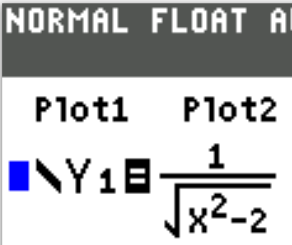
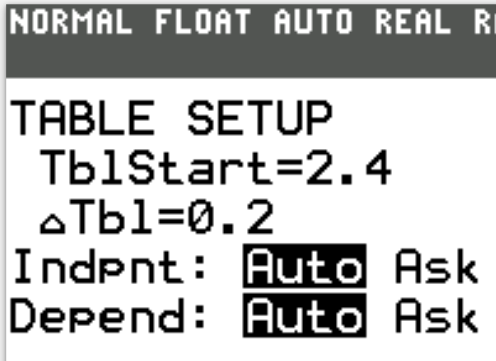
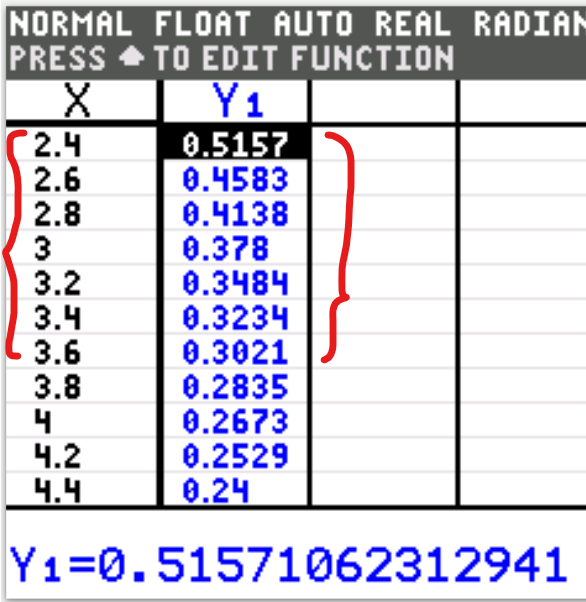
$ \dfrac{1}{\sqrt{x^2 - 2}} \\[5ex] r = \text{number of ordinates (nodes)} = 7 \\[3ex] n = \text{number of intervals} = 7 - 1 = 6 \\[5ex] \underline{\text{Interval Width}} \\[3ex] \Delta x = \dfrac{d - c}{n} \\[5ex] where: \\[3ex] c = \text{lower limit of integration} = 2.4 \\[3ex] d = \text{upper limit of integration} = 3.6 \\[3ex] \Delta x = \text{width of the interval} \\[3ex] \Delta x = \dfrac{3.6 - 2.4}{6} \\[5ex] = \dfrac{1.2}{6} \\[5ex] = 0.2 \\[5ex] \underline{\text{Nodes (Ordinates)}} \\[3ex] \text{The nodes are:} \\[3ex] x_0, x_1, x_2, x_3, x_4, x_5, x_6, x_7 \\[3ex] = 2.4, 2.4 + 0.2, 2.4 + 2(0.2), 2.4 + 3(0.2), 2.4 + 4(0.2), 2.4 + 5(0.2), 2.4 + 6(0.2) \\[3ex] = 2.4, 2.6, 2.8, 3, 3.2, 3.4, 3.6 \\[5ex] \underline{\text{Function Values}} \\[3ex] f(x_0), f(x_1), f(x_2), f(x_3), f(x_4), f(x_5), f(x_6), f(x_7) \\[3ex] f(2.4) = \dfrac{1}{\sqrt{(2.4)^2 - 2}} \approx 0.515711 \\[5ex] f(2.6) = \dfrac{1}{\sqrt{(2.6)^2 - 2}} \approx 0.458349 \\[5ex] f(2.8) = \dfrac{1}{\sqrt{(2.8)^2 - 2}} \approx 0.413803 \\[5ex] f(3) = \dfrac{1}{\sqrt{(3)^2 - 2}} \approx 0.377964 \\[5ex] f(3.2) = \dfrac{1}{\sqrt{(3.2)^2 - 2}} \approx 0.348367 \\[5ex] f(3.4) = \dfrac{1}{\sqrt{(3.4)^2 - 2}} \approx 0.323423 \\[5ex] f(3.6) = \dfrac{1}{\sqrt{(3.6)^2 - 2}} \approx 0.302061 \\[7ex] \underline{\text{Trapezium Rule}} \\[3ex] \text{Definite Integral} = \dfrac{\Delta x}{2} [f(x_0) + f(x_n) + 2(f(x_1) + f(x_2) + f(x_3) + ... + f(x_{n - 1}))] \\[5ex] = \dfrac{0.2}{2} [0.515711 + 0.302031 + 2(0.458349 + 0.413803 + 0.377964 + 0.348367 + 0.323423)] \\[5ex] = 0.1(4.661554) \\[3ex] = 0.4661554 \\[3ex] \approx 0.466 \quad\dots\text{to 3 decimal places} $
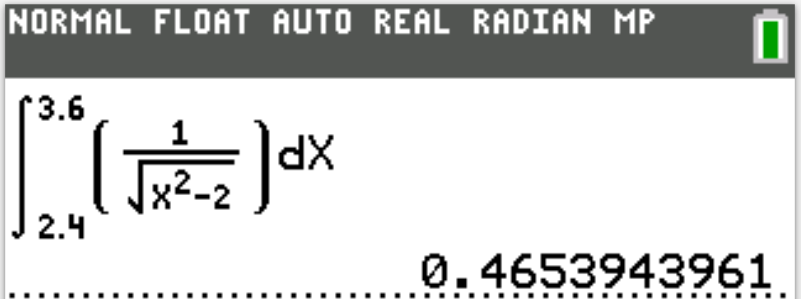
Directly (by Calculator): This is the exact answer.
Trapezium Rule gives an approximate.
Intermediate Steps: