Relations and Functions
The Joy of the Teacher is the Success of the Students. – Samuel Chukwuemeka
Welcome to Our Site
I greet you this day,
These are the solutions to the NSSCO past questions on Relations and Functions.
The TI-84 Plus CE shall be used for applicable questions.
If time permits and there is sufficient interest, video solutions may be provided. Please subscribe to the
YouTube channel to be notified
of upcoming livestreams.
You are welcome to ask questions during the video livestreams.
If you find these resources valuable and if any of these resources were helpful in your passing the
Mathematics exams of NSSCO, please consider making a donation:
Cash App: $ExamsSuccess or
cash.app/ExamsSuccess
PayPal: @ExamsSuccess or
PayPal.me/ExamsSuccess
Venmo: @ExamsSuccess or
Venmo.com/u/ExamsSuccess
Your donation is appreciated.
Comments, ideas, areas of improvement, questions, and constructive criticisms are welcome.
Feel free to contact me. Please be positive in your message.
I wish you the best.
Thank you.
Formulas for Linear Functions
$ (1.)\;\; \text{Slope,}\;\; m = \dfrac{\Delta y}{\Delta x} = \dfrac{y_2 - y_1}{x_2 - x_1} = \dfrac{rise}{run} \\[5ex] (2.)\;\; \text{Slope-Intercept Form:}\;\; y = mx + b \\[5ex] (3.)\;\; \text{Point-Slope Form:}\;\; y - y_1 = m(x - x_1) \\[5ex] (4.)\;\; \text{Two-Points Form:}\;\; \dfrac{y - y_1}{x - x_1} = \dfrac{y_2 - y_1}{x_2 - x_1} \\[5ex] $Formulas for Quadratic Functions
$ (1.)\;\; \text{Discriminant}\;\; = b^2 - 4ac \\[5ex] (2.)\;\; \text{Standard Form:}\;\; f(x) = ax^2 + bx + c \\[5ex] (3.)\;\; \text{Vertex from Standard Form:}\;\; \left[-\dfrac{b}{2a}, f\left(-\dfrac{b}{2a}\right)\right] \\[7ex] (4.)\;\; \text{Vertex Form:}\;\; f(x) = a(x - h)^2 + k \\[5ex] (5.)\;\; \text{Vertex from Vertex Form:}\;\; Vertex = (h, k) \\[5ex] (6.)\;\; \text{Extended Vertex Form:}\;\; f(x) = a\left(x + \dfrac{b}{2a}\right)^2 + \dfrac{4ac - b^2}{4a} \\[7ex] (7.)\;\; \text{Vertex from Extended Vertex Form:}\;\; Vertex = \left(-\dfrac{b}{2a}, \dfrac{4ac - b^2}{4a}\right) \\[7ex] $Factoring Formulas
$ \underline{Difference\;\;of\;\;Two\;\;Squares} \\[3ex] (1.)\;\;x^2 - y^2 = (x + y)(x - y) \\[5ex] \underline{Difference\;\;of\;\;Two\;\;Cubes} \\[3ex] (2.)\;\; x^3 - y^3 = (x - y)(x^2 + xy + y^2) \\[5ex] \underline{Sum\;\;of\;\;Two\;\;Cubes} \\[3ex] (3.)\;\; x^3 + y^3 = (x + y)(x^2 - xy + y^2) $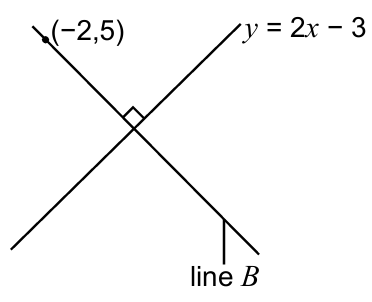
Work out the equation of line B, giving your answer in the form y = mx + c.
Two lines are perpendicular to each other if the slope of one line is the negative reciprocal of the slope of the other line.
Let the other line = Line A
$ \underline{\text{For Line A}} \\[3ex] y = 2x - 3 \\[3ex] \text{Compare to: } y = mx + c \\[3ex] m = slope = 2 \\[5ex] \underline{\text{For Line B}} \\[3ex] Line\;B \perp Line\;A \\[3ex] \implies \\[3ex] slope = m = -\dfrac{1}{\text{slope of Line A}} \\[5ex] m = -\dfrac{1}{2} \\[5ex] Passes\;\;through\;\;(-2, 5) \\[3ex] x = -2 \\[3ex] y = 5 \\[3ex] y = mx + c \\[3ex] c = y - mx \\[3ex] c = 5 - \left(-\dfrac{1}{2} * -2\right) \\[5ex] c = 5 - 1 \\[3ex] c = 4 \\[3ex] \implies \\[3ex] y = mx + c \\[3ex] y = -\dfrac{1}{2}x + 4 $


