Mensuration
The Joy of the Teacher is the Success of the Students. – Samuel Chukwuemeka
Welcome to Our Site
I greet you this day,
These are the solutions to Mathematics questions on Mensuration.
If you find these resources valuable/helpful, please consider making a donation:
Cash App: $ExamsSuccess or
cash.app/ExamsSuccess
PayPal: @ExamsSuccess or
PayPal.me/ExamsSuccess
Venmo: @ExamsSuccess or
Venmo.com/u/ExamsSuccess
Your donation is appreciated.
Comments, ideas, areas of improvement, questions, and constructive criticisms are welcome.
Feel free to contact me. Please be positive in your message.
I wish you the best.
Thank you.
Formulas
Right Triangle
$ perpendicular\:\:height = height \\[3ex] Area = \dfrac{1}{2} * base * height \\[5ex] height = \dfrac{2 * Area}{base} \\[5ex] base = \dfrac{2 * Area}{height} \\[5ex] hypotenuse^2 = height^2 + base^2...Pythagorean\:\:Theorem \\[3ex] hypotenuse = \sqrt{height^2 + base^2} \\[3ex] height = \sqrt{hypotenuse^2 - base^2} \\[3ex] base = \sqrt{hypotenuse^2 - height^2} \\[3ex] Perimeter = hypotenuse + height + base \\[3ex] Area = \dfrac{1}{2} * height * base * \sin (hypotenuseAngle) \\[5ex] Area = \dfrac{1}{2} * height * hypotenuse * \sin (baseAngle) \\[5ex] Area = \dfrac{1}{2} * base * hypotenuse * \sin (heightAngle) \\[5ex] Semiperimeter = \dfrac{height + base + hypotenuse}{2} \\[5ex] Semiperimeter - height = firstdifference \\[3ex] Semiperimeter - base = seconddifference \\[3ex] Semiperimeter - hypotenuse = thirddifference \\[3ex] Area = \sqrt{Semiperimeter * firstdifference * seconddifference * thirddifference}...Hero's\:\:Formula\:\:or\:\:Heron's\:\:Formula \\[5ex] hypotenuse = {Perimeter^2 - 4 * Area}{2 * Perimeter} \\[5ex] base = \dfrac{(Perimeter - hypotenuse) \pm Math.sqrt((hypotenuse - Perimeter)^2 - 8 * Area)}{2} \\[5ex] height = \dfrac{2 * Area}{base} $
Triangle
$ Perimeter = firstside + secondside + thirdside \\[5ex] Area = \dfrac{1}{2} * firstside * secondside * \sin (thirdAngle) \\[5ex] Area = \dfrac{1}{2} * firstside * thirdside * \sin (secondAngle) \\[5ex] Area = \dfrac{1}{2} * secondside * thirdside * \sin (firstAngle) \\[5ex] Semiperimeter = \dfrac{firstside + secondside + thirdside}{2} \\[5ex] Semiperimeter - firstside = firstdifference \\[3ex] Semiperimeter - secondside = seconddifference \\[3ex] Semiperimeter - thirdside = thirddifference \\[3ex] Area = \sqrt{Semiperimeter * firstdifference * seconddifference * thirddifference}...Hero's\:\:Formula\:\:or\:\:Heron's\:\:Formula \\[5ex] \underline{Cosine\:\:Law} \\[3ex] firstside^2 = secondside^2 + thirdside^2 - 2 * secondside * thirdside * \cos (firstAngle) \\[3ex] secondside^2 = firstside^2 + thirdside^2 - 2 * firstside * thirdside * \cos (secondAngle) \\[3ex] thirdside^2 = firstside^2 + secondside^2 - 2 * firstside * secondside * \cos (thirdAngle) \\[5ex] firstAngle = \cos^{-1} \left(\dfrac{secondside^2 + thirdside^2 - firstside^2}{2 * secondside * thirdside}\right) \\[5ex] secondAngle = \cos^{-1} \left(\dfrac{firstside^2 + thirdside^2 - secondside^2}{2 * firstside * thirdside}\right) \\[5ex] thirdAngle = \cos^{-1} \left(\dfrac{firstside^2 + secondside^2 - thirdside^2}{2 * firstside * secondside}\right) \\[7ex] \underline{\text{Area of a Triangle given the vertices}} \\[3ex] \text{Let the vertices be:} \\[3ex] Vertex\;1:\;\;(x_1, y_1) \\[4ex] Vertex\;2:\;\;(x_2, y_2) \\[4ex] Vertex\;3:\;\;(x_3, y_3) \\[4ex] Area = \dfrac{1}{2}|x_1(y_2 - y_3) + x_2(y_3 - y_1) + x_3(y_1 - y_2)| $
Insribed Triangle (Circumscribed Circle)
$ Circumradius = \dfrac{firstside \cdot secondside \cdot thirdside}{4 \cdot Area} $
Square
$ side = length = width = height \\[3ex] Area = side^2 \\[3ex] side = \sqrt{Area} \\[3ex] Perimeter = 4 * side \\[3ex] side = \dfrac{Perimeter}{4} \\[5ex] diagonal = side * \sqrt{2} \\[3ex] side = \dfrac{diagonal * \sqrt{2}}{2} \\[5ex] Area = \dfrac{Perimeter^2}{16} \\[5ex] Perimeter = 4 * \sqrt{Area} \\[3ex] Area = \dfrac{diagonal^2}{2} \\[5ex] diagonal = \sqrt{2 * Area} \\[3ex] Perimeter = 2 * diagonal * \sqrt{2} \\[3ex] diagonal = \dfrac{Perimeter * \sqrt{2}}{4} $
Rectangle
$ Area = length * width \\[3ex] length = \dfrac{Area}{width} \\[5ex] width = \dfrac{Area}{length} \\[5ex] Area = \dfrac{(length * Perimeter) - (2 * length^2)}{2} \\[5ex] Area = \dfrac{(width * Perimeter) - (2 * width^2)}{2} \\[5ex] Perimeter = 2(length + width) \\[3ex] length = \dfrac{Perimeter - 2 * width}{2} \\[5ex] width = \dfrac{Perimeter - 2 * length}{2} \\[5ex] Perimeter = \dfrac{2(length^2 + Area)}{length} \\[5ex] Perimeter = \dfrac{2(width^2 + Area)}{width} \\[5ex] diagonal = \sqrt{length^2 + width^2} \\[4ex] length = \sqrt{diagonal^2 - width^2} \\[4ex] width = \sqrt{diagonal^2 - length^2} \\[4ex] diagonal = \dfrac{\sqrt{length^4 + Area^2}}{length} \\[5ex] diagonal = \dfrac{\sqrt{width^4 + Area^2}}{width} \\[5ex] diagonal = \dfrac{\sqrt{(Perimeter^2) + (5 * length^2) - (4 * Perimeter * length)}}{2} \\[5ex] diagonal = \dfrac{\sqrt{(Perimeter^2) + (5 * width^2) - (4 * Perimeter * width)}}{2} $
Circle
$ Area = A \\[3ex] Circumference = C \\[3ex] Radius = r \\[3ex] Diameter = d \\[3ex] d = 2r \\[3ex] r = \dfrac{d}{2} \\[5ex] A = \pi r^2 \\[3ex] A = \dfrac{\pi d^2}{4} \\[5ex] C = 2\pi r \\[3ex] C = \pi d \\[3ex] r = \dfrac{\sqrt{A\pi}}{\pi} \\[5ex] r = \dfrac{C}{2\pi} \\[5ex] d = \dfrac{2\sqrt{A\pi}}{\pi} \\[5ex] r = \dfrac{C}{\pi} \\[5ex] A = \dfrac{C^2}{4\pi} \\[5ex] C = 2\sqrt{A\pi} $
Cube
6 square faces
12 edges
$
edge = side = length = width = height \\[3ex]
Surface\:\:Area = 6 * edge^2 \\[3ex]
edge = \sqrt{\dfrac{Surface\:\:Area}{6}} \\[5ex]
Volume = edge^3 \\[3ex]
edge = \sqrt[3]{Volume} \\[3ex]
Volume = \dfrac{edge * Surface\:\: Area}{6} \\[5ex]
edge = \dfrac{6 * Volume}{Surface\:\:Area} \\[5ex]
Surface\:\:Area = \dfrac{6 * Volume}{edge} \\[5ex]
Volume = \dfrac{Surface\:\:Area * \sqrt{6 * Surface\:\:Area}}{36} \\[5ex]
edge = \dfrac{diagonal * \sqrt{3}}{3} \\[5ex]
diagonal = \sqrt{3} * edge \\[3ex]
Surface\:\:Area = 2 * diagonal^2 \\[3ex]
diagonal = \dfrac{\sqrt{2 * Surface\:\:Area}}{2} \\[5ex]
Volume = \dfrac{diagonal^3 * \sqrt{3}}{9} \\[5ex]
diagonal = \sqrt{3} * \sqrt[3]{Volume}
$
Cuboid (Right Rectangular Prism)
$ Volume = Length \cdot Width \cdot Height \\[3ex] $
Right Cone
Curved Surface Area = Lateral Surface Area
Height = Perpendicular Height
$
Volume\:\:of\:\:Cone = \dfrac{1}{3} * Volume\:\:of\:\:Cylinder \\[5ex]
Lateral\:\:Surface\:\:Area = LSA \\[3ex]
Base\:\:Area = BA \\[3ex]
Total\:\:Surface\:\:Area = TSA \\[3ex]
Volume = V \\[3ex]
Diameter = d \\[3ex]
Radius = r \\[3ex]
Height = h \\[3ex]
Slant Height = l \\[3ex]
r = \dfrac{d}{2} \\[5ex]
d = 2r \\[3ex]
l = \sqrt{h^2 + r^2} \\[3ex]
l = \dfrac{\sqrt{4h^2 + d^2}}{2} \\[5ex]
h = \sqrt{l^2 - r^2} \\[3ex]
h = \dfrac{\sqrt{4l^2 - d^2}}{2} \\[5ex]
r = \sqrt{l^2 - h^2} \\[3ex]
d = 2 * \sqrt{l^2 - h^2} \\[3ex]
BA = \pi r^2 \\[3ex]
r = \dfrac{\sqrt{BA * \pi}}{\pi} \\[5ex]
BA = \dfrac{\pi d^2}{4} \\[5ex]
d = \dfrac{2\sqrt{BA * \pi}}{\pi} \\[5ex]
LSA = \pi rl \\[3ex]
LSA = \dfrac{\pi dl}{2} \\[5ex]
l = \dfrac{LSA}{\pi r} \\[5ex]
LSA = \pi r\sqrt{h^2 + r^2} \\[3ex]
h = \dfrac{\sqrt{LSA^2 - \pi^2 r^4}}{\pi r} \\[5ex]
TSA = BA + LSA \\[3ex]
TSA = \pi r(r + l) \\[3ex]
l = \dfrac{TSA - \pi r^2}{\pi r} \\[5ex]
TSA = \dfrac{\pi d(d + 2l)}{4} \\[5ex]
l = \dfrac{4 * TSA - \pi d^2}{2\pi d} \\[5ex]
r = \dfrac{-\pi l \pm \sqrt{\pi^2 l^2 + 4\pi * TSA}}{2\pi} \\[5ex]
TSA = \pi r(r + \sqrt{h^2 + r^2}) \\[3ex]
h = \dfrac{\sqrt{TSA(TSA - 2\pi r^2)}}{\pi r} \\[5ex]
V = \dfrac{BA * h}{3} \\[5ex]
V = \dfrac{\pi r^2h}{3} \\[5ex]
V = \dfrac{\pi hd^2}{12} \\[5ex]
V = \dfrac{\pi h(l^2 - h^2)}{3} \\[5ex]
h = \dfrac{3V}{\pi r^2} \\[5ex]
r = \dfrac{\sqrt{3V\pi h}}{\pi h}
$
Right Cylinder
Curved Surface Area = Lateral Surface Area
Height = Perpendicular Height
$
Volume\:\:of\:\:Cylinder = 3 * Volume\:\:of\:\:Cone \\[3ex]
Lateral\:\:Surface\:\:Area = LSA \\[3ex]
Base\:\:Area = BA \\[3ex]
Total\:\:Surface\:\:Area = TSA \\[3ex]
Volume = V \\[3ex]
Diameter = d \\[3ex]
Radius = r \\[3ex]
Height = h \\[3ex]
r = \dfrac{d}{2} \\[5ex]
d = 2r \\[3ex]
LSA = 2\pi rh \\[3ex]
r = \dfrac{LSA}{2\pi h} \\[5ex]
h = \dfrac{LSA}{2\pi r} \\[5ex]
LSA = \pi dh \\[3ex]
h = \dfrac{LSA}{\pi d} \\[5ex]
d = \dfrac{LSA}{\pi h} \\[5ex]
BA = \pi r^2 \\[3ex]
r = \dfrac{\sqrt{\pi BA}}{\pi} \\[5ex]
r = \dfrac{1}{\pi} * \sqrt{\dfrac{\pi(TSA - 2 * LSA)}{2}} \\[5ex]
BA = \dfrac{\pi d^2}{4} \\[5ex]
d = \dfrac{2\sqrt{\pi BA}}{\pi} \\[5ex]
d = \dfrac{\sqrt{2\pi (TSA - LSA)}}{\pi} \\[5ex]
TSA = 2\pi r(r + h) \\[3ex]
h = \dfrac{TSA - 2\pi r^2}{2\pi r} \\[5ex]
r = \dfrac{-\pi h \pm \sqrt{\pi(\pi h^2 + 2 * TSA)}}{2\pi} \\[5ex]
TSA = 2BA + LSA \\[3ex]
BA = \dfrac{TSA - LSA}{2} \\[5ex]
LSA = TSA - 2BA \\[3ex]
TSA = \pi d\left(\dfrac{d + 2h}{2}\right) \\[5ex]
h = \dfrac{2 * TSA - \pi d^2}{2\pi d} \\[5ex]
d = \dfrac{-\pi h \pm \sqrt{\pi(h^2 + 2 * TSA)}}{\pi} \\[5ex]
h = \dfrac{LSA * \sqrt{\pi * BA}}{\pi * BA} \\[5ex]
h = \dfrac{LSA}{\sqrt{2\pi(TSA - LSA)}} \\[5ex]
BA = \dfrac{LSA^2}{\pi h^2} \\[5ex]
BA = \dfrac{(4 * TSA + \pi h^2) \pm h\sqrt{\pi(\pi h^2 - 8 * TSA)}}{8} \\[5ex]
LSA = h\sqrt{BA * \pi} \\[3ex]
LSA = \dfrac{-\pi h^2 \pm h\sqrt{\pi(\pi h^2 + 8 * TSA)}}{4} \\[5ex]
TSA = 2 * BA \pm h\sqrt{\pi * BA} \\[3ex]
TSA = \dfrac{LSA(2 * LSA + \pi h^2)}{\pi h^2} \\[5ex]
V = \pi r^2h \\[3ex]
r = \dfrac{2V}{LSA} \\[5ex]
d = \dfrac{4V}{LSA} \\[5ex]
r = \dfrac{\sqrt{Vh\pi}}{h\pi} \\[5ex]
V = BA * h \\[3ex]
BA = \dfrac{V}{h} \\[5ex]
h = \dfrac{V}{BA} \\[5ex]
h = \dfrac{V}{\pi r^2} \\[5ex]
h = \dfrac{4V}{\pi d^2} \\[5ex]
V = \dfrac{\pi d^2h}{4} \\[5ex]
d = \dfrac{\sqrt{Vh\pi}}2{h\pi} \\[5ex]
V = \dfrac{LSA^2}{h\pi} \\[5ex]
LSA = \sqrt{Vh\pi} \\[3ex]
h = \dfrac{LSA^2}{4V\pi} \\[5ex]
V = \dfrac{(h^3\pi + 4 * TSA * h) \pm h^2\sqrt{\pi(h^2\pi + 8 * TSA)}}{8} \\[5ex]
TSA = \dfrac{2V + h\sqrt{Vh\pi}}{h} \\[5ex]
TSA = \dfrac{2V + 2\pi rh^2}{h} \\[5ex]
r = \dfrac{TSA * h - 2V}{2\pi h^2} \\[5ex]
d = \dfrac{TSA * h - 2V}{\pi h^2} \\[5ex]
h = \dfrac{TSA \pm \sqrt{TSA^2 - 16\pi rV}}{4\pi r}
$
Trapezoid
Trapezoid's Midpoint Segment Theorem states that the line segment connecting the nonparallel sides of a
trapezoid is parallel to the bases, and it's length is the average of the lengths of the bases.
$
Midline = \dfrac{short\;\;base + long\;base}{2}
$
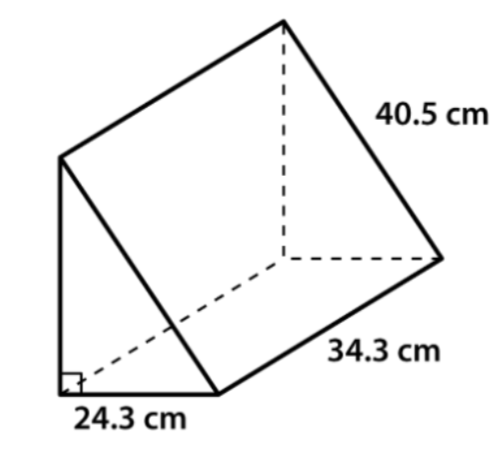
The three-dimensional figure is a triangular prism.
Let the perpendicular height of the right-triangle = h
Let us indicate points on it.
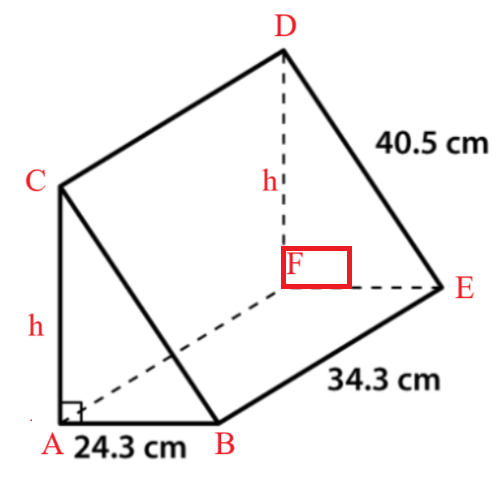
$ \text{Let us find the perpendicular height of the right traingle} \\[3ex] \text{Right Triangle ACB or Right Triangle FDE} \\[3ex] leg = base = 24.3\;cm \\[3ex] leg = \perp height = h \\[3ex] hypotenuse = 40.5\;cm \\[3ex] h^2 + 24.3^2 = 40.5^2 \quad\dots\text{Pythagorean Theorem} \\[3ex] h^2 = 40.5^2 - 24.3^2 \\[3ex] h = \sqrt{40.5^2 - 24.3^2} \\[3ex] h = 32.4\;cm \\[5ex] \underline{\text{2 Right Triangles: Right Triangle ACB and Right Triangle FDE}} \\[3ex] Area = 2 * \dfrac{1}{2} * base * height \\[5ex] Area = 24.3 * 32.4 \\[3ex] Area = 787.32\;cm^2 \\[5ex] \text{Area of a Rectangle} = Length * Width \\[3ex] \underline{\text{Rectangle AFEB}} \\[3ex] Length = 34.3\;cm \\[3ex] Width = 24.3\;cm \\[3ex] Area = 34.3 * 24.3 \\[3ex] Area = 833.49\;cm^2 \\[5ex] \underline{\text{Rectangle ACDF}} \\[3ex] Length = 34.3\;cm \\[3ex] Width = 32.4\;cm \\[3ex] Area = 34.3 * 32.4 \\[3ex] Area = 1111.32\;cm^2 \\[5ex] \underline{\text{Rectangle BCDE}} \\[3ex] Length = 34.3\;cm \\[3ex] Width = 40.5\;cm \\[3ex] Area = 34.3 * 40.5 \\[3ex] Area = 1389.15\;cm^2 \\[5ex] \underline{\text{3-D Figure: Triangular Prism}} \\[3ex] \text{Area = Area of the 2 Right Triangles + Area of the 3 Rectangles} \\[3ex] Area = 787.32 + 833.49 + 1111.32 + 1389.15 \\[3ex] Area = 4121.28\;cm^2 $
Round the answer to the nearest hundredth.
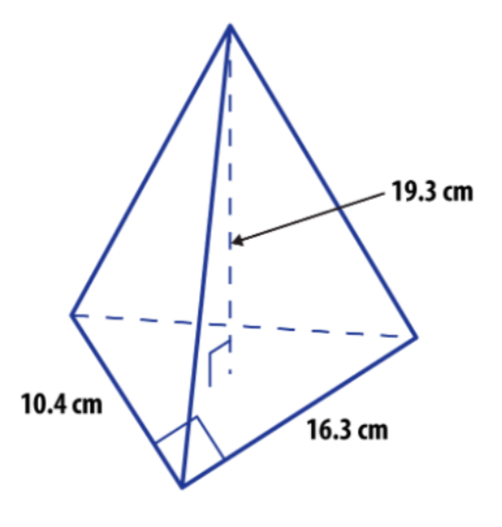
The pyramid is a right triangular pyramid.
Let us indicate points on it.
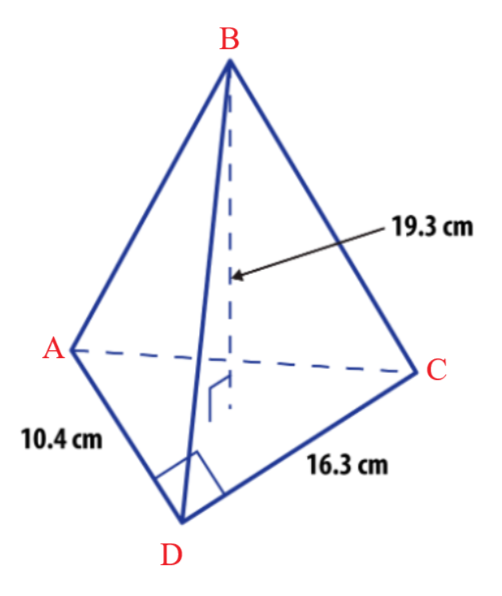
$ \text{Volume of a Pyramid} = \dfrac{1}{3} * \text{Base Area} * \perp Height \\[5ex] \perp Height = 19.3\;cm \\[3ex] \text{The base is a right triangle} \\[5ex] \underline{\text{Base: Right Triangle ADC}} \\[3ex] base = 16.3\;cm \\[3ex] \perp height = 10.4\;cm \\[3ex] Area = \dfrac{1}{2} * base * \perp height \\[5ex] Area = \dfrac{1}{2} * 16.3 * 10.4 \\[5ex] Area = 84.76 \\[3ex] \text{Base Area} = 84.76\;cm^2 \\[5ex] \underline{\text{Right Triangular Pyramid}} \\[3ex] Volume = \dfrac{1}{3} * 84.76 * 19.3 \\[5ex] Volume = 545.2893333 \\[3ex] Volume \approx 545.29\;cm^3\quad\dots\text{to the nearest hundredth} $


