Inequalities
The Joy of the Teacher is the Success of the Students. – Samuel Chukwuemeka
Welcome to Our Site
I greet you this day,
These are the solutions to Mathematics questions on Inequalities.
When applicable, the TI-84 Plus CE calculator (also applicable to TI-84 Plus calculator) solutions are provided
for some questions.
If you find these resources valuable and helpful in your learning of Mathematics, please consider making
a donation:
Cash App: $ExamsSuccess or
cash.app/ExamsSuccess
PayPal: @ExamsSuccess or
PayPal.me/ExamsSuccess
Venmo: @ExamsSuccess or
Venmo.com/u/ExamsSuccess
Your donation is appreciated.
Comments, ideas, areas of improvement, questions, and constructive
criticisms are welcome.
Feel free to contact me. Please be positive in your message.
I wish you the best.
Thank you.
Notes and Rules
(1.) At least 5 means ≥ 5
It means that the minimum should be 5
(2.) At most 5 means ≤ 5
It means that the maximum should be 5
(3.) Just 5 means = 5
It means exactly 5 or equal to 5
(4.) More than 5 means > 5
(5.) Less than 5 means < 5
(6.) No more than 5 means ≤ 5
It should not be more than 5
It means 5 or less
(7.) No less than 5 means ≥ 5
It should not be less than 5
It means 5 or more
Rules of Inequalities
c, d, e are real numbers
$
(1.)\text{ If } c \lt d \text{ and } d \lt e, \text{ then } c \lt e \quad\dots\text{Transitive Rule} \\[3ex]
(2.)\text{ If } c \gt d \text{ and } d \gt e, \text{ then } c \gt e \quad\dots\text{Transitive Rule} \\[3ex]
(3.)\text{ If } c \lt d, \text{ then } d \gt c \\[3ex]
(4.)\text{ If } c \gt d, \text{ then } d \lt c \\[3ex]
(5.)\text{ If } c \lt d, \text{ then } -c \gt -d \\[3ex]
(6.)\text{ If } c \gt d, \text{ then } -c \lt -d \\[3ex]
(7.)\text{ If } c \lt d, \text{ then } \dfrac{1}{c} \gt \dfrac{1}{d} \\[5ex]
(8.)\text{ If } c \gt d, \text{ then } \dfrac{1}{c} \lt \dfrac{1}{d} \\[5ex]
(9.)\text{ If } c \lt d, \text{ then } (c + e) \lt (d + e) \\[3ex]
(10.)\text{ If } c \gt d, \text{ then } (c + e) \gt (d + e) \\[3ex]
(11.)\text{ If } c \lt d, \text{ then } (c - e) \lt (d - e) \\[3ex]
(12.)\text{ If } c \gt d, \text{ then } (c - e) \gt (d - e) \\[3ex]
(13.)\text{ If } c \lt d, \text{ and } e \gt 0; \text{ then } ce \lt de \\[3ex]
(14.)\text{ If } c \lt d, \text{ and } e \lt 0; \text{ then } ce \gt de \\[3ex]
(15.)\text{ If } c \gt d, \text{ and } e \gt 0; \text{ then } ce \gt de \\[3ex]
(16.)\text{ If } c \gt d, \text{ and } e \lt 0; \text{ then } ce \lt de \\[3ex]
(17.)\text{ If } c \lt d, \text{ and } e \gt 0; \text{ then } \dfrac{c}{e} \lt \dfrac{d}{e} \\[5ex]
(18.)\text{ If } c \gt d, \text{ and } e \gt 0; \text{ then } \dfrac{c}{e} \gt \dfrac{d}{e} \\[5ex]
(19.)\text{ If } c \lt d, \text{ and } e \lt 0; \text{ then } \dfrac{c}{e} \gt \dfrac{d}{e} \\[5ex]
(20.)\text{ If } c \gt d, \text{ and } e \lt 0; \text{ then } \dfrac{c}{e} \lt \dfrac{d}{e}
$
Write the solution in set notation and interval notation.
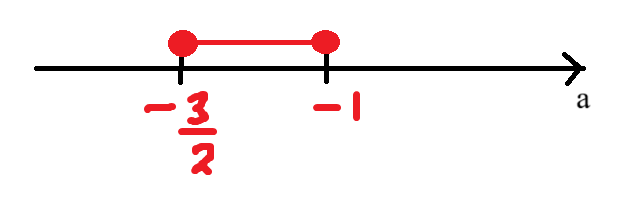
Graph the solution.
Check the solution.
$ (2a + 3)(a + 1) \le 0 \\[3ex] \text{Assume }(2a + 3)(a + 1) = 0 \\[3ex] 2a + 3 = 0 \hspace{2em}OR\hspace{2em} a + 1 = 0 \\[3ex] 2a = -3 \hspace{3em}OR\hspace{3em} a = -1 \\[3ex] a = -\dfrac{3}{2} \hspace{3em}OR\hspace{3em} a = -1 \\[5ex] $ Number line to determine test intervals:
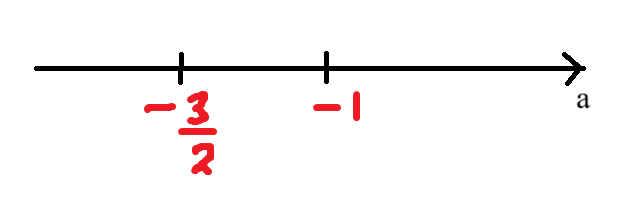
$ \text{Test Intervals are:} \\[3ex] a \lt -\dfrac{3}{2} \\[5ex] -\dfrac{3}{2} \lt a \lt -1 \\[5ex] a \gt -1 \\[3ex] $
|
Let: |
$ a \lt -\dfrac{3}{2} \\[5ex] a = -2 $ | $ -\dfrac{3}{2} \lt a \lt -1 \\[5ex] a = -\dfrac{7}{5} $ | $ a \gt -1 \\[3ex] a = 0 $ |
|---|---|---|---|
| $2a + 3$ | − | + | + |
| $a + 1$ | − | − | + |
| $(2a + 3)(a + 1)$ | + | − | + |
Less than or equal to zero: ≤ 0 means nonpositive
$ \text{Set Notation: } \left\{-\dfrac{3}{2} \le a \le -1\right\} \\[5ex] \text{Interval Notation: } \left[-\dfrac{3}{2}, -1\right] \\[5ex] $
Check
| LHS | RHS |
|---|---|
| $ (2a + 3)(a + 1) \\[3ex] a = -\dfrac{7}{5} \\[5ex] \left[2\left(-\dfrac{7}{5}\right) + 3\right]\left(-\dfrac{7}{5} + 1\right) \\[5ex] \left(-\dfrac{14}{5} + \dfrac{15}{5}\right)\left(-\dfrac{7}{5} + \dfrac{5}{5}\right) \\[5ex] \left(\dfrac{1}{5}\right)\left(-\dfrac{2}{5}\right) \\[5ex] -\dfrac{2}{25} $ | 0 |
| $-\dfrac{2}{25} \le 0$ | |


