Combinatorics
The Joy of the Teacher is the Success of the Students. – Samuel Chukwuemeka
Welcome to Our Site
I greet you this day,
These are the solutions to questions on the topics in Combinatorics.
When applicable, the TI-84 Plus CE calculator (also applicable to TI-84 Plus calculator) solutions are provided
for some questions.
If you find these resources valuable/helpful, please consider making a donation:
Cash App: $ExamsSuccess or
cash.app/ExamsSuccess
PayPal: @ExamsSuccess or
PayPal.me/ExamsSuccess
Venmo: @ExamsSuccess or
Venmo.com/u/ExamsSuccess
Your donation is appreciated.
Comments, ideas, areas of improvement, questions, and constructive
criticisms are welcome.
Feel free to contact me. Please be positive in your message.
I wish you the best.
Thank you.
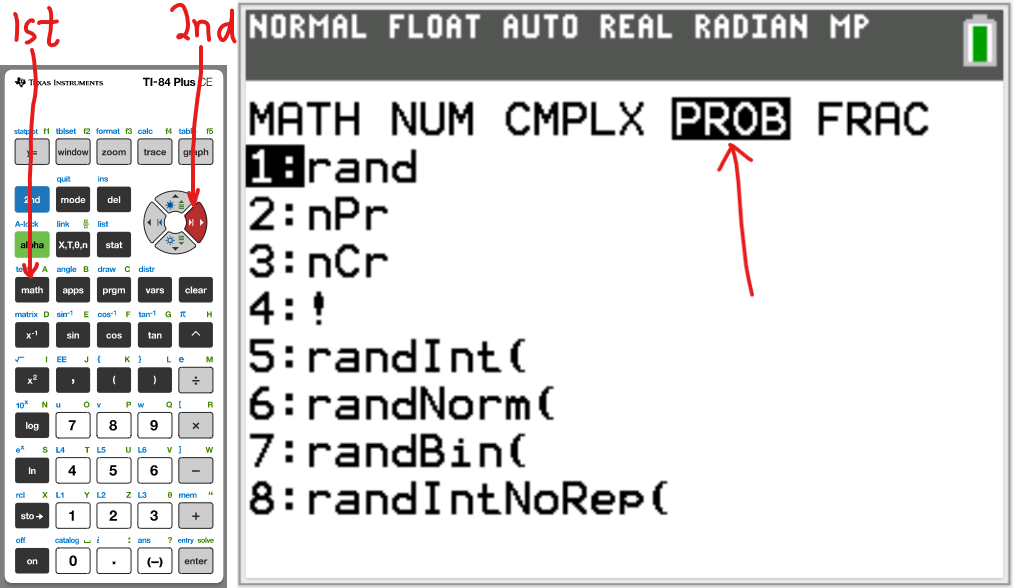
Please NOTE: For applicable questions involving factorials, permutation, and/or combinations, these are
the steps to use the functions:
Formulas
Say:
n is the number of items (n items)
c and d are the number of duplicate items
n! is read as n-factorial
The number of permutations of nitems is n!
The number of permutations of duplicate items is $\dfrac{n!}{c! * d!}$
The number of permutations of $n$ total items taking $r$ items at a time is $^nP_r \;\;\;or\;\;\; _nP_r
\;\;\;or\;\;\; P(n, r)$
The number of combinations of $n$ total items taking $r$ items at a time is $^nC_r \;\;\;or\;\;\; _nC_r
\;\;\;or\;\;\; C(n, r) \;\;\;or\;\;\; \displaystyle{\binom{n}{r}}$
$
(1.)\:\: 0! = 1 \\[4ex]
(2.)\:\: n! = n * (n - 1) * (n - 2) * (n - 3) * ... * 1 \\[4ex]
(3.)\;\; n! = n * (n - 1)! \\[4ex]
(4.)\;\; n! = n * (n - 1) * (n - 2)!\quad\dots\text{and so on and so forth} \\[4ex]
(5.)\;\; (n - 1)! = (n - 1) * (n - 2)!\quad\dots\text{and so on and so forth} \\[4ex]
(6.)\;\; (n - 2)! = (n - 2) * (n - 3) * (n - 4)!\quad\dots\text{and so on and so forth} \\[4ex]
(7.)\;\; (n - 3)! = (n - 3) * (n - 4) * (n - 5)!\quad\dots\text{and so on and so forth} \\[4ex]
(8.)\;\; (n + 1)! = (n + 1) * n!\quad\dots\text{and so on and so forth} \\[4ex]
(9.)\;\; (n + 2)! = (n + 2) * (n + 1) * n!\quad\dots\text{and so on and so forth} \\[4ex]
(10.)\;\; (n + 3)! = (n + 3) * (n + 2) * (n + 1) * n!\quad\dots\text{and so on and so forth} \\[4ex]
(11.)\:\: P(n, r) = \dfrac{n!}{(n - r)!} \\[7ex]
(12.)\:\: C(n, r) = \dfrac{n!}{(n - r)!r!} \\[7ex]
(13.)\;\; P(n, r) = n! * C(n, r) \\[4ex]
(14.)\;\; C(n, r) = C(n, n - r) \\[4ex]
(15.)\;\; (n - r) * P(n, r) = P(n, r + 1) \\[4ex]
(16.)\;\; Number\;\;of\;\;circular\;\;permutations = (n - 1)! \\[4ex]
$
Case 1:
Given: a certain number of digits/letters say p
(14.) The number of unique number of digits/letters say c digits/letters that can be formed if the
digits/letters may be repeated is $p^c$ digits/letters.
(15.) The number of unique number of digits/letters say c digits/letters that can be formed if the
digits/letters may not be repeated is $P(p, c)$ digits/letters.
Case 2:
Given: a certain number of people or items in a linear random order say $n$
(16.) The number of ways in which two people or two items must be close together is $2 * (n - 1) * (n - 2)!$
ways
Binomial Theorem
$
(x + y)^n \\[3ex]
= C(n, 0)(x^n)(y^0) + C(n, 1)(x^{n - 1})(y) + C(n, 2)(x^{n - 2})(y^2) + ... + C(n, r)(x^{n - r})(y^r) + ... +
C(n, n)(x^0)(y^n) \\[4ex]
= x^n + C(n, 1)(x^{n - 1})(y) + C(n, 2)(x^{n - 2})(y^2) + ... + C(n, r)(x^{n - r})(y^r) + ... + y^n \\[5ex]
$
Generalized Binomial Series
Recommended for negative values of the outside exponent (negative values of n)
$
(1 + x)^n = 1 + nx + \dfrac{n(n - 1)}{2!}x^2 + \dfrac{n(n - 1)(n - 2)}{3!}x^3 + O(x^4) \\[3ex]
$
where $O(x^4)$ is the Big-O Notation representing the remainder of the series, and indicating that the omitted
terms are of the order of $x^4$ as x approaches zero.
The binomial expansion of $(1 + ax)^n$ is valid when $|ax| \lt 1$
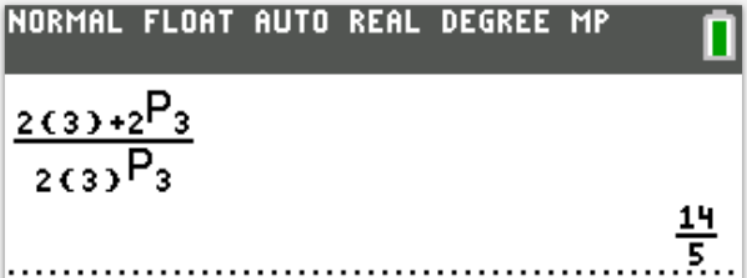
Find the value of n
Numerator: The number of arrangements of $(2n + 2)$ different objects taken n objects at a time is: $P(2n + 2), n$
Denominator: The number of arrangements of $2n$ different objects taken n objects at a time is: $P(2n, n)$
$ \underline{\text{Numerator}} \\[3ex] P(2n + 2, n) \\[3ex] = \dfrac{(2n + 2)!}{(2n + 2 - n)!} \\[5ex] = \dfrac{(2n + 2)!}{(n + 2)!} \\[5ex] (2n + 2)! \\[3ex] = (2n + 2)(2n + 2 - 1)(2n + 2 - 2)! \\[3ex] = (2n + 2)(2n + 1)(2n)! \\[5ex] (n + 2)! \\[3ex] = (n + 2)(n + 2 - 1)(n + 2 - 2)! \\[3ex] = (n + 2)(n + 1)(n)! \\[5ex] \implies \\[3ex] P(2n + 2, n) = \dfrac{(2n + 2)(2n + 1)(2n)!}{(n + 2)(n - 1)(n)!} \\[5ex] \underline{\text{Denominator}} \\[3ex] P(2n, n) \\[3ex] = \dfrac{(2n)!}{(2n -n)!} \\[5ex] = \dfrac{(2n)!}{n!} \\[5ex] \underline{\text{Ratio: }Numerator \div Denominator} \\[3ex] P(2n + 2, n) \div P(2n, n) \\[3ex] \dfrac{(2n + 2)(2n + 1)(2n)!}{(n + 2)(n + 1)(n)!} \div \dfrac{(2n)!}{n!} \\[5ex] \dfrac{2(n + 1)(2n + 1)(2n)!}{(n + 2)(n + 1)(n)!} * \dfrac{n!}{(2n)!} \\[5ex] \dfrac{2(2n + 1)}{(n + 2)} \\[5ex] \dfrac{4n + 2}{n + 2} \\[5ex] \text{This ratio } = \dfrac{14}{5} \\[5ex] \implies \\[3ex] \dfrac{4n + 2}{n + 2} = \dfrac{14}{5} \\[5ex] 5(4n + 2) = 14(n + 2) \\[3ex] 20n + 10 = 14n + 28 \\[3ex] 20n - 14n = 28 - 10 \\[3ex] 6n = 18 \\[3ex] n = 3 $