CSEC Examination: Mathematics: Paper 02: General Proficiency
The Joy of the Teacher is the Success of the Students. – Samuel Chukwuemeka
Welcome to Our Site
I greet you this day,
These are the solutions to the CSEC Mathematics Paper 02 questions.
Please review the Formulas, rules/laws, and theorems on the website for each topic as applicable.
If time permits and there is sufficient interest, video solutions may be provided. Please subscribe to the
YouTube channel to be notified
of upcoming livestreams.
You are welcome to ask questions during the video livestreams.
If you find these resources valuable and if any of these resources were helpful in your passing the
Mathematics tests/exams, please consider making a donation:
Cash App: $ExamsSuccess or
cash.app/ExamsSuccess
PayPal: @ExamsSuccess or
PayPal.me/ExamsSuccess
Venmo: @ExamsSuccess or
Venmo.com/u/ExamsSuccess
Your donation is appreciated.
Comments, ideas, areas of improvement, questions, and constructive
criticisms are welcome.
Feel free to contact me. Please be positive in your message.
I wish you the best.
Thank you.
CARIBBEAN SECONDARY EDUCATION CERTIFICATE EXAMINATION
MATHEMATICS
Time: 2 hours 40 minutes
READ THE FOLLOWING INSTRUCTIONS CAREFULLY.
(1.) This paper consists of TWO sections: I and II.
(2.) Section I has SEVEN questions and Section II has THREE questions.
(3.) All responses MUST be written in the answer booklet provided.
(4.) Your responses MUST be written in English.
(5.) Numerical answers that are non-exact should be given correct to 3 significant figues or 1 decimal place for
angles in degrees, unless a different level of accuracy is specified in the question.
(6.) All working MUST be clearly shown.
(7.) It is an offense to share your keycode with any other candidate or to log in with another candidate's
details.
(8.) Any attempt to change the configuration of this machine, connect external devices, connect to external
networks or to in any way initiate communication with resources other than the URL provided will result in your
disqualification, you being shut out of the system and the cancellation of your entire test.
Formula Sheet: List of Formulae
(i.) Evaluation of Functions: find the value of A when $p = 2, q = -1$ and $r = 1$
(ii.) Literal Equations: express q in terms of A, p and r.
(b.) Trigonometry: Triangles: In the triangle EFG shown below, $EG = (2x + 3)$ cm and the perpendicular height from F to EG is $(x + 5)$ cm.
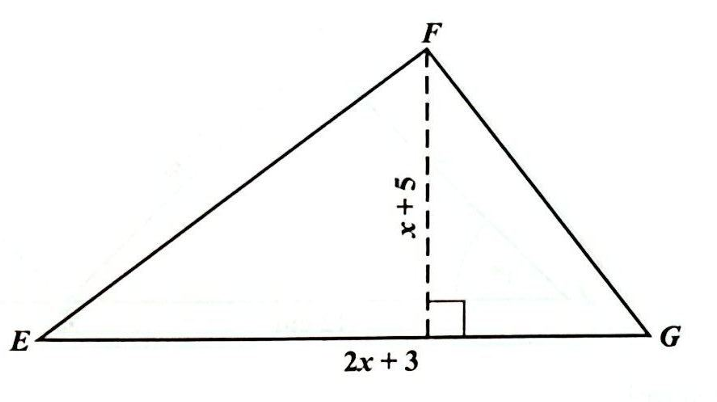
Given that the area of Triangle EFG = 50 cm²,
(i.) show that $2x^2 + 13x - 85 = 0$
(ii.) find the value of x, giving your answer correct to 2 decimal places.
Show all working.
$ (a.) \\[3ex] A = \dfrac{p - q}{2r} \\[5ex] (i.) \\[3ex] p = 2 \\[3ex] q = -1 \\[3ex] r = 1 \\[3ex] A = \dfrac{2 - (-1)}{2(1)} \\[5ex] = \dfrac{2 + 1}{2} \\[5ex] = \dfrac{3}{2} \\[5ex] (ii.) \\[3ex] p - q = A \cdot 2r \\[3ex] p - q = 2Ar \\[3ex] p - 2Ar = q \\[3ex] q = p - 2Ar \\[5ex] (b.) \\[3ex] \text{Area of } \triangle = \dfrac{1}{2} \cdot \text{base} \cdot \perp\text{height} \\[5ex] (i.) \\[3ex] \text{Area of } \triangle EFG = \dfrac{1}{2} \cdot (2x + 3) \cdot (x + 5) \\[5ex] 50 = \dfrac{2x^2 + 10x + 3x + 15}{2} \\[5ex] 2x^2 + 13x + 15 = 50(2) \\[3ex] 2x^2 + 13x + 15 - 100 = 0 \\[3ex] 2x^2 + 13x - 85 = 0 \\[5ex] (ii.) \\[3ex] 2x^2 + 13x - 85 = 0 \\[3ex] \text{Compare to the standard form of a Quadratic Equation: } ax^2 + bx + c = 0 \\[3ex] a = 2 \\[3ex] b = 13 \\[3ex] c = -85 \\[3ex] x = \dfrac{-b \pm \sqrt{b^2 - 4ac}}{2a} \\[5ex] = \dfrac{-13 \pm \sqrt{13^2 - 4(2)(-85)}}{2(2)} \\[5ex] = \dfrac{-13 \pm \sqrt{169 + 680}}{4} \\[5ex] = \dfrac{-13 \pm \sqrt{849}}{4} \\[5ex] = \dfrac{-13 \pm 29.13760457}{4} \\[5ex] = \dfrac{-13 + 29.13760457}{4} \text{ or } \dfrac{-13 - 29.13760457}{4} \\[5ex] = \dfrac{16.13760457}{4} \text{ or } -\dfrac{42.13760457}{4} \\[5ex] = 4.034401143 \text{ or } -10.53440114 \\[3ex] \approx 4.03 \text{ or } -10.53 \quad\text{to 2 decimal places} $
The line segment JM is parallel to KQ, JK = 12 cm and MK = 8 cm.
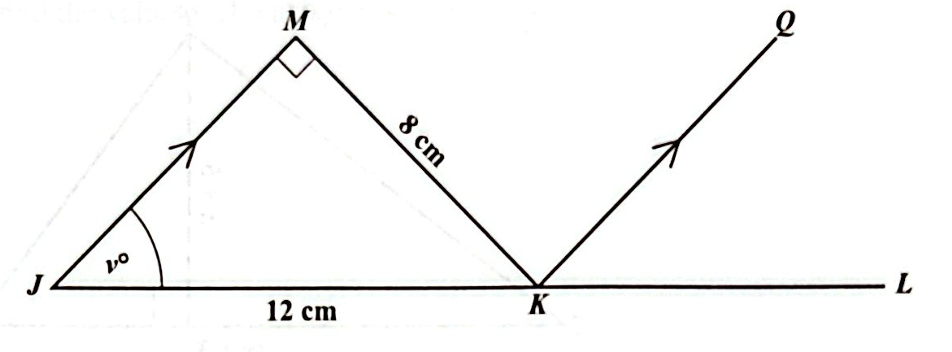
(a.) Determine (i.) $\sin v^\circ$
(ii.) the length JM
(iii.) $\angle MKL$
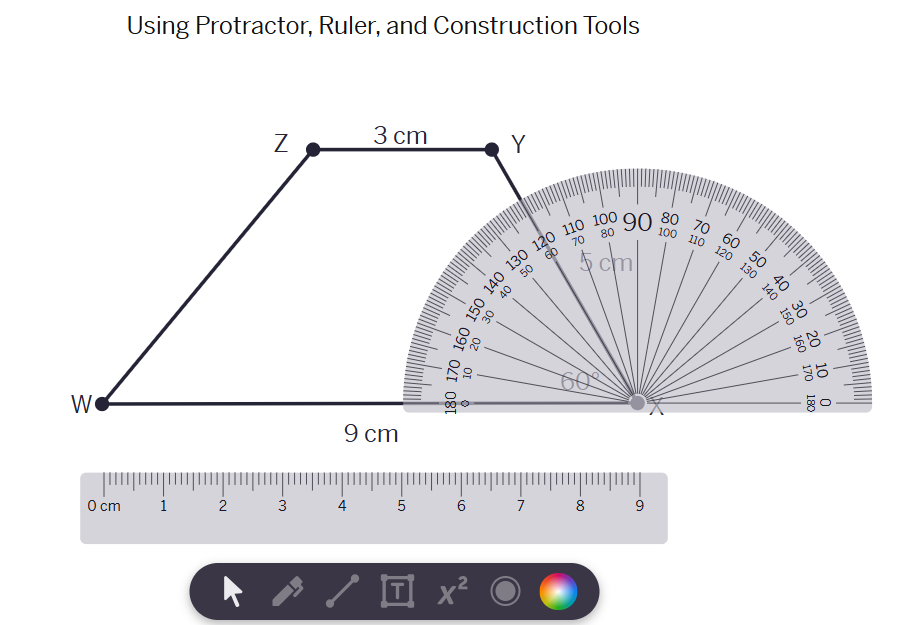
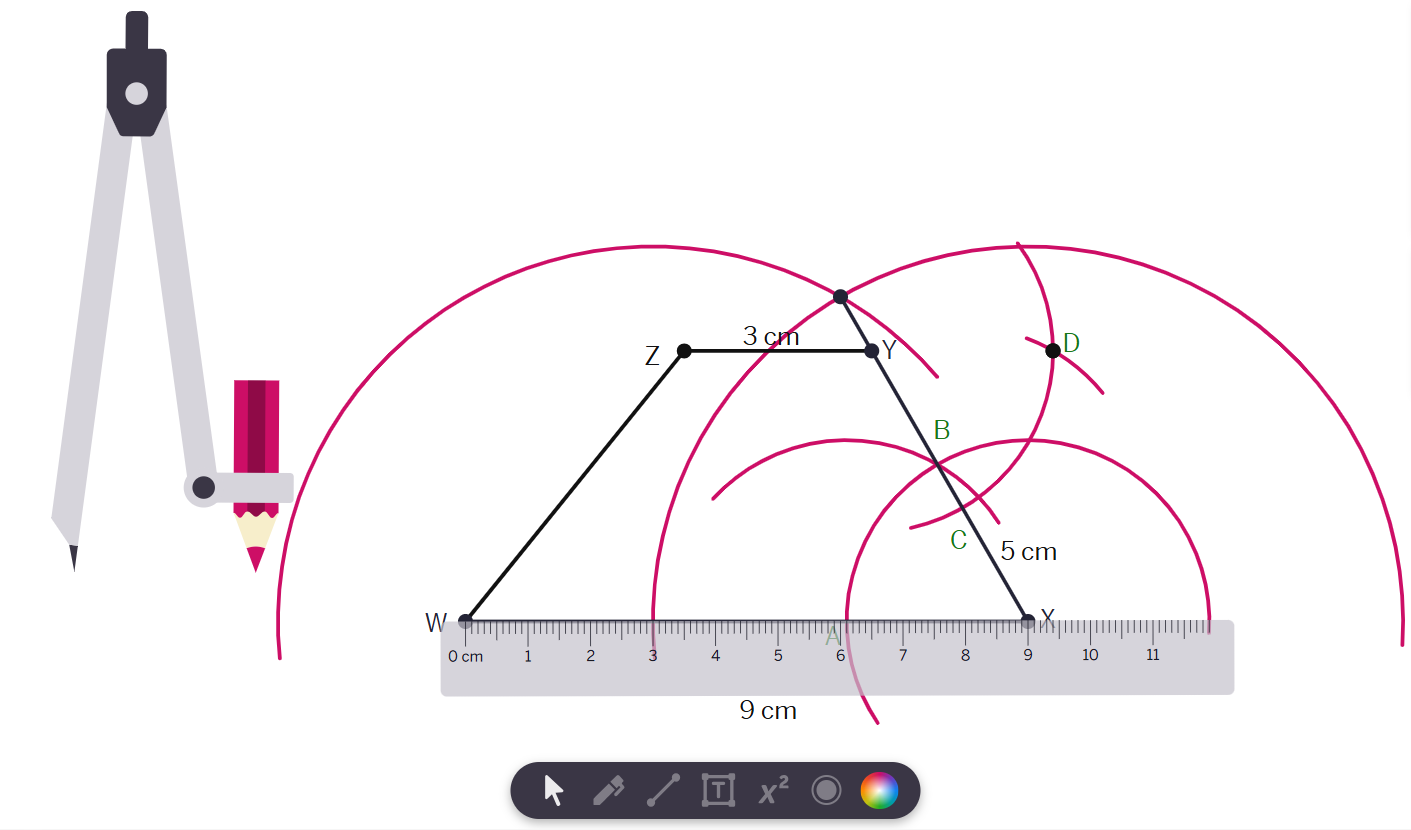
(b.) Geometric Constructions: Construct a trapezium, WXYZ, in which WX = 9 cm, XY = 5 cm, YZ = 3 cm, $\angle WXY = 60^\circ$ and WX || YZ.
$ (a.) \\[3ex] \underline{\text{Right }\triangle JMK} \\[3ex] \text{opp} = 8\;cm \\[3ex] \text{hyp} = 12\;cm \\[3ex] (i.) \\[3ex] \sin v = \dfrac{opp}{hyp} \quad\text{SOHCAHTOA} \\[5ex] = \dfrac{8}{12} \\[5ex] = \dfrac{2}{3} \\[5ex] = 0.6\bar{6} \\[3ex] \approx 0.667 \quad\text{to 3 significant figures} \\[5ex] (ii.) \\[3ex] hyp^2 = leg^2 + leg^2 \quad\text{Pythagorean Theorem} \\[3ex] |JK|^2 = |JM|^2 + |MK|^2 \\[3ex] 12^2 = |JM|^2 + 8^2 \\[3ex] |JM|^2 = 12^2 - 8^2 \\[3ex] = 144 - 64 \\[3ex] = 80 \\[3ex] |JM| = \sqrt{80} \\[3ex] = 8.94427191 \\[3ex] \approx 8.94\;cm \quad\text{to 3 significant figures} \\[5ex] (iii.) \\[3ex] v = \sin^{-1}(0.6\bar{6}) \\[3ex] = 41.8103149^\circ \\[5ex] \angle MKL = v^\circ + 90^\circ \\[3ex] = 41.8103149 + 90 \\[3ex] = 131.8103149 \\[3ex] \approx 131.8^\circ \quad\text{to 1 decimal place} \\[3ex] $ (b.) The trapezium is constructed as shown:
Use any Trapezium option you prefer.
Part 1: Using Ruler, Protractor, and Construction Tools
Part 2: Using Ruler, Compass, and Construction Tools
| Number of Goals Scored | 0 | 1 | 2 | 3 | 4 | 5 |
| Number of Matches | 3 | 10 | k | 15 | 4 | 3 |
If the mean number of goals scored is 2.2, determine the value of k.
(b.) Teacher Joy recorded the time taken for the 60 students in her Math Club to complete a 12-piece puzzle.
The cumulative frequency graph below shows information regarding the time it takes 60 students to complete the puzzle.
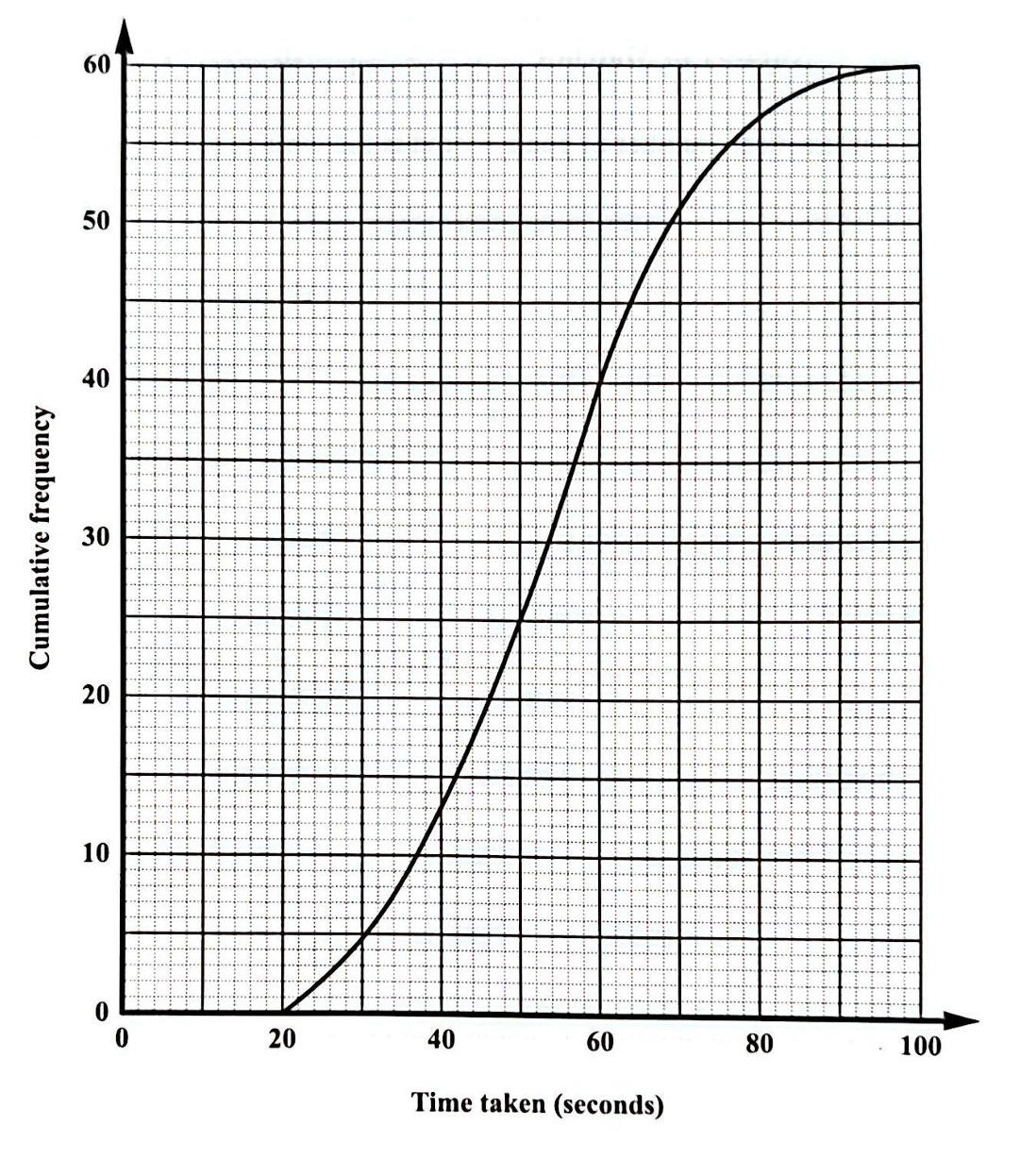
Use the cumulative frequency curve to:
(i.) determine the probability that a student chosen at random will take at least 42 seconds to complete the puzzle.
(ii.) determine the semi-interquartile range of the time taken by the 60 students to complete the puzzle.
(iii.) Complete the table below.
| Time Taken (seconds) | Number of Students (f) | Midpoint (x) | Frequency × Midpoint ($fx$) |
|---|---|---|---|
| $21 - 40$ | 13 | 30.5 | 396.5 |
| $41 - 60$ | ............ | 50.5 | ............ |
| $61 - 80$ | ............ | 70.5 | ............ |
| $81 - 100$ | ............ | 90.5 | 271.5 |
(a.)
| Number of Goals Scored, $x$ | Number of Matches, $f$ | $f \cdot x$ |
| 0 | 3 | 0 |
| 1 | 10 | 10 |
| 2 | k | 2k |
| 3 | 15 | 45 |
| 4 | 4 | 16 |
| 5 | 3 | 15 |
| $\Sigma f = k + 35$ | $\Sigma fx = 2k + 86$ |
$ \text{Mean, } \bar{x} = \dfrac{\Sigma fx}{\Sigma f} \\[5ex] 2.2 = \dfrac{2k + 86}{k + 35} \\[5ex] 2.2(k + 35) = 2k + 86 \\[3ex] 2.2k + 77 = 2k + 86 \\[3ex] 2.2k - 2k = 86 - 77 \\[3ex] 0.2k = 9 \\[3ex] k = \dfrac{9}{0.2} \\[5ex] k = 45 \\[3ex] $
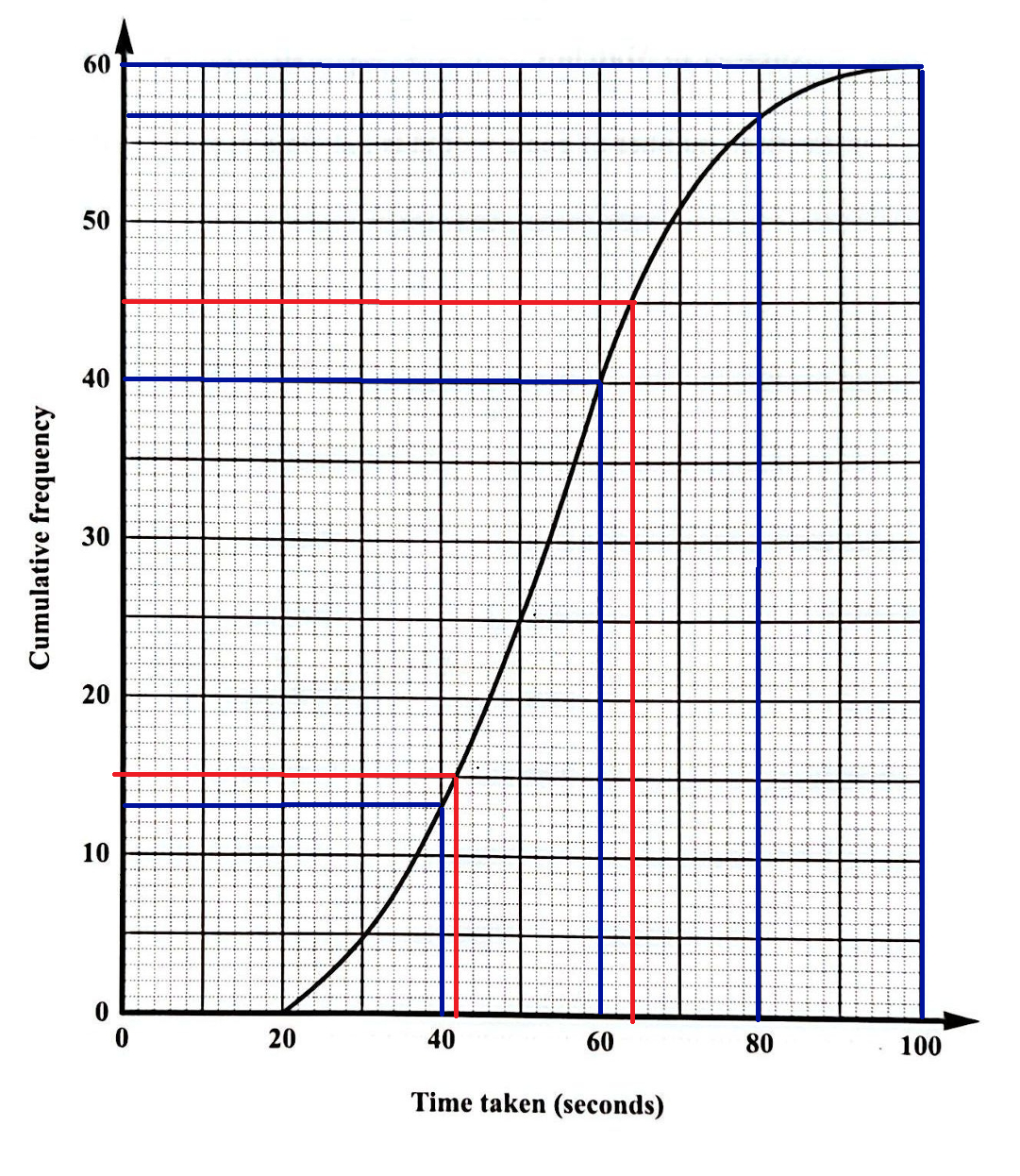
(b.) $n(S) = N$ = Total number of students = 60
Based on the cumulative frequency curve,
$n(E)$ = Number of students that took at least 42 seconds to complete the puzzle = 60 − 15 = 45
$ (i.) \\[3ex] P(E) = \dfrac{n(E)}{n(S)} \\[5ex] = \dfrac{45}{60} \\[5ex] = 0.75 \\[5ex] (ii.) \\[3ex] \text{Lower Quartile Position} \\[3ex] = \dfrac{N}{4}th \\[5ex] = \dfrac{60}{4}th \\[5ex] = 15th \\[3ex] \text{Lower Quartile, } Q_1 = 15th\text{ value} = 42 \\[5ex] \text{Upper Quartile Position} \\[3ex] = \dfrac{3N}{4}th \\[5ex] = \dfrac{3 \cdot 60}{4}th \\[5ex] = 45th \\[3ex] \text{Upper Quartile, } Q_3 = 45th\text{ value} = 64 \\[5ex] \text{Semi-Interquartile Range} = \dfrac{Q_3 - Q_1}{2} \\[5ex] = \dfrac{64 - 42}{2} \\[5ex] = \dfrac{22}{2} \\[5ex] = 11 \\[3ex] $ (iii.)
| Time Taken (seconds) | Cumulative Frequency (from the Ogive) | Number of Students (f) | Midpoint (x) | Frequency × Midpoint ($fx$) |
|---|---|---|---|---|
| $21 - 40$ | 13 | 13 | 30.5 | 396.5 |
| $41 - 60$ | 40 | 40 − 13 = 27 | 50.5 | 27 × 50.5 = 1363.5 |
| $61 - 80$ | 57 | 57 − 40 = 17 | 70.5 | 17 × 70.5 = 1198.5 |
| $81 - 100$ | 60 | 3 | 90.5 | 271.5 |
The numbers on the chart follow various patterns.
Study the patterns and answer the questions that follow.
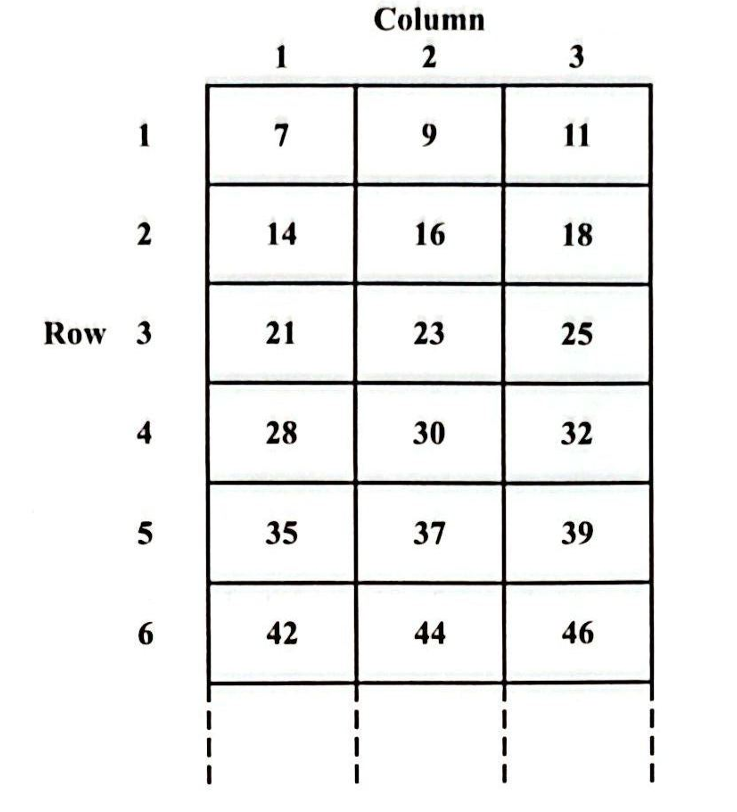
(i.) What number should be placed in Column 1 of Row 9?
(ii.) The following diagram represents a given row from the chart described on (7.)(a.).
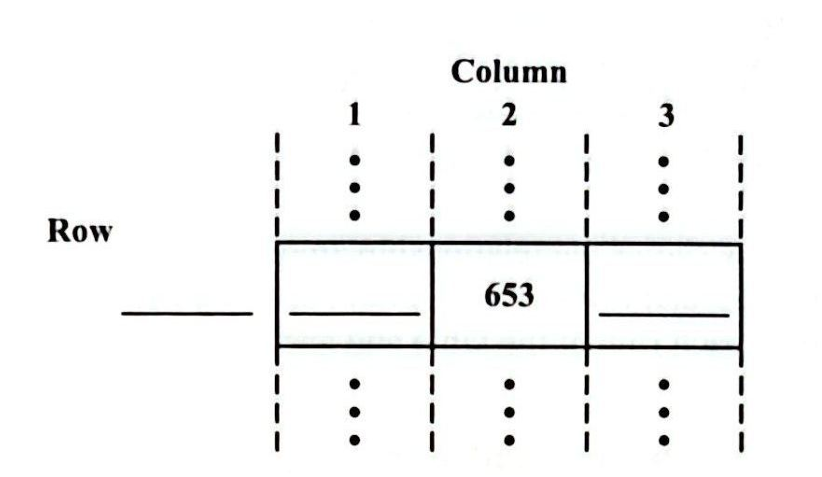
Fill in the three missing numbers in the diagram above.
(iii.) Which row would contain the number 942?
Explain how you arrived at your answer.
(b.) A sequence is formed using diagrams made up of equilateral triangles, each constructed from sticks of unit length.
The first four diagrams in the sequence are shown below.

The table below shows the relationship among the number of equilateral triangles, E, the number of sticks that form each diagram, S, and the number of dots, D.
Study the pattern of numbers in each row of the table and answer the questions that follow.
| Diagram | Number of Equilateral Triangles (E) | Number of Sticks (S) | Number of Dots (D) |
|---|---|---|---|
| 1 | 1 | 3 | 3 |
| 2 | 3 | 7 | 5 |
| 3 | 5 | 11 | 7 |
| 4 | 7 | 15 | 9 |
| $\vdots$ | $\vdots$ | $\vdots$ | $\vdots$ |
| n | $\rule{5em}{0.5pt}$ | $\rule{5em}{0.5pt}$ | $\rule{5em}{0.5pt}$ |
(i.) Complete the row in the table that corresponds to Diagram n.
(ii.) Using your answers in (b.)(i.), show that the difference between the number of equilateral triangles and the number of dots will always be equal to 2.
(a.)
A quick look at Column 1 shows the Multiplication Table of 7
$ \text{Column 1 of Row 1: } 7 * 1 = 7 \\[3ex] \text{Column 1 of Row 6: } 7 * 6 = 42 \\[3ex] (i.) \\[3ex] \text{Column 1 of Row 9:} \\[3ex] 7 * 9 = 63 \\[3ex] $ The three columns represent Arithmetic Sequences.
Let us write the nth term of each column.
Let:
n = number of terms = Row number
F, G, H = nthe terms for Columns 1, 2, and 3 respectively
a = first term
d = common difference
nth term = $a + d(n - 1)$
$ (ii.) \\[3ex] \underline{\text{Column 1 }, F_n} \\[3ex] F_n = 7n \quad\text{Quick Observation} \\[5ex] \underline{\text{Column 2 }, G_n} \\[3ex] a = 9 \\[3ex] d = 16 - 9 = 7 \\[3ex] G_n = 9 + 7(n - 1) \\[3ex] = 9 + 7n - 7 \\[3ex] = 7n + 2 \\[5ex] \underline{\text{Column 3 }, H_n} \\[3ex] a = 11 \\[3ex] d = 32 - 25 = 7 \\[3ex] H_n = 11 + 7(n - 1) \\[3ex] = 11 + 7n - 7 \\[3ex] = 7n + 4 \\[5ex] \underline{\text{To Find the Missing Numbers}} \\[3ex] \text{Column 2: } G_n = 7n + 2 \\[3ex] \text{Column 2: } 653 \quad\text{Given} \\[3ex] \implies \\[3ex] 7n + 2 = 653 \\[3ex] 7n = 653 - 2 \\[3ex] 7n = 651 \\[3ex] n = \dfrac{651}{7} \\[5ex] n = 93 \quad\text{Row Number 93} \\[5ex] \text{Column 1: } F_n = 7n \\[3ex] F_{93} = 7(93) \\[3ex] = 651 \\[5ex] \text{Column 3: } G_n = 7n + 4 \\[3ex] G_{93} = 7(93) + 4 \\[3ex] = 651 + 4 \\[3ex] = 655 \\[5ex] (iii.) \\[3ex] \text{Which row would contain the number } 942? \\[3ex] \text{Let us check each Column} \\[5ex] \text{Check for Column 1:} \\[3ex] 7n = 942 \\[3ex] n = \dfrac{942}{7} = 134.5714286 \quad\text{not a natural number.} \\[5ex] \text{Check for Column 2:} \\[3ex] 7n + 2 = 942 \\[3ex] 7n = 942 - 2 \\[3ex] 7n = 940 \\[3ex] n = \dfrac{940}{7} = 134.2857143 \quad\text{not a natural number.} \\[5ex] \text{Check for Column 3:} \\[3ex] 7n + 4 = 942 \\[3ex] 7n = 942 - 4 \\[3ex] 7n = 938 \\[3ex] n = \dfrac{938}{7} = 134 \quad\text{Natural number: Row 134, Column 3} \\[3ex] $ Row 134 would contain the number 942
I checked each column to see the one that will output a natural number.
$ (b.) \\[3ex] \text{Let Diagram} = A \\[3ex] A, E, S, D \text{ are arithmetic sequences.} \\[3ex] \underline{\text{Diagram, } A} \\[3ex] 1, 2, 3, 4, ... \\[3ex] a = 1 \\[3ex] d = 2 - 1 = 1 \\[3ex] A_n = 1 + 1(n - 1) \\[3ex] = 1 + n - 1 \\[3ex] = n \\[5ex] \underline{\text{Number of Equilateral Triangles, } E} \\[3ex] 1, 3, 5, 7, ... \\[3ex] a = 1 \\[3ex] d = 5 - 3 = 2 \\[3ex] E_n = 1 + 2(n - 1) \\[3ex] = 1 + 2n - 2 \\[3ex] = 2n - 1 \\[5ex] \underline{\text{Number of Sticks, } S} \\[3ex] 3, 7, 11, 15, ... \\[3ex] a = 3 \\[3ex] d = 15 - 11 = 4 \\[3ex] S_n = 3 + 4(n - 1) \\[3ex] = 3 + 4n - 4 \\[3ex] = 4n - 1 \\[5ex] \underline{\text{Number of Dots, }D} \\[3ex] 3, 5, 7, 9, ... \\[3ex] a = 3 \\[3ex] d = 5 - 3 = 2 \\[3ex] D_n = 3 + 2(n - 1) \\[3ex] = 3 + 2n - 2 \\[3ex] = 2n + 1 \\[3ex] $ (i.)
| Diagram | Number of Equilateral Triangles (E) | Number of Sticks (S) | Number of Dots (D) |
|---|---|---|---|
| 1 | 1 | 3 | 3 |
| 2 | 3 | 7 | 5 |
| 3 | 5 | 11 | 7 |
| 4 | 7 | 15 | 9 |
| $\vdots$ | $\vdots$ | $\vdots$ | $\vdots$ |
| n | $2n - 1$ | $4n - 1$ | $2n + 1$ |
(ii.) The difference between the number of dots and the number of equilateral triangles will always be equal to 2
$ 3 - 1 = 2 \\[3ex] 5 - 3 = 2 \\[3ex] 7 - 5 = 2 \\[3ex] 9 - 7 = 2 \\[5ex] \text{Similarly:} \\[3ex] (2n + 1) - (2n - 1) \\[3ex] = 2n + 1 - 2n + 1 \\[3ex] = 2 $
$ f(x) = 5 + 4x - 2x^2 \\[3ex] $ (a.) Write the function in the form $f(x) = a(x + h)^2 + k$, where a, h and k are constants.
(b.) A table of values for the function $f(x) = 5 + 4x - 2x^2$ is shown below.
| x | −2 | −1 | 0 | 1 | 2 | 3 | 4 |
| y | −11 | −1 | 5 | ............ | 5 | ............ | −11 |
(i.) Insert the missing values in the table above.
(ii.) Using a scale of 2 cm to represent 1 unit on the x-axis and 1 cm to represent 2 units on the y-axis, plot the graph of $f(x) = 5 + 4x - 2x^2$ for $-2 \le x \le 4$ on the grid shown below. [page 27].
(c.) Draw an appropriate line on your graph and use it to determine estimates of the solutions of the equation $5 + 4x - 2x^2 = 3$
(a.) We shall solve it using at least two approaches.
Use any approach you prefer.
$ \underline{\text{1st Approach: Converting from Standard Form to Vertex Form}} \\[3ex] f(x) = 5 + 4x - 2x^2 \\[3ex] f(x) = -2x^2 + 4x + 5 \\[3ex] \text{Compare to the:} \\[3ex] \underline{\text{Standard Form of a Quadratic Function}} \\[3ex] f(x) = ax^2 + bx + c \\[3ex] a = -2 \\[3ex] b = 4 \\[3ex] c = 5 \\[3ex] \underline{\text{Vertex Form of a Quadratic Function}} \\[3ex] f(x) = a(x - h)^2 + k \\[3ex] \text{where} \\[3ex] h = -\dfrac{b}{2a} \\[5ex] = -\dfrac{4}{2(-2)} \\[5ex] = 1 \\[5ex] k = f(h) \\[3ex] = f(1) \\[3ex] = -2(1)^2 + 4(1) + 5 \\[3ex] = -2(1) + 4 + 5 \\[3ex] = 7 \\[5ex] \therefore f(x) = -2(x - 1)^2 + 7 \\[5ex] \underline{\text{2nd Approach: Completing the Square Method}} \\[3ex] f(x) = 5 + 4x - 2x^2 \\[3ex] f(x) = -2x^2 + 4x + 5 \\[3ex] = -2\left(x^2 - 2x - \dfrac{5}{2}\right) \\[5ex] ...................................................... \\[3ex] \text{coefficient of } x = -2 \\[3ex] \text{half of it} = \dfrac{1}{2} \cdot -2 = -1 \\[5ex] \text{square it} = (-1)^2 = 1 \\[5ex] ...................................................... \\[3ex] = -2\left[x^2 - 2x + (-1)^2 - \dfrac{5}{2} - (-1)^2\right] \\[5ex] = -2\left[(x - 1)^2 - \dfrac{5}{2} - 1\right] \\[5ex] = -2\left[(x - 1)^2 - \dfrac{5}{2} - \dfrac{2}{2}\right] \\[5ex] = -2\left[(x - 1)^2 - \dfrac{7}{2}\right] \\[5ex] = -2(x - 2)^2 + 7 \\[5ex] (b.) \\[3ex] f(x) = 5 + 4x - 2x^2 \\[3ex] (i.) \\[3ex] f(1) = 5 + 4(1) - 2(1)^2 \\[3ex] = 5 + 4 - 2 \\[3ex] = 7 \\[5ex] f(3) = 5 + 4(3) - 2(3)^2 \\[3ex] = 5 + 12 - 2(9) \\[3ex] = 5 + 12 - 18 \\[3ex] = -1 \\[3ex] $
| x | −2 | −1 | 0 | 1 | 2 | 3 | 4 |
| y | −11 | −1 | 5 | 7 | 5 | −1 | −11 |
(ii.)
The graph of $f(x) = 5 + 4x - 2x^2$ for $-2 \le x \le 4$ using the scale:
2 cm to 1 unit on the x-axis
1 cm to 2 units on the y-axis
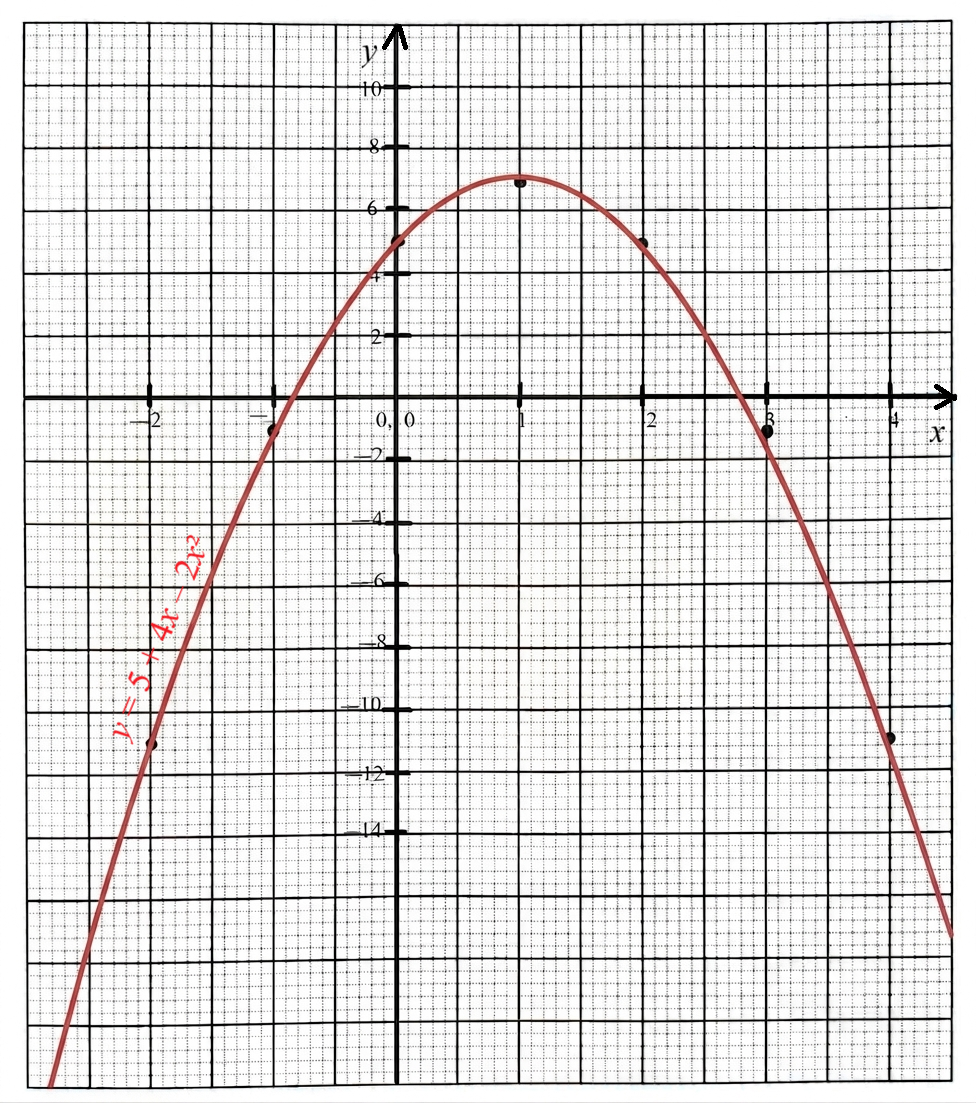
$ (c.) \\[3ex] y = 5 + 4x - 2x^2 \quad\text{curve in red color} \\[3ex] y = 3 \quad\text{line in blue color} \\[5ex] 5 + 4x - 2x^2 = 3 \\[3ex] $
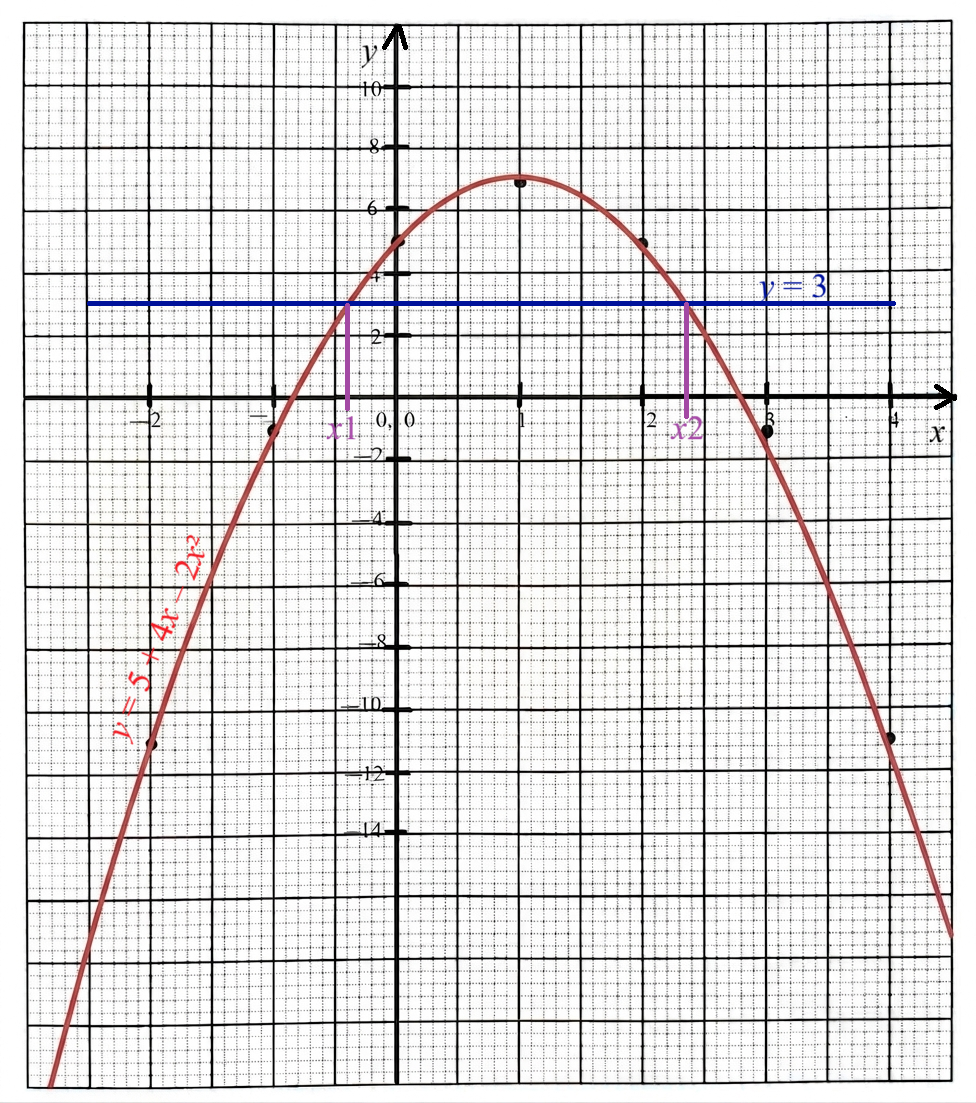
$ \text{Let } x_1, x_2 \text{ be estimates of the solutions of the equations: } 5 + 4x - 2x^2 = 3 \\[3ex] 10\text{ lines} \rightarrow 1 \\[3ex] 1\text{ line} \rightarrow \dfrac{1}{10} = 0.1 \\[5ex] 4\text{ lines} = 4(0.1) = 0.4 \\[3ex] 3.5\text{ lines} = 3.5(0.1) = 0.35 \\[5ex] x_1 = -0.4 \\[3ex] x_2 = 2 + 0.35 = 2.35 $
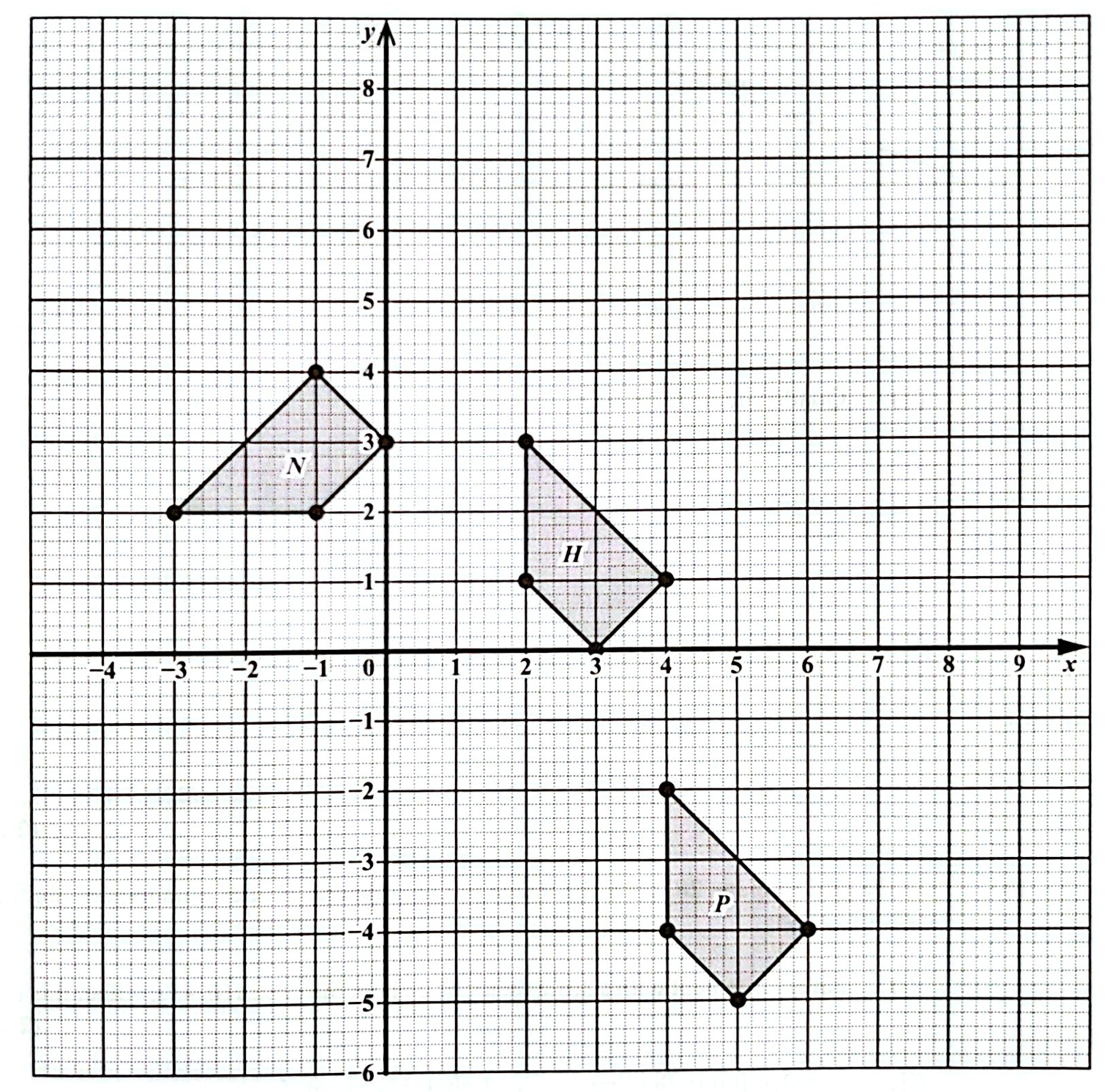
Quadrilaterals P and N are the images of Quadrilateral H after it has undergone two different transformations.
(a.) Describe fully the single transformation that maps
(i.) Quadrilateral H onto Quadrilateral N
(ii.) Quadrilateral H onto Quadrilateral P
(b.) On the grid on (page 29), draw the image of Quadrilateral H after it undergoes the following transformations.
(i.) An enlargement with a scale factor of 2 about the centre $(0, -1)$.
Label this image M.
(ii.) A reflection in the line $y = -x$.
Lable this image L.
(c.) Trigonometry: Bearings and Distances: The diagram below shows three pillars, L, M and N, that are located on level ground.
MN is 12 km and LN is 15 km.
L is due west of N.
The bearing of M from N is 291°.
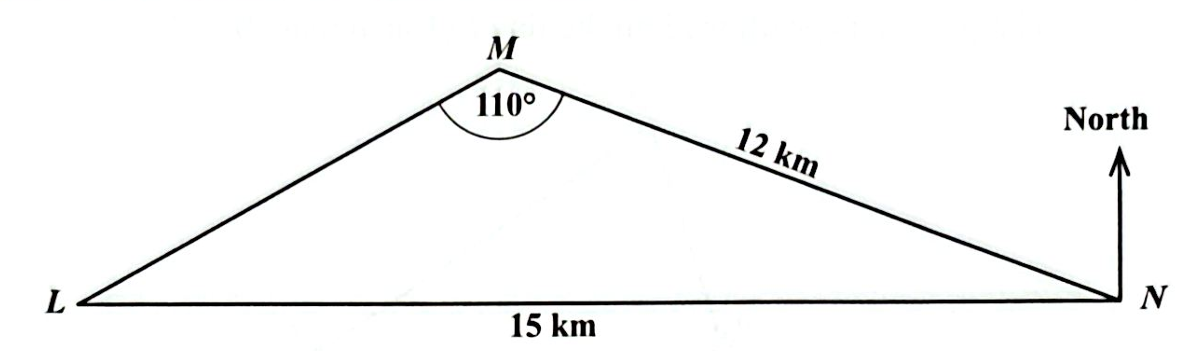
Calculate
(i.) Angle MNL
(ii.) the length of LM
(a.) Assume that Quadrilateral H has vertices A, B, C, D
(i.) A visual observation of the transformation of Quadrilateral H mapping onto Quadrilateral N suggests a rotation.
Let us verify this by examining the coordinate mapping.
$ \text{Quadrilateral } H \text{ onto Quadrilateral } N \\[3ex] A(2, 3) \rightarrow A'(-3, 2) \\[3ex] B(4, 1) \rightarrow B'(-1, 4) \\[3ex] C(3, 0) \rightarrow C'(0, 3) \\[3ex] D(2, 1) \rightarrow D'(-1, 2) \\[3ex] $ (i.) For every point, the transformation follows the coordinate rule $(x, y) \rightarrow (-y, x)$, where the y-coordinate is negated and interchanged with the x-coordinate.
This implies a counterclockwise rotation of 90° about the origin.
Therefore, the single transformation that maps Quadrilateral H onto Quadrilateral N is a counterclockwise rotation of 90° about the origin (0, 0).
(ii.) A visual observation of the transformation of Quadrilateral H onto Quadrilateral P suggests a translation.
Let us verify this by examining the coordinate mapping.
$ \text{Quadrilateral } H \text{ onto Quadrilateral } P \\[3ex] A(2, 3) \rightarrow A'(4, -2) \\[3ex] B(4, 1) \rightarrow B'(6, -4) \\[3ex] C(3, 0) \rightarrow C'(5, -5) \\[3ex] D(2, 1) \rightarrow D'(4, -4) \\[5ex] \underline{\text{Change in } x-\text{coordinates}} \\[3ex] 4 - 2 = 2 \\[3ex] 6 - 4 = 2 \\[3ex] 5 - 3 = 2 \\[3ex] 4 - 2 = 2 \\[3ex] \Delta x = 2 \quad\text{same for all vertices} \\[5ex] \underline{\text{Change in } y-\text{coordinates}} \\[3ex] -2 - 3 = -5 \\[3ex] -4 - 1 = -5 \\[3ex] -5 - 0 = -5 \\[3ex] -4 - 1 = -5 \\[3ex] \Delta y = -5 \quad\text{same for all vertices} \\[5ex] \text{Every vertex of } H \text{ moves by the same vector } \begin{pmatrix} 2 \\ -5 \end{pmatrix} \\[3ex] $ This implies that the single transformation that maps Quadrilateral H onto Quadrilateral P is a translation by the vector $\begin{pmatrix} 2 \\ -5 \end{pmatrix}$
(b.) An enlargement with a scale factor of 2 about the centre $(0, -1)$.
distance from center to image = scale factor * distance from center to object
$ (i.) \\[3ex] \text{centre} = (0, -1) \\[3ex] \text{scale factor} = 2 \\[5ex] \text{Image of A, } A' \\[3ex] \text{centre} (0, -1) \text{ to } A(2, 3) \\[5ex] \text{horizontal change} = 2 - 0 = 2 \\[3ex] \text{new horizontal change} = 2 \cdot 2 = 4 \\[3ex] \text{new x-coordinate} = 0 + 4 = 4 \\[5ex] \text{vertical change} = 3 - (-1) = 4 \\[3ex] \text{new vertical change} = 2 \cdot 4 = 8 \\[5ex] \text{new y-coordinate} = -1 + 8 = 7 \\[5ex] A' = (4, 7) \\[5ex] \text{Image of B, } B' \\[3ex] \text{centre} (0, -1) \text{ to } B(4, 1) \\[5ex] \text{horizontal change} = 4 - 0 = 4 \\[3ex] \text{new horizontal change} = 2 \cdot 4 = 8 \\[3ex] \text{new x-coordinate} = 0 + 8 = 8 \\[5ex] \text{vertical change} = 1 - (-1) = 2 \\[3ex] \text{new vertical change} = 2 \cdot 2 = 4 \\[5ex] \text{new y-coordinate} = -1 + 4 = 3 \\[5ex] B' = (8, 3) \\[5ex] \text{Image of C, } C' \\[3ex] \text{centre} (0, -1) \text{ to } C(3, 0) \\[5ex] \text{horizontal change} = 3 - 0 = 3 \\[3ex] \text{new horizontal change} = 2 \cdot 3 = 6 \\[3ex] \text{new x-coordinate} = 0 + 6 = 6 \\[5ex] \text{vertical change} = 0 - (-1) = 1 \\[3ex] \text{new vertical change} = 2 \cdot 1 = 2 \\[5ex] \text{new y-coordinate} = -1 + 2 = 1 \\[5ex] C' = (6, 1) \\[5ex] \text{Image of D, } D' \\[3ex] \text{centre} (0, -1) \text{ to } D(2, 1) \\[5ex] \text{horizontal change} = 2 - 0 = 2 \\[3ex] \text{new horizontal change} = 2 \cdot 2 = 4 \\[3ex] \text{new x-coordinate} = 0 + 4 = 4 \\[5ex] \text{vertical change} = 1 - (-1) = 2 \\[3ex] \text{new vertical change} = 2 \cdot 2 = 4 \\[5ex] \text{new y-coordinate} = -1 + 4 = 3 \\[5ex] D' = (4, 3) \\[3ex] $ Alternatively, we can do it by formula:
$ \text{For an enlargement of an object } (x, y) \text{ with:} \\[3ex] \text{scale factor, } k \\[3ex] \text{about a centre, } (c, d) \\[3ex] \text{the image, } (x', y')= [c + k(x - c), d + k(y - d)] \\[5ex] (c, d) = (0, -1) \\[3ex] k = 2 \\[5ex] \text{For } A(2, 3) \\[3ex] A' = [0 + 2(2 - 0), -1 + 2(3 - (-1))] \\[3ex] = [0 + 2(2), -1 + 2(4)] \\[3ex] = (0 + 4, -1 + 8) \\[3ex] = (4, 7) \\[5ex] \text{For } B(4, 1) \\[3ex] B' = [0 + 2(4 - 0), -1 + 2(1 - (-1))] \\[3ex] = [0 + 2(4), -1 + 2(2)] \\[3ex] = (0 + 8, -1 + 4) \\[3ex] = (8, 3) \\[5ex] \text{For } C(3, 0) \\[3ex] C' = [0 + 2(3 - 0), -1 + 2(0 - (-1))] \\[3ex] = [0 + 2(3), -1 + 2(1)] \\[3ex] = (0 + 6, -1 + 2) \\[3ex] = (6, 1) \\[5ex] \text{For } D(2, 1) \\[3ex] D' = [0 + 2(2 - 0), -1 + 2(1 - (-1))] \\[3ex] = [0 + 2(2), -1 + 2(2)] \\[3ex] = (0 + 4, -1 + 4) \\[3ex] = (4, 3) \\[3ex] $ The diagram with the image of Quadrilateral H after undergoing an enlargement with a scale factor of 2 about the centre $(0, -1)$ is:
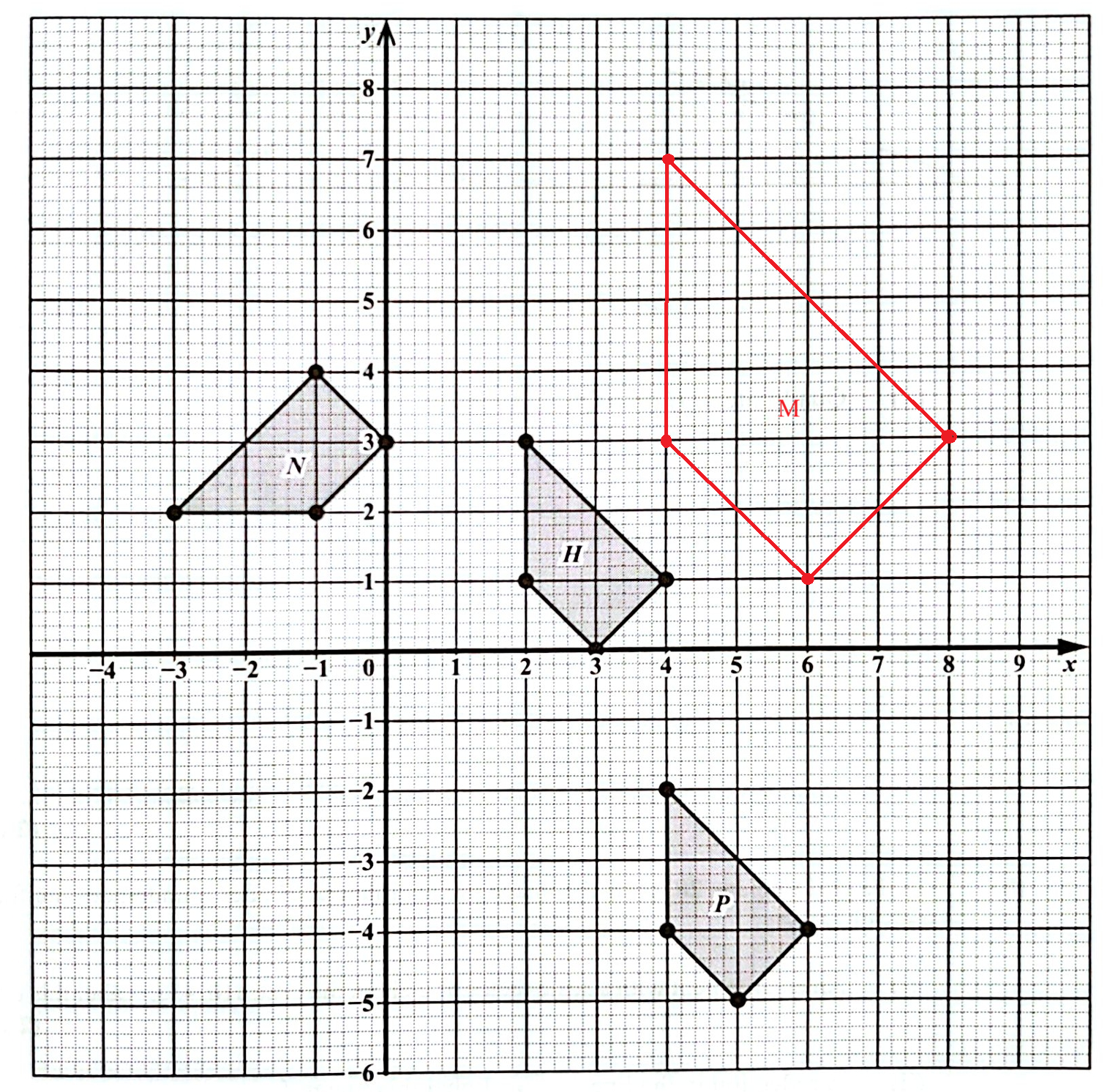
(ii.) For any point, (x, y):
Reflection across the line: $y = -x$ gives $(-y, -x)$
$ \underline{\text{Reflection in the line } y = -x} \\[3ex] A(2, 3) \rightarrow A'(-3, -2) \\[3ex] B(4, 1) \rightarrow B'(-1, -4) \\[3ex] C(3, 0) \rightarrow C'(0, -3) \\[3ex] D(2, 1) \rightarrow D'(-1, -2) \\[3ex] $ The diagram with the image of Quadrilateral H after a reflection in the line $y = -x$ is:
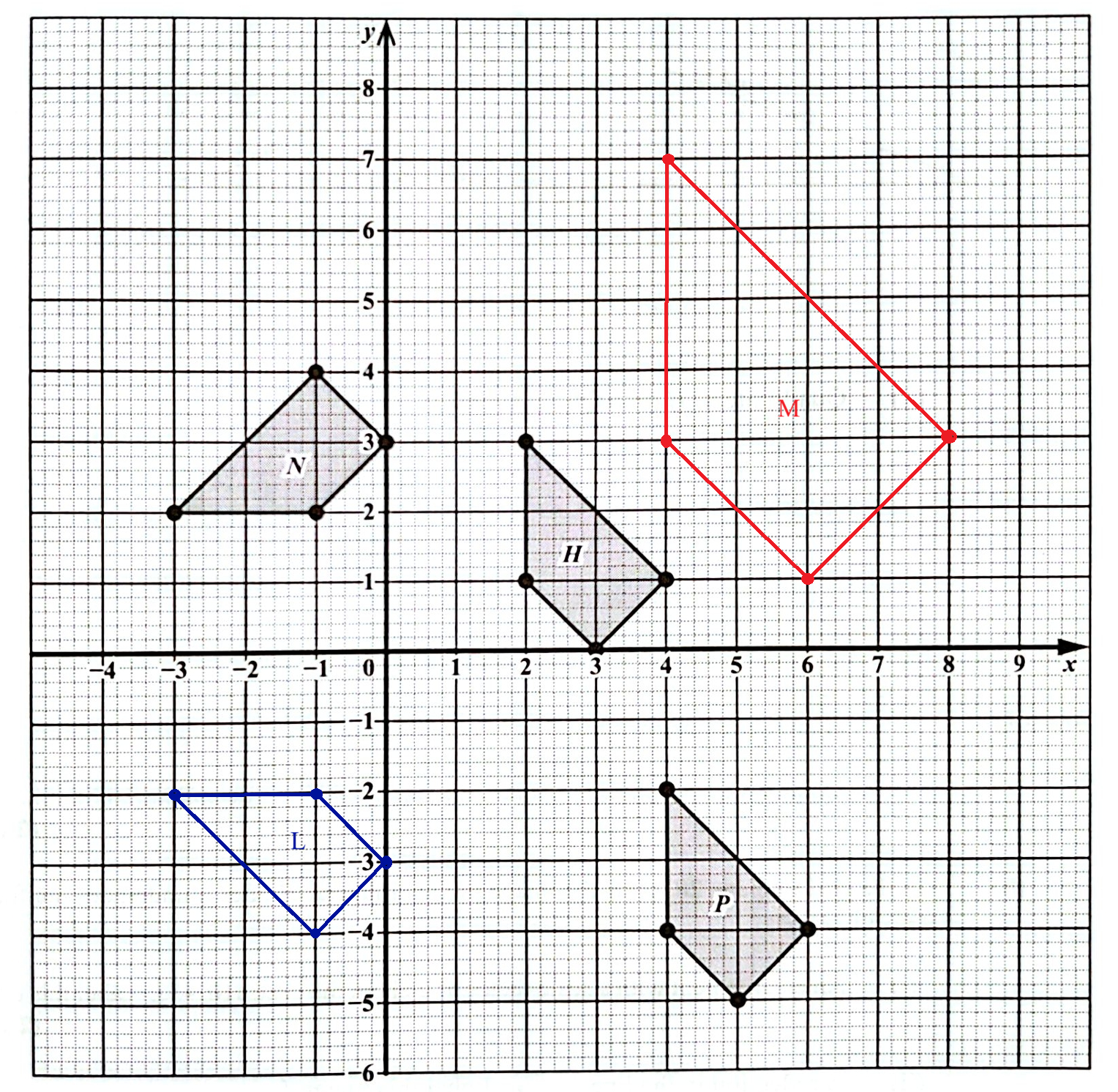
(c.) Let us represent the information diagrammatically as shown:
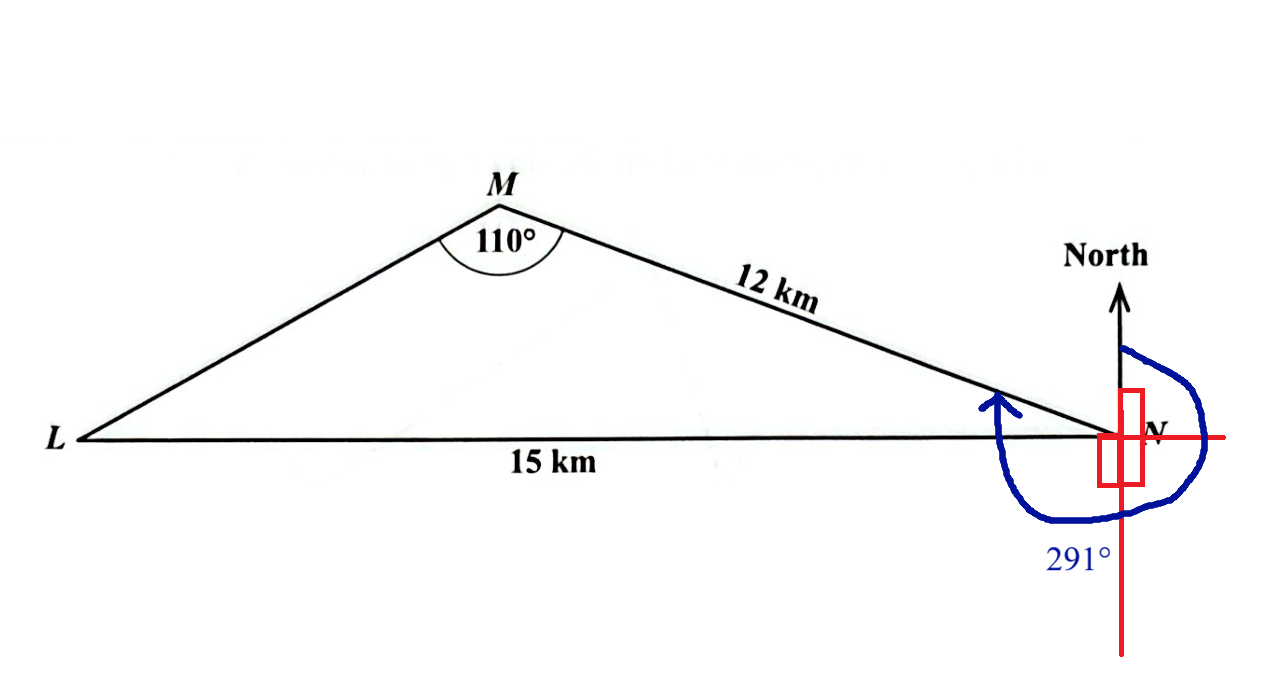
$ (i.) \\[3ex] 90 + 90 + 90 + \angle MNL = 291^\circ \quad\text{Bearing of } M \text{ from } N \\[3ex] \angle MNL = 291 - 270 \\[3ex] = 21^\circ \\[5ex] (ii.) \\[3ex] \underline{\text{1st Approach: Sine Rule}} \\[3ex] \dfrac{|LM|}{\sin \angle MNL} = \dfrac{|LN|}{\sin \angle LMN} \quad\text{Sine Rule} \\[5ex] \dfrac{|LM|}{\sin 21^\circ} = \dfrac{15}{\sin 110^\circ} \\[5ex] |LM| = \dfrac{15\sin 21}{\sin 110} \\[5ex] = \dfrac{5.375519243}{0.9396926208} \\[5ex] = 5.720508094 \\[3ex] \approx 5.72\;km \quad\text{to 3 significant figures} \\[5ex] \underline{\text{2nd Approach: Cosine Rule}} \\[3ex] |LM|^2 = |MN|^2 + |LN|^2 - 2 \cdot |MN| \cdot |LN| \cdot \cos \angle MNL \quad\text{Cosine Rule} \\[3ex] |LM|^2 = 12^2 + 15^2 - 2(12)(15) \cos 21^\circ \\[3ex] = 144 + 225 - 360(0.9335804265) \\[3ex] = 369 - 336.0889535 \\[3ex] = 32.9110465 \\[3ex] |LM| = \sqrt{32.9110465} \\[3ex] = 5.736815014 \\[3ex] \approx 5.74\;km \quad\text{to 3 significant figures} \\[3ex] $ Student: SamDom For Peace
Teacher: What's good?
Student: I thought that is we use the Sine Rule and the Cosine Rule, we should get the same final answer before it is rounded.
Is my assumption right or wrong? Teacher: Yes, we should get the same final answer. Your assumption is right.
Student: Could you explain the discrepancy in this situation?
Teacher: What do you think?
Student: I think there must have been some rounded values in the diagram.
Teacher: That is a possibility.
Student: In this case, is it better to use the Cosine Rule or the Sine Rule?
Teacher: Cosine Rule is used when ...
Student: we are given two sides and an included angle: SAS
Teacher: Sine Rule is used when ...
Student: Two angles and a side (ASA or AAS)
Teacher: We are given these values, so either rule is fine and should give the same result.
Student: So, is it fair to say that the triangle in that question is not physically possible?
Teacher: Yes, if those values are the exact values.
The point T is positioned on the line PQ such that $PT : TQ = 3 : 2$
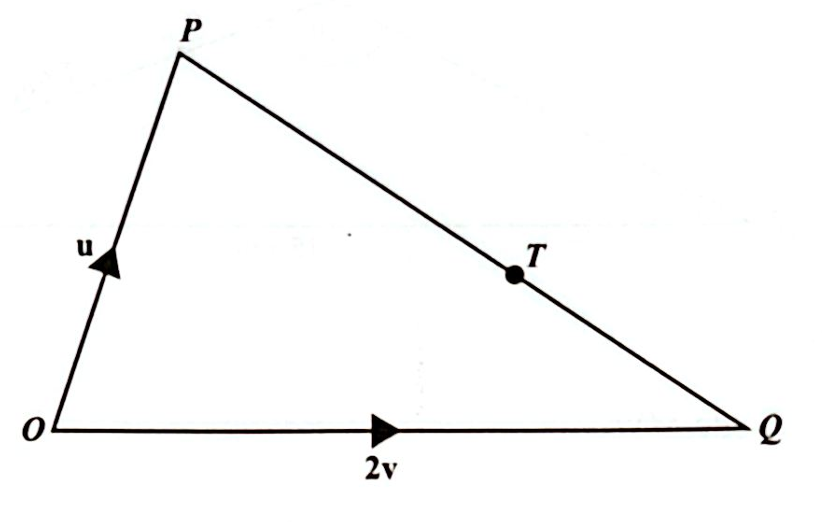
Derive a simplified expression, in terms of $\mathbf{u}$ and $\mathbf{v}$, for
(i.) $\overrightarrow{PQ}$
(ii.) $\overrightarrow{OT}$
Matrix Algebra: (b.) (i.) Write down the 2 × 2 matrices that represent the following transformations.
(a.) An enlargement with centre (0, 0) and a scale factor of 8.
(b.) A reflection in the x-axis
(c.) An enlargement with centre (0, 0) and a scale factor of 8, followed by a reflection in the x-axis.
(ii.) The matrices R and Q, expressed in terms of the constants k and c, are as follows.
$R = \begin{bmatrix} 6 & 1 \\ 4 & 2 \end{bmatrix}$ and $Q = \begin{bmatrix} k & 1 \\ c & -6 \end{bmatrix}$
(a.) Calculate, in terms of k and c, the matrix product RQ.
(b.) The matrix RQ represents the transformation of an enlargement with centre (0, 0) and a scale factor of 8, followed by a reflection in the x-axis.
Determine the values of k and c.
$ (a.) \\[3ex] \underline{\text{Given:}} \\[3ex] \overrightarrow{OP} = u \\[3ex] \overrightarrow{OQ} = 2v \\[3ex] PT : TQ = 3 : 2 \\[3ex] \dfrac{\overrightarrow{PT}}{\overrightarrow{TQ}} = \dfrac{3}{2} \\[5ex] \overrightarrow{PT} = \dfrac{3}{2}\overrightarrow{TQ} \quad eqn.(1) \\[5ex] (i.) \\[3ex] \overrightarrow{OP} + \overrightarrow{PQ} = \overrightarrow{OQ} \\[3ex] \text{Substitute accordingly} \\[3ex] u + \overrightarrow{PQ} = 2v \\[3ex] \overrightarrow{PQ} = 2v - u \\[5ex] (ii.) \\[3ex] \overrightarrow{OT} + \overrightarrow{TQ} = \overrightarrow{OQ} \\[3ex] \overrightarrow{TQ} = \overrightarrow{OQ} - \overrightarrow{OT} \\[3ex] \overrightarrow{TQ} = 2v - \overrightarrow{OT} \quad eqn.(2) \\[3ex] \underline{\text{Also:}} \\[3ex] \overrightarrow{OT} = \overrightarrow{OP} + \overrightarrow{PT} \\[3ex] \text{Substitute accordingly} \\[3ex] \overrightarrow{OT} = u + \dfrac{3}{2}\overrightarrow{TQ} \\[5ex] \text{Substitute accordingly} \\[3ex] \overrightarrow{OT} = u + \dfrac{3}{2}(2v - \overrightarrow{OT}) \\[5ex] \overrightarrow{OT} = u + 3v - \dfrac{3}{2}\overrightarrow{OT} \\[5ex] \overrightarrow{OT} + \dfrac{3}{2}\overrightarrow{OT} = u + 3v \\[5ex] \dfrac{2\overrightarrow{OT} + 3\overrightarrow{OT}}{2} = u + 3v \\[5ex] 5\overrightarrow{OT} = 2(u + 3v) \\[3ex] \overrightarrow{OT} = \dfrac{2(u + 3v)}{5} \\[5ex] $ (b.) (i.) The 2 × 2 matrices that represent the following transformations are:
$ x = (1, 0) \\[3ex] y = (0, 1) \\[3ex] \begin{bmatrix} x \\ y \end{bmatrix} = \begin{bmatrix} 1 & 0 \\ 0 & 1 \end{bmatrix} \\[5ex] (a.) \text{ An enlargement with centre (0, 0) and a scale factor of 8} \\[3ex] \text{centre} = (0, 0) \\[3ex] \text{scale factor} = 8 \\[5ex] x' = 0 + 8(1 - 0) \\[3ex] = 0 + 8(1) \\[3ex] = 8 \\[5ex] y' = 0 + 8(1 - 0) \\[3ex] = 0 + 8(1) \\[3ex] = 8 \\[5ex] 2 \times 2 \text{ matrix} = \begin{bmatrix} 8 & 0 \\ 0 & 8 \end{bmatrix} \\[5ex] (b.) \text{ A reflection in the }x -\text{axis} \\[3ex] (x, y) \rightarrow (x, -y) \\[5ex] (1, 0) \rightarrow (1, -0) \\[3ex] \hspace{2.5em} \rightarrow (1, 0) \\[5ex] (0, 1) \rightarrow (0, -1) \\[5ex] 2 \times 2 \text{ matrix} = \begin{bmatrix} 1 & 0 \\ 0 & -1 \end{bmatrix} \\[5ex] (c.) \text{ (a.) followed by (b.)} \\[3ex] (8, 0) \rightarrow (8, -0) \\[3ex] \hspace{2.5em} \rightarrow (8, 0) \\[5ex] (0, 8) \rightarrow (0, -8) \\[5ex] 2 \times 2 \text{ matrix} = \begin{bmatrix} 8 & 0 \\ 0 & -8 \end{bmatrix} \\[3ex] $ Alternatively, we can use matrix multiplication.
If transformation $A$ is followed by transformation $B$, the combined matrix is $B \times A$
$ \begin{bmatrix} 1 & 0 \\ 0 & -1 \end{bmatrix} \times \begin{bmatrix} 8 & 0 \\ 0 & 8 \end{bmatrix} \\[5ex] = \begin{bmatrix} 1(8) + 0(0) & 1(0) + 0(8) \\ 0(8) + -1(0) & 0(0) + -1(8) \end{bmatrix} \\[5ex] = \begin{bmatrix} 8 + 0 & 0 + 0 \\ 0 + 0 & 0 - 8 \end{bmatrix} \\[5ex] = \begin{bmatrix} 8 & 0 \\ 0 & -8 \end{bmatrix} \\[5ex] (ii) \\[3ex] R = \begin{bmatrix} 6 & 1 \\ 4 & 2 \end{bmatrix} \text{ and } Q = \begin{bmatrix} k & 1 \\ c & -6 \end{bmatrix} \\[5ex] (a.) \\[3ex] RQ = \begin{bmatrix} 6k + c & 6(1) + 1(-6) \\ 4k + 2c & 4(1) + 2(-6) \end{bmatrix} \\[5ex] = \begin{bmatrix} 6k + c & 6 - 6 \\ 4k + 2c & 4 - 12 \end{bmatrix} \\[5ex] = \begin{bmatrix} 6k + c & 0 \\ 4k + 2c & -8 \end{bmatrix} \\[7ex] (b.) \\[3ex] \begin{bmatrix} 6k + c & 0 \\ 4k + 2c & -8 \end{bmatrix} = \begin{bmatrix} 8 & 0 \\ 0 & -8 \end{bmatrix} \\[5ex] 6k + c = 8 \quad eqn.(1) \\[3ex] 4k + 2c = 0 \quad eqn.(2) \\[3ex] \underline{\text{Cramer's Rule}} \\[3ex] \begin{bmatrix} 6 & 1 \\ 4 & 2 \end{bmatrix} \begin{bmatrix} k \\ c \end{bmatrix} = \begin{bmatrix} 8 \\ 0 \end{bmatrix} \\[5ex] .............................................. \\[3ex] \underline{\text{Denominator}} \\[3ex] \begin{vmatrix} 6 & 1 \\ 4 & 2 \end{vmatrix} \\[5ex] = 6(2) - 4(1) \\[3ex] = 12 - 4 \\[3ex] = 8 \\[5ex] \underline{\text{Numerator for } k} \\[3ex] \begin{vmatrix} 8 & 1 \\ 0 & 2 \end{vmatrix} \\[5ex] = 8(2) - 0(1) \\[3ex] = 16 - 0 \\[3ex] = 16 \\[5ex] \underline{\text{Numerator for } c} \\[3ex] \begin{vmatrix} 6 & 8 \\ 4 & 0 \end{vmatrix} \\[5ex] = 6(0) - 4(8) \\[3ex] = 0 - 32 \\[3ex] = -32 \\[3ex] .............................................. \\[3ex] k = \dfrac{16}{8} = 2 \\[5ex] c = -\dfrac{32}{8} = -4 \\[3ex] $ Check (if you have the time)
| LHS | RHS |
|---|---|
| $ 6k + c \\[3ex] 6(2) + -4 \\[3ex] 12 - 4 \\[3ex] 8 $ | $8$ |
| $ 4k + 2c \\[3ex] 4(2) + 2(-4) \\[3ex] 8 - 8 \\[3ex] 0 $ | $0$ |


(b.) Expand and simplify the following expression $$ (4r - 5q)(3r + q) + 3qr $$ (c.) (i.) Solve the inequality $-4p + 3 \ge 19 + 2p$
(ii.) Determine the LARGEST integer value of p that satisfies the inequality in (c.)(i.)
(d.) The diagram below shows a right-angled triangle with its dimensions given in terms of x.
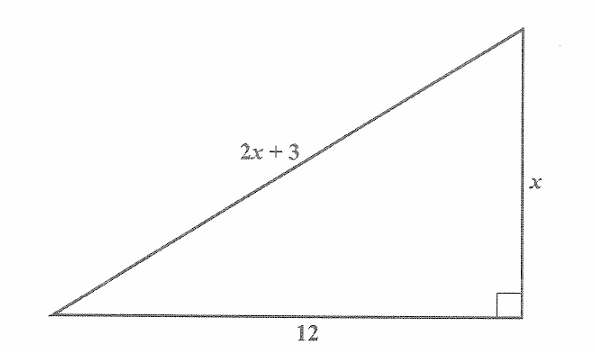
For the right-angled triangle, show that $x^2 + 4x - 45 = 0$
$ (a.) \\[3ex] 1 - t^2 \\[3ex] = 1^2 - t^2 \\[3ex] = (1 + t)(1 - t) \quad\text{Difference of Two Squares} \\[5ex] (b.) \\[3ex] (4r - 5q)(3r + q) + 3qr \\[3ex] = 12r^2 + 4qr - 15qr - 5q^2 + 3qr \\[3ex] = 12r^2 - 8qr - 5q^2 \\[5ex] (c.) (i.) \\[3ex] -4p + 3 \ge 19 + 2p \\[3ex] -4p - 2p \ge 19 - 3 \\[3ex] -6p \ge 16 \\[3ex] p \le \dfrac{16}{-6} \\[5ex] p \le -\dfrac{8}{3} \\[5ex] $ Check
| LHS | RHS |
|---|---|
| $ -4p + 3 \\[3ex] -4(-5) + 3 \\[3ex] 20 + 3 \\[3ex] 23 $ | $ 19 + 2p \\[3ex] 19 + 2(-5) \\[3ex] 19 - 10 \\[3ex] 9 $ |
| $23 \ge 9$ | |
$ (ii.) \\[3ex] p \le -\dfrac{8}{3} \\[5ex] p \le -2.666666667 \\[3ex] \text{Largest integer value of } p = -3 \\[5ex] (d.) \\[3ex] hyp = 2x + 3 \\[3ex] leg = x \\[3ex] leg = 12 \\[3ex] hyp^2 = leg^2 + leg^2 \quad\text{Pythagorean Theorem} \\[3ex] (2x + 3)^2 = x^2 + 12^2 \\[3ex] (2x + 3)(2x + 3) = x^2 + 144 \\[3ex] 4x^2 + 6x + 6x + 9 - x^2 - 144 = 0 \\[3ex] 3x^2 + 12x - 135 = 0 \\[3ex] \text{Simplify: Divide both sides by 3} \\[3ex] x^2 + 4x - 45 = 0 $
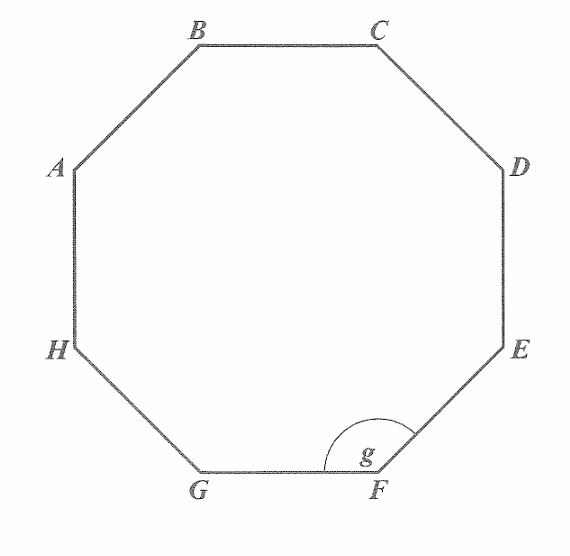
(i.) Complete the statement below in relation to the diagram shown above.
The regular octagon has .......... lines of symmetry and rotational symmetry of order .......... .
(ii.) Calculate the value of Angle g.
(b.) The diagram below shows two similar, right-angled triangles drawn from a common vertex, V.
The lines ZY and WX are parallel.
Also, the lines VY = 5 cm, ZY = 7 cm and WX = 28 cm.
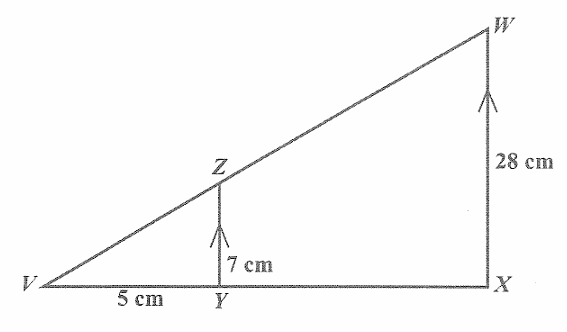
(i.) Calculate the length of YX.
(ii.) Determine the magnitude of Angle VWX.
(a.) (i.)
A line of symmetry (also called reflectional or mirror symmetry) is an imaginary line that divides a shape into two identical halves.
For any regular polygon, the number of lines of symmetry is always equal to the number of sides, n
For a regular octagon, $n = 8$, therefore, there are 8 lines of symmetry.
They are:
4 lines of symmetry that run directly through opposite vertices (corners) and
4 lines of symmetry that run directly through the midpoints of opposite sides
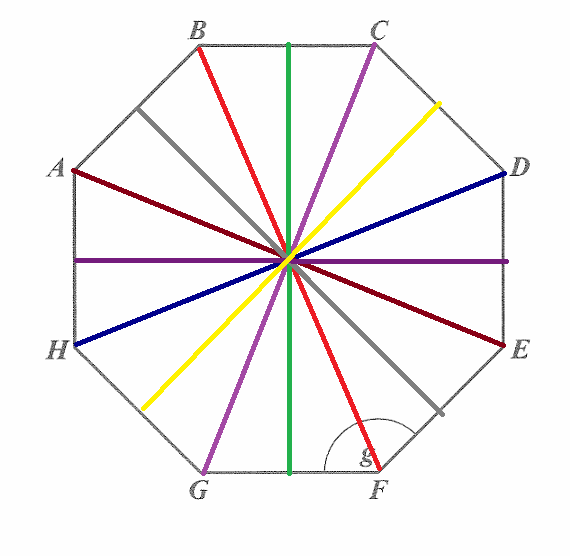
The order of rotational symmetry is the number of times a shape looks exactly the same as its original position during a full 360° rotation around its center point.
For any regular polygon, the order of rotational symmetry is always equal to the number of sides n
For a regular octagon, $n = 8$, therefore, the rotational symmetry is of order, 8.
The regular octagon has 8 lines of symmetry and rotational symmetry of order 8.
(ii.)
For a regular polygon of sides, n, the measure of an interior angle = $\dfrac{180(n - 2)}{n}$
$ \underline{\text{Regular Octagon }}: n = 8 \\[3ex] \angle g = \dfrac{180(8 - 2)}{8} \\[5ex] = \dfrac{45(6)}{2} \\[5ex] = 135^\circ \\[3ex] $ (b.) The diagram below shows two similar, right-angled triangles drawn from a common vertex, V.
Let us show the two similar right-angled triangles.
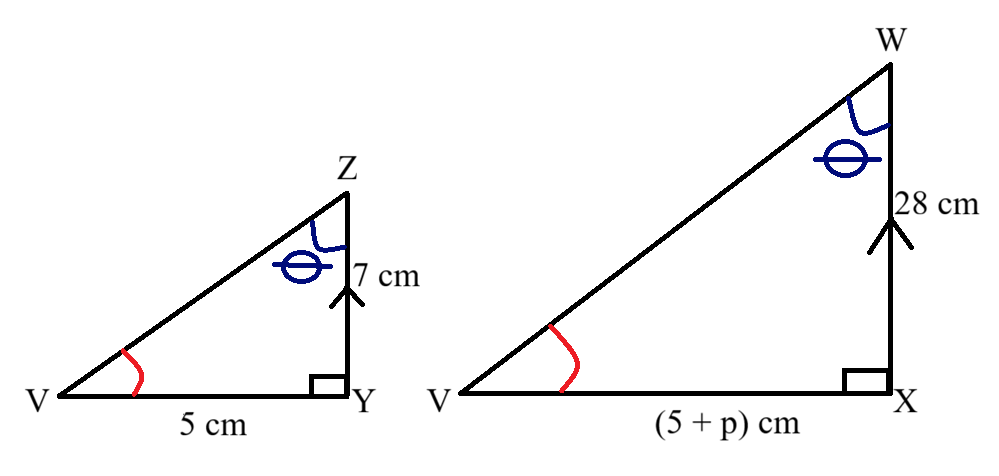
$ (i.) \\[3ex] \text{Let } |YX| = p \\[3ex] \triangle ZVY \sim \triangle WVX \\[3ex] \dfrac{5 + p}{28} = \dfrac{5}{7} \\[5ex] 5 + p = \dfrac{28(5)}{7} \\[5ex] 5 + p = 20 \\[3ex] p = 20 - 5 \\[3ex] p = 15 \\[3ex] |YX| = 15\;cm \\[5ex] (ii.) \\[3ex] \angle VWX = \angle VZY = \theta \quad\text{Corresponding angles are congruent} \\[3ex] \underline{\triangle VZY} \\[3ex] \tan\theta = \dfrac{opp}{adj} \quad\text{SOHCAHTOA} \\[5ex] \tan\theta = \dfrac{5}{7} \\[5ex] \theta = \tan^{-1}\left(\dfrac{5}{7}\right) \\[5ex] \theta = 35.53767779 \\[3ex] \theta \approx 35.5^\circ \quad\text{(to 1 decimal place)} $
(a.) Show that the value of c is 10.
(b.) Determine the gradient of L.
(c.) The line with equation $3x + 4y = 8$ intersects the line L at the point T. Determine the coordinates of the point T.
(d.) The diagram below shows the graph of L and two other lines, $x = -1$ and $y = 5$.
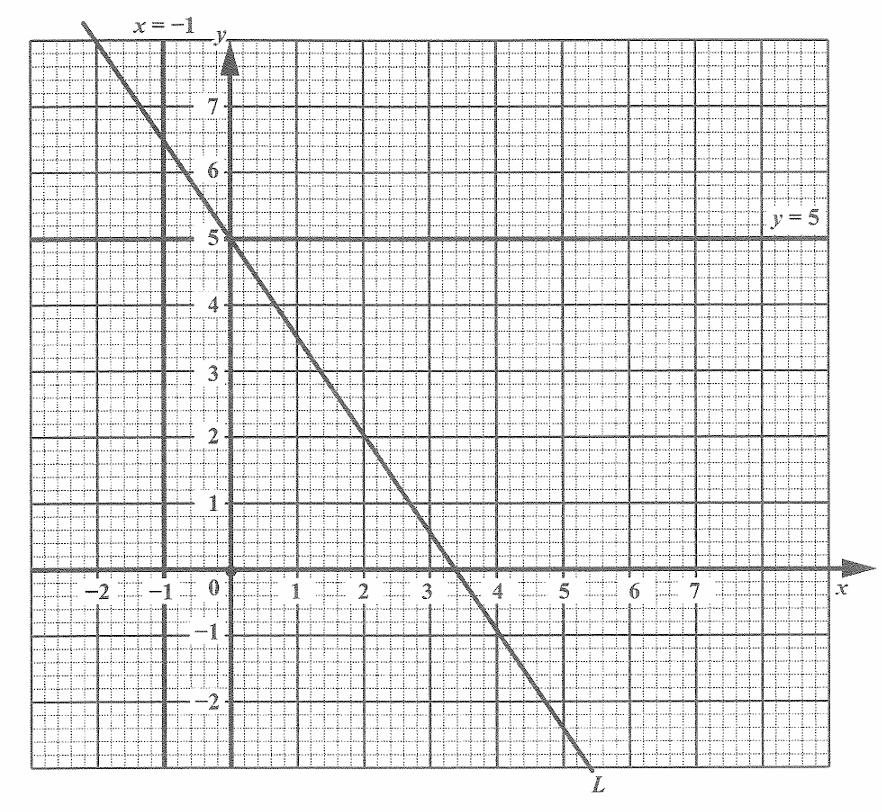
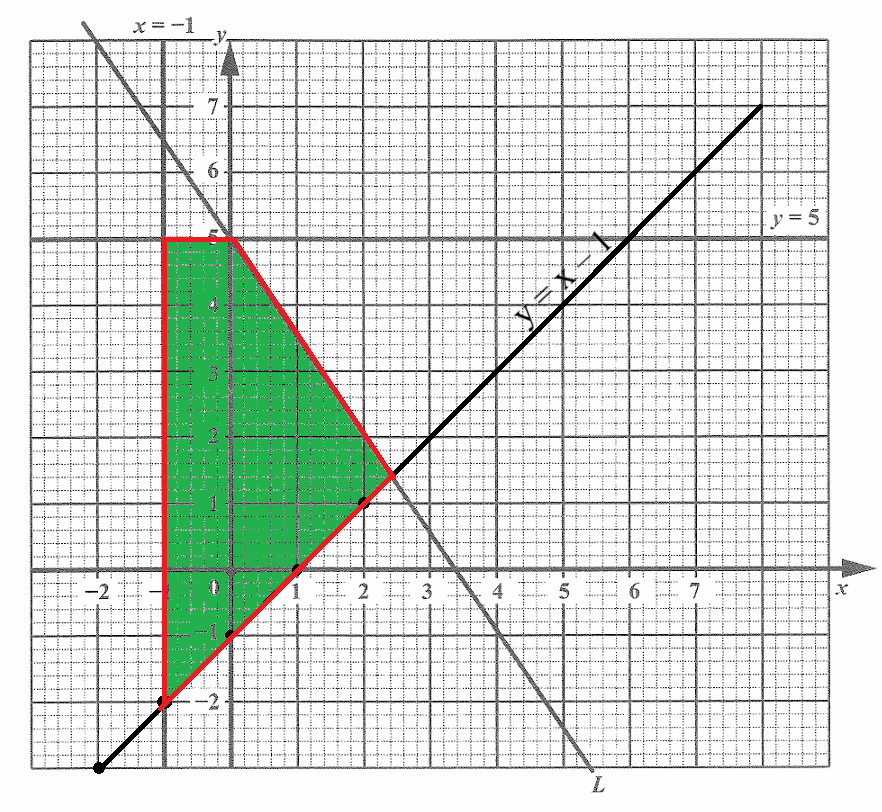
On the graph above, draw the line $y = x - 1$ and shade the region that satisfies the inequalities listed below.
$ x \ge -1 \\[3ex] y \le 5 \\[3ex] y \ge x - 1 \\[3ex] 3x + 2y \le 10 \\[3ex] $
$ (a.) \\[3ex] 3x + 2y = c \\[3ex] \text{Passes through } (-2, 8) \implies \\[3ex] x = -2 \\[3ex] y = 8 \\[3ex] \implies \\[3ex] 3(-2) + 2(8) = c \\[3ex] -6 + 16 = c \\[3ex] c = 10 \\[3ex] \text{Line L: } 3x + 2y = 10 \\[5ex] (b.) \\[3ex] 3x + 2y = 10 \\[3ex] 2y = -3x + 10 \\[3ex] y = -\dfrac{3}{2}x + \dfrac{10}{2} \\[5ex] y = -\dfrac{3}{2}x + 5 \quad\text{Slope – Intercept Form} \\[5ex] \text{Gradient = Slope} = -\dfrac{3}{2} \\[5ex] (c.) \\[3ex] 3x + 4y = 8 \text{ intersects } 3x + 2y = 10 \\[3ex] 3x + 4y - 8 = 0 \text{ intersects } 3x + 2y - 10 = 0 \\[3ex] 0 = 0 \implies \\[3ex] 3x + 4y - 8 = 3x + 2y - 10 \\[3ex] 3x - 3x + 4y - 2y = -10 + 8 \\[3ex] 2y = -2 \\[3ex] y = -\dfrac{2}{2} \\[5ex] y = -1 \\[3ex] \text{Substitute for } y \text{ using any of the lines say line } L \\[3ex] 3x + 2(-1) = 10 \\[3ex] 3x - 2 = 10 \\[3ex] 3x = 10 + 2 \\[3ex] 3x = 12 \\[3ex] x = \dfrac{12}{3} \\[5ex] x = 4 \\[5ex] \text{Point T} = (x, y) \\[3ex] = (4, -1) \\[3ex] $
| x | y |
|---|---|
| −2 | −3 |
| −1 | −2 |
| 0 | −1 |
| 1 | 0 |
| 2 | 1 |
The shaded region that satisfies the inequalities is shown:
Their choices are represented on the pie chart shown below.
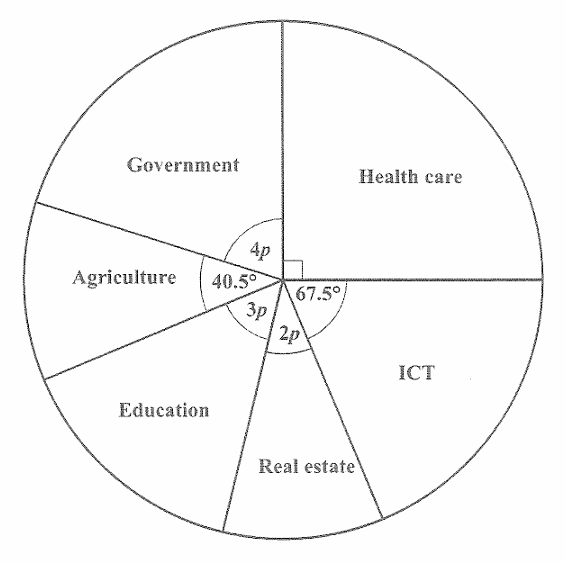
Calculate the:
(i.) percentage of students who are likely to seek employment within the agriculture and ICT sectors.
(ii.) value of p.
(b.) Liz has a set of red, yellow, and white buttons in a sack.
She chooses a button at random.
The probability that she chooses a yellow button is 0.3.
The probability that she chooses a white button is 0.1.
(i.) Determine the probability that Liz chooses a red button.
(ii.) If there were 80 buttons in the sack originally, determine the number of buttons that were red or yellow.
$ (a.) (i.) \\[3ex] \underline{\text{Agriculture and ICT}} \\[3ex] \text{Sum of sectorial } \angle s = 40.5^\circ + 67.5^\circ = 108^\circ \\[3ex] \text{Percentage of students} = \dfrac{108^\circ}{360^\circ} * 100\% = 30\% \\[5ex] (ii.) \\[3ex] 40.5 + 4p + 90 + 67.5 + 2p + 3p = 360^\circ \quad\text{sum of angles in a circle} \\[3ex] 9p = 360 - 108 \\[3ex] 9p = 252 \\[3ex] p = \dfrac{252}{9} \\[5ex] p = 28^\circ \\[5ex] (b.) \\[3ex] \text{Let:} \\[3ex] \text{red} = R \\[3ex] \text{yellow} = Y \\[3ex] \text{white} = W \\[3ex] P(Y) = 0.3 \\[3ex] P(W) = 0.1 \\[3ex] P(R) = ? \\[5ex] (i.) \\[3ex] P(R) + P(Y) + P(W) = 1 \quad\text{sum of individual probabilities} \\[3ex] P(R) + 0.3 + 0.1 = 1 \\[3ex] P(R) = 1 - 0.4 \\[3ex] P(R) = 0.6 \\[5ex] (ii.) \\[3ex] P(R \text{ or } Y) = P(R) + P(Y) \quad\text{Addition Rule for Mutually Exclusive events} \\[3ex] = 0.6 + 0.3 \\[3ex] = 0.9 \\[5ex] n(\text{Sample Space}) = 80 \\[3ex] \text{Also:} \\[3ex] P(R \text{ or } Y) = \dfrac{n(R) + n(Y)}{n(\text{Sample Space})} \quad\text{Definition} \\[5ex] 0.9 = \dfrac{n(R) + n(Y)}{80} \\[5ex] n(R) + n(Y) = 0.9(80) \\[3ex] = 72\text{ buttons.} $
On the map, 1 cm represents n km.
Determine the:
(i.) value of n
(ii.) distance on the map, in cm, which corresponds to an actual distance of 4.8 km.
(iii.) actual area, in square kilometres, of a lake which has an area of 12 cm² on the map.
(b.) The diagram below shows a running belt, EFGHIJE, that revolves around a running board on a treadmill.
In the diagram, EJI and HGF are semicircles with a diameter of 0.7 m and EFHI is a rectangle.
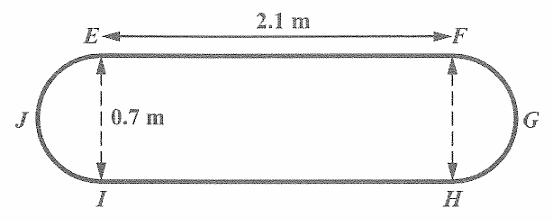
$ \left[\text{Use } \pi = \dfrac{22}{7}\right] \\[5ex] $ (i.) Calculate the length of the belt.
(ii.) Glenda uses the equipment to exercise 4 times a week and runs at 9 km/h for 20 minutes each time.
Calculate the number of complete revolutions the running belt makes in one week during Glenda's exercise routine.
[Assume that the running belt moves at the same speed as Glenda.]
$ (a.) \\[3ex] \underline{\text{Map Scale as Ratio}} \\[3ex] 1 : 20000 \\[3ex] 1\;cm = 20000\;cm \\[5ex] \underline{\text{Map Scale Representation}} \\[3ex] 1\;cm = n\;km \\[3ex] \implies \\[3ex] 20000\;cm = n\;km \\[5ex] (i.) \\[3ex] \underline{\text{Unity Fraction Method}} \\[3ex] \text{Set up units: } 20000\;cm * \dfrac{...\;m}{...\;cm} * \dfrac{...\;km}{...\;m} \\[5ex] \text{Set up measurements and units: } 20000\;cm * \dfrac{10^{-2}\;m}{1\;cm} * \dfrac{1\;km}{10^3\;m} \\[5ex] = 20000\;cm * \dfrac{0.01\;m}{1\;cm} * \dfrac{1\;km}{1000\;m} \\[5ex] = 0.2\;km \\[3ex] \implies \\[3ex] 20000\;cm = n\;km = 0.2\;km \\[3ex] n = 0.2 \\[5ex] (ii.) \\[3ex] 1\;cm \text{ on the map} = 0.2\;km \\[3ex] \text{Set up units: } 4.8\;km * \dfrac{...\;cm}{...\;km} \\[5ex] \text{Set up measurements and units: } 4.8\;km * \dfrac{1\;cm}{0.2\;km} \\[5ex] = 24\;cm \\[5ex] (iii.) \\[3ex] 1\;cm \text{ on the map} = 0.2\;km \\[3ex] \text{Set up units: } 12\;cm * cm * \dfrac{...\;km}{...\;cm} * \dfrac{...\;km}{...\;cm} \\[5ex] \text{Set up measurements and units: } 12\;cm * cm * \dfrac{0.2\;km}{1\;cm} * \dfrac{0.2\;km}{1\;cm} \\[5ex] = 0.48\;km^2 \\[3ex] $ Running belt, EFGHIJE = 2 semicircles: semicircles EJI and HGF with a diameter of 0.7 m and rectangle EFHI
$ (b.) \\[3ex] 2\text{ semicircles} = 1\text{ circle} \\[3ex] C = \text{circumference} \\[3ex] d = \text{diameter} = 0.7\;m \\[5ex] C = \pi d \\[3ex] C = \dfrac{22}{7} * 0.7 \\[5ex] C = 2.2\;m \\[5ex] \text{Rectangle } EFHI \\[3ex] L = \text{length} = |EF| = |IH| = 2.1\;m \\[5ex] (i.) \\[3ex] \underline{\text{Running Belt }} EFGHIJE \\[3ex] \text{Length of Belt} = C + 2L \quad\text{Diagram} \\[3ex] = 2.2 + 2(2.1) \\[3ex] = 6.4\;m \\[5ex] (ii.) \\[3ex] 1\text{ revolution} = \text{Length of Belt} = 6.4\;m \\[3ex] \text{Set up units: } \dfrac{9\;km}{...\;hr} * \dfrac{...\;hr}{...\;min} * 20\;min * \dfrac{...\;m}{...\;km} * \dfrac{...\;rev}{...\;m} \\[5ex] \text{Set up measurements and units: } \dfrac{9\;km}{1\;hr} * \dfrac{1\;hr}{60\;min} * 20\;min * \dfrac{10^3\;m}{1\;km} * \dfrac{1\;rev}{6.4\;m} \\[5ex] = 468.75\;rev \\[3ex] 1\text{ time a week} = 468.75\text{ revolutions} \\[3ex] 4\text{ times a week} = 4(468.75) = 1875\text{ revoluions}. $
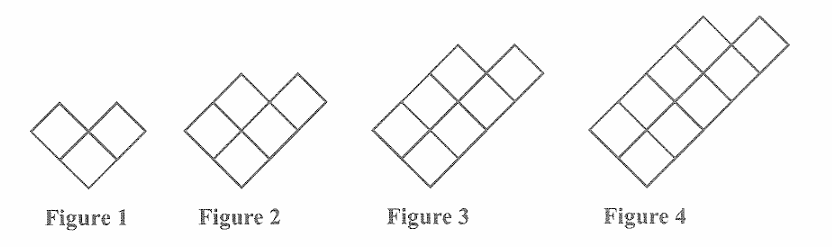
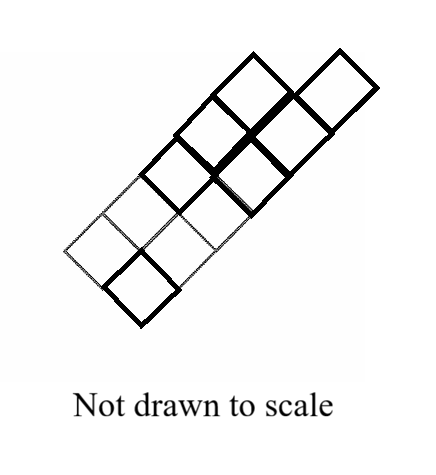
(a.) Complete the diagram below to show Figure 5.
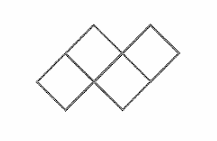
(b.) The number of squares, Q, the number of sticks, S, and the perimeter of each figure, P, follow a pattern.
The values for Q, S and P for the first 4 figures are shown in the table below.
Study the pattern of numbers in each row of the table and answer the questions that follow.
| Figure Number (D) | Number of Squares (Q) | Number of Sticks (S) | Perimeter (P) |
|---|---|---|---|
| 1 | 3 | 10 | 8 |
| 2 | 5 | 15 | 10 |
| 3 | 7 | 20 | 12 |
| 4 | 9 | 25 | 14 |
| 5 | $\rule{5em}{0.4pt}$ | $\rule{5em}{0.5pt}$ | 16 |
| $\vdots$ | $\vdots$ | $\vdots$ | $\vdots$ |
| $\rule{5em}{0.5pt}$ | 47 | 120 | $\rule{5em}{0.5pt}$ |
| $\vdots$ | $\vdots$ | $\vdots$ | $\vdots$ |
| n | $\rule{5em}{0.5pt}$ | $\rule{5em}{0.5pt}$ | $\rule{5em}{0.5pt}$ |
(c.) Mala says that she can make one of the figures with EXACTLY 502 squares.
Explain why she is incorrect.
(a.)
A study of the fugures show that:
Figure 1: 1 square on top, 2 squares on bottom
Figure 2: 2 squares on top, 3 squares on bottom
Figure 3: 3 squares on top, 4 squares on bottom
Figure 4: 4 squares on top, 5 squares on bottom
So, Figure 5 will be:
Figure 2: 5 squares on top, 6 squares on bottom
$ (b.) \\[3ex] D, Q, S, P \text{ are arithmetic sequences.} \\[3ex] \underline{\text{Arithmetic Sequence}} \\[3ex] \text{first term} = a \\[3ex] \text{common difference} = d \\[3ex] \text{number of terms} = n \\[3ex] \text{nth term} = AS_n \\[3ex] AS_n = a + d(n - 1) \\[5ex] \underline{\text{Figure Number, }D} \\[3ex] 1, 2, 3, 4, 5, ... \\[3ex] a = 1 \\[3ex] d = 2 - 1 = 1 \\[3ex] AS_n = 1 + 1(n - 1) \\[3ex] = 1 + n - 1 \\[3ex] = n \\[3ex] \implies \\[3ex] D = n \\[5ex] \underline{\text{Number of Squares, }Q} \\[3ex] 3, 5, 7, 9, ... \\[3ex] a = 3 \\[3ex] d = 9 - 7 = 2 \\[3ex] AS_n = 3 + 2(n - 1) \\[3ex] = 3 + 2n - 2 \\[3ex] = 2n + 1 \\[3ex] \implies \\[3ex] Q = 2n + 1 \\[5ex] \underline{\text{Number of Sticks, }S} \\[3ex] 10, 15, 20, 25, ... \\[3ex] a = 10 \\[3ex] d = 20 - 15 = 5 \\[3ex] AS_n = 10 + 5(n - 1) \\[3ex] = 10 + 5n - 5 \\[3ex] = 5n + 5 \\[3ex] \implies \\[3ex] S = 5n + 5 \\[5ex] \underline{\text{Perimeter, }P} \\[3ex] 8, 10, 12, 14, 16 ... \\[3ex] a = 8 \\[3ex] d = 16 - 14 = 2 \\[3ex] AS_n = 8 + 2(n - 1) \\[3ex] = 8 + 2n - 2 \\[3ex] = 2n + 6 \\[3ex] \implies \\[3ex] P = 2n + 6 \\[5ex] (i.) \\[3ex] D = n = 5 \\[5ex] Q = 2(5) + 1 \\[3ex] Q = 11 \\[5ex] S = 5(5) + 5 \\[3ex] S = 30 \\[5ex] (ii.) \\[3ex] Q = 2n + 1 = 47 \\[3ex] 2n = 47 - 1 \\[3ex] 2n = 46 \\[3ex] n = \dfrac{46}{2} \\[5ex] n = 23 \\[5ex] D = n = 23 \\[5ex] P = 2(23) + 6 \\[3ex] P = 52 \\[5ex] (iii.) \\[3ex] D = n \\[3ex] Q = 2n + 1 \\[3ex] S = 5n + 5 \\[3ex] P = 2n + 6 \\[5ex] (c.) \\[3ex] Q = 502? \\[3ex] 2n + 1 = 502 \\[3ex] 2n = 502 - 1 \\[3ex] 2n = 501 \\[3ex] n = \dfrac{501}{2} = 250.5 \\[5ex] $ The number of squares must be a positive integer.
250.5 is not an integer.
Hence, Mala is incorrect.
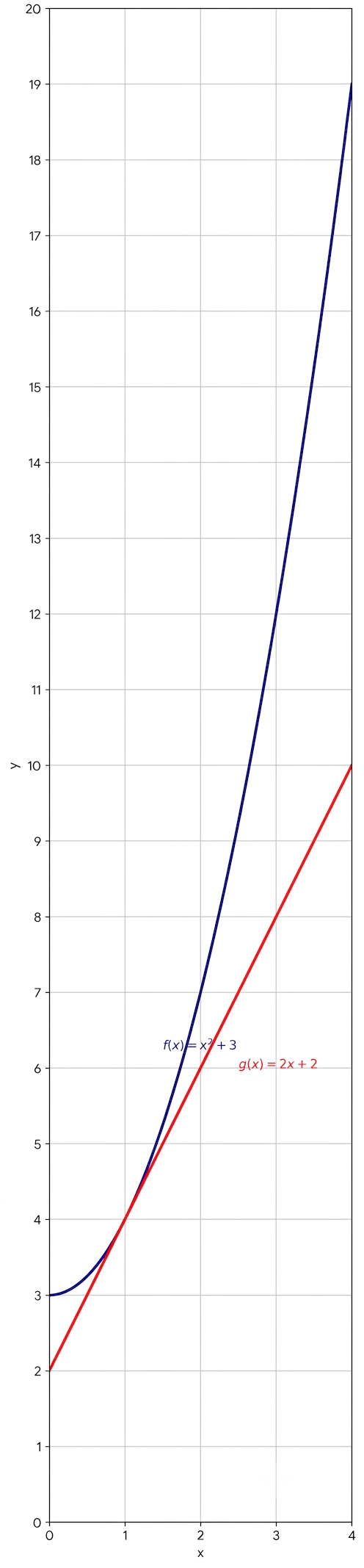
$ f : x \rightarrow x^2 + 3, \;\; x \ge 0 \\[3ex] g : x \rightarrow 2x + 2, \;\; x \in R \\[3ex] $ (i.) Calculate the value of $g(-1)$
(ii.) Write down an expression for $f^{-1}(x)$
(b.) (i.) Derive a simplified expression for $gf(x)$
(ii.) Given that $fg(x) = 4x^2 + 8x + 7$, solve the following equation.
$ fg(x) = 2gf(x) + 15 \\[3ex] $ (c.) On the grid provided in the answer booklet, plot the graph of the functions f and g, for $x \ge 0$
$ (a.) \\[3ex] f(x) = x^2 + 3 \hspace{3em} x \ge 0 \\[3ex] g(x) = 2x + 2 \\[5ex] (i.) \\[3ex] g(-1) = 2(-1) + 2 \\[3ex] g(-1) = 0 \\[5ex] (ii.) \\[3ex] y = x^2 + 3 \\[3ex] \text{Interchange } x \text{ and } y \\[3ex] x = y^2 + 3 \\[3ex] \text{Solve for } y \\[3ex] x - 3 = y^2 \\[3ex] y = \sqrt{x - 3} \\[3ex] \therefore f^{-1}(x) = \sqrt{x - 3} \\[5ex] (b.)(i.) \\[3ex] gf(x) \\[3ex] = g(x^2 + 3) \\[3ex] = 2(x^2 + 3) + 2 \\[3ex] = 2x^2 + 6 + 2 \\[3ex] = 2x^2 + 8 \\[5ex] (ii.) \\[3ex] fg(x) = 4x^2 + 8x + 7 \\[3ex] fg(x) = 2gf(x) + 15 \\[3ex] \implies \\[3ex] 4x^2 + 8x + 7 = 2(2x^2 + 8) + 15\\[3ex] 4x^2 + 8x + 7 = 4x^2 + 16 + 15 \\[3ex] 8x = 31 - 7 \\[3ex] 8x = 24 \\[3ex] x = \dfrac{24}{8} \\[5ex] x = 3 \\[3ex] $ (c.) The table of value of the functions f and g, for $x \ge 0$
| x | y |
|---|---|
| 0 | 3 |
| 1 | 4 |
| 2 | 7 |
| 3 | 12 |
| 4 | 19 |
| 5 | 28 |
| x | y |
|---|---|
| 0 | 2 |
| 1 | 4 |
| 2 | 6 |
| 3 | 8 |
| 4 | 10 |
| 5 | 12 |
I do not have the answer booklet.
Be it as it may, the graph of $f(x)$ and $g(x)$ where $x \ge 0$ is shown:
Scale: 1 cm to 1 unit on both axis.
Quadrilaterals M and N are the images of Quadrilateral O after it has undergone 2 different transformations.
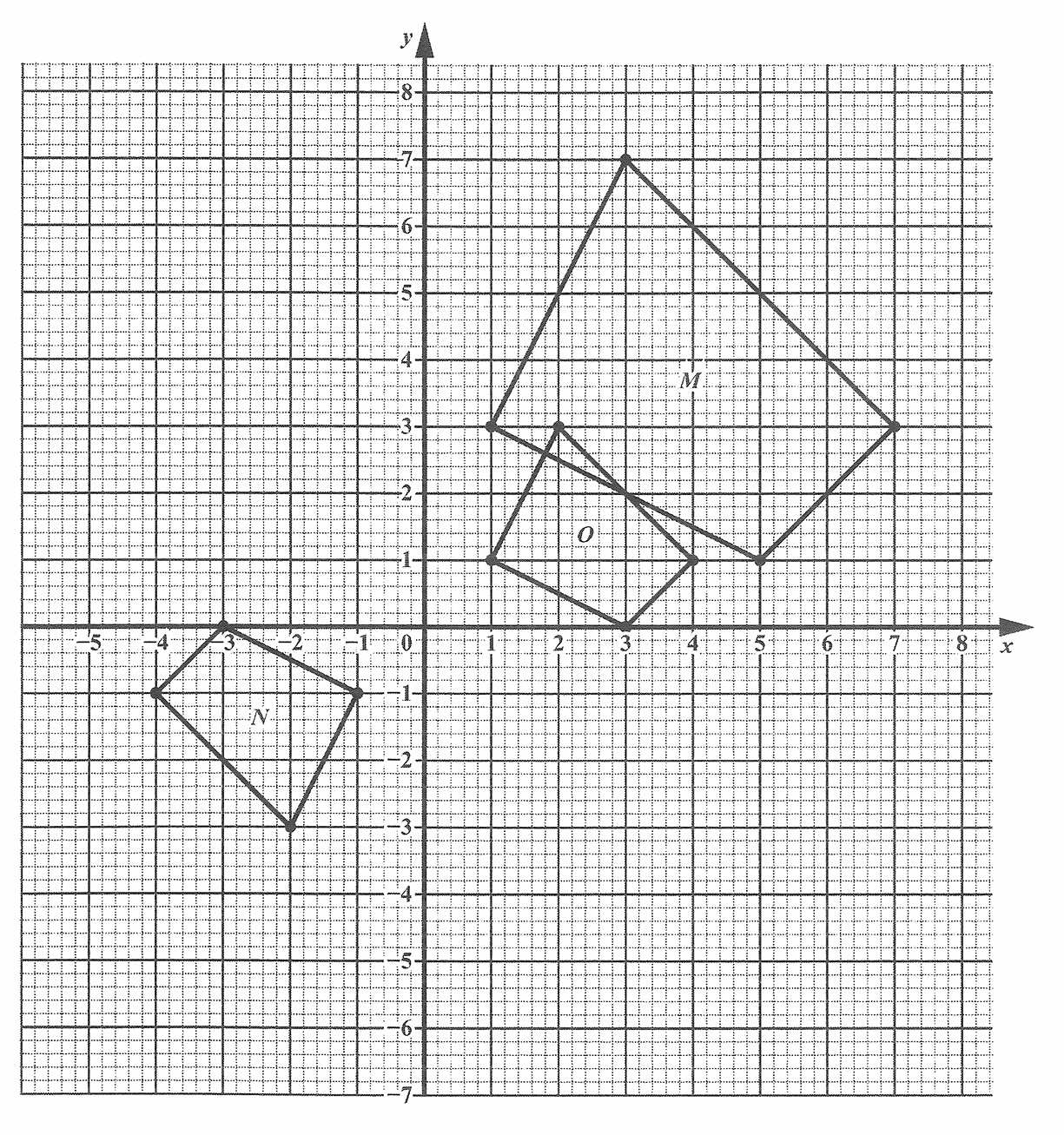
(i.) Describe fully the single transformation that maps Quadrilateral O onto Quadrilateral M.
(ii.) Describe fully the single transformation that maps Quadrilateral O onto Quadrilateral N.
(iii.) On the diagram on page 24, draw the image of Quadrilateral O after it undergoes the following transformations.
(a.) Translation by the vector $\begin{pmatrix} -5 \\ 2 \end{pmatrix}$. Label this image L.
(b.) Reflection in the line $y = -1$. Label this image P.
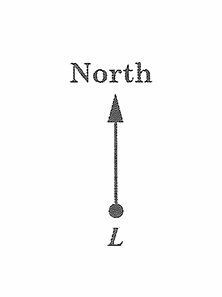
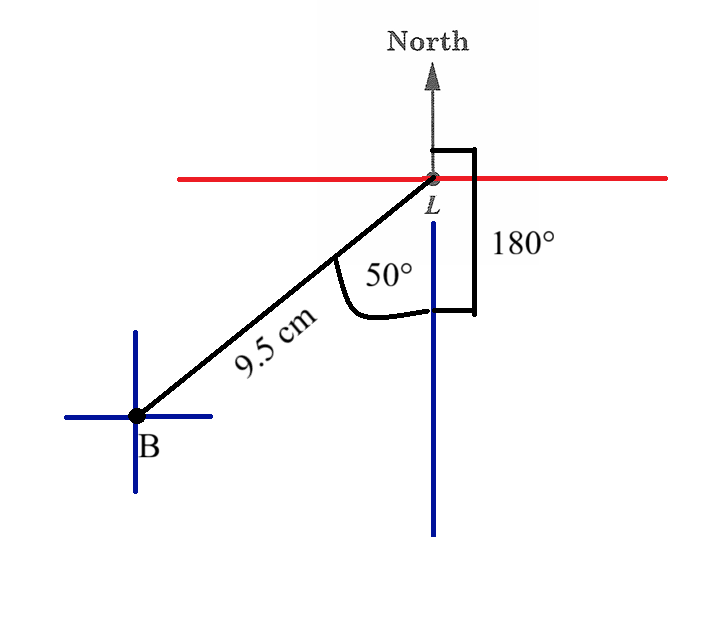
(b.) A buoy (B) and a lighthouse (L) are 95 km apart.
The bearing of B from L is 230°.
Using a scale of 1 cm : 10 km and the space provided below, complete the diagram to show the buoy (B) relative to the lighthouse (L).
Indicate the given bearing on your drawing.
Assume that Quadrilateral O has vertices A, B, C, D
(a.) A visual observation of the transformation of Quadrilateral O onto Quadrilateral M suggests an enlargement.
Let us verify this by examining the coordinate mapping.
$ \text{Quadrilateral } O \text{ onto Quadrilateral } M \\[3ex] A(1, 1) \rightarrow A'(1, 3) \\[3ex] B(2, 3) \rightarrow B'(3, 7) \\[3ex] C(4, 1) \rightarrow C'(7, 3) \\[3ex] D(3, 0) \rightarrow D'(5, 1) \\[5ex] (i.) \\[3ex] \overrightarrow{AB} = \vec{B} - \vec{A} \\[3ex] = \begin{pmatrix} 2 \\ 3 \end{pmatrix} - \begin{pmatrix} 1 \\ 1 \end{pmatrix} = \begin{pmatrix} 1 \\ 2 \end{pmatrix} \\[5ex] \overrightarrow{A'B'} = \vec{B'} - \vec{A'} \\[3ex] = \begin{pmatrix} 3 \\ 7 \end{pmatrix} - \begin{pmatrix} 1 \\ 3 \end{pmatrix} = \begin{pmatrix} 2 \\ 4 \end{pmatrix} \\[5ex] \overrightarrow{A'B'} = 2 * \overrightarrow{AB} \quad\text{enlargement suspected} \\[5ex] \overrightarrow{CD} = \vec{D} - \vec{C} \\[3ex] = \begin{pmatrix} 3 \\ 0 \end{pmatrix} - \begin{pmatrix} 4 \\ 1 \end{pmatrix} = \begin{pmatrix} -1 \\ -1 \end{pmatrix} \\[5ex] \overrightarrow{C'D'} = \vec{D'} - \vec{C'} \\[3ex] = \begin{pmatrix} 5 \\ 1 \end{pmatrix} - \begin{pmatrix} 7 \\ 3 \end{pmatrix} = \begin{pmatrix} -2 \\ -2 \end{pmatrix} \\[5ex] \overrightarrow{C'D'} = 2 * \overrightarrow{CD} \quad\text{enlargement confirmed} \\[3ex] \text{scale factor} = 2 \\[3ex] $ Let the coordinates of the center be $P(m, n)$, with its position vector represented as $\vec{P} = \begin{pmatrix} m \\ n \end{pmatrix}$.
distance from center to image = scale factor * distance from center to object
$(m, n)$ to $A'(1, 3)$ = 2 * $(m, n)$ to $A(1, 1)$
This implies that:
$ \overrightarrow{PA'} = 2 * \overrightarrow{PA} \\[3ex] \vec{A'} - \vec{P} = 2(\vec{A} - \vec{P}) \\[3ex] \vec{A'} - \vec{P} = 2\vec{A} - 2\vec{P} \\[3ex] -\vec{P} + 2\vec{P} = 2\vec{A} - \vec{A'} \\[3ex] \vec{P} = 2\begin{pmatrix} 1 \\ 1 \end{pmatrix} - \begin{pmatrix} 1 \\ 3 \end{pmatrix} \\[5ex] \begin{pmatrix} m \\ n \end{pmatrix} = \begin{pmatrix} 2 \\ 2 \end{pmatrix} - \begin{pmatrix} 1 \\ 3 \end{pmatrix} = \begin{pmatrix} 1 \\ -1 \end{pmatrix} \\[5ex] $ The single transformation that maps Quadrilateral $O$ onto Quadrilateral $M$ is an enlargement with a scale factor of $2$, centered at the point $(1, -1)$.
Also:
A visual observation of the transformation of Quadrilateral O mapping onto Quadrilateral N suggests a rotation.
Let us verify this by examining the coordinate mapping.
$ \text{Quadrilateral } O \text{ onto Quadrilateral } N \\[3ex] A(1, 1) \rightarrow A'(-1, -1) \\[3ex] B(2, 3) \rightarrow B'(-2, -3) \\[3ex] C(4, 1) \rightarrow C'(-4, -1) \\[3ex] D(3, 0) \rightarrow D'(-3, 0) \\[3ex] $ (ii.) For every point, the transformation follows the coordinate rule $(x, y) \rightarrow (-x, -y)$, where both coordinates are negated.
This implies a rotation of 180° about the origin.
Therefore, the single transformation that maps Quadrilateral O onto Quadrilateral N is a rotation of 180° about the origin (0, 0).
(iii.) These are the results of the transformations.
$ (a.) \\[3ex] \text{Quadrilateral } O \text{ onto Quadrilateral } L \\[3ex] \text{Rule: Translation by the vector } \begin{pmatrix} -5 \\ 2 \end{pmatrix} \\[5ex] \underline{\text{Point } A} \text{ to } \underline{\text{Point } A'} \\[3ex] \begin{pmatrix} 1 \\ 1 \end{pmatrix} + \begin{pmatrix} -5 \\ 2 \end{pmatrix} = \begin{pmatrix} -4 \\ 3 \end{pmatrix} \\[5ex] A(1, 1) \rightarrow A'(-4, 3) \\[5ex] \underline{\text{Point } B} \text{ to } \underline{\text{Point } B'} \\[3ex] \begin{pmatrix} 2 \\ 3 \end{pmatrix} + \begin{pmatrix} -5 \\ 2 \end{pmatrix} = \begin{pmatrix} -3 \\ 5 \end{pmatrix} \\[5ex] B(2, 3) \rightarrow B'(-3, 5) \\[5ex] \underline{\text{Point } C} \text{ to } \underline{\text{Point } C'} \\[3ex] \begin{pmatrix} 4 \\ 1 \end{pmatrix} + \begin{pmatrix} -5 \\ 2 \end{pmatrix} = \begin{pmatrix} -1 \\ 3 \end{pmatrix} \\[5ex] C(4, 1) \rightarrow C'(-1, 3) \\[5ex] \underline{\text{Point } D} \text{ to } \underline{\text{Point } D'} \\[3ex] \begin{pmatrix} 3 \\ 0 \end{pmatrix} + \begin{pmatrix} -5 \\ 2 \end{pmatrix} = \begin{pmatrix} -2 \\ 2 \end{pmatrix} \\[5ex] D(3, 0) \rightarrow D'(-2, 2) \\[3ex] $
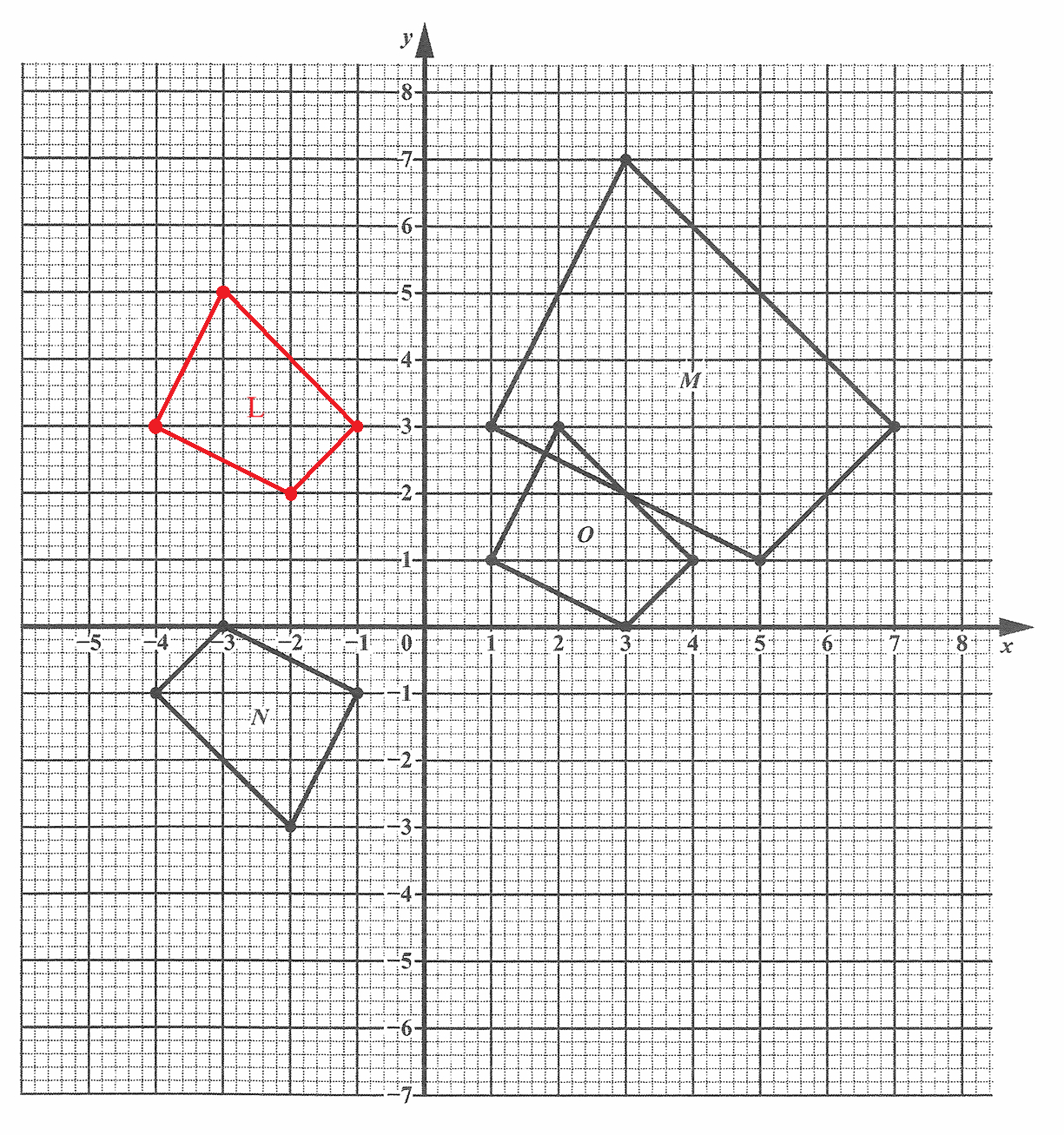
..................................................
For Review Purposes only
Scale: 1 cm to 1 unit on the x-axis
1 cm to 1 unit on the y-axis
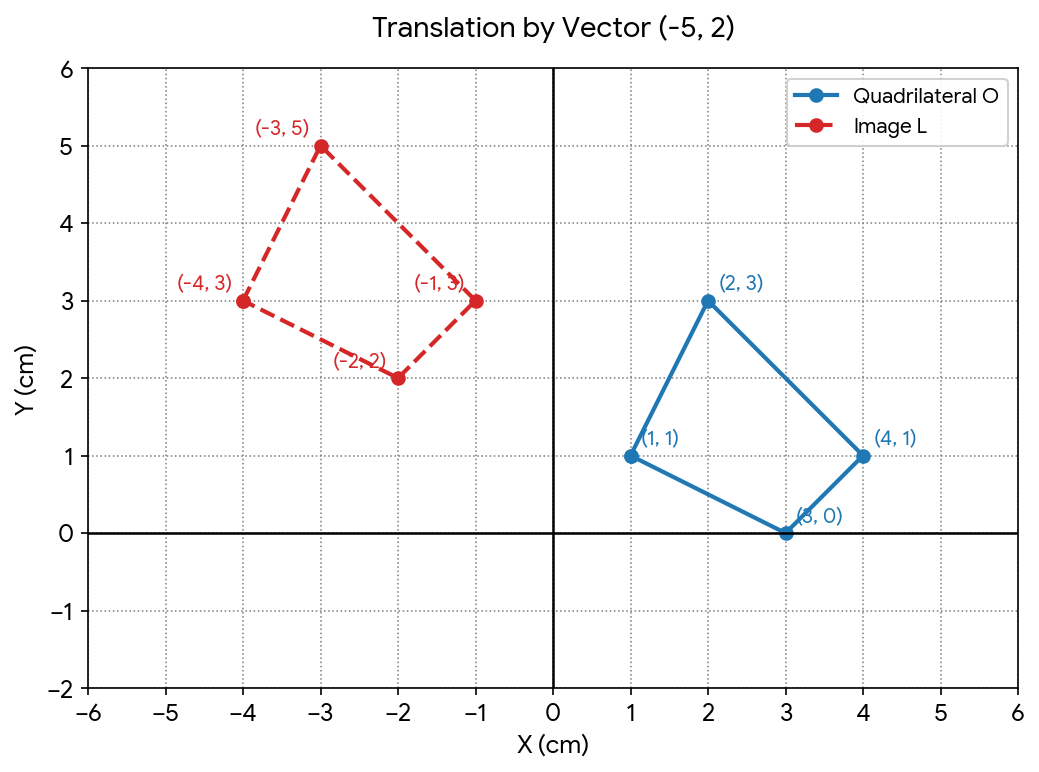
..................................................
(b.) Reflection in the line $y = -1$ implies that:
The distance from the y-coordinate of the initial point to the line $y = -1$ is equal to the distance from the line $y = -1$ to the y-coordinate of the image.
For an initial point $(x, y)$, reflection in the line $y = -1$ maps to the image $(x', y')$ where:
$ x' = x \\[3ex] y - (-1) = -1 - y' \quad\text{equal distance to the reflection line} \\[3ex] y + 1 = -1 - y' \\[3ex] y' = -1 - y - 1 \\[3ex] y' = -2 - y \\[5ex] \text{Quadrilateral } O \text{ onto Quadrilateral } P \\[3ex] \text{Rule: Reflection in the line } y = -1 \\[5ex] \underline{\text{Point } A} \\[3ex] \begin{pmatrix} x' \\ y' \end{pmatrix} = \begin{pmatrix} 1 \\ -2 - 1 \end{pmatrix} = \begin{pmatrix} 1 \\ -3 \end{pmatrix} \\[5ex] A(1, 1) \rightarrow A'(1, -3) \\[5ex] \underline{\text{Point } B} \\[3ex] \begin{pmatrix} x' \\ y' \end{pmatrix} = \begin{pmatrix} 2 \\ -2 - 3 \end{pmatrix} = \begin{pmatrix} 2 \\ -5 \end{pmatrix} \\[5ex] B(2, 3) \rightarrow B'(2, -5) \\[5ex] \underline{\text{Point } C} \\[3ex] \begin{pmatrix} x' \\ y' \end{pmatrix} = \begin{pmatrix} 4 \\ -2 - 1 \end{pmatrix} = \begin{pmatrix} 4 \\ -3 \end{pmatrix} \\[5ex] C(4, 1) \rightarrow C'(4, -3) \\[5ex] \underline{\text{Point } D} \\[3ex] \begin{pmatrix} x' \\ y' \end{pmatrix} = \begin{pmatrix} 3 \\ -2 - 0 \end{pmatrix} = \begin{pmatrix} 3 \\ -2 \end{pmatrix} \\[5ex] D(3, 0) \rightarrow D'(3, -2) \\[3ex] $
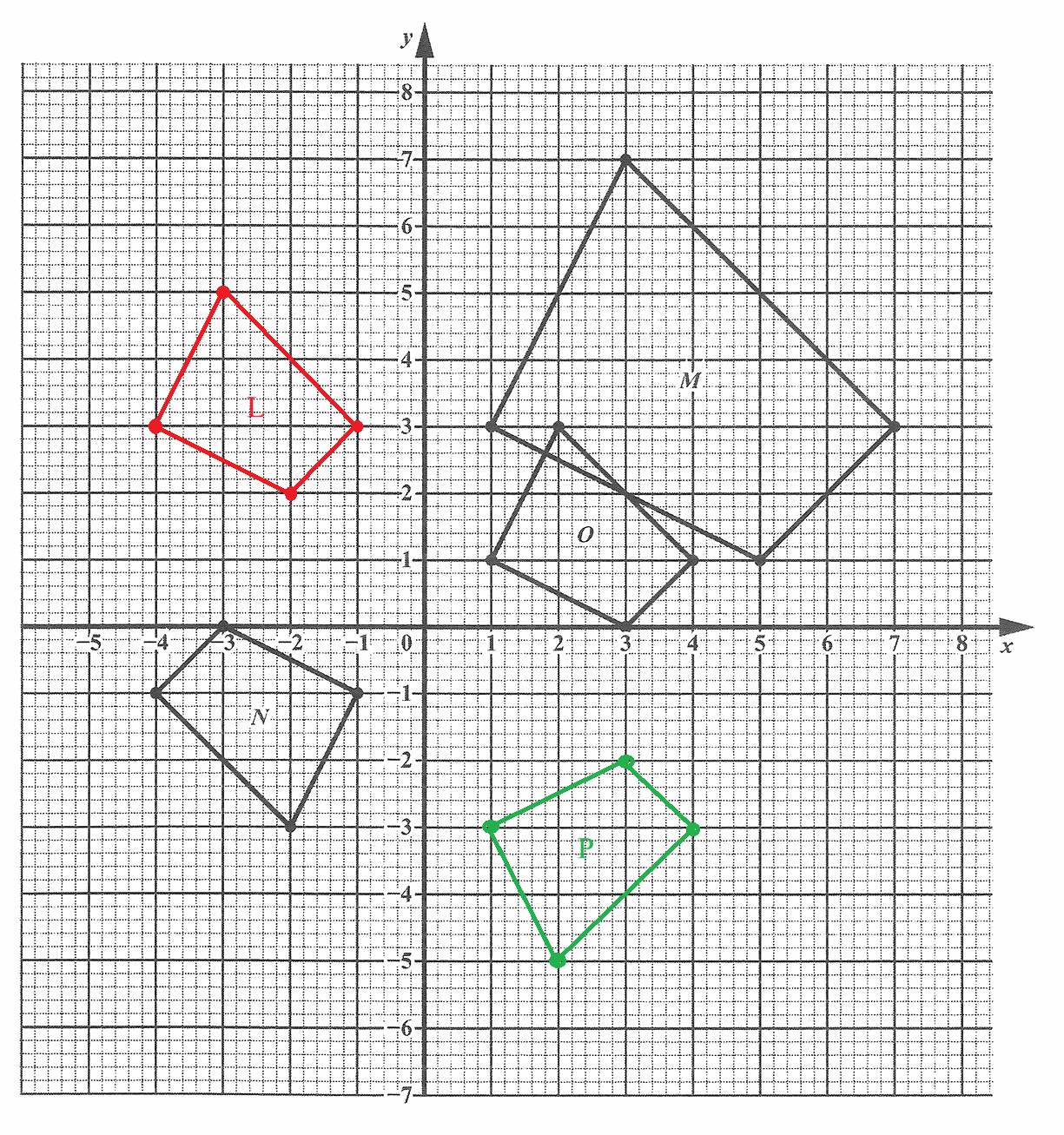
..................................................
For Review Purposes only
Scale: 1 cm to 1 unit on the x-axis
2 cm to 2 units on the y-axis
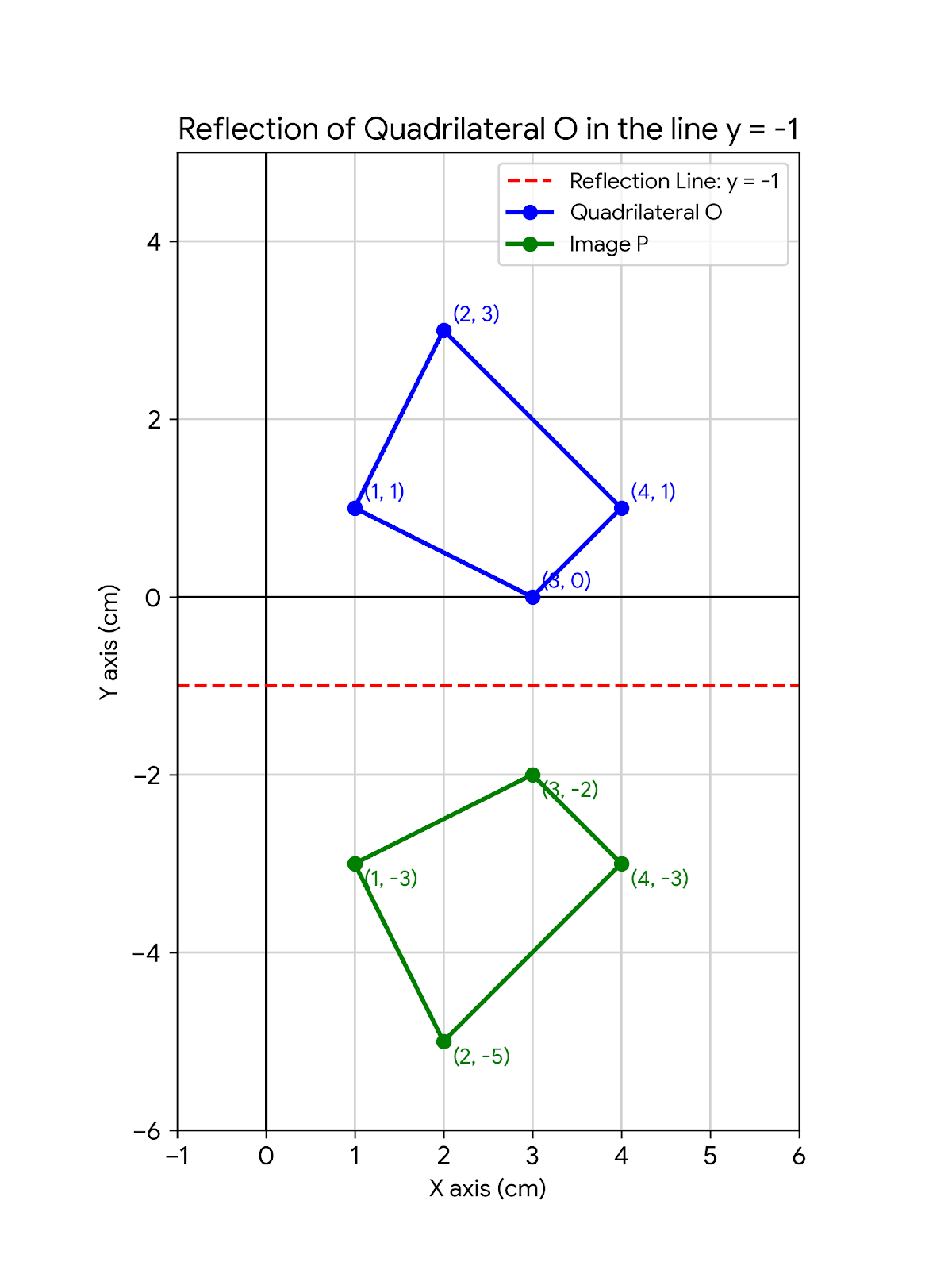
..................................................
$ \text{Distance between B and L} = 95\;km \\[3ex] 1\;cm : 10\;km \\[3ex] 1\;cm = 10\;km \\[3ex] \text{what } cm = 95\;km \\[3ex] \dfrac{\text{what}}{1} = \dfrac{95}{10} \\[5ex] \text{what} = 9.5\;cm \\[5ex] \text{Bearing of B from L} = 230^\circ \\[3ex] 230^\circ - 180^\circ = 50^\circ \\[3ex] $ The diagram that shows the buoy (B) relative to the lighthouse (L) is:
The point M is the midpoint of OP and the point N is the midpoint of OR.
In the diagram, $\overrightarrow{OM}$ = u and $\overrightarrow{ON}$ = v.
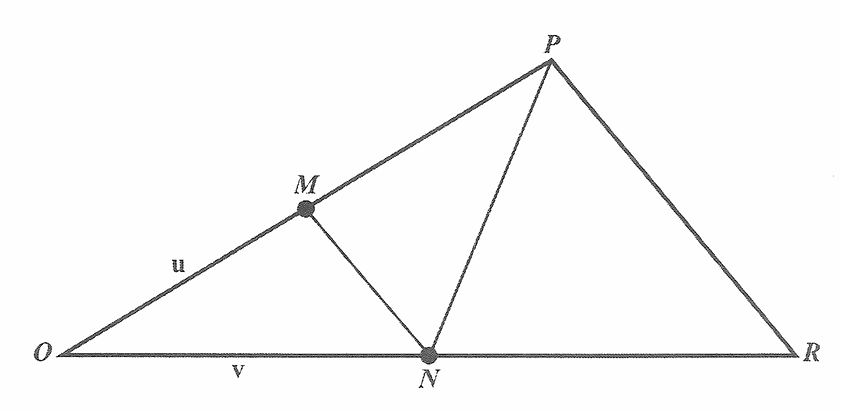
(i.) Find in terms of u and v, simplified expressions for:
$ (a.)\;\; \overrightarrow{MN} \\[3ex] (b.)\;\; \overrightarrow{NP} \\[3ex] $ (ii.) Show that MN is parallel to PR.
(b.) The matrix P, written in terms of a where a is a real constant, is as follows.
$P = \begin{bmatrix} 3a & 4 \\ 6 & 2a \end{bmatrix}$
(i.) Calculate the determinant of P, in terms of a.
(ii.) Determine the values of a for which Matrix P is singular.
(iii.) Determine $P^{-1}$, the inverse of P, for which P is non-singular.
(c.) Write down the 2 × 2 matrix that represents a:
(i.) counterclockwise rotation of 90° about the origin. Label this matrix X.
(ii.) counterclockwise rotation of 90° about the origin followed by a reflection in the y-axis, given that $Q = \begin{bmatrix} -1 & 0 \\ 0 & 1 \end{bmatrix}$ represents a reflection in the y-axis. Label this matrix T.
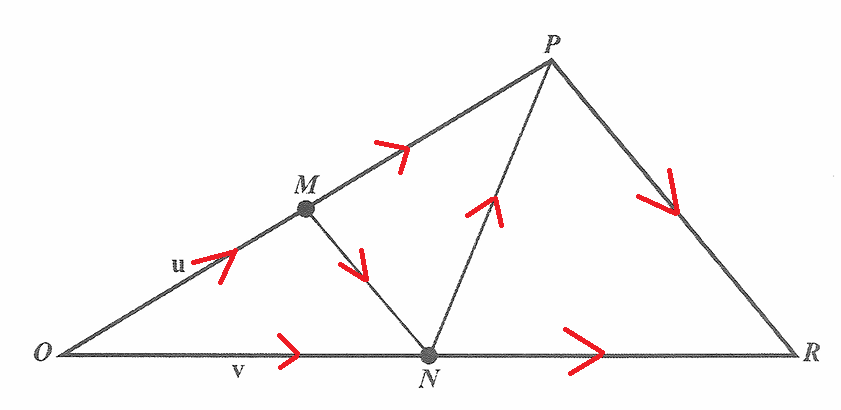
$ (i.) (a.) \\[3ex] \overrightarrow{OM} + \overrightarrow{MN} = \overrightarrow{ON} \\[3ex] \mathbf{u} + \overrightarrow{MN} = \mathbf{v} \\[3ex] \overrightarrow{MN} = \mathbf{(v - u)} \\[5ex] (b.) \\[3ex] \overrightarrow{MN} + \overrightarrow{NP} = \overrightarrow{MP} \\[3ex] .................................................................. \\[3ex] \overrightarrow{MP} = \overrightarrow{OM} = \mathbf{u} \quad\text{M is the midpoint of } \overrightarrow{OP} \\[3ex] .................................................................. \\[3ex] \mathbf{v} - \mathbf{u} + \overrightarrow{NP} = \mathbf{u} \\[3ex] \overrightarrow{NP} = \mathbf{u - v + u} \\[3ex] \overrightarrow{NP} = \mathbf{2u - v} \\[5ex] (ii.) \\[3ex] \overrightarrow{OP} = \overrightarrow{OM} + \overrightarrow{MP} \\[3ex] = \mathbf{u + u} \\[3ex] = 2\mathbf{u} \\[5ex] \overrightarrow{NR} = \overrightarrow{ON} = \mathbf{v} \quad\text{N is the midpoint of } \overrightarrow{OR} \\[3ex] \overrightarrow{OR} = \overrightarrow{ON} + \overrightarrow{NR} \\[3ex] = \mathbf{v + v} \\[3ex] = 2\mathbf{v} \\[5ex] \overrightarrow{OP} + \overrightarrow{PR} = \overrightarrow{OR} \\[3ex] 2\mathbf{u} + \overrightarrow{PR} = 2\mathbf{v} \\[3ex] \overrightarrow{PR} = 2\mathbf{v} - 2\mathbf{u} \\[3ex] \overrightarrow{PR} = 2(\mathbf{v} - \mathbf{u}) \\[3ex] \overrightarrow{PR} = 2 * \overrightarrow{MN} \\[3ex] $ Because $\overrightarrow{PR}$ is a scalar multiple of $\overrightarrow{MN}$, MN is parallel to PR.
$ (b.) \\[3ex] P = \begin{bmatrix} 3a & 4 \\ 6 & 2a \end{bmatrix} \\[5ex] (i.) \\[3ex] \text{det } P = \begin{vmatrix} 3a & 4 \\ 6 & 2a \end{vmatrix} \\[5ex] = 3a(2a) - 6(4) \\[3ex] = 6a^2 - 24 \\[3ex] = 6(a^2 - 4) \\[3ex] = 6(a + 2)(a - 2) \quad\text{Difference of Two Squares} \\[3ex] $ A matrix is singular if its determinant is zero.
So, we set the determinant to zero and solve for a
$ (ii.) \\[3ex] 6(a + 2)(a - 2) = 0 \\[3ex] (a + 2)(a - 2) = 0 \\[3ex] a + 2 = 0 \text{ or } a - 2 = 0 \\[3ex] a = -2 \text{ or } a = 2 \\[5ex] (iii.) \\[3ex] \underline{\text{Matrix of Cofactors, } C} \\[3ex] C_{11} = 2a \\[3ex] C_{12} = -6 \\[3ex] C_{21} = -4 \\[3ex] C_{22} = 3a \\[3ex] C = \begin{bmatrix} 2a & -6 \\ -4 & 3a \end{bmatrix} \\[5ex] \text{adj } P = C^T = \begin{bmatrix} 2a & -4 \\ -6 & 3a \end{bmatrix} \\[5ex] P^{-1} = \dfrac{\text{adj } P}{\text{det } P} \\[5ex] = \dfrac{\begin{bmatrix} 2a & -4 \\ -6 & 3a \end{bmatrix}}{6(a + 2)(a - 2)} \quad a \ne -2, 2 \\[7ex] (c.) \\[3ex] x-\text{axis vector} = \begin{bmatrix} 1 \\ 0 \end{bmatrix} \\[5ex] y-\text{axis vector} = \begin{bmatrix} 0 \\ 1 \end{bmatrix} \\[5ex] (i.) \\[3ex] (1, 0) \text{ counterclockwise rotation of } 90^\circ \text{ about the origin} \\[3ex] \rightarrow (\cos 90^\circ, \sin 90^\circ) \\[3ex] = (0, 1) \\[5ex] (0, 1) \text{ counterclockwise rotation of } 90^\circ \text{ about the origin} \\[3ex] \rightarrow (-\sin 90^\circ, \cos 90^\circ) \\[3ex] = (-1, 0) \\[5ex] \therefore \text{The } 2 \times 2 \text{ matrix, } X = \begin{bmatrix} 0 & -1 \\ 1 & 0 \end{bmatrix} \\[5ex] $ (ii.) There are two transformations:
1st transformation: A counterclockwise rotation of 90° about the origin, represented by matrix X.
2nd transformation: Reflection in the y-axis, represented by matrix Q.
When applying multiple transformations to a coordinate vector, we multiply the matrices in the reverse order of their application.
This implies that we will find the composite matrix, $QX$.
$ T = QX \\[3ex] = \begin{bmatrix} -1 & 0 \\ 0 & 1 \end{bmatrix} \begin{bmatrix} 0 & -1 \\ 1 & 0 \end{bmatrix} \\[5ex] = \begin{bmatrix} -1(0) + 0(1) & -1(-1) + 0(0) \\ 0(0) + 1(1) & 0(-1) + 1(0) \end{bmatrix} \\[5ex] = \begin{bmatrix} 0 + 0 & 1 + 0 \\ 0 + 1 & 0 + 0 \end{bmatrix} \\[5ex] = \begin{bmatrix} 0 & 1 \\ 1 & 0 \end{bmatrix} $
