CSEC Examination: Mathematics: Paper 01: General Proficiency
The Joy of the Teacher is the Success of the
Students.
– Samuel Chukwuemeka
Welcome to Our Site
I greet you this day,
These are the solutions to the CSEC Mathematics Paper 01 multiple-choice questions.
Please review the Formulas, rules/laws, and theorems on the website for each topic as applicable.
If time permits and there is sufficient interest, video solutions may be provided. Please subscribe to the
YouTube channel to be notified of upcoming livestreams.
You are welcome to ask questions during the video livestreams.
If you find these resources valuable and if any of these resources were helpful in your passing the
Mathematics tests/exams, please consider making a donation:
Your donation is appreciated.
Comments, ideas, areas of improvement, questions, and constructive
criticisms are welcome.
Feel free to contact me. Please be positive in your message.
I wish you the best.
Thank you.
Paper 01 - General Proficiency
Time: 1 hour 30 minutes
READ THE FOLLOWING INSTRUCTIONS CAREFULLY.
(1.) This test consists of 60 items. You will have 1 hour and 30 minutes to answer them.
(2.) In addition to this test booklet, you should have an answer sheet.
(3.) A list of formulae is provided on page 2 of this booklet.
(4.) Each item in this test has four suggested answers lettered (A), (B), (C), (D). Read each item you are
about to answer and decide which choice is best.
(5.) On your answer sheet, find the number which corresponds to your item and shade the space having the same
letter as the answer you have chosen. Look at the sample item below.
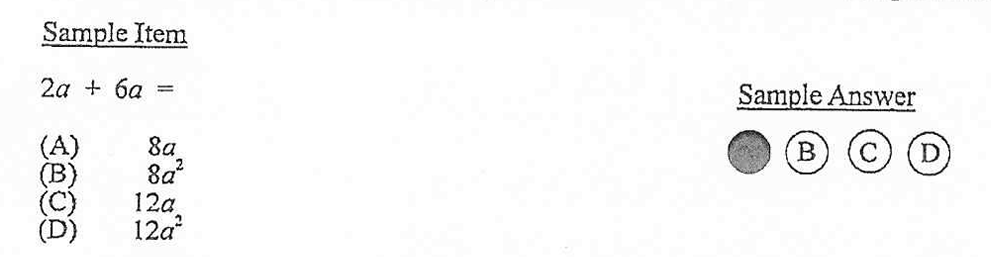
The best answer to this item is "$8a$", so (A) has been shaded.
(6.) If you want to change your answer, erase it completely before you fill in your new choice.
(7.) When you are told to begin, turn the page and work as quickly and as carefully as you can. If you cannot
answer an item, go on to the next one. You may return to that item later.
(8.) You may do any rough work in this booklet.
(9.) Calculators and mathematical tables are NOT allowed for this paper.
Formula Sheet: List of Formulae
(1.) Numbers: The number 3.14063 written correct to 3 decimal places is
$
3.14063 \\[3ex]
\text{target digit} = \text{3rd digit after the decimal point} = 0 \\[3ex]
\text{deciding digit} = \text{4th digit after the decimal point} = 6 \\[3ex]
$
If the deciding digit is greater than or equal to 5 (at least 5), round up by adding 1 to the target digit,
then discard the remaining digits.
If the deciding digit is less than 5, keep the target digit and discard the remaining digits.
To write a number in standard form, move the decimal point immediately after the 1st significant digit.
$
208.06 \\[3ex]
\text{1st significant digit} = 2 \\[3ex]
$
To place the decimal point after the 1st significant digit, move the decimal two places to the left.
This implies a division by 100
To ensure the same digit (keep it unchanged), multiply by 100
$
4231_8 \\[3ex]
\text{Converting to base ten} \\[3ex]
= (4 \times 8^3) + (2 \times 8^2) + ... \\[3ex]
\text{Value of the digit, 2 in base ten} = 2 \times 8^2 \\[3ex]
= 2 \times 64 \\[3ex]
= 128
$
(5.) Sequences:Item 5 refers to the following table which shows the relationship between the
number of matches an umpire officiates during a T20 cricket tournament and the amount of money he earns.
Number of Matches
3
4
5
6
Amount of Money Earned ($)
61
73
85
97
If the pattern continues, how much money would the umpire receive if he officiates at 8 matches?
$
\color{darkblue}{97} + 12 = 109 \\[3ex]
\color{darkblue}{109} + 12 = 121 \\[3ex]
$
Continuing the pattern, the umpire will receive $121 if he officiates 8 matches.
(6.) Percent Applications: There are 40 students in a class.
Girls make up 60% of the class and 25% of the girls wear glasses.
How many girls in the class wear glasses?
Student: SamDom For Peace Teacher: What's good? Student: Can you give an example? Teacher: Sure, let's do it.
$
n(A) = m \\[3ex]
n(P(A)) = 2^m \quad\text{where } P(A) \text{ is the power set of set } A \\[3ex]
$
Here is an example:
Set C = {b, o, y}
(a.) Determine the cardinality of set C
(b.) List the power set of C
(c.) What is the cardinality of the power set of C?
C = {b, o, y}
(a.) n(C) = 3
(b.) P(C) = {φ, {b}, {o}, {y}, {b, o}, {b, y}, {o, y}, {b, o, y}}
(c.) n(P(C)) = 8
(8.) Set Theory: Given that A = {1, 3, 6, 8, 9, 12, 15} and B = {6, 9, 12}, which of the
following statements about A and B is true?
(A) B ⊂ A.
(B) $A \cap B = \phi$
(C) A and B are disjoint sets.
(D) B is the complement of A
(A) B ⊂ A.
This is correct because A contains all of B
(B) $A \cap B = \phi$
(C) i>A and B are disjoint sets.
These are incorrect because $A \cap B = \{6, 9, 12\}$
(D) B is the complement of A
This is incorrect because B contains some elements of A
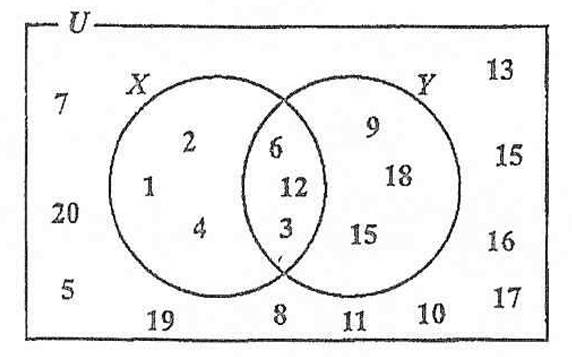
Items 9 and 10 refer to the following Venn diagram which shows 2 intersecting sets.
(9.) Set Theory: According to the diagram, $n(X \cup Y)'$ is
(10.) Set Theory: Which of the following statements BEST describes the elements of the subset
$X \cap Y'$ in the Venn diagram?
(A) Factors of 4
(B) Factors of 12
(C) Multiples of 4
(D) Multiples of 3 ≤ 20
$X \cap Y'$ is onlyX = {1, 2, 4}
{1, 2, 4} are factors of 4.
Therefore, $X \cap Y'$ are factors of 4.
(11.) Set Theory: Which of the following pairs of sets is an example of disjoint sets?
(A) X = {whole numbers} and Y = {rational numbers}
(B) G = {multiples of five} and H = {multiples of ten}
(C) P = {multiples of 2} and Q = {multiples of 3}
(D) E = {even numbers} and F = {odd numbers}
The set of even numbers and the set of odd numbers are disjoint sets because they have no common elements.
Their intersection is an empty set.
The cardinality of their intersection is 0.
The crrect answer is:
(D) E = {even numbers} and F = {odd numbers}
$
E \cap F = \phi \\[3ex]
n(E \cap F) = 0
$
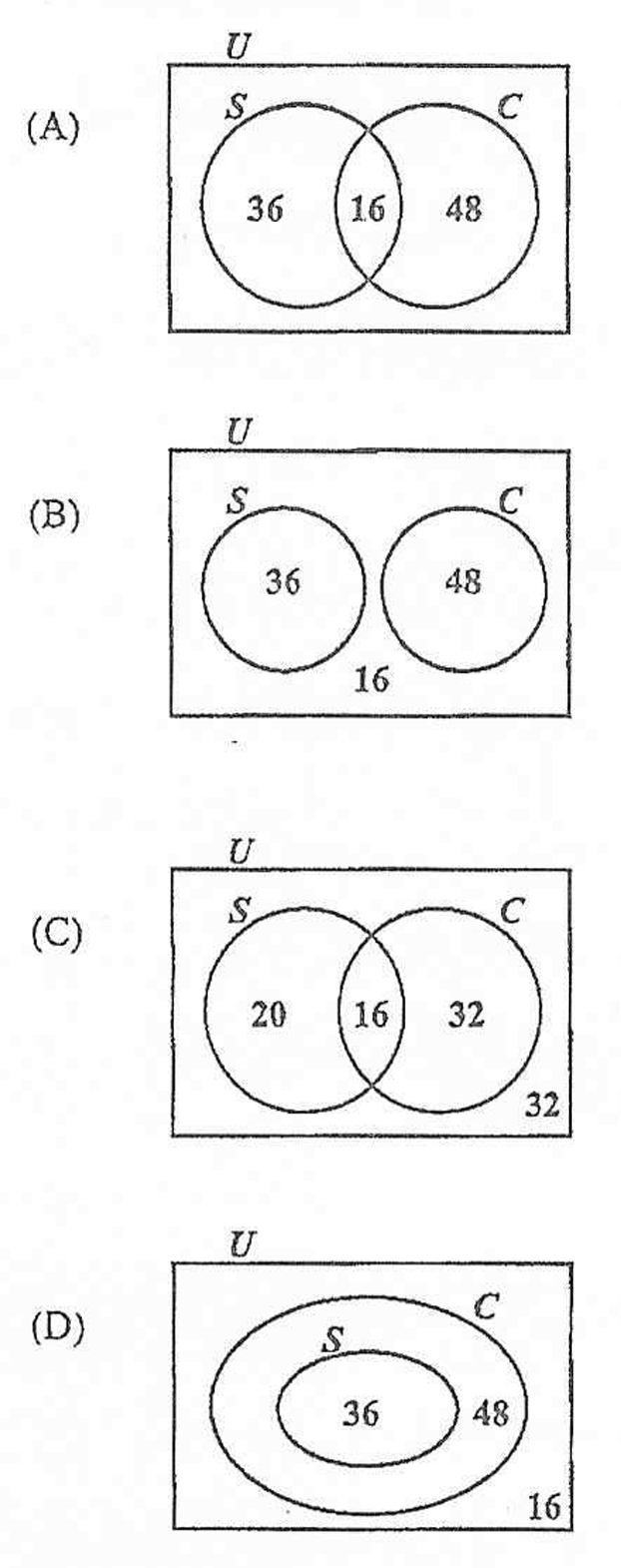
(12.) Set Theory: All students in a class play Scrabble (S) or Checkers (C) or both.
If 36% of the students play Scrabble only and 48% of the students play Checkers only, which of the following
Venn diagrams MOST accuractely represents the information?
All students in a class play Scrabble (S) or Checkers (C) or both.
This implies that no student plays neither.
$n(S \cup C)' = 0$
If 36% of the students play Scrabble only and 48% of the students play Checkers only
Assume the cardinality of the universal set is 100 students
$
n(Universal Set) = 100 \\[3ex]
n(S \cap C') = n(\text{only S}) = 36 \\[3ex]
n(C \cap S') = n(\text{only C}) = 48 \\[3ex]
n(S \cup C)' = n(\text{neither Scrabble nor Checkers}) = 0 \\[3ex]
n(S \cap C) = n(\text{both Scrabble and Checkers}) = k \\[3ex]
\implies \\[3ex]
36 + 48 + k + 0 = 100 \\[3ex]
84 + k = 100 \\[3ex]
k = 100 - 84 \\[3ex]
k = 16 \\[3ex]
$
The correct Venn diagram is Option (A)
(13.) Percent Applications: Excluding sales tax, how much will be saved when a video which costs
$12.00 is sold at a 20% discount?
(14.) Finance Literacy: At a store, 3 cents on every dollar spent is charged as sales tax.
How much is paid as sales tax on a costume which costs $196.00?
(15.) Finance Literacy: The cash price of a television set is $350.
When bought on hire purchase, a deposit of $35 is required, followed by 12 monthly payments of
$30.
How much is saved by paying cash?
(17.) Measurements and Units: A man pays 60 cents for every 200 m³ of gas used, plus a fixed charge.
If he pays $178.75 when he uses 55 000 m³ of gas, how much is the fixed charge?
(19.) Finance Literacy: A man's basic wage for a 40-hour week is $160.00
He is paid $5.00 per hour for overtime.
If he works $6\dfrac{1}{2}$ hours of overtime in a certain week, then his wage for that week would be
$
\text{Basic pay for a 40-hour work week} = \$160 \\[3ex]
\text{Overtime pay for } 6\dfrac{1}{2}\text{ hours @ } \$5 \text{ per hour} \\[5ex]
= 6\dfrac{1}{2} \times 5 \\[5ex]
= \dfrac{13}{2} \times 5 \\[5ex]
= \dfrac{65}{2} \\[5ex]
= 32.5 \\[5ex]
\text{That week's wage} = 160 + 32.5 = \$192.50
$
(20.) Mathematics of Finance: Compound Interest: The amount accumulated on $2 500 invested
for 2 years at a rate of 5% per annum compounded interest is
$
A = P\left(1 + \dfrac{r}{m}\right)^{mt} \\[5ex]
\text{where} \\[3ex]
A = \text{compound amount} \\[3ex]
P = \text{principal} = \$2 500 \\[3ex]
r = \text{annual interest rate} = 5\% = \dfrac{5}{100} = 0.05 \\[5ex]
m = \text{number of compounding perriod per year} = 1 \quad\text{compounded annually} \\[3ex]
t = \text{time} = 2\text{ years} \\[5ex]
A = 2500\left(1 + \dfrac{0.05}{1}\right)^{1 \times 2} \\[5ex]
= 2500 \times (1 + 0.05)^{2} \\[4ex]
= 2500 \times (1.05)^2 \\[4ex]
= 2500 \times 1.05 \times 1.05 \\[3ex]
= 2500 \times \dfrac{105}{100} \times 1.05 \\[5ex]
= 25 \times 105 \times 1.05 \\[3ex]
= 2625 \times 105 \times 0.01 \\[3ex]
= 275625 \times 0.01 \\[3ex]
= \$2756.25 \\[3ex]
$
Student: SamDom For Peace Teacher: What's good? Talk to me. Student: So, what if I do not remember this formula?
I checked in the Formula Sheet and can't find it. Teacher: Do you remember the Simple Interest Formula?
I mean...the formula for the Amount...the Simple Amount Student: I don't know it off hand, but I think I can derive it.
Remember I'm being timed in this test. Teacher: I understand.
What is the Simple Interest Formula? Student: $\text{simple interest} = \text{principal} \times \text{rate} \times \text{rate}$
If the rate is given in %, we divide by 100. Teacher: Okay. Compound Interest is the interest compounded on a principal sum of money over a period
of time.
It is the interest on the principal plus interest.
We shall use that formula in a Table Approach to solve the question.
Let's do it.
$
m * n = \sqrt{m^3 - n^2} \\[3ex]
\text{ For } 5 * 2 \\[3ex]
m = 5 \\[3ex]
n = 2 \\[5ex]
5 * 2 = \sqrt{5^3 - 2^2} \\[3ex]
= \sqrt{125 - 4} \\[3ex]
= \sqrt{121} \\[3ex]
= 11
$
(24.) Quantitative Reasoning: Given that 39 people who work 5 hours per day can repair a road in 12 days,
in how many days would 30 people complete the same repairs if they work 6 hours per day at the same rate?
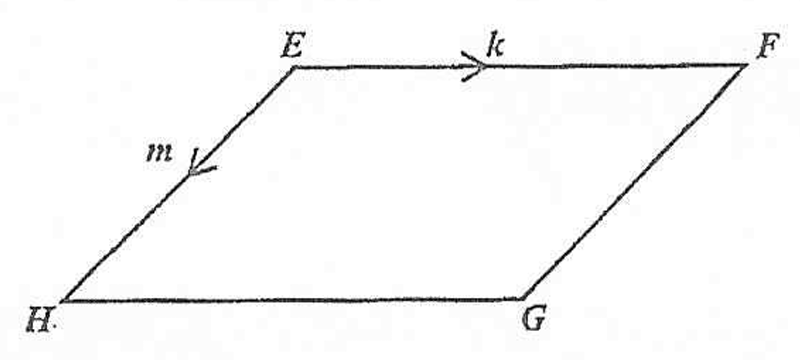
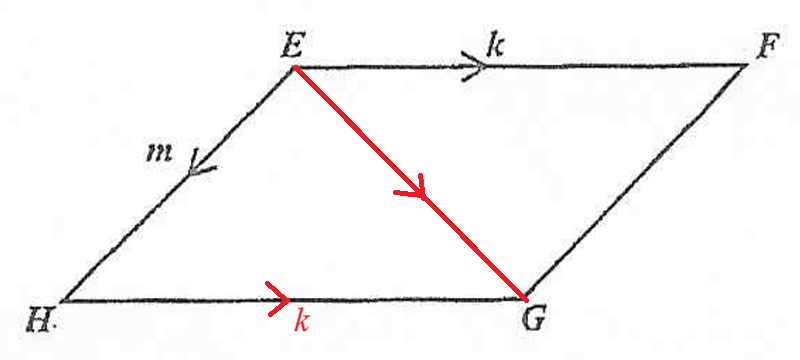
(28.) Vectors:Item 28 refers to the following diagram of a parallelogram, in which $EF$ is
parallel to $HG$, $EH$ is parallel to $FG$, $\overrightarrow{EF} = k$ and $\overrightarrow{EH} = m$.
$\overrightarrow{EG}$ expressed in terms of $k$ and $m$ is
$
(A)\;\; k + m \\[3ex]
(B)\;\; k - m \\[3ex]
(C)\;\; m - k \\[3ex]
(D)\;\; -m - k \\[3ex]
$
$
\overrightarrow{HG} = \overrightarrow{EF} = k \quad\text{opposite sides of a parallelogram are equal} \\[3ex]
\overrightarrow{EG} = \overrightarrow{EH} + \overrightarrow{HG} \\[3ex]
= m + k \\[3ex]
= k + m
$
(34.) Mensuration: In a rectangular garden plot that is 15 m long and 12 m wide, an area of 80 m² is used
for a vegetable garden.
What area of the plot is NOT used for vegetable gardening?
$
\text{Area of the rectangular garden plot} = 15 \times 12 = 180\;m^2 \\[4ex]
\text{Area used for a vegetable garden} = 80\;m^2 \\[4ex]
\text{Area not used for a vegetable garden} = 180 - 80 = 100\;m^2
$
(35.) Kinematics: An aircraft leaves A at 16:00 hours and arrives at B at 19:30 hours,
travelling at an average speed of 550 kilometres per hour. A and B are in the same time zone.
The distance from A to B, in kilometres, is
(36.) Measurements and Units: The distance around a lake is 8 km.
On a map, this distance around the lake is represented by a length of 2 cm.
The scale on the map is
The mode is the number of books (data value) bought by the most number of students (highest frequency).
Highest number of students = 13
Those 13 students bought 5 books.
Mode = 5
(41.) Statistics: Measures of Center: The median number of books the students bought at the sale is
(44.) Probability:Item 44 refers to the following contingency table which shows the results of a
survey of 125 people who were asked whether they have an Instagram account, a Facebook account or neither.
Have Instagram
Do not Have Instagram
Total
Have Facebook
36
14
50
Do Not Have Facebook
64
11
75
Total
100
25
125
A person who has an Instagram account is chosen at random.
What is the probability that the person also has a Facebook account?
(45.) Linear Function: Which of the following functions represents the equation of a straight line?
$
(A)\;\; y = \dfrac{4}{x} \\[5ex]
(B)\;\; y = x^2 - 4 \\[3ex]
(C)\;\; y = 2x + 3 \\[3ex]
(D)\;\; y = x^2 + 2x - 5 \\[3ex]
$
$(C)\;\; y = 2x + 3 \\[3ex]$
This is a linear function because the highest exponent of the variable in the equation is 1.
A linear function represents the equation of a straight line.
(46.) Linear Function: The point where a linear function crosses the horizontal axis is
(A) always negative
(B) always positive
(C) the y-intercept
(D) the x-intercept
The horizontal axis is the x-axis
The point where a linear function crosses the horizontal axis is the x-intercept.
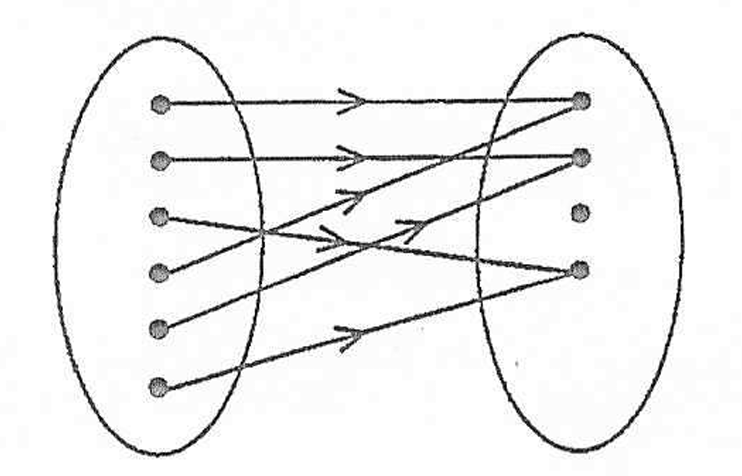
(47.) Relations and Functions:Item 47 refers to the following mapping diagram.
The relationship that BEST describes the mapping in the diagram is
independent variable has 6 values
dependent variable has 4 values
2 values of the independent variable maps to one value of the dependent variable
1st and 4th values maps to the 1st value
2nd and 5th values maps to the 2nd value
3rd and 6th values maps to the 4th value
This is a many-to-one relationship.
(48.) Linear Functions: What is the gradient of the straight line $2y = -3x - 8$?
$
\text{Equation of a straight line in slope-intercept form: } y = mx + b \\[3ex]
\text{where} \\[3ex]
m = \text{gradient} \\[5ex]
2y = -3x - 8 \\[3ex]
y = \dfrac{-3x - 8}{2} \\[5ex]
y = -\dfrac{3}{2}x - \dfrac{8}{2} \\[5ex]
y = -\dfrac{3}{2}x - 4 \\[5ex]
m = -\dfrac{3}{2}
$
(49.) Evaluation of Functions: If $h(x) = \dfrac{3x - 2}{5}$, then $h(4)$ =
$
f : x \rightarrow 5 - 2x \\[3ex]
f(x) = 5 - 2x \\[3ex]
y = 5 - 2x \\[3ex]
\text{Interchange } y \text{ and } x \\[3ex]
x = 5 - 2y \\[3ex]
\text{Solve for } y \\[3ex]
x + 2y = 5 \\[3ex]
2y = 5 - x \\[3ex]
y = \dfrac{5 - x}{2} \\[5ex]
f^{-1}(x) = \dfrac{5 - x}{2} \\[5ex]
ff^{-1}(x) = (5 - 2x) \times \dfrac{5 - x}{2} \\[5ex]
ff^{-1}(1) = [5 - 2(1)] \times \dfrac{5 - 1}{2} \\[5ex]
= (5 - 2) \times \dfrac{4}{2} \\[5ex]
= 3 \times 2 \\[3ex]
= 6 \\[3ex]
$
Student: SamDom4Peace Teacher: It's me. What's good? Student: The answer is not in any of the options.
Can you review your work and check for any error? Teacher: Did you see any? Student: I'm still looking, but cannot find any. Teacher: I think there's an issue with the typo.
Let me explain.
$
f(x) = 5 - 2x \\[3ex]
f^{-1}(x) = \dfrac{5 - x}{2} \\[5ex]
\text{Is there any difference between } ff^{-1}(x) \text{ and } f[f^{-1}(x)]? \\[5ex]
\underline{\text{Multiplication of Functions}} \\[3ex]
ff^{-1}(x) = f \cdot f^{-}(x) \\[3ex]
= (5 - 2x) \times \dfrac{5 - x}{2} \\[5ex]
= \dfrac{(5 - 2x)(5 - x)}{2} \\[5ex]
\underline{\text{Composition of Functions}} \\[3ex]
f[f^{-1}(x)] = f\left(\dfrac{5 - x}{2}\right) \\[5ex]
= 5 - 2\left(\dfrac{5 - x}{2}\right) \\[5ex]
= 5 - (5 - x) \\[3ex]
= 5 - 5 + x \\[3ex]
= x \\[5ex]
\text{Similarly, } f[f^{-1}(1)] = 1 \\[3ex]
$
Student: Wait a minute.
Is this not the Test for Inverses using the Composition of Functions? Teacher: Yes, it is. Student: Then, we really didn't need to show all that work because all linear functions are
one-to-one functions.
And all one-to-one functions have inverses. Teacher: That is correct.
We could save time using that knowledge.
It is still recommended that you verify if you have time.
$
\underline{\text{Test for Function Inverses using Function Composition}} \\[3ex]
f[f^{-1}(x)] = f^{-1}[f(x)] = x
$
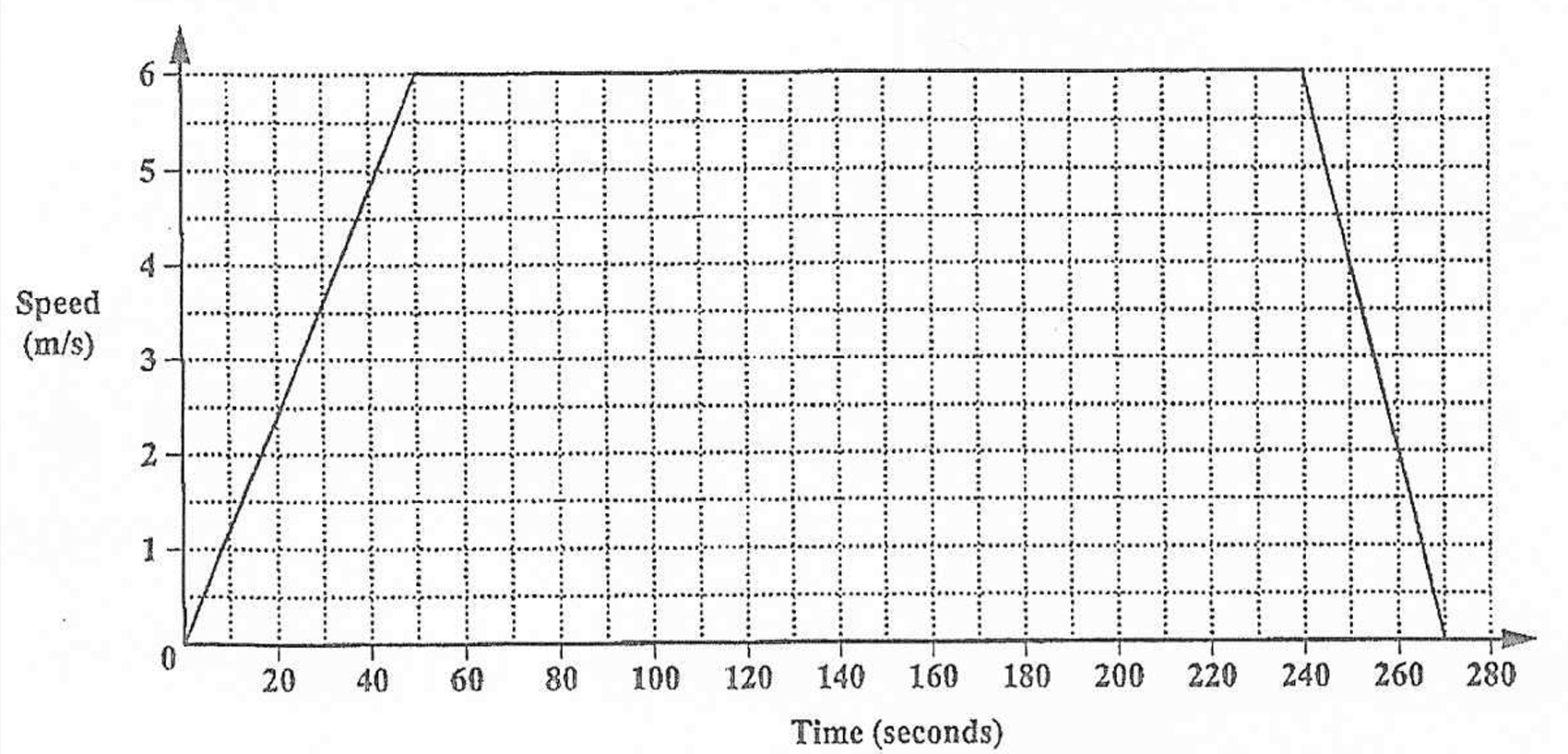
Items 51 and 52 refer to the following speed-time graph which shows a cyclist's journey along a straight
path.
(51.) Kinematics: Based on the graph, which of the following statements about the cyclist is true?
(A) The cyclist accelerates at 0.1 m/s² for 50 seconds, rests for 190 seconds, then decelerates at 0.2 m/s² for
30 seconds.
(B) The cyclist starts at a constant speed of 6 m/s, accelerates at a constant rate for 190 seconds, then
decelerates to rest in 30 seconds.
(C) From rest, the cyclist decelerates at a constant rate to a speed of 6 m/s for 50 seconds, maintains this
speed for 190 seconds, then accelerates to rest in 30 seconds.
(D) From rest, the cyclist accelerates at a constant rate to a speed of 6 m/s after 50 seconds, maintains this
speed for 190 seconds, then decelerates to rest in 30 seconds.
The correct answer is Option D.
Student: Could you explain how you got thr answer? Teacher: Sure, let's do it...
The cyclist starts from rest (when the velocity is 0 m/s)
Then, the cyclist accelerates at a constant rate (represented by the rising straight line) from that 0 m/s to
6 m/s for 50 seconds
The cyclist maintains this speed (represented by the level straight line) for 190 (240 – 50) seconds.
The cyclist then decelerates to rest (back at 0 m/s) in 30 (270 - 240) seconds.
(52.) Kinematics: According to the graph, the average speed of the cyclist for the first 4 minutes
of the journey is
$
s.......t.......d \\[3ex]
\text{speed} \times \text{time} = \text{distance} \\[3ex]
\text{speed} = \dfrac{\text{distance}}{\text{time}} \\[5ex]
\text{distance} = ? \\[3ex]
\text{time} = 4\text{ minutes} = 4\text{ minutes} \cdot \dfrac{60\text{ seconds}}{1\text{ minute}} \\[5ex]
= 240\text{ seconds} \\[3ex]
$
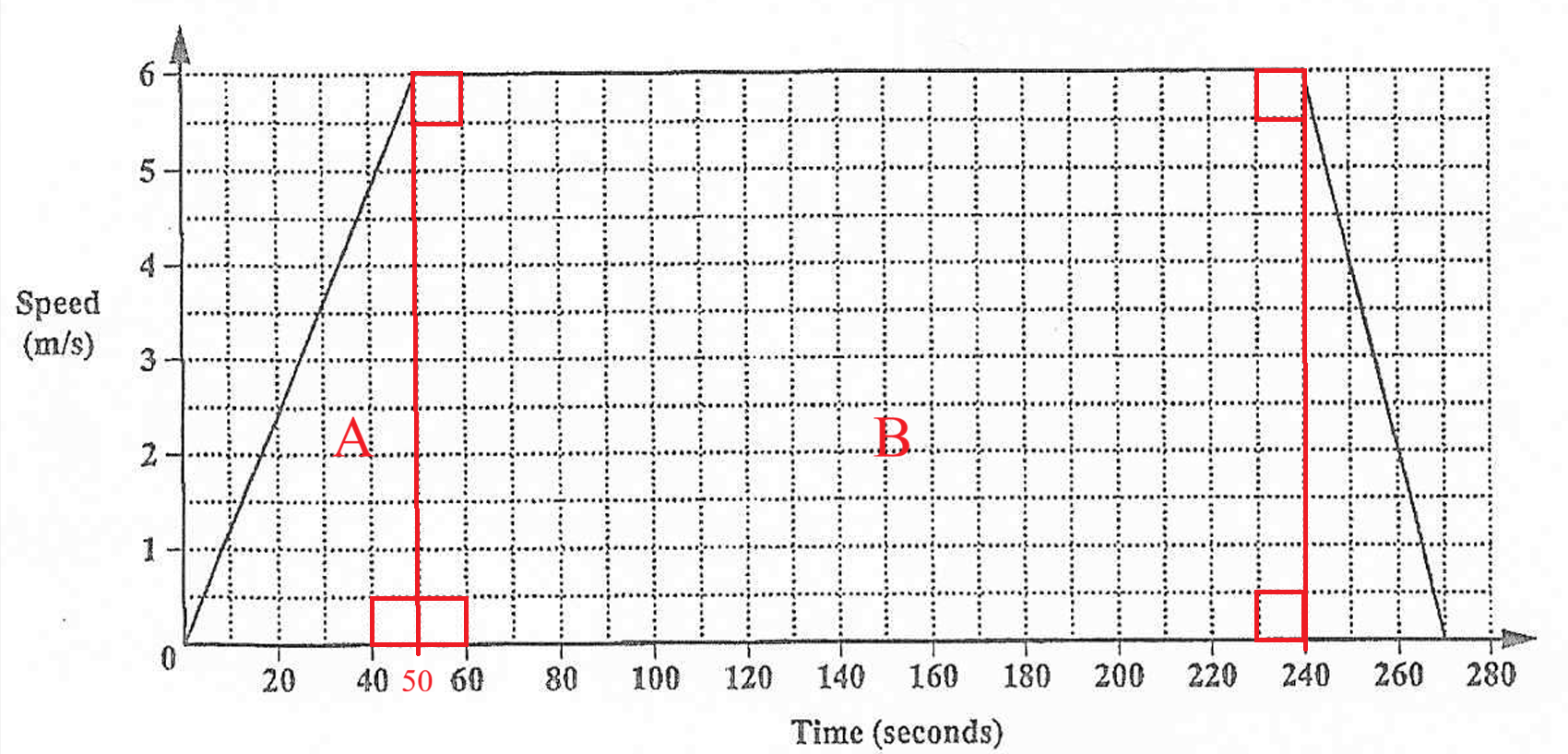
Distance is the area under the speed-time graph.
Let us find the area of the graph beginning from 0 seconds to 240 seconds.
$
\Sigma \text{exterior } \angle s = 360 \quad\text{sum of the exterior angles of a polygon} \\[3ex]
\text{exterior } \angle = \dfrac{360}{n} \quad\text{exterior angle of a regular polygon with } n \text{ sides}
\\[3ex]
60 = \dfrac{360}{n} \\[5ex]
60n = 360 \\[3ex]
n = \dfrac{360}{60} \\[5ex]
n = 6 \\[3ex]
$
A regular polygon with 6 sides is a regular hexagon.
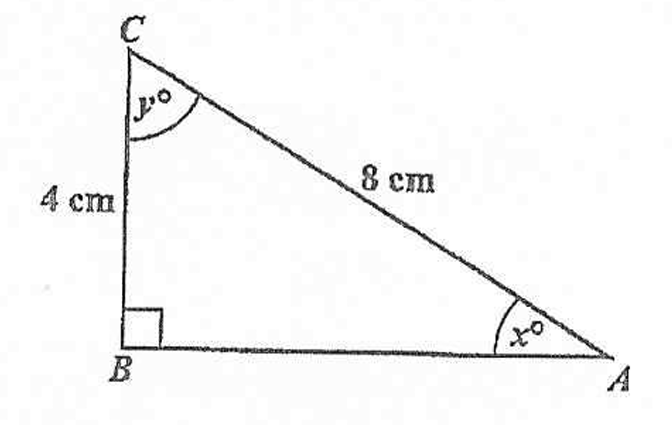
(55.) Trigonometry: Triangles:Item 55 refers to the following diagram of a right-angled triangle,
ABC.
In the right-angled triangle above, which trigonometric ratio is equal to $\dfrac{4}{8}$
$
(A)\;\; \tan y \\[3ex]
(B)\;\; \tan x \\[3ex]
(C)\;\; 5.375\;m/s \\[3ex]
(D)\;\; 1290.0\;m/s \\[3ex]
$
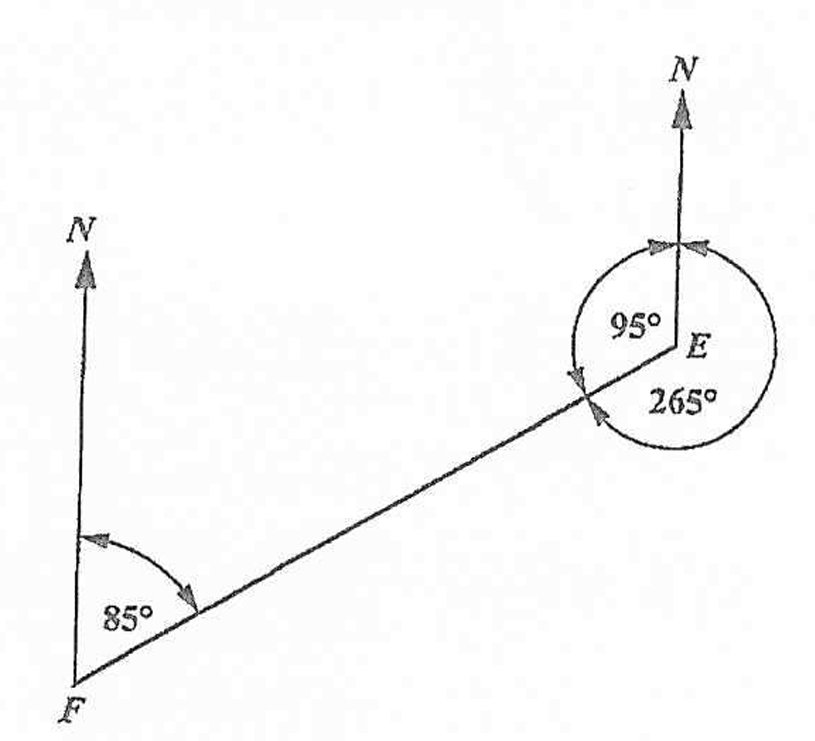
From F, the bearing of E is 85° (clockwise measurement from the North pole.)
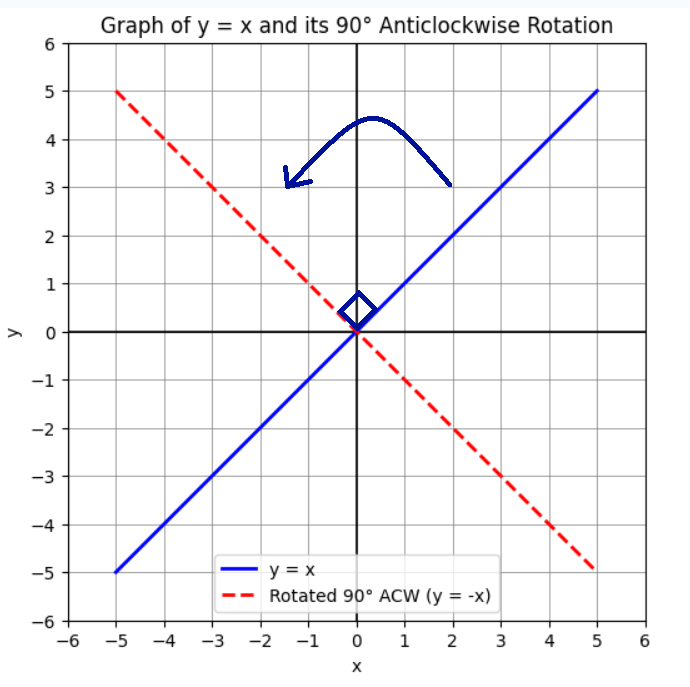
(57.) Algebra Transformations: If the line $y = x$ is rotated through anti-clockwise about O
through 90°, then its image is
$
(A)\;\; y = -x \\[3ex]
(B)\;\; x = y \\[3ex]
(C)\;\; x = 0 \\[3ex]
(D)\;\; y = 0 \\[3ex]
$
If the line $y = x$ is rotated through anti-clockwise about O through 90°, then its image is
$y = -x$
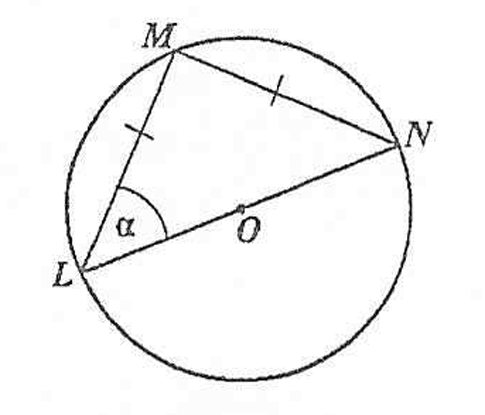
(58.) Circle Theorems:Item 58 refers to the following diagram which shows a triangle within a
circle.
In the triangle, LM and MN are equal.
The circle is centred at O.