Mechanics: Statics and Dynamics
The Joy of the Teacher is the Success of the Students. – Samuel Chukwuemeka
Welcome to Our Site
I greet you this day,
These are the solutions to the WASSCE Further Mathematics past questions on the topics: Mechanics.
This consists of topics in Statics and Dynamics.
When applicable, the TI-84 Plus CE calculator (also applicable to TI-84 Plus calculator) solutions are provided
for some questions.
If time permits and there is sufficient interest, video solutions may be provided. Please
subscribe to the YouTube channel to be notified of upcoming livestreams. You are welcome to ask questions during
the video livestreams.
If you find these resources valuable and helpful in your passing the
Mathematics test of the WASSCE, please consider making a donation:
Cash App: $ExamsSuccess or
cash.app/ExamsSuccess
PayPal: @ExamsSuccess or
PayPal.me/ExamsSuccess
Venmo: @ExamsSuccess or
Venmo.com/u/ExamsSuccess
Your donation is appreciated.
Comments, ideas, areas of improvement, questions, and constructive
criticisms are welcome.
Feel free to contact me. Please be positive in your message.
I wish you the best.
Thank you.
Symbols and Formulas
(1.) Basic Formulas
$
W = mg \\[3ex]
where \\[3ex]
W = weight\;(N) \\[3ex]
g = \text{acceleration due to gravity}\; (ms^{-2}) \\[3ex]
m = \text{mass}\;(kg) \\[3ex]
$
(2.) Basic Equations of Motion
$
(a.)\;\; v = u + at \\[3ex]
(b.)\;\; s = ut + \dfrac{1}{2}at^2 \\[5ex]
(c.)\;\; v^2 = u^2 + 2as \\[5ex]
\underline{\text{Working towards gravity}} \\[3ex]
a = g \\[5ex]
\underline{\text{Working aganist gravity}} \\[3ex]
a = -g \\[5ex]
$
where:
u = initial velocity
v = final velocity
a = acceleration
t = time
s = distance
g = acceleration due to gravity
(3.) Total Momentum
$
m_1 = \text{mass of first body} \\[4ex]
v_1 = \text{velocity of first body} \\[4ex]
m_2 = \text{mass of second body} \\[4ex]
v_2 = \text{velocity of second body} \\[5ex]
\underline{\text{Before Collision: Moving in Same Direction}} \\[4ex]
\text{momentum of first body} = m_1v_1 \\[4ex]
\text{momentum of second body} = m_2v_2 \\[4ex]
\text{total momentum} = m_1v_1 + m_2v_2 \\[5ex]
\underline{\text{After Collision: If Stuck Together}} \\[3ex]
\text{mass of: first body and second body} = m_1 + m_2 \\[4ex]
\text{common velocity} = v \\[3ex]
\text{total momentum} = v(m_1 + m_2) \\[5ex]
\underline{\text{Based on the Principle of Conservation of Momentum}} \\[3ex]
\text{total momentum before collision = total momentum after collision} \\[3ex]
m_1v_1 + m_2v_2 = v(m_1 + m_2) \\[5ex]
\underline{\text{Before Collision: Moving in Opposite Directions}} \\[4ex]
\text{momentum of first body} = m_1v_1 \\[4ex]
\text{momentum of second body} = m_2 * -v_2 = -m_2v_2 \\[4ex]
\text{The negative value of the velocity is because the second body is moving in opposite direction} \\[3ex]
\text{total momentum} = m_1v_1 - m_2v_2 \\[5ex]
\underline{\text{After Collision: If Stuck Together}} \\[3ex]
\text{mass of: first body and second body} = m_1 + m_2 \\[4ex]
\text{common velocity} = v \\[3ex]
\text{total momentum} = v(m_1 + m_2) \\[5ex]
\underline{\text{Based on the Principle of Conservation of Momentum}} \\[3ex]
\text{total momentum before collision = total momentum after collision} \\[3ex]
m_1v_1 - m_2v_2 = v(m_1 + m_2) \\[5ex]
$
(4.) Forces acting on a body
$
F_x = F \cos\theta \\[3ex]
F_y = F \sin\theta \\[3ex]
$
where:
$F$ = magnitude of the force
$F_x$ = horizontal component (x-component) of the force
$F_y$ = vertical component (y-component) of the force
θ = angle the force makes with the positive x-axis (measured counterclockwise).
$
F = \sqrt{F_x^2 + F_y^2} \\[3ex]
\theta = \tan^{-1}\left(\dfrac{F_y}{F_x}\right) \\[5ex]
$
(5.) A Body in Equilibrium
$
\Sigma F_x = 0 \\[3ex]
\Sigma F_y = 0 \\[5ex]
$
(6.) Gravitational Force
$
\underline{\text{Newton's Law of Universal Gravitation}} \\[3ex]
F = \dfrac{Gm_1m_2}{r^2} \\[5ex]
\text{where} \\[3ex]
\text{F is the gravitational force between two bodies} \\[3ex]
\text{G is the gravitational constant} \\[3ex]
m_1 \text{ is the mass of the first body} \\[3ex]
m_2 \text{ is the mass of the second body} \\[3ex]
\text{r is the distance between the centers of mass of the two bodies.} \\[5ex]
\underline{\text{Escape Velocity}} \\[3ex]
v_e = \sqrt{\dfrac{2GM}{R}} \\[5ex]
v_e = \sqrt{2gR} \\[3ex]
g = \dfrac{GM}{R^2} \\[5ex]
\text{where} \\[3ex]
v_e \text{ is the escape velocity} \\[3ex]
\text{G is the gravitational constant} \\[3ex]
\text{M is the mass of the celestial body} \\[3ex]
\text{R is the radius of the celestial body} \\[3ex]
\text{g is acceleration due to gravity on the surface of the celestial body} \\[5ex]
$
If a force of 420 N is applied upwards parallel to the plane, find the:
(a.) maximum frictional force that will keep the body in equilibrium;
(b.) coefficient of friction.
[Take g = 10$ms^{-2}$]
Let us represent the informaion diagrammatically
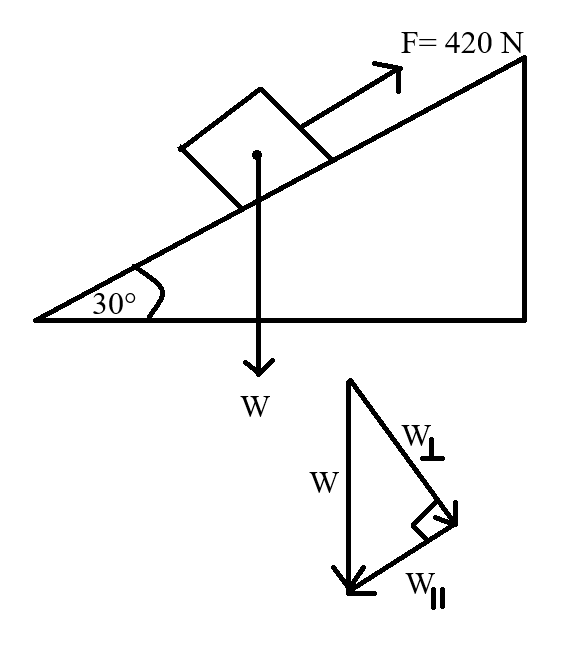
m = mass of the body = 40 kg
θ = 30°
$F_A$ = applied force = 420 N
$F_F$ = frictional force
W = weight of the body
This acts vertically downward, forming the longest side of the right triangle (hypotenuse).
$W_\perp$ = perpendicular component of the weight also known as the Normal force
This is the part of the weight that presses the body against the surface of the inclined plane.
It is the side of the triangle that is perpendicular to the incline (adjacent side relative to the 30° angle).
$W_{||}$ = parallel component of the weight also known as the Downslope force
This is the part of the weight that acts down the slope of the incline, trying to pull the body downward.
It is the side of the triangle that is aligned with the incline (opposite side relative to the 30° angle).
Frictional force opposes motion and acts upslope to prevent motion.
Hence in equilibrium, the applied force (which tries to pull the body forward) is equal to the frictional force (which opposes the motion) and the downslope force (which tries to pull the body downward).
μ = coefficient of friction
This is the ratio of the frictional force to the normal force.
$ W = mg \\[3ex] = 40(10) \\[3ex] = 400\;N \\[5ex] \underline{\text{Downslope force}} \\[3ex] W_{||} = W\sin\theta ...SOHCAHTOA \\[3ex] = 400\sin 30^\circ \\[3ex] = 400 (0.5) \\[3ex] = 200\;N \\[5ex] (a.) \\[3ex] \underline{\text{In Equilibrium}} \\[3ex] F_A = F_F + W_{||} \\[3ex] F_F = F_A - W_{||} \\[3ex] = 420 - 200 \\[3ex] = 220\;N \\[5ex] (b.) \\[3ex] \underline{\text{Normal force}} \\[3ex] W_\perp = W\cos\theta ...SOHCAHTOA \\[3ex] = 400\cos 30^\circ \\[3ex] = 400 * \dfrac{\sqrt{3}}{2} \\[5ex] = 200\sqrt{3}\;N \\[5ex] \mu = \dfrac{F_F}{W_\perp} \\[5ex] = \dfrac{220}{200\sqrt{3}} \\[5ex] = \dfrac{11}{10\sqrt{3}} \\[5ex] = \dfrac{11}{10\sqrt{3}} * \dfrac{\sqrt{3}}{\sqrt{3}} \\[5ex] = \dfrac{11\sqrt{3}}{30} $


