Malawi School Certificate Examination: Mathematics: Paper II
The Joy of the Teacher is the Success of the Students. – Samuel Chukwuemeka
Welcome to Our Site
I greet you this day,
These are the solutions to the Malawi School Certificate Examination (MSCE) Paper II Mathematics questions by
The Malawi National Examinations Board (MANEB).
Please review the Formulas, rules/laws, and theorems on the website for each topic as applicable.
If time permits and there is sufficient interest, video solutions may be provided. Please subscribe to the
YouTube channel to be notified of upcoming livestreams.
You are welcome to ask questions during the video livestreams.
If you find these resources valuable and if any of these resources were helpful in your passing the
Mathematics tests/exams, please consider making a donation:
Cash App: $ExamsSuccess or
cash.app/ExamsSuccess
PayPal: @ExamsSuccess or
PayPal.me/ExamsSuccess
Venmo: @ExamsSuccess or
Venmo.com/u/ExamsSuccess
Square: Exams Success
Buy Me a Coffee: Exams Success
Buy Me a Coffee @ Ko-Fi: Exams Success
Your donation is appreciated.
Comments, ideas, areas of improvement, questions, and constructive
criticisms are welcome.
Feel free to contact me. Please be positive in your message.
I wish you the best.
Thank you.
The Malawi National Examinations Board (MANEB)
Malawi School Certificate Examination (MSCE)
Mathematics
Paper II
Time Allowed: 2 h 30 min
8:00 – 10:30 am
Instructions
(1.) This paper contains 19 printed pages. Please check.
(2.) Write your Examination Number at the top of each page of this question paper in the spaces provided.
(3.) Answer all the six questions in Section A and any four questions from Section B.
(4.) The maximum number of marks for each answer is indicated against each question.
(5.) Scientific calculators may be used.
(6.) The blank answer sheet at the end of the question paper can be used if required.
(7.) All working must be clearly shown.
(8.) In the table provided on this page, tick against the question number you have answered.
(9.) At the end of the examination, hand in your paper to the invigilator.
(b.) Applications of Arithmetic Sequences: Meria started a business of selling maize and sold 80 bags during the first month.
If she decided to increase her sales by 20 bags every month, calculate the number of bags of maize that were sold in the 12th month of her business.
Let us begin with a working copy
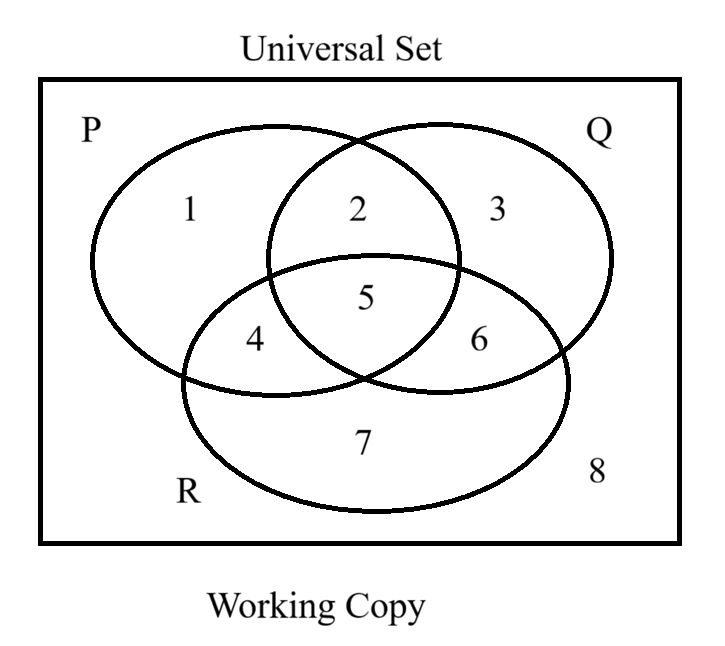
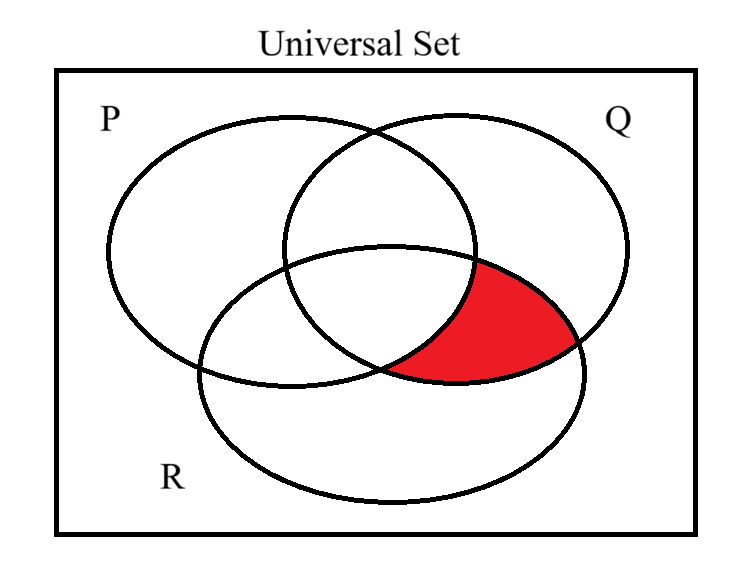
$ \mu = \{1, 2, 3, 4, 5, 6, 7, 8\} \\[5ex] P = \{1, 2, 4, 5\} \\[3ex] P' = \{3, 6, 7, 8\} \\[5ex] Q = \{2, 3, 5, 6\} \\[5ex] R = \{4, 5, 6, 7\} \\[5ex] P' \cap Q = \{3, 6\} \\[3ex] P' \cap Q \cap R = \{6\} \\[3ex] $ (a.) The region defined by $P' \cap Q \cap R$ is shaded as shown
$ (b.) \\[3ex] \underline{\text{Arithmetic Sequence}} \\[3ex] \text{1st month} = \text{1st term, } a = 80 \\[3ex] \text{common difference, } d = 20 \quad[\text{20 bags every month}] \\[3ex] \text{2nd month} = \text{2nd term} = a + d = 80 + 20 = 100 \\[3ex] \text{3rd month} = \text{3rd term} = a + 2d = 80 + 2(20) = 80 + 40 = 120 \\[3ex] \text{4th month} = \text{4th term} = a + 3d = 80 + 3(20) = 80 + 60 = 140 \\[3ex] \text{12th month} = \text{12th term} = a + 11d = 80 + 11(20) = 80 + 220 = 300 \\[3ex] $ If she decided to increase her sales by 20 bags every month, 300 bags of maize were sold in the 12th month of her business.
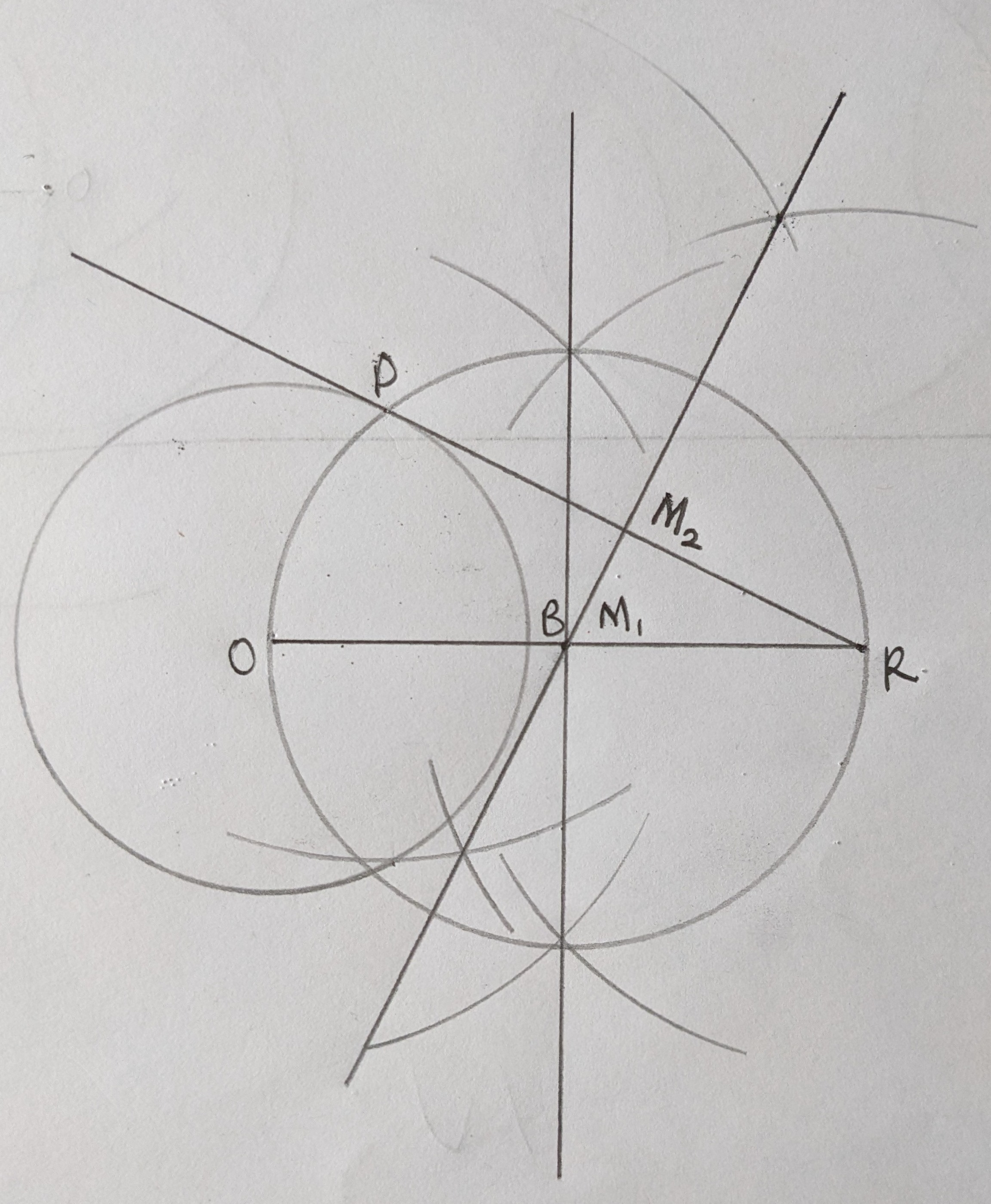
(b.) Locus and Construction: Using a pair of compasses and a ruler only, construct in the same diagram:
- a circle centre O of radius 3 cm
- a point R outside the circle and 7 cm from the centre O
- a tangent PR at P
- a perpendicular bisector of PR intersecting OR at B.
$ (a.) \\[3ex] \underline{\text{Sphere}} \\[3ex] V = \dfrac{4}{3}\pi r^3 \\[5ex] \text{where} \\[3ex] V = \text{volume} = 440\;cm^3 \\[3ex] r = \text{radius} = ? \\[3ex] \pi = \dfrac{22}{7} \\[5ex] \dfrac{4\pi r^3}{3} = 440 \\[5ex] r^3 = 440 \times \dfrac{3}{4\pi} \\[5ex] = 440 \times \dfrac{3}{4} \times \dfrac{7}{22} \\[5ex] = 5 \times 3 \times 7 \\[3ex] = 105 \\[3ex] r = \sqrt[3]{105} \\[3ex] = 4.71769398 \\[3ex] \approx 4.7\;cm \quad[\text{to one decimal place}] \\[3ex] $ (b.) The steps in the construction are:
• A circle centre O of radius 3 cm
(1.) Mark a point, O
(2.) Measure a length of 3 cm on the ruler with the compass.
(3.) With the centre at O, draw a circle.
That measured length of 3 cm becomes the radius of the circle.
• A point R outside the circle and 7 cm from the centre O
(4.) Using the ruler, draw a straight line from O measuring a length of 7 cm.
(5.) Mark the endpoint, R
This implies that $|OR| = 7\;cm$
• A tangent PR at P
The tangent to the circle is perpendicular to the radius at the point of contact
This implies that:
The point of contact should be point P
$\overline{PR}$ should be the tangent to the circle
$\overline{OP}$ should be the radius
$\overline{OR}$ should be the diameter of a new circle
So, $\overline{OP} \perp \overline{PR}$
To begin, we need to contruct the midpoint of $\overline{OR}$
(6.) Open the compass to a length greater than half the length $\overline{OR}$;
$ \dfrac{1}{2} \times |OR| \\[5ex] = \dfrac{1}{2} \times 7 \\[5ex] = 3.5\;cm \\[3ex] $ Any length greater than 3.5 cm (and preferably less than 7 cm) is fine.
For example, we can use a length of 5 cm.
(7.) From point O, draw arcs above and below $\overline{OR}$
(8.) Using the same length, from point, R, draw arcs above and below $\overline{OR}$ that intersect the previous arcs you just drew
(9.) Join the arc intersections to draw the line that bisects $\overline{OR}$ at the midpoint, say M1
(10.) With the centre, M and radius, $|OM|$, draw a second circle.
This implies that the diameter of this new circle is $\overline{OR}$
This second circle intersects the first circle at two points.
Label any intersection point as P
(11.) Draw the tangent line, $\overline{PR}$ that joins point P to point R
• A perpendicular bisector of PR intersecting OR at B
(12.) Open the compass to a length greater than half the length $\overline{PR}$
(13.) From point P, draw arcs above and below $\overline{PR}$
(14.) Using the same length, from point, R, draw arcs above and below $\overline{PR}$ that intersect the previous arcs you just drew
(15.) Join the arc intersections to draw the line that bisects $\overline{PR}$ at the midpoint, say M2
and extend that line to intersect $\overline{OR}$ at point B.
The diagram is constructed as shown:
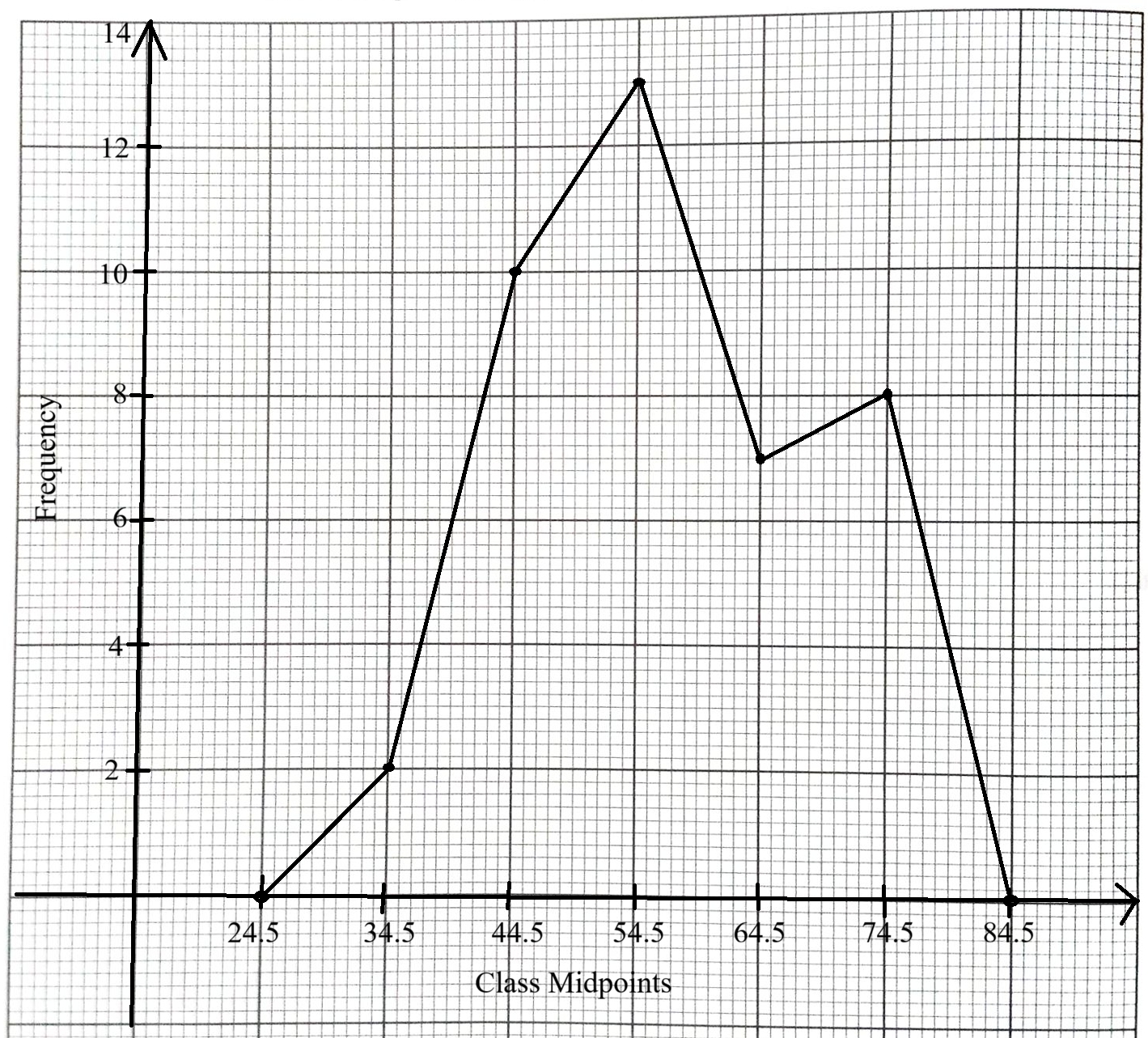
| Marks | $30 - 39$ | $40 - 49$ | $50 - 59$ | $60 - 69$ | $70 - 79$ |
| Number of students | $2$ | $10$ | $13$ | $7$ | $8$ |
Draw a frequency polygon using the information in the table.
(b.) Circle Theorems: Figure 1 shows a circle ABD with centre O and a tangent CDE at D.
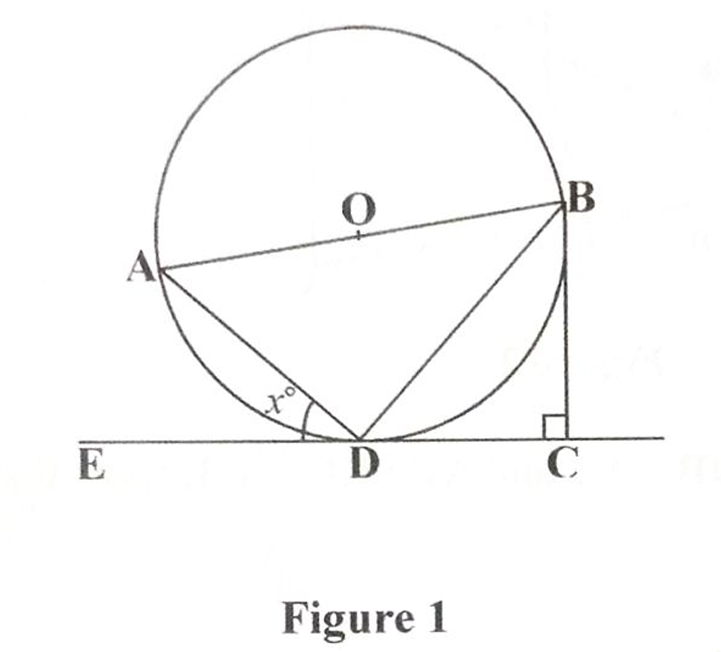
If angle ADE = x° and angle BCD = 90°, show that angle DBC = angle ABD.
To draw a frequency polygon, we plot the class midpoints on the x-axis and the frequencies on the y-axis.
Optional: To close the frequency polygon, we add one imaginary class before the first class and one imaginary class after the last class. Those classes will have frequencies of 0.
I prefer to close the frequency polygon, so we shall include the imaginary classes.
| Class Intervals | Class Midpoints | Frequency |
|---|---|---|
| $20 - 29$ (imaginary class) | $ \dfrac{20 + 29}{2} = \dfrac{49}{2} = 24.5 $ | $0$ |
| $30 - 39$ | $ \dfrac{30 + 39}{2} = \dfrac{69}{2} = 34.5 $ | $2$ |
| $40 - 49$ | $ \dfrac{40 + 49}{2} = \dfrac{89}{2} = 44.5 $ | $10$ |
| $50 - 59$ | $ \dfrac{50 + 59}{2} = \dfrac{109}{2} = 54.5 $ | $13$ |
| $60 - 69$ | $ \dfrac{60 + 69}{2} = \dfrac{129}{2} = 64.5 $ | $7$ |
| $70 - 79$ | $ \dfrac{70 + 79}{2} = \dfrac{149}{2} = 74.5 $ | $8$ |
| $80 - 89$ (imaginary class) | $ \dfrac{80 + 89}{2} = \dfrac{169}{2} = 84.5 $ | $0$ |
$ y-\text{axis} \\[3ex] 10\text{ lines} = 2\text{ units} \\[3ex] 1\text{ line} = \dfrac{2}{10} = 0.2 \\[5ex] 13 = \dfrac{13}{0.2} = 65th\text{ line} \\[5ex] 7 = \dfrac{7}{0.2} = 35th\text{ line} \\[5ex] $ (a.) The frequency polygon is drawn as shown:
$ (b.) \\[3ex] \underline{\text{Figure 1}} \\[3ex] \angle ABD = \angle ADE = x \quad \text{$\angle$ between tangent $\overline{ED}$ and chord $\overline{AD}$ = $\angle$ in alternate segment} \\[3ex] \angle ADB = 90^\circ \quad\text{$\angle$ in a semicircle} \\[3ex] \angle ABC = 90^\circ \quad \text{radius $\overline{OB}$ is $\perp$ to tangent $\overline{CB}$ at point of contact} \\[5ex] \angle ABC = \angle ABD + \angle DBC \quad[\text{Diagram}] \\[3ex] 90 = x + \angle DBC \\[3ex] \angle DBC = 90 - x \\[5ex] \angle ADE + \angle ADB + \angle BDC = 180^\circ \quad\text{sum of $\angle s$ on a straight line} \\[3ex] x + 90 + \angle BDC = 180 \\[3ex] \angle BDC = 180 - x - 90 \\[3ex] \angle BDC = 90 - x \\[5ex] \underline{\triangle BDC} \\[3ex] \angle DBC + \angle BDC + \angle BCD = 180^\circ \quad\text{sum of $\angle s$ in a triangle} \\[3ex] 90 - x + 90 - x + 90 = 180 \\[3ex] 270 - 2x = 180 \\[3ex] 270 - 180 = 2x \\[3ex] 2x = 90 \\[3ex] x = \dfrac{90}{2} \\[5ex] \angle ABD = x = 45^\circ \\[5ex] \angle DBC = 90 - x \\[3ex] = 90 - 45 \\[3ex] = 45^\circ \\[5ex] \therefore \angle ABD = \angle DBC = 45^\circ $
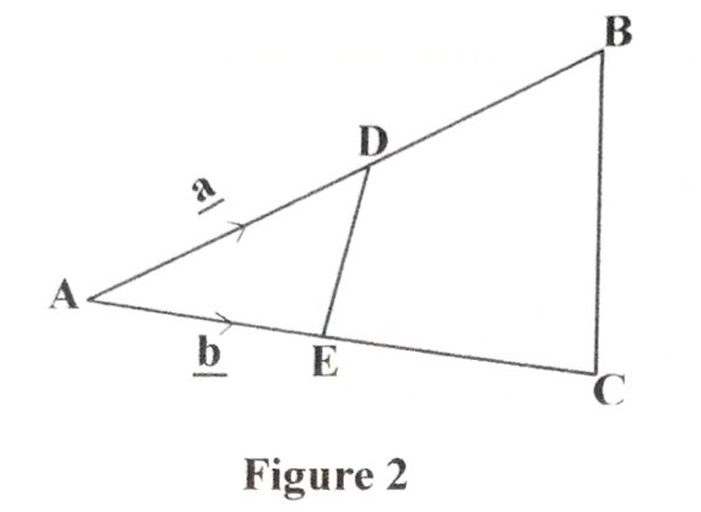
Given that $AD : DB = 1 : 3$ and $AE : EC = 1 : 3$, show that $BC$ is parallel to $DE$
(b.) Circle Theorems: Prove that the exterior angle of a cyclic quadrilateral is equal to the opposite interior angle of the quadrilateral.
Parallelism of Vectors: Given two vectors say: $\overrightarrow{A}$ and $\overrightarrow{B}$ and a scalar say k;
$\overrightarrow{A}$ and $\overrightarrow{B}$ are parallel
if $\overrightarrow{B} = k \cdot \overrightarrow{A}$
$ (a.) \\[3ex] AD : DB = 1 : 3 \\[3ex] \dfrac{AD}{DB} = \dfrac{1}{3} \\[5ex] \overrightarrow{DB} = 3\overrightarrow{AD} = 3a \\[5ex] AE : EC = 1 : 3 \\[3ex] \dfrac{AE}{EC} = \dfrac{1}{3} \\[5ex] \overrightarrow{EC} = 3\overrightarrow{AE} = 3b \\[3ex] $
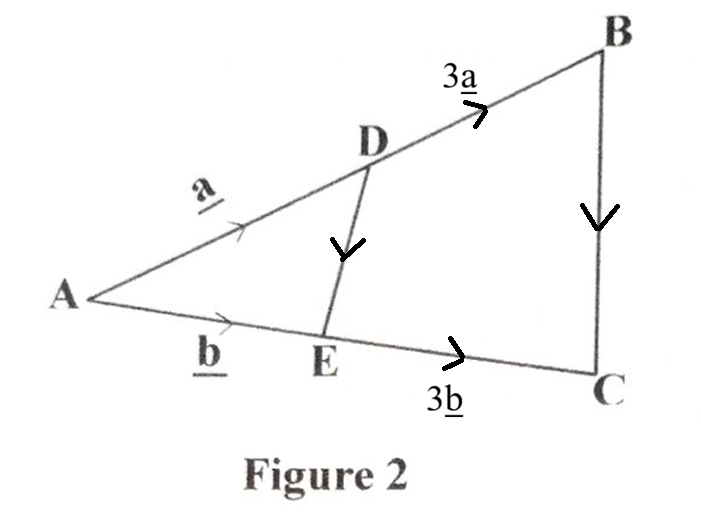
$ \overrightarrow{AB} = \overrightarrow{AD} + \overrightarrow{DB} \\[3ex] = a + 3a \\[3ex] = 4a \\[5ex] \overrightarrow{AC} = \overrightarrow{AE} + \overrightarrow{EC} \\[3ex] = b + 3b \\[3ex] = 4b \\[5ex] \overrightarrow{AD} + \overrightarrow{DE} = \overrightarrow{AE} \\[3ex] \overrightarrow{DE} = \overrightarrow{AE} - \overrightarrow{AD} \\[3ex] = b - a \\[5ex] \overrightarrow{AB} + \overrightarrow{BC} = \overrightarrow{AC} \\[3ex] \overrightarrow{BC} = \overrightarrow{AC} - \overrightarrow{AB} \\[3ex] = 4b - 4a \\[3ex] = 4(b - a) \\[3ex] = 4 \cdot \overrightarrow{AD} \\[3ex] \therefore \overrightarrow{BC} \;||\; \overrightarrow{DE} \\[3ex] $ (b.) Prove that the exterior angle of a cyclic quadrilateral is equal to the opposite interior angle of the quadrilateral.
Construction: Draw the cyclic quadrilateral $ABCD$
Extend $BC$ to point E
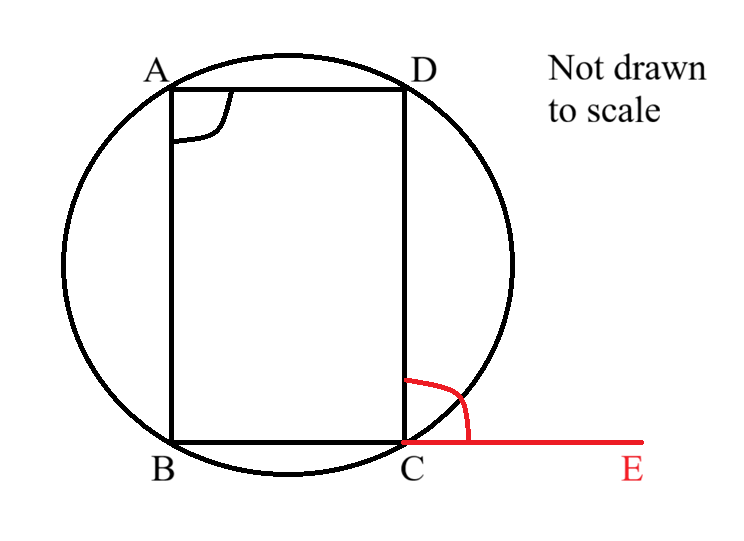
$ \underline{\text{Cyclic Quadrilateral } ABCD} \\[3ex] \angle DCE = \text{exterior $\angle$ of the cyclic quad} \\[3ex] \angle BAD = \text{interior opposite $\angle$} \\[3ex] \text{Prove: } \angle DCE = \angle BAD \\[5ex] \angle DCB + \angle DCE = 180^\circ \quad...eqn.(1) \quad[\text{sum of angles on a straight line}] \\[3ex] \angle BAD + \angle DCB = 180^\circ \quad...eqn.(2) \quad[\text{interior opposite angles of a cyclic quad.}] \\[5ex] \text{From } eqn.(2) \\[3ex] \angle DCB = 180 - \angle BAD \quad...eqn.(3) \\[3ex] \text{Substitute for $\angle DCB$ in } eqn.(1) \\[3ex] 180 - \angle BAD + \angle DCE = 180 \\[3ex] \angle DCE = 180 - 180 + \angle BAD \\[3ex] \angle DCE = \angle BAD \quad[\text{exterior $\angle$ of a cyclic quad = opposite interior $\angle$}] $
The other two sides are x cm and y cm.
If the perimeter of the triangle is 24 cm, calculate the possible values of x and y.
Let us represent the information diagramatically as shown:
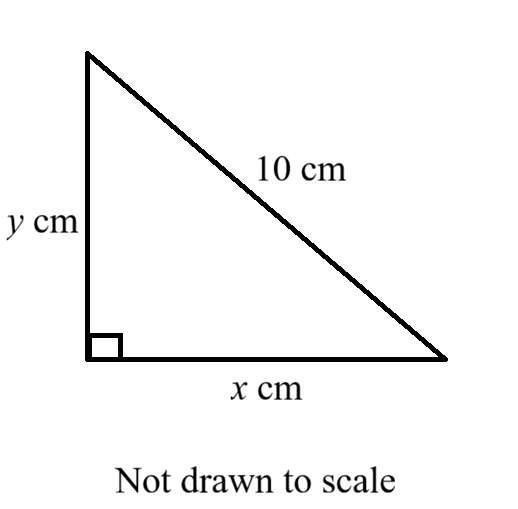
$ x + y + 10 = 24 \quad[\text{Perimeter of the right triangle}] \\[3ex] x + y = 24 - 10 \\[3ex] x + y = 14 \quad...eqn.(1) \\[5ex] x^2 + y^2 = 10^2 \quad[\text{Pythagorean Theorem}] \\[3ex] x^2 + y^2 = 100 quad...eqn.(2) \\[5ex] \underline{\text{Substitution Method}} \\[3ex] \text{From } eqn.(1) \\[3ex] x = 14 - y \quad...eqn.(3) \[5ex] \text{Substitute for $x$ in } eqn.(2) \\[3ex] (14 - y)^2 + y^2 = 100 \\[3ex] (14 - y)(14 - y) + y^2 = 100 \\[3ex] 196 - 14y - 14y + y^2 + y^2 - 100 = 0 \\[3ex] 2y^2 - 28y + 96 = 0 \\[3ex] \text{Simplify by dividing each term by } 2: \\[3ex] y^2 - 14y + 48 = 0 \\[3ex] (y - 8)(y - 6) = 0 \\[3ex] y - 8 = 0 \text{ or } y - 6 = 0 \\[3ex] y = 8\;cm \text{ or } y = 6\;cm \\[5ex] \text{Substitute for $y$ in } eqn.(2) \\[3ex] x = 14 - 8 \text{ or } x = 14 - 6 \\[3ex] x = 6\;cm \text{ or } x = 8\;cm $
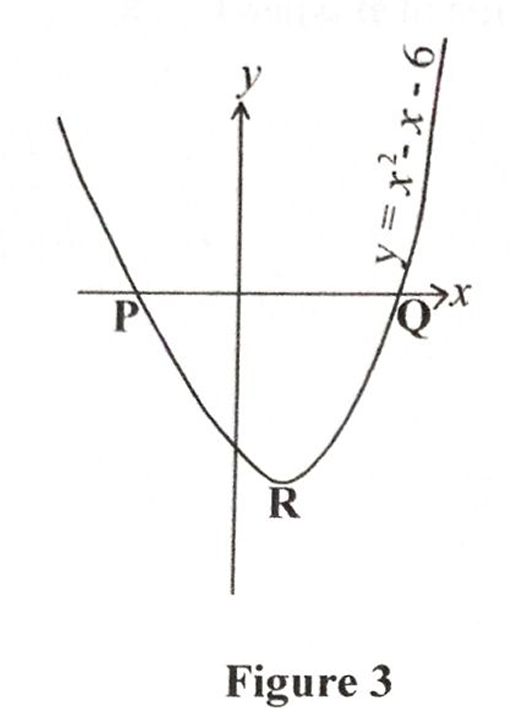
Find the:
(a.) coordinates of point P
(b.) equation of the line of symmetry
(c.) minimum value of y at point R
$ y = x^2 - x - 6 \\[3ex] y = (x + 2)(x - 3) \\[3ex] \text{When } y = 0: \text{ on the $x$-axis} \\[3ex] 0 = (x + 2)(x - 3) \\[3ex] x + 2 = 0 \text{ or } x - 3 = 0 \\[3ex] x = -2 \text{ or } x = 3 \\[3ex] (a.) \\[3ex] \text{coordinates of } P = (-2, 0) \\[5ex] \text{Compare: } y = x^2 - x - 6 \text{ to the standard form: } y = ax^2 + bx + c \\[3ex] a = 1 \\[3ex] b = -1 \\[3ex] c = -6 \\[5ex] \text{$x$-coordinate of the vertex} \\[3ex] = -\dfrac{b}{2a} \\[5ex] = -\dfrac{-1}{2(1)} \\[5ex] = \dfrac{1}{2} \\[5ex] (b.) \\[3ex] \text{equation of the line of symmetry: } x = \dfrac{1}{2} \\[5ex] (c.) \\[3ex] \text{Point $R$ is the vertex} \\[3ex] \text{minimum value of $y$ at point $R$} \\[3ex] = \text{$y$-coordinate of the vertex} \\[3ex] = \text{value of $y$ when } x = \dfrac{1}{2} \\[5ex] = \left(\dfrac{1}{2}\right)^2 - \dfrac{1}{2} - 6 \\[5ex] = \dfrac{1}{4} - \dfrac{2}{4} - \dfrac{24}{4} \\[5ex] = \dfrac{1 - 2 - 24}{4} \\[5ex] = -\dfrac{25}{4} $



