☰ Please Read Me.

Lesotho General Certificate of Secondary Education: Mathematics: Paper 3

The Joy of the Teacher is the Success of the Students. – Samuel Dominic Chukwuemeka
⚠️ Page Update Notice: This webpage is still being developed. Questions and answers are added regularly. Please check back for updates.

Welcome to Our Site


I greet you this day,
These are the solutions to the LGCSE Mathematics Paper 3 questions.
Please review the Formulas, rules/laws, and theorems on the website for each topic as applicable.
If time permits and there is sufficient interest, video solutions may be provided. Please subscribe to the YouTube channel to be notified of upcoming livestreams. You are welcome to ask questions during the video livestreams.
If you find these resources valuable and if any of these resources were helpful in your passing the Mathematics tests/exams, please consider making a donation:

Cash App: $ExamsSuccess or
cash.app/ExamsSuccess

PayPal: @ExamsSuccess or
PayPal.me/ExamsSuccess

Venmo: @ExamsSuccess or
Venmo.com/u/ExamsSuccess

Your donation is appreciated.
Comments, ideas, areas of improvement, questions, and constructive criticisms are welcome.
Feel free to contact me. Please be positive in your message.
I wish you the best.
Thank you.

Examinations Council of Lesotho
Lesotho General Certificate of Secondary Education
Mathematics
Paper 3 (Core)

2 hours
Marks: 100

Read These Instructions First
(1.) Write your name, centre number and candidate number in the relevant spaces provided at the top of this page.
(2.) Write in dark blue or black pen.
(3.) You may use an HB pencil for any diagrams or graphs.
(4.) Do not use staples, paper clips, glue or correction fluid.
(5.) Answer all questions.
(6.) Electronic calculators should be used.
(7.) If working is needed for any question, it must be shown below that question.
(8.) If the degree of accuracy is not specified in the question, and if the answer is not exact, give the answer to three significant figures. Give answers in degrees to one decimal place.
For π, use either your calculator value or 3.142.
(9.) The number of marks is given in brackets [ ] at the end of each question or part question.
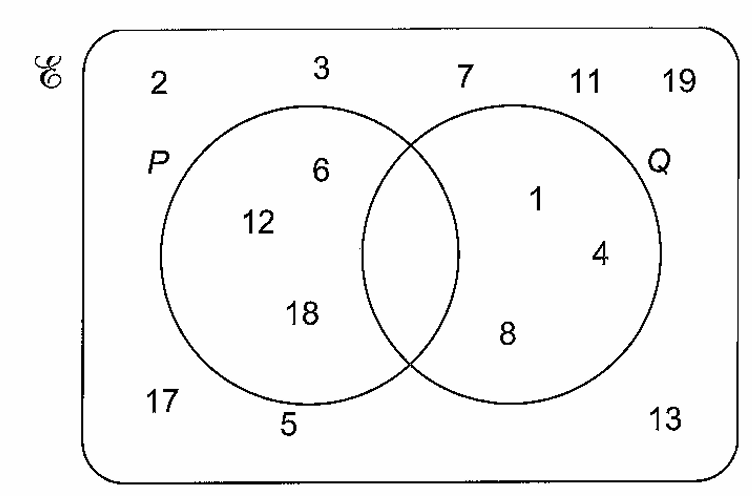
(1.) Set Theory: (a.) The Venn diagram shows the elements of set P and Q in the universal set.

Number 1

(i.) Write the type of numbers given to the elements of $(P \cup Q)'$
(ii.) Describe $P \cap Q$
(iii.) Find $n(Q)'$

(b.) In a class of 102 students,
70 joined Mathematics club,
60 joined Debate club,
15 joined neither of the clubs.
By means of a Venn diagram or otherwise, find the number of students who joined Mathematics club only.


$ (a.) (i.) \\[3ex] (P \cup Q)' = \{2, 3, 5, 7, 11, 13, 17, 19\} \\[5ex] (ii.) \\[3ex] P \cap Q \text{ is the set that contain elements that are in both } P \text{ and } Q \\[5ex] (iii.) \\[3ex] Q' = \{2, 3, 5, 6, 7, 11, 12, 13, 17, 18, 19\} \\[3ex] n(Q)' = 11 \\[3ex] $ (b.) Let:
Mathematics club be represented by M
Debate club be represented by D

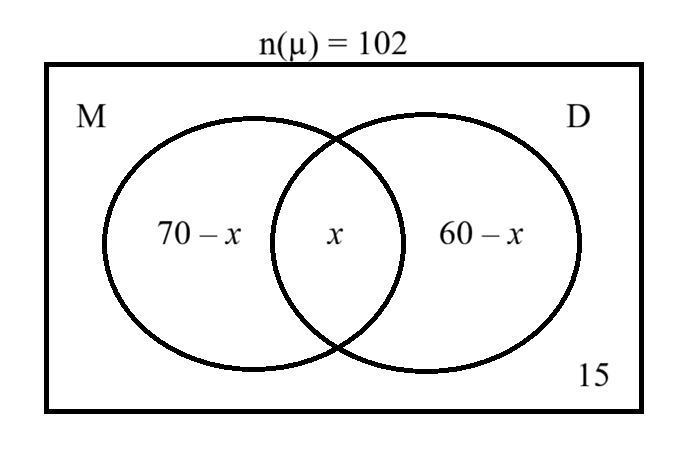
$ n(\mu) = 102 \quad{\text(cardinality of the Universal Set is the number of students)} \\[3ex] n(M) = 70 \\[3ex] n(D) = 60 \\[3ex] n(M \cap D) = \text{Both Mathematics and Debate clubs} = x \\[3ex] n(M \cap D') = \text{Mathematics club only} = 70 - x \\[3ex] n(M' \cap D) = \text{Debate club only} = 60 - x \\[3ex] n(M' \cap D') = \text{Neither Mathematics nor Debate clubs} = 15 \\[3ex] $ Let us represent the information in a Venn diagram as shown:
Number 1

$ 70 - x + 60 - x + x + 15 = 102 \\[3ex] 145 - x = 102 \\[3ex] 145 - 102 = x \\[3ex] x = 43 \\[5ex] \underline{\text{Mathematics club only}} \\[3ex] 70 - x \\[3ex] = 70 - 43 \\[3ex] = 27\text{ students} $
(2.) Sequences: (a.) Given the sequence 2, ..., 18, 54, 162, ..., ...
find the 2nd term and the 6th term of the sequence.

(b.) Another sequence is given by $-1, -1, 1, 5, 11, ...$
Find the nth term of the sequence.

(c.) The 1st term and the 5th term of the sequence are 4 and 16 respectively.
The nth term of the sequence is given by $T_n = a + d(n - 1)$.
Find
(i.) the common difference,
(ii.) the nth term.


$ (a.) \\[3ex] 2, ..., 18, 54, 162, ..., ... \\[3ex] \dfrac{54}{18} = \dfrac{162}{54} = 3 \quad\text{(common ratio)} \\[5ex] \text{This is a Geometric Sequence} \\[3ex] \text{2nd term} = 2 \times 3 = 6 \\[3ex] \text{6th term} = 162 \times 3 = 486 \\[5ex] (b.) \\[3ex] -1, -1, 1, 5, 11, ... \\[3ex] $ A quick observation of the sequence shows that it is not a/an:
Arithmetic Sequence because we do not have a common difference
Geometric Sequence because we do not have a common ratio
So, let us try to see if it is a Quadratic Sequence

$ \underline{\text{1st Difference Between Consecutive Terms}} \\[3ex] -1 - (-1) = -1 + 1 = 0 \\[3ex] 1 - (-1) = 1 + 1 = 2 \\[3ex] 5 - 1 = 4 \\[3ex] 11 - 5 = 6 \\[5ex] \text{Sequence of 1st Differences: } 0, 2, 4, 6 \\[3ex] \underline{\text{2nd Difference Between Consecutive Terms of the Sequence of First Differences}} \\[3ex] 2 - 0 = 2 \\[3ex] 4 - 2 = 2 \\[3ex] 6 - 4 = 2 \\[3ex] \text{2nd Differences are the same: The initial sequence is a Quadratic Sequence} \\[3ex] \text{General Form} = n\text{th term: } y = ax^2 + bx + c \\[3ex] \text{where: } \\[3ex] y = \text{outputs of terms} \\[3ex] x = \text{input of terms} \\[3ex] a, b, c = \text{coefficients and constant in the }n\text{th term} \\[3ex] \text{Initial Sequence: } y = -1, -1, 1, 5, 11, ... \\[3ex] ax^2 + bx + c = y \\[3ex] \text{When } x = 1 \quad\text{1st term: } y = -1 \\[3ex] a(1)^2 + b(1) + c = -1 \\[3ex] a + b + c = -1 \quad eqn.(1) \\[5ex] \text{When } x = 2 \quad\text{2nd term: } y = -1 \\[3ex] a(2)^2 + b(2) + c = -1 \\[3ex] 4a + 2b + c = -1 \quad eqn.(2) \\[5ex] \text{When } x = 3 \quad\text{2nd term: } y = 1 \\[3ex] a(3)^2 + b(3) + c = 1 \\[3ex] 9a + 3b + c = 1 \quad eqn.(3) \\[5ex] eqn.(2) - eqn.(1) \implies \\[3ex] 3a + b = 0 \quad eqn.(4) \\[5ex] eqn.(3) - eqn.(2) \implies \\[3ex] 5a + b = 2 \quad eqn.(5) \\[5ex] eqn.(5) - eqn.(4) \implies \\[3ex] 2a = 2 \\[3ex] a = \dfrac{2}{2} \\[5ex] a = 1 \\[5ex] \text{Substitute for } a \text{ in } eqn.(4) \\[3ex] 3(1) + b = 0 \\[3ex] 3 + b = 0 \\[3ex] b = 0 - 3 \\[3ex] b = -3 \\[5ex] \text{Substitute for } a \text{ and } b \text{ in } eqn.(1) \\[3ex] 1 + (-3) + c = -1 \\[3ex] -2 + c = -1 \\[3ex] c = -1 + 2 \\[3ex] c = 1 \\[5ex] n\text{th term, } y = x^2 - 3x + 1 \\[5ex] (c.) \\[3ex] a = \text{1st term} = 4 \\[3ex] d = \text{common difference} \\[3ex] n = \text{number of terms} \\[3ex] T_n = n\text{th term} \\[5ex] (i.) \\[3ex] T_n = a + d(n - 1) \\[3ex] T_5 = 4 + d(5 - 1) = 16 \\[3ex] 4 + 4d = 16 \\[3ex] 4d = 16 - 4 \\[3ex] 4d = 12 \\[3ex] d = \dfrac{12}{4} \\[5ex] d = 3 \\[5ex] (ii.) \\[3ex] T_n = 4 + 3(n - 1) \\[3ex] = 4 + 3n - 3 \\[3ex] = 3n + 1 $
(3.) Mathematics of Finance: (a.) Teboho and Sebolelo share M72 000 in the ratio 3 : 5.
Calculate
(i.) Teboho's share,
(ii.) the percentage of Sebolelo's share.

(b.) Lebeha invested part of M10 000 at 2.5% per annum simple interest and the remaining amount at 1.9% per annum simple interest.
He obtained the total interest of M678 after three years.
Calculate the amount invested at 2.5%.


$ (a.) \\[3ex] \text{Teboho : Sebolelo} = \text{Ratio of } 3 : 5 \\[3ex] \text{Sum of ratios} = 3 + 5 = 8 \\[3ex] \text{Amount shared} = M72 000 \\[5ex] (i.) \\[3ex] \text{Teboho's share} = \dfrac{3}{8} \times 72000 \\[5ex] = 3 \times 900 \\[3ex] = M2700 \\[5ex] (ii.) \\[3ex] \text{Percentage of Sebolelo's share} = \dfrac{5}{8} \times 100\% \\[5ex] = 62.5\% \\[5ex] (b.) \\[3ex] SI = P \times r \times t \\[3ex] \text{Where} \\[3ex] SI = \text{Simple Interest} \\[3ex] P = \text{Principal} \\[3ex] r = \text{rate} \\[3ex] t = \text{time} = 3\text{ years} \\[3ex] $ Let us represent the information in a table for easier computation.
Let the:
part of M10 000 invested at 2.5% per annum simple interest = $x$
part invested at 1.9% per annum simple interest = $10000 - x$

Account Principal, P (M) rate, r (%) time, t (years) Simple Interest, SI (M)
Part 1 $x$ $ 2.5\% = \dfrac{2.5}{100} = 0.025 $ $3$ $0.075x$
Part 2 $10000 - x$ $ 1.9\% = \dfrac{1.9}{100} = 0.019 $ $3$ $0.057(10000 - x)$

$ 0.075x + 0.057(10000 - x) = 678 \quad\text{(total interest of M678)} \\[3ex] 0.075x + 570 - 0.057x = 678 \\[3ex] 0.018x = 678 - 570 \\[3ex] 0.018x = 108 \\[3ex] x = \dfrac{108}{0.018} \\[5ex] x = M6000 \\[3ex] $ The amount invested at 2.5% is M6000
(4.)


(5.)


(6.)


(7.)


(8.)

(9.)


(10.)


(11.)


(12.)


Cash App: Your donation is appreciated. PayPal: Your donation is appreciated. Venmo: Your donation is appreciated. YouTube: Please Subscribe, Share, and Like my Channel