☰ Please Read Me.

Secondary School Certificate I (SSC-I)
2026 1st Annual

The Joy of the Teacher is the Success of the Students. – Samuel Dominic Chukwuemeka

Welcome to Our Site


I greet you this day,
These are the solutions to the Federal Board of Intermediate & Secondary Education: Secondary School Certificate I (SSC-I) 2026 Mathematics questions.
Please review the Formulas, rules/laws, and theorems on the website for each topic as applicable.
If time permits and there is sufficient interest, video solutions may be provided. Please subscribe to the YouTube channel to be notified of upcoming livestreams. You are welcome to ask questions during the video livestreams.
If you find these resources valuable and if any of these resources were helpful in your passing the Mathematics tests/exams, please consider making a donation:

Cash App: $ExamsSuccess or
cash.app/ExamsSuccess

PayPal: @ExamsSuccess or
PayPal.me/ExamsSuccess

Venmo: @ExamsSuccess or
Venmo.com/u/ExamsSuccess

Square: Exams Success

Buy Me a Coffee: Exams Success

Buy Me a Coffee @ Ko-Fi: Exams Success

Your donation is appreciated.
Comments, ideas, areas of improvement, questions, and constructive criticisms are welcome.
Feel free to contact me. Please be positive in your message.
I wish you the best.
Thank you.

SECTION A (Marks 15):
Time allowed: 20 Minutes
Question (1.)
(1.) Indices: $\left(\dfrac{1}{16}\right)^{-\dfrac{3}{2}}$ =

$ A.\;\; \dfrac{1}{4} \\[5ex] B.\;\; 4 \\[3ex] C.\;\; 16 \\[3ex] D.\;\; 64 \\[3ex] $

$ \left(\dfrac{1}{16}\right)^{-\dfrac{3}{2}} \\[7ex] = \dfrac{1}{\left(\dfrac{1}{16}\right)^{\dfrac{3}{2}}} \quad(\text{Law 6 Exp}) \\[9ex] ......................................................... \\[3ex] \left(\dfrac{1}{16}\right)^{\dfrac{3}{2}} \\[7ex] = \left(\sqrt{\dfrac{1}{16}}\right)^3 \quad(\text{Law 7 Exp}) \\[5ex] = \left(\dfrac{1}{4}\right)^3 \\[5ex] = \dfrac{1^3}{4^3} \quad(\text{Law 5 Exp}) \\[5ex] = \dfrac{1}{64} \\[5ex] ......................................................... \\[3ex] = 1 \div \dfrac{1}{64} \\[5ex] = 1 \times \dfrac{64}{1} \\[5ex] = 64 $
(2.) Numbers: 4500 in scientific notation:

$ A.\;\; 4.5 \times 10^3 \\[3ex] B.\;\; 45 \times 10^3 \\[3ex] C.\;\; 4.5 \times 10^2 \\[3ex] D.\;\; 0.45 \times 10^5 \\[3ex] $

The scientific notation of a number is of the form: $a \times 10^n$
where $1 \le a \lt 10$ and $n$ is an integer exponent.

To convert a number to scientific notation, we:
(1.) Place the decimal point after the first non-zero digit to find $a$.
(2.) Count the number of places the decimal point is moved to determine the absolute value of $n$.
The sign of the exponent depends on the direction moved:
Moving the decimal point to the left yields a positive exponent ($n > 0$).
Moving the decimal point to the right yields a negative exponent ($n < 0$).
In that regard,

$ 4500 \\[3ex] = 4.5 \times 10^3 \quad(\text{Moved the decimal point 3 places to the left}) $
(3.) Binary Relation: Which one is binary relation?

$ A.\;\; \{1, 2, 3\} \\[3ex] B.\;\; \{(1, 2), (2, 3)\} \\[3ex] C.\;\; \{1 \rightarrow 2 \rightarrow 3\} \\[3ex] D.\;\; \{1, 2\} \times \{3\} \\[3ex] $

A binary relation between two sets is a set of ordered pairs (x, y), where the first element, x is related to the second element, y.
Even though Option D is a binary relation defined via the Cartesian product, Option B is explicitly written as a set of ordered pairs.
So, Option B is the correct answer.
(4.) Factors and Multiples: Highest common factor of $-12x^2y^2, 6xy^3, 24x^2y^2$ is:

$ A.\;\; -6xy \\[3ex] B.\;\; -6x^2y^3 \\[3ex] C.\;\; 6xy^2 \\[3ex] D.\;\;24y^3x^2 \\[3ex] $

The common factors are written in black, dark blue, green, and purple.

$ -12x^2y^2 = -2 \times \color{black}{2} \times \color{darkblue}{3} \times \color{green}{x} \times x \times \color{purple}{y^2} \\[3ex] 6xy^3 = \color{black}{2} \times \color{darkblue}{3} \times \color{green}{x} \times y \times \color{purple}{y^2} \\[3ex] 24x^2y^2 = \color{black}{2} \times 2 \times 2 \times \color{darkblue}{3} \times \color{green}{x} \times x \times \color{purple}{y^2} \\[5ex] HCF = \color{black}{2} \times \color{darkblue}{3} \times \color{green}{x} \times \color{purple}{y^2} \\[3ex] = 6xy^2 $
(5.) Linear Inequality: $x + 3 \gt 5$ implies:

$ A.\;\; x = 0 \\[3ex] B.\;\; x \lt 2 \\[3ex] C.\;\; x \le 2 \\[3ex] D.\;\; x \gt 2 \\[3ex] $

$ x + 3 \gt 5 \\[3ex] x \gt 5 - 3 \\[3ex] x \gt 2 $
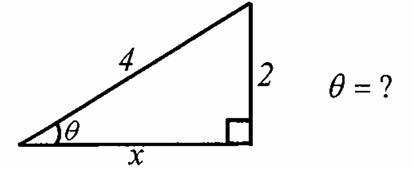
(6.) Trigonometry: Triangles: Number 1-6

$ A.\;\; 90^\circ \\[3ex] B.\;\; 60^\circ \\[3ex] C.\;\; 30^\circ \\[3ex] D.\;\; 0^\circ \\[3ex] $

$ \underline{\text{SOHCAHTOA}} \\[3ex] \sin\theta = \dfrac{\text{opp}}{\text{hyp}} \\[5ex] = \dfrac{2}{4} \\[5ex] = 0.5 \\[5ex] \theta = \sin^{-1}(0.5) \\[3ex] = 30^\circ \quad(\text{Unit Circle Trigonometry}) $
(7.) Bearings and Distances: If a plane files on a bearing of 180°, it is moving towards:

A. North
B. South
C. East
D. West


Three-figure (or three-digt) bearings are measured clockwise starting from the True North ($000^\circ$)
North ($N$): $000^\circ$ (or $360^\circ$)
East ($E$): $090^\circ$ (a $90^\circ$ clockwise turn from North)
South ($S$): $180^\circ$ (a $180^\circ$ clockwise turn from North, directly opposite North)
West ($W$): $270^\circ$ (a $270^\circ$ clockwise turn from North)

180° N (000°) E (090°) S (180°) W (270°)
Since a bearing of $180^\circ$ points directly downwards along the cardinal axis opposite to North, the plane is moving towards South.
(8.) Trigonometry: Triangles: If two triangles are equal, then their corresponding sides are:

A. Equal
B. Unequal
C. Unproportional
D. Perpendicular


Corresponding Parts of Congruent Triangles are Congruent:
If two triangles are equal, then their corresponding sides are equal.
(9.) Trigonometry: $ \dfrac{1}{\sin\theta} = \\[5ex] A.\;\; \tan\theta \\[3ex] B.\;\; \cos\theta \\[3ex] C.\;\; \sec\theta \\[3ex] D.\;\; \csc\theta \\[3ex] $

$ \dfrac{1}{\sin\theta} = \csc\theta \quad(\text{Reciprocal Identities}) $
(10.) Trigonometry: Triangles: The points where the medians of a triangle intersect is called the:

A. Incentre
B. Circumcentre
C. Centroid
D. Orthocentre


The points where the medians of a triangle intersect is called the centroid.
(11.) Trigonometry: Triangles: A triangular road sign has all sides equal.
What type of triangle is it?

A. Right-angled
B. Equilateral
C. Isosceles
D. Scalene


A triangle is a polygon with three sides and three angles.
An equilateral triangle is a triangle with three equal sides.
(12.) Locus and Construction: The locus of points equidistant from two given points is the:

A. Perpendicular bisector
B. Angle bisector
C. Median
D. Altitude


The locus of points equidistant from two given points is the perpendicular bisector of the line segment joining them.
(13.) Statistics: Data Organization: Class mark of interval $(15 - 20)$ is:

$ A.\;\; 15 \\[3ex] B.\;\; 17.5 \\[3ex] C.\;\; 20 \\[3ex] D.\;\; 35 \\[3ex] $

$ \text{Class mark (or Class Midpoint) of } 15 - 20 \\[3ex] = \dfrac{15 + 20}{2} \\[5ex] = \dfrac{35}{2} \\[5ex] = 17.5 $
(14.) Probability: The probability of an event CANNOT be:

$ A.\;\; 0 \\[3ex] B.\;\; 0.5 \\[3ex] C.\;\; 1 \\[3ex] D.\;\; 2 \\[3ex] $

0 is the probability of an event that will never occur.
1 is the probability of an event that must occur.
The probability of an event lies between 0 and 1, where both endpoints are included.
It cannot be less than 0 or more than 1.
This implies that the probability of an event cannot be 2.
(15.) Probability: A boy scored 3 goals in 9 matches.
His relative frequency of scoring goal is:

$ A.\;\; 9 \\[3ex] B.\;\; 3 \\[3ex] C.\;\; \dfrac{1}{2} \\[5ex] D.\;\; \dfrac{1}{3} \\[5ex] $

$ \text{Relative Frequency} = \dfrac{\text{Number of goals}}{\text{Number of matches}} \\[5ex] = \dfrac{3}{9} \\[5ex] = \dfrac{1}{3} $


Total Marks Sections B and C : 60
Time allowed: 2:40 Hours

SECTION B: (Marks 36)
Question (2.)
(i.) Indices: Simplify the following expression using laws of indices:

$ (a.)\;\; \dfrac{2^{\dfrac{2}{3}} \cdot 2^{\dfrac{1}{7}}}{2^{\dfrac{1}{2}}} \\[7ex] (b.)\;\; \dfrac{3^{-\dfrac{1}{2}} \cdot 3^{\dfrac{1}{2}}}{3^{\dfrac{1}{2}}} \\[7ex] $

$ (a.) \\[3ex] \dfrac{2^{\dfrac{2}{3}} \cdot 2^{\dfrac{1}{7}}}{2^{\dfrac{1}{2}}} \\[7ex] = 2^{\dfrac{2}{3} + \dfrac{1}{7} - \dfrac{1}{2}} \quad[\text{Laws 1 and 2 Exp}] \\[7ex] ................................................ \\[3ex] \dfrac{2}{3} + \dfrac{1}{7} - \dfrac{1}{2} \\[5ex] \text{LCM} = 3 \cdot 7 \cdot 2 = 42 \\[3ex] = \dfrac{14(2) + 6(1) - 21(1)}{42} \\[5ex] = \dfrac{28 + 6 - 21}{42} \\[5ex] = \dfrac{13}{42} \\[5ex] ................................................ \\[3ex] = 2^{\dfrac{13}{42}} \\[7ex] (b.) \\[3ex] \dfrac{3^{-\dfrac{1}{2}} \cdot 3^{\dfrac{1}{2}}}{3^{\dfrac{1}{2}}} \\[7ex] = \dfrac{3^{-\dfrac{1}{2} + \dfrac{1}{2}}}{3^{\dfrac{1}{2}}} \quad[\text{Law 1 Exp}] \\[7ex] = \dfrac{3^0}{3^{\dfrac{1}{2}}} \\[7ex] = \dfrac{1}{3^{\dfrac{1}{2}}} \quad[\text{Law 4 Exp}] $
OR
Probability: In a bag with 10 balls, there are 7 black and 3 white balls.
If one ball is selected at random from the bag, calculate:
(a.) The probability of selecting a white ball
(b.) The probability of selecting a black ball
(c.) The sum of all the probability


Let:
sample space = S
black = B
white = W

$ S = \{\text{7 black, 3 white}\} \\[3ex] n(S) = 7 + 3 = 10\text{ balls} \\[3ex] n(B) = 7 \\[3ex] n(W) = 3 \\[5ex] (a.) \\[3ex] P(W) = \dfrac{n(W)}{n(S)} \\[5ex] = \dfrac{3}{10} \\[5ex] (b.) \\[3ex] P(B) = \dfrac{n(B)}{n(S)} \\[5ex] = \dfrac{7}{10} \\[5ex] (c.) \\[3ex] P(W) + P(B) \\[3ex] = \dfrac{3}{10} + \dfrac{7}{10} \\[5ex] = \dfrac{10}{10} \\[5ex] = 1 $
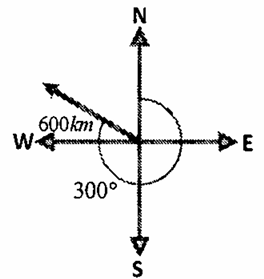
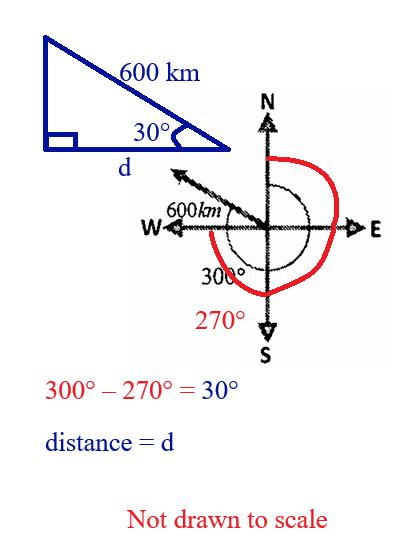
(ii.) Trigonometry: Bearings and Distances: A plane travels 600 km on a bearing of 300°.
How far west did the plane travel?

Number 2ii


Let the distance far west traveled by the plane = d
Number 2ii

$ \underline{\text{SOHCAHTOA}} \\[3ex] \cos 30^\circ = \dfrac{d}{600} \\[5ex] d = 600\cos 30^\circ \\[3ex] = 600 \times \dfrac{\sqrt{3}}{2} \quad[\text{Unit Circle Trigonometry}] \\[5ex] = 300\sqrt{3}\;km $
OR
Applications of Logarithms: An earthquake that occurred in Pakistan in 2005, measured 7.6 on the Richter scale.
In 1978, an earthquake in China measured 8.2 on the Richter scale.
How many times, the China's earthquake was stronger than the Pakistan's earthquake? $\left[\text{Use } M = \log\left(\dfrac{I}{I_o}\right)\right]$


$ M_1 = \text{earthquake magnitude in Pakistan} = 7.6 \\[3ex] I_1 = \text{earthquake intensity in Pakistan} = ? \\[3ex] M_2 = \text{earthquake magnitude in China} = 8.2 \\[3ex] I_2 = \text{earthquake intensity in China} = ? \\[5ex] \Delta M = \text{Difference in magnitude} \\[3ex] = M_2 - M_1 \\[3ex] = 8.2 - 7.6 \\[3ex] = 0.6 \\[5ex] \Delta M = \log\left(\dfrac{I_2}{I_1}\right) \\[5ex] \dfrac{I_2}{I_1} = 10^{\Delta M} \\[5ex] = 10^{0.6} \\[5ex] I_2 = I_1 \times 10^{0.6} \\[3ex] $ The earthquake intensity in China in 1978 is $10^{0.6}$ times stronger than the earthquake intensity in Pakistan in 2005.
(iii.) Set Theory: If $A = \{1, 3\}$ and $B = \{2, 4\}$:
(a.) Write the Cartesian product $A \times B$
(b.) Find $R_1 = \{(x, y) | x \in A,\; y \in B \land x \gt y\}$


The Cartesian product, Set $A$ cross Set $B$ is the set of all possible ordered pairs of the form, $(a, b)$ where $a \in A$ and $b \in B$

$ (a.) \\[3ex] A \times B = \{(1, 2), (1, 4), (3, 2), (3, 4)\} \\[5ex] (b.) \\[3ex] x \gt y \\[3ex] 3 \gt 2 \\[3ex] R_1 = \{(3, 2)\} $
OR
Linear Functions: Find the equation of a line through the point $(1, 3)$ and the point of intersection of lines $2x - 3y + 4 = 0$ and $4x + y - 1 = 0$


$ \text{Line 1: } 2x - 3y + 4 = 0 \\[3ex] 2x - 3y = -4 \quad...eqn.(1) \\[5ex] \text{Line 2: } 4x + y - 1 = 0 \\[3ex] 4x + y = 1 \quad...eqn.(2) \\[5ex] 2 \times eqn.(1) \rightarrow \\[3ex] 4x - 6y = -8 \quad...eqn.(3) \\[5ex] eqn.(2) - eqn.(3) \rightarrow \\[3ex] y - (-6y) = 1 - (-8) \\[3ex] y + 6y = 1 + 8 \\[3ex] 7y = 9 \\[3ex] y = \dfrac{9}{7} \\[5ex] 3 \times eqn.(2) \rightarrow \\[3ex] 12x + 3y = 3 \quad...eqn.(4) \\[5ex] eqn.(1) + eqn.(4) \rightarrow \\[3ex] 2x + 12x = -4 + 3 \\[3ex] 14x = -1 \\[3ex] x = -\dfrac{1}{14} \\[5ex] \text{Point 1: } (x, y) = (1, 3) \\[3ex] x_1 = 1 \\[3ex] y_1 = 3 \\[5ex] \text{Point 2: } (x, y) = \left(-\dfrac{1}{14}, \dfrac{9}{7}\right) \\[5ex] x_2 = -\dfrac{1}{14} \\[5ex] y_2 = \dfrac{9}{7} \\[5ex] \text{Slope, } m = \dfrac{y_2 - y_1}{x_2 - x_1} \\[5ex] = \dfrac{\dfrac{9}{7} - 3}{-\dfrac{1}{14} - 1} \\[9ex] = \dfrac{9 - 21}{7} \div \dfrac{-1 - 14}{14} \\[5ex] = -\dfrac{12}{7} \times \dfrac{14}{-15} \\[5ex] = -\dfrac{4}{1} \times -\dfrac{2}{5} \\[5ex] = \dfrac{8}{5} \\[5ex] y - y_1 = m(x - x_1) \quad[\text{Point – Slope Form}] \\[3ex] y - 3 = \dfrac{8}{5}(x - 1) \\[5ex] 5(y - 3) = 8(x - 1) \\[3ex] 5y - 15 = 8x - 8 \\[3ex] 8x - 8 - 5y + 15 = 0 \\[3ex] 8x - 5y + 7 = 0 $
(iv.) Linear Inequalities: Solve the inequality, and plot the solution on real number line.

$-3x + 11 \ge 5(x + 7) - 32 \ge 3x - 1 \quad \forall x \in \mathbb{R}$


$ \underline{\text{Compound Linear Inequality}} \\[3ex] -3x + 11 \ge 5(x + 7) - 32 \ge 3x - 1 \quad \forall x \in \mathbb{R} \\[5ex] \underline{\text{1st Part of the Compound Linear Inequality}} \\[3ex] -3x + 11 \ge 5(x + 7) - 32 \\[3ex] -3x + 11 \ge 5x + 35 - 32 \\[3ex] -3x - 5x \ge 35 - 32 - 11 \\[3ex] -8x \ge -8 \\[3ex] x \le \dfrac{-8}{-8} \quad[\text{Division by a negative; Inequality is reveresed}] \\[5ex] x \le 1 \\[5ex] \underline{\text{2nd Part of the Compound Linear Inequality}} \\[3ex] 5(x + 7) - 32 \ge 3x - 1 \\[3ex] 5x + 35 - 32 \ge 3x - 1 \\[3ex] 5x - 3x \ge -1 - 35 + 32 \\[3ex] 2x \ge -4 \\[3ex] x \ge -\dfrac{4}{2} \\[5ex] x \ge -2 \\[3ex] -2 \le x \\[5ex] \underline{\text{Combining Both Solutions}} \\[3ex] -2 \le x \le 1 \\[3ex] $ The solution represented on a real number line is:

Number 2iv
OR
Factoring Quadratic Trinomials: Factorize the quadratic expression: $3x^2 + 16x - 12$


$ \underline{\text{Factoring Quadratic Trinomials}} \\[3ex] 3x^2 + 16x - 12 \\[3ex] 3x^2 \times -12 = -36x^2 \\[3ex] \text{Factors are: } 18x \text{ and } -2x \\[3ex] \implies \\[3ex] 3x^2 + 18x - 2x - 12 \\[3ex] 3x(x + 6) - 2(x + 6) \\[3ex] (x + 6)(3x - 2) \\[5ex] \underline{\text{Check}} \\[3ex] (x + 6)(3x - 2) \\[3ex] 3x^2 - 2x + 18x - 12 \\[3ex] 3x^2 + 16x - 12 $
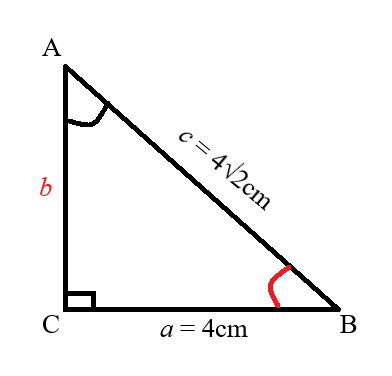
(v.) Trigonometry: Triangles: Solve the right-angled triangle $\triangle ABC, \;\; m\angle C = 90^\circ, \;\; a = 4cm, \;\; c = 4\sqrt{2}cm$


Let us represent the information diagrammatically.
Number 2v

$ \text{Calculate side } b \\[3ex] \triangle ABC \\[3ex] hyp^2 = leg^2 + leg^2 \quad[\text{Pythagorean Theorem}] \\[3ex] c^2 = a^2 + b^2 \\[3ex] 4^2 + b^2 = (4\sqrt{2})^2 \\[3ex] b^2 = (4\sqrt{2})^2- 4^2 \\[3ex] = 4^2 \times (\sqrt{2})^2 - 16 \\[3ex] = 16(2) - 16 \\[3ex] = 32 - 16 \\[3ex] = 16 \\[3ex] b = \sqrt{16} \\[3ex] = 4\;cm \\[5ex] \text{Calculate } \angle A \\[3ex] \dfrac{\sin\angle A}{a} = \dfrac{\sin 90^\circ}{c} \quad[\text{Sine Rule}] \\[5ex] \sin 90^\circ = 1 \quad[\text{Unit Circle Trigonometry}] \\[3ex] \dfrac{\sin\angle A}{4} = \dfrac{1}{4\sqrt{2}} \\[5ex] \sin\angle A = \dfrac{4 \times 1}{4\sqrt{2}} \\[5ex] = \dfrac{1}{\sqrt{2}} \\[5ex] \angle A = \sin^{-1}\left(\dfrac{1}{\sqrt{2}}\right) \\[5ex] = 45^\circ \quad[\text{Unit Circle Trigonometry}] \\[5ex] \text{Calculate } \angle B \\[3ex] \dfrac{\sin\angle B}{b} = \dfrac{\sin 90^\circ}{c} \quad[\text{Sine Rule}] \\[5ex] \dfrac{\sin\angle B}{4} = \dfrac{1}{4\sqrt{2}} \\[5ex] \sin\angle B = \dfrac{4 \times 1}{4\sqrt{2}} \\[5ex] = \dfrac{1}{\sqrt{2}} \\[5ex] \angle B = \sin^{-1}\left(\dfrac{1}{\sqrt{2}}\right) \\[5ex] = 45^\circ \quad[\text{Unit Circle Trigonometry}] $
OR
Trigonometry: Verify that $\sin^2\theta + \cos^2\theta = 1$


We are asked to prove the Pythagorean Identity.
Let us use the same right-angled triangle we used in the previous question to prove this identity.
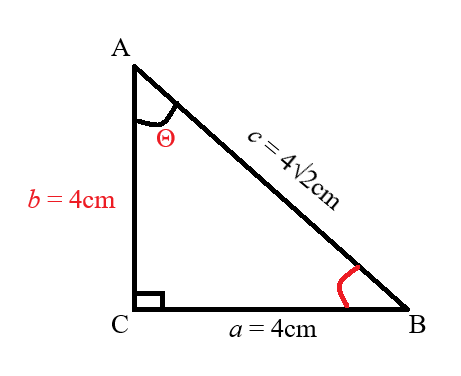
Number 2v-alternate

$ \triangle ABC \\[3ex] \text{Verify that: } \sin^2\theta + \cos^2\theta = 1 \\[3ex] \text{From the Left Hand Side (LHS):} \\[3ex] \underline{\text{SOHCAHTOA}} \\[3ex] \sin\theta = \dfrac{opp}{hyp} = \dfrac{4}{4\sqrt{2}} = \dfrac{1}{\sqrt{2}} \\[5ex] \sin^2\theta = \left(\dfrac{1}{\sqrt{2}}\right)^2 = \dfrac{1^2}{(\sqrt{2})^2} = \dfrac{1}{2} \\[5ex] \cos\theta = \dfrac{adj}{hyp} = \dfrac{4}{4\sqrt{2}} = \dfrac{1}{\sqrt{2}} \\[5ex] \cos^2\theta = \left(\dfrac{1}{\sqrt{2}}\right)^2 = \dfrac{1}{2} \\[5ex] \sin^2\theta + \cos^2\theta \\[3ex] = \dfrac{1}{2} + \dfrac{1}{2} \\[5ex] = 1 \\[3ex] = \text{Right Hand Side (RHS)} $
(vi.) Linear Functions: Find the gradient of the line passing through the points $A(2, 3)$ and $B(6, 11)$.


$ \text{Point A: } (2, 3) \\[3ex] x_1 = 2 \\[3ex] y_1 = 3 \\[5ex] \text{Point B: } (6, 11) \\[3ex] x_2 = 6 \\[3ex] y_2 = 11 \\[5ex] \text{Gradient, } m = \dfrac{y_2 - y_1}{x_2 - x_1} \\[5ex] = \dfrac{11 - 3}{6 - 2} \\[5ex] = \dfrac{8}{4} \\[5ex] = 2 $
OR
Set Theory: Prove by using Venn diagram $(P \cup Q) \cup R = P \cup (Q \cup R)$.
$P = \{0, 1, 2, 3\}$, $Q = \{2, 3, 4, 5, 6\}$, $R = \{5, 6, 7, 8, 9\}$


$ \mu = \{0, 1, 2, 3, 4, 5, 6, 7, 8, 9\} \\[3ex] P = \{0, 1, 2, 3\} \\[3ex] P' = \{4, 5, 6, 7, 8, 9\} \\[5ex] Q = \{2, 3, 4, 5, 6\} \\[3ex] Q' = \{0, 1, 7, 8, 9\} \\[5ex] R = \{5, 6, 7, 8, 9\} \\[3ex] R' = \{0, 1, 2, 3, 4\} \\[5ex] \underline{\text{All Three}} \\[3ex] P \cap Q \cap R = \phi \\[5ex] \underline{\text{Only Two}} \\[3ex] P \cap Q = \{2, 3\} \\[3ex] P \cap Q \cap R' = \{2, 3\} \quad[\text{P and Q only}] \\[5ex] P \cap R = \phi \\[3ex] P \cap Q \cap R' = \phi \quad[\text{P and R only}] \\[5ex] Q \cap R = \{5, 6\} \\[3ex] Q \cap R \cap P' = \{5, 6\} \quad[\text{Q and R only}] \\[5ex] \underline{\text{Only One}} \\[3ex] P \cap Q' = \{0, 1\} \\[3ex] P \cap Q' \cap R' = \{0, 1\} \quad[\text{P only}] \\[5ex] Q \cap P' = \{4, 5, 6\} \\[3ex] Q \cap P' \cap R' = \{4\} \quad[\text{Q only}] \\[5ex] R \cap Q' = \{7, 8, 9\} \\[3ex] R \cap Q' \cap P' = \{7, 8, 9\} \quad[\text{R only}] \\[5ex] (P \cup Q) \cup R = P \cup (Q \cup R) \\[5ex] \underline{\text{LHS}} \\[3ex] (P \cup Q) \cup R \\[3ex] P \cup Q = \{0, 1, 2, 3, 4, 5, 6\} \\[3ex] (P \cup Q) \cup R = \{0, 1, 2, 3, 4, 5, 6, 7, 8, 9\} \\[5ex] \underline{\text{RHS}} \\[3ex] P \cup (Q \cup R) \\[3ex] Q \cup R = \{2, 3, 4, 5, 6, 7, 8, 9\} \\[3ex] P \cup (Q \cup R) = \{0, 1, 2, 3, 4, 5, 6, 7, 8, 9\} \\[5ex] (P \cup Q) \cup R = P \cup (Q \cup R) \\[3ex] $ The Venn diagram is:
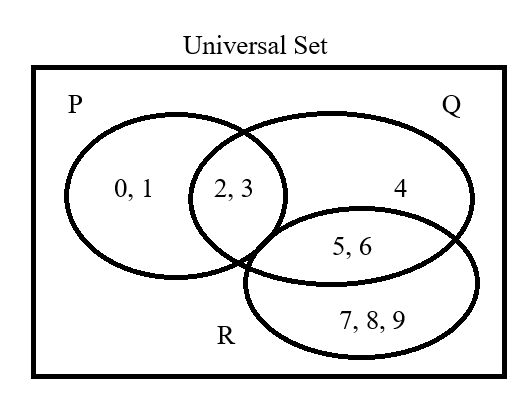
Number 2vi
(vii.) Coordinate Geometry: A water fountain is to be placed at a point which is equidistant from two lamp posts located at $P(4, 7)$ and $Q(10, 1)$.
Find possible positions of the fountain.


Equidistant (equal distance) from the two lamp posts at $P(4, 7)$ and $Q(10, 1)$ implies that the fountain should be placed at the Midpoint of those two lamp posts.

$ P(4, 7) \\[3ex] x_1 = 4 \\[3ex] y_1 = 7 \\[5ex] Q(10, 1) \\[3ex] x_2 = 10 \\[3ex] y_2 = 1 \\[5ex] \text{Midpoint} = \left(\dfrac{x_1 + x_2}{2}, \dfrac{y_1 + y_2}{2}\right) \\[5ex] = \left(\dfrac{4 + 10}{2}, \dfrac{7 + 1}{2}\right) \\[5ex] = \left(\dfrac{14}{2}, \dfrac{8}{2}\right) \\[5ex] = (7, 4) $
OR
Linear Functions: Find the equation of straight line passing through $(-4, -4)$ and parallel to the line with slope $-5$.


$ \underline{\text{Line 2}} \\[3ex] \text{slope} = m_2 = m = -5 \\[5ex] \underline{\text{Line 1}} \\[3ex] \text{slope} = m_1 = -5 \quad[\text{Parallel lines have the same slope}] \\[5ex] \text{passing through } (-4, -4) \\[3ex] x_1 = -4 \\[3ex] y_1 = -4 \\[3ex] \underline{\text{Equation of Line 1}} \\[3ex] y - y_1 = m(x - x_1) \quad[\text{Point – Slope Form}] \\[3ex] y - (-4) = -5[x - (-4)] \\[3ex] y + 4 = -5(x + 4) \\[3ex] y = -5x - 20 - 4 \\[3ex] y = -5x - 24 \quad[\text{Slope – Intercept Form}] $
(viii.) Geometry: The ratio of areas of the bases of two similar cylinders is $9 : 4$
The area of base of the smaller cylinder is $240cm^2$.
Calculate the radius, diameter and area of the base of large cylinder.


The ratio of areas of the bases of two similar cylinders is $9 : 4$
The small cylinder has the small base area
The large cylinder has the large base area
This implies that the ratio of the base area of the large cylinder to that of the small cylinder is $9 : 4$

$ \text{base area of small cylinder} = 240cm^2 \\[3ex] \dfrac{\text{base area of large cylinder}}{\text{base area of small cylinder}} = 9 : 4 \\[5ex] \dfrac{\text{base area of large cylinder}}{240} = \dfrac{9}{4} \\[5ex] \text{base area of large cylinder} = 240 \times \dfrac{9}{4} \\[5ex] = 60 \times 9 \\[3ex] = 540cm^2 \\[5ex] \underline{\text{Large Cylinder}} \\[3ex] \text{base area of large cylinder} = \pi \times \text{radius}^2 \\[3ex] 540 = \pi \times \text{radius}^2 \\[3ex] \text{radius}^2 = \dfrac{540}{\pi} \\[5ex] \text{radius} = \sqrt{\dfrac{540}{\pi}} \\[5ex] = \dfrac{\sqrt{540}}{\sqrt{\pi}} \\[5ex] = \dfrac{\sqrt{9 \times 4 \times 15}}{\sqrt{\pi}} \times \dfrac{\sqrt{\pi}}{\sqrt{\pi}} \\[5ex] = \dfrac{3 \times 2 \times \sqrt{15\pi} \times \sqrt{\pi}}{\pi}cm \\[5ex] = \dfrac{6\times \sqrt{15\pi}}{\pi}cm \\[5ex] \text{diameter} = 2 \times \text{radius} \\[3ex] = 2 \times \dfrac{6\times \sqrt{15\pi}}{\pi} \\[5ex] = \dfrac{12\times \sqrt{15\pi}}{\pi}cm $
OR
Descriptive Statistics: Measures of Central Tendency: The monthly incomes (in thousand rupees) of five workers are: $$ 20, 22, 25, 90, 23 $$ Calculate the mean and median.
Which measure better represents the income level?
Give reason.


$ \underline{\text{Dataset arrnaged in ascending order}} \\[3ex] 20, 22, 23, 25, 90 \\[5ex] \text{mean} = \dfrac{20 + 22 + 23 + 25 + 90}{5} \\[5ex] = \dfrac{180}{5} \\[5ex] = 36\text{ thousand rupees} \\[5ex] \text{median} = 23\text{ thousand rupees} \\[3ex] $ The measure that better represents the income level is the median.
This is because the median is resistant to outliers. 90 thousand rupees is an extremely high income from the rest. It can be shown to be an outlier. The median is the better measure of center to represent datasets with outliers.
(ix.) Number Theory: For algebraic expressions $P = 6x^2y$ and $Q = 9xy^2$, show that $P \times Q = LCM \times HCF$


$ 6x^2y = 2 \times \color{black}{3} \times \color{black}{x} \times x \times \color{black}{y} \\[3ex] 9xy^2 = 3 \times \color{black}{3} \times \color{black}{x} \times \color{black}{y} \times y \\[5ex] LCM = \color{black}{3} \times \color{black}{x} \times \color{black}{y} \times 2 \times x \times 3 \times y \\[3ex] = 18x^2y^2 \\[5ex] HCF = \color{black}{3} \times \color{black}{x} \times \color{black}{y} \\[3ex] = 3xy \\[5ex] LCM \times HCF \\[3ex] = 18x^2y^2 \times 3xy \\[3ex] = 54x^3y^3 \\[5ex] P \times Q \\[3ex] = 6x^2y \times 9xy^2 \\[3ex] = 54x^3y^3 $
OR
Probability: In a coin toss experiment, Head is obtained 15 times in 50 trials.
Calculate the relative frequencies of Head and Tails.


$ \text{Let: } \\[3ex] S = \text{Sample Space} \\[3ex] H = \text{Head} \\[3ex] T = \text{Tail} \\[5ex] \text{number of trials, } n(S) = 50 \\[3ex] \text{number of heads in those trials, } n(H) = 15 \\[3ex] \text{number of tails in those trials, } n(T) = 50 - 15 = 35 \\[5ex] \text{Relative Frequency of Heads} = \dfrac{n(H)}{n(S)} \\[5ex] = \dfrac{15}{50} \\[5ex] = \dfrac{3}{10} \\[5ex] \text{Relative Frequency of Tails} = \dfrac{n(T)}{n(S)} \\[5ex] = \dfrac{35}{50} \\[5ex] = \dfrac{7}{10} $


SECTION C: (Marks 24)
(i.) Polynomials: Find the values of $p$ and $q$ if $x^4 - 12x^3 + px + q$ is a complete square.


Any 4th-degree polynomial that is a perfect square can be written in the form $(x^2 + cx + d)^2$ where $c$ and $d$ are constants.

$ (x^2 + cx + d)^2 \\[3ex] = (x^2 + cx + d)(x^2 + cx + d) \\[3ex] = x^4 + cx^3 + dx^2 + cx^3 + c^2x^2 + cdx + dx^2 + cdx + d^2 \\[3ex] = x^4 + 2cx^3 + c^2x^2 + 2dx^2 + 2cdx + d^2 \\[3ex] = x^4 + 2cx^3 + x^2(c^2 + 2d) + 2cdx + d^2 \\[5ex] x^4 - 12x^3 + px + q = x^4 - 12x^3 + 0x^2 + px + q \quad[\text{Complete form of a 4th-degree polynomial}] \\[3ex] \underline{\text{Equating terms:}} \\[3ex] x^4 - 12x^3 + 0x^2 + px + q = x^4 + 2cx^3 + x^2(c^2 + 2d) + 2cdx + d^2 \\[3ex] -12 = 2c \\[3ex] c = -\dfrac{12}{2} \\[5ex] c = -6 \\[5ex] 0 = c^2 + 2d \\[3ex] (-6)^2 + 2d = 0 \\[3ex] 36 + 2d = 0 \\[3ex] 2d = -36 \\[3ex] d = -\dfrac{36}{2} \\[5ex] d = -18 \\[5ex] p = 2cd \\[3ex] p = 2 \times -6 \times -18 \\[3ex] p = 216 \\[5ex] q = d^2 \\[3ex] q = (-18)^2 \\[3ex] q = 324 $
OR
Trigonometry: Triangles: Find the interior angles of triangle whose vertices are $A(-2, 0)$, $B(3, 0)$, and $C(6, 5)$.


$ \underline{\text{Distance Formula}} \\[3ex] \text{distance} = \text{side lengths of the triangle} = d \\[3ex] (x, y) = \text{coordinates of each vertex} \\[3ex] d = \sqrt{(x_2 - x_1)^2 + (y_2 - y_1)^2} \\[5ex] \text{Side } |AB| \\[3ex] A(-2, 0) \quad x_1 = -2, \quad y_1 = 0 \\[3ex] B(3, 0) \quad x_2 = 3, \quad y_2 = 0 \\[3ex] |AB| = \sqrt{[3 - (-2)]^2 + (0 - 0)^2} \\[3ex] = \sqrt{5^2 + 0^2} \\[3ex] = \sqrt{25 + 0} \\[3ex] = \sqrt{25} \\[3ex] = 5\text{ units} \\[5ex] \text{Side } |AC| \\[3ex] A(-2, 0) \quad x_1 = -2, \quad y_1 = 0 \\[3ex] C(6, 5) \quad x_2 = 6, \quad y_2 = 5 \\[3ex] |AC| = \sqrt{[6 - (-2)]^2 + (5 - 0)^2} \\[3ex] = \sqrt{8^2 + 5^2} \\[3ex] = \sqrt{64 + 25} \\[3ex] = \sqrt{89}\text{ units} \\[5ex] \text{Side } |BC| \\[3ex] B(3, 0) \quad x_1 = 3, \quad y_1 = 0 \\[3ex] C(6, 5) \quad x_2 = 6, \quad y_2 = 5 \\[3ex] |BC| = \sqrt{(6 - 3)^2 + (5 - 0)^2} \\[3ex] = \sqrt{3^2 + 5^2} \\[3ex] = \sqrt{9 + 25} \\[3ex] = \sqrt{34}\text{ units} \\[5ex] \underline{\text{Cosine Rule}} \\[3ex] |BC|^2 = |AB|^2 + |AC|^2 - 2 \times |AB| \times |AC| \times \cos A \\[3ex] (\sqrt{34})^2 = 5^2 + (\sqrt{89})^2 - 2 \times 5 \times \sqrt{89} \times \cos A \\[3ex] 34 = 25 + 89 - 10\sqrt{89} \times \cos A \\[3ex] 34 = 114 - 10\sqrt{89} \times \cos A \\[3ex] \cos A = \dfrac{34 - 114}{-10\sqrt{89}} \\[5ex] = \dfrac{-80}{-10\sqrt{89}} \times \dfrac{\sqrt{89}}{\sqrt{89}} \\[5ex] = \dfrac{8\sqrt{89}}{89} \\[5ex] A = \cos^{-1}\left(\dfrac{8\sqrt{89}}{89}\right) \\[5ex] |AC|^2 = |AB|^2 + |BC|^2 - 2 \times |AB| \times |BC| \times \cos B \\[3ex] (\sqrt{89})^2 = 5^2 + (\sqrt{34})^2 - 2 \times 5 \times \sqrt{34} \times \cos B \\[3ex] 89 = 25 + 34 - 10\sqrt{34} \times \cos B \\[3ex] 89 = 59 - 10\sqrt{34} \times \cos B \\[3ex] \cos B = \dfrac{89 - 59}{-10\sqrt{34}} \\[5ex] = \dfrac{30}{-10\sqrt{34}} \times \dfrac{\sqrt{34}}{\sqrt{34}} \\[5ex] = -\dfrac{3\sqrt{34}}{34} \\[5ex] B = \cos^{-1}\left(-\dfrac{3\sqrt{34}}{34}\right) \\[5ex] |AB|^2 = |AC|^2 + |BC|^2 - 2 \times |AC| \times |BC| \times \cos C \\[3ex] 5^2 = (\sqrt{89})^2 + (\sqrt{34})^2 - 2 \times \sqrt{89} \times \sqrt{34} \times \cos C \\[3ex] 25 = 89 + 34 - 2\sqrt{89 \times 34} \times \cos C \\[3ex] 25 = 123 - 2\sqrt{3026} \times \cos C \\[3ex] \cos C = \dfrac{25 - 123}{-2\sqrt{3026}} \\[5ex] = \dfrac{-98}{-2\sqrt{3026}} \times \dfrac{\sqrt{3026}}{\sqrt{3026}} \\[5ex] = \dfrac{49\sqrt{3026}}{3026} \\[5ex] C = \cos^{-1}\left(\dfrac{49\sqrt{3026}}{3026}\right) $
(4C.) Trigonometry: Angles of Elevation and Depression: From the eye level of a 6 feet tall person standing on the ground, the angle of elevation of the top of a tower is 30°.
(a.) What type of triangle is formed in this situation?
(b.) Which trigonometric ratio would be used to find the height of the tower?
(c.) Find the height of the tower from its base.


Let us represent the information diagrammatically:
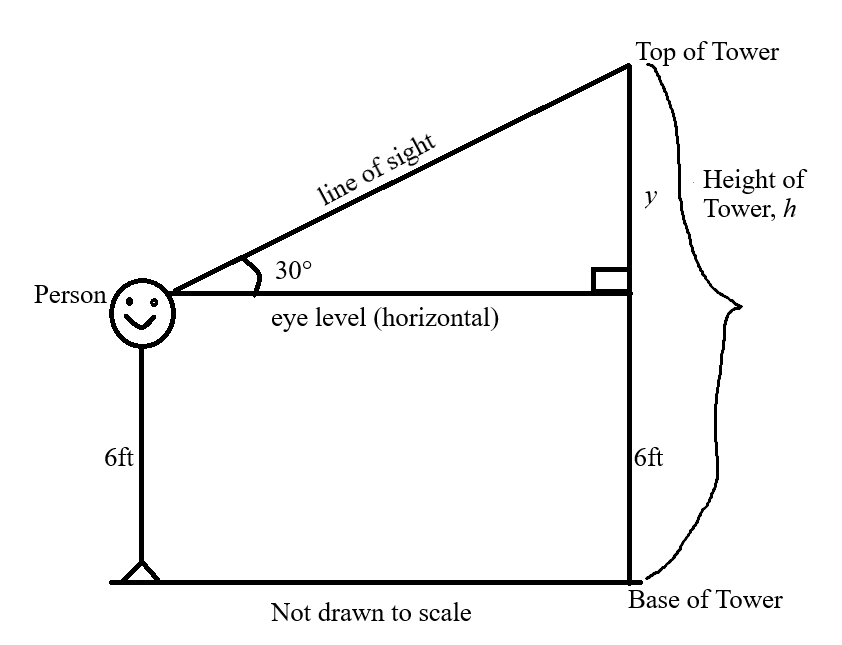
Number 4C

(a.) The triangle that is formed in this situation is a right triangle.
(b.) The trigonometric ratio that would be used to find the height of the tower is the sine or the tangent ratio.

$ \text{line of sight} = \text{hypotenuse} = k \\[3ex] \text{eye level} = \text{horizontal} = x \\[3ex] \text{height of tower} = h \\[3ex] \text{height of tower above eye level} = y \\[3ex] \text{height of the tower from its base} = y + 6 \\[5ex] (c.) \\[3ex] \underline{\text{Unit Circle Trigonometry}} \\[3ex] \sin 30^\circ = \dfrac{1}{2} \\[5ex] \tan 30^\circ = \dfrac{1}{\sqrt{3}} \\[5ex] \underline{\text{SOHCAHTOA}} \\[3ex] \sin 30^\circ = \dfrac{\text{opposite}}{\text{hypotenuse}} \\[5ex] \dfrac{1}{2} = \dfrac{y}{k} \\[5ex] y = \dfrac{1}{2}k \\[5ex] \text{height of the tower from its base} = \left(6 + \dfrac{1}{2}k\right)ft \\[5ex] OR \\[3ex] \tan 30^\circ = \dfrac{\text{opposite}}{\text{adjacent}} \\[5ex] \dfrac{1}{\sqrt{3}} = \dfrac{y}{x} \\[5ex] y = \dfrac{x}{\sqrt{3}} \\[5ex] y = \dfrac{x}{\sqrt{3}} \times \dfrac{\sqrt{3}}{\sqrt{3}} \\[5ex] y = \dfrac{x\sqrt{3}}{3} \\[5ex] \text{height of the tower from its base} = \left(6 + \dfrac{x\sqrt{3}}{3}\right)ft $
OR
Coordinate Geometry: Convert $4x - 3y + 9 = 0$ in given forms:
(a.) Slope intercept
(b.) Two intercepts
(c.) Symmetric
(d.) Normal


$ (a.) \\[3ex] \underline{\text{Slope – Intercept Form}} \\[3ex] y = mx + b \\[3ex] m = \text{slope} \\[3ex] b = y-\text{coordinate of the} y-\text{intercept} \\[5ex] 4x - 3y + 9 = 0 \\[3ex] 4x + 9 = 0 + 3y \\[3ex] 3y = 4x + 9 \\[3ex] y = \dfrac{4x + 9}{3} \\[5ex] y = \dfrac{4}{3}x + \dfrac{9}{3} \\[5ex] y = \dfrac{4}{3}x + 3 \\[5ex] (b.) \\[3ex] \underline{\text{Two – Intercepts Form}} \\[3ex] \dfrac{x}{a} + \dfrac{y}{b} = 1 \\[5ex] a = x-\text{intercept} \\[3ex] b = y-\text{coordinate of the} y-\text{intercept} \\[5ex] 4x - 3y + 9 = 0 \\[3ex] \text{To find the } x-\text{intercept:} \\[3ex] 4x - 3(0) + 9 = 0 \\[3ex] 4x = -9 \\[3ex] a = x-\text{coordinate of the} x-\text{intercept} = -\dfrac{9}{4} \\[5ex] \text{To find the } y-\text{intercept:} \\[3ex] 4(0) - 3y + 9 = 0 \\[3ex] -3y = -9 \\[3ex] y = \dfrac{-9}{-3} \\[5ex] b = y-\text{coordinate of the} y-\text{intercept} = 3 \\[5ex] \dfrac{x}{-\dfrac{9}{4}} + \dfrac{y}{3} = 1 \\[7ex] -\dfrac{4x}{9} + \dfrac{y}{3} = 1 \\[5ex] (c.) \\[3ex] \underline{\text{Symmetric Form}} \\[3ex] \dfrac{x - x_1}{c} = \dfrac{y - y_1}{d} \\[5ex] (x_1, y_1) = \text{coordinate of a point on the line} \\[3ex] (c, d) = \text{direction ratios of the line} \\[3ex] c = \text{change in} x \\[3ex] d = \text{change in } y \\[3ex] m = \dfrac{d}{c} \\[5ex] \text{Comparing } y = \dfrac{4}{3}x + 3 \text{ with } y = mx + b \\[5ex] m = \dfrac{4}{3} \\[5ex] \dfrac{4}{3} = \dfrac{d}{c} \\[5ex] c = 3 \\[3ex] d = 4 \\[5ex] \text{When } x = 0 \\[3ex] y = \dfrac{4}{3} \times 0 + 3 \\[5ex] y = 3 \\[3ex] (x_1, y_1) = (0, 3) \text{ is a point on the line} \\[5ex] \dfrac{x - 0}{3} = \dfrac{y - 3}{4} \\[5ex] \dfrac{x}{3} = \dfrac{y - 3}{4} \\[5ex] (d.) \\[3ex] \underline{\text{Normal Form}} \\[3ex] x\cos\alpha + y\sin\alpha = p \\[3ex] $ p is the perpendicular distance from the origin to the line.
The distance must be nonnegative, hence $p \ge 0$

α is the angle made by the perpendicular distance from the origin to the line with the positive x-\text{axis}

To convert to the normal form, we shall begin with the standard form/general standard form.

$ \underline{\text{U.S Secondary School Algebra: Standard Form:}} \\[3ex] Ax + By = C \\[3ex] A, B, C \text{ are integers} \\[3ex] A \gt 0 \\[3ex] gcd(A, B, C) = 1 \\[5ex] \underline{\text{International (Outside the U.S): General Standard Form:}} \\[3ex] Ax + By + C = 0 \\[3ex] A, B, C \text{ are integers} \\[3ex] $ Be it as it may, for both U.S and International:
(1.) Begin with the General Standard Form and move the value of $C$ to the RHS.
(2.) Multiply the entire equation by whatever sign is needed to make the right-hand side positive.
(3.) Divide every term by the dividing factor: $\sqrt{A^2 + B^2}$
This gives the Normal Form. (4.) If applicable, compare to the Normal Form to get the values of $\cos \alpha$, $\sin\alpha$, and $p$.

$ 4x - 3y + 9 = 0 \\[3ex] 4x - 3y = -9 \\[3ex] \text{Multiplying each term by $-1$ to make the RHS positive gives} \\[3ex] -4x + 3y = 9 \\[3ex] ................................................... \\[3ex] \text{dividing factor} = \sqrt{A^2 + B^2} \\[3ex] = \sqrt{4^2 + (-3)^2} \\[3ex] = \sqrt{16 + 9} \\[3ex] = \sqrt{25} \\[3ex] = 5\text{ units} \\[3ex] ................................................... \\[3ex] \text{Dividing each term by the dividing factor gives} \\[3ex] -\dfrac{4}{5}x + \dfrac{3}{5}y = \dfrac{9}{5} $
(5C.) Locus and Constructions: Draw a triangle $\triangle ABC$ when $\overline{AB} = 5.8cm$, $\overline{BC} = 4.9cm$, $m\angle b = 60^\circ$.
(a.) Draw angle bisectors of triangle.
(b.) Are these angle bisectors concurrent? Verify.


The triangle and its angle bisectors are constructed as shown:
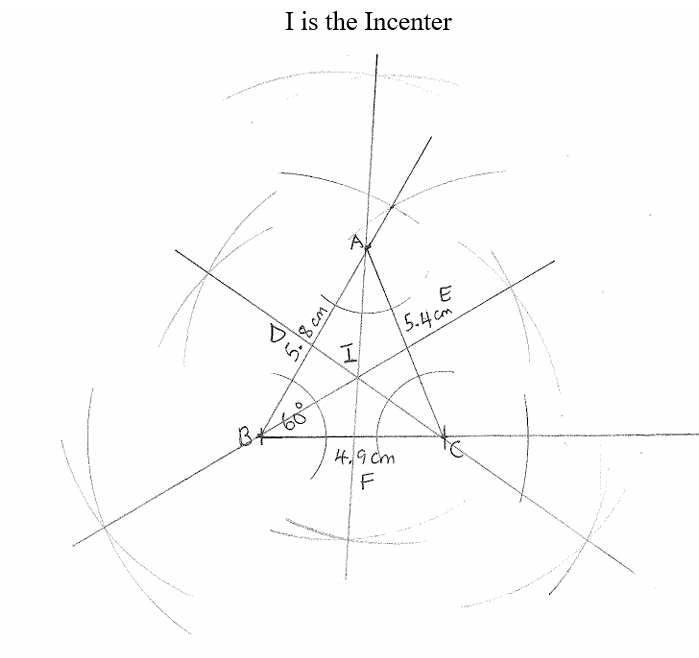
Number 5C

The angle bisector of a vertex angle is a line segment that divides the vertex angle into two equal parts.

Verify Concurrency Geometrically:
The three angle bisectors of the triangle meet at a single concurrent point known as the incenter, I


$ \underline{\text{Side Lengths of the Triangle}} \\[3ex] |AB| = 5.8cm \\[2ex] |BC| = 4.9cm \\[3ex] |AC| = 5.4cm \\[5ex] \underline{\text{Lengths by the Angle Bisectors}} \\[3ex] |BF| = 2.5cm \\[3ex] |FC| = 2.4cm \\[5ex] |BD| = 2.8cm \\[3ex] |DA| = 3cm \\[5ex] |AE| = 3cm \\[3ex] |EC| = 2.4cm \\[3ex] $ Alternatively:
Verify Concurrency Algebraically:
The Angle Bisector Theorem states that the angle bisector of a triangle divides the opposite side into segments proportional to the adjacent sides.
This implies that:

$ \underline{\text{Based on the Angle Bisector Theorem}} \\[3ex] \text{From Vertex A} \\[3ex] \dfrac{|BF|}{|FC|} = \dfrac{|AB|}{|AC|} \\[5ex] \dfrac{2.5}{2.4} ?= \dfrac{5.8}{5.4} \\[5ex] 1.041666667 \approx 1.074074074 \quad[\text{Note: It is supposed to be equal}] \\[5ex] \text{From Vertex C} \\[3ex] \dfrac{|BD|}{|DA|} = \dfrac{|BC|}{|AC|} \\[5ex] \dfrac{2.8}{3} ?= \dfrac{4.9}{5.4} \\[5ex] 0.9333333333 \approx 0.9074074074 \quad[\text{Note: It is supposed to be equal}] \\[5ex] \text{From Vertex B} \\[3ex] \dfrac{|AE|}{|EC|} = \dfrac{|AB|}{|BC|} \\[5ex] \dfrac{3}{2.4} ?= \dfrac{5.8}{4.9} \\[5ex] 1.25 \approx 1.183673469 \quad[\text{Note: It is supposed to be equal}] $
OR
Statistics: Measures of Central Tendency: Consider the data and find the mean.

$CI$ $140 - 150$ $150 - 160$ $160 - 170$ $170 - 180$ $180 - 190$
$f$ 6 9 13 7 5


$\text{Class Intervals, $x$}$ $\text{Midpoint, $x_{mid}$}$ $\text{Frequency, $f$}$ $x_{mid} \times f$
$140 - 150$ $ \dfrac{140 + 150}{2} = 145 $ $6$ $870$
$150 - 160$ $ \dfrac{150 + 160}{2} = 155 $ $9$ $1395$
$160 - 170$ $ \dfrac{160 + 170}{2} = 165 $ $13$ $2145$
$170 - 180$ $ \dfrac{170 + 180}{2} = 175 $ $7$ $1225$
$180 - 190$ $ \dfrac{180 + 190}{2} = 185 $ $5$ $925$
$\Sigma f = 40$ $\Sigma (x_{mid} \times f) = 6560$

$ \text{Mean, } \bar{x} = \dfrac{\Sigma (x_{mid} \times f)}{\Sigma f} \\[5ex] = \dfrac{6560}{40} \\[5ex] = 164 $