Please Read Me.

Enhanced ACT Mathematics Tests

The Joy of the Teacher is the Success of the Students. – Samuel Chukwuemeka

Welcome to Our Site


I greet you this day,
These are the solutions to the Enhanced American College Testing (Enhanced ACT) Mathematics Tests.
If you find these resources valuable and if any of these resources were helpful in your passing the the test, please consider making a donation:

Cash App: $ExamsSuccess or
cash.app/ExamsSuccess

PayPal: @ExamsSuccess or
PayPal.me/ExamsSuccess

Venmo: @ExamsSuccess or
Venmo.com/u/ExamsSuccess

Your donation is appreciated.
Comments, ideas, areas of improvement, questions, and constructive criticisms are welcome.
Feel free to contact me. Please be positive in your message.
I wish you the best.
Thank you.

MATHEMATICS TEST

DIRECTIONS: Solve each problem, choose the correct answer, and then fill in the corresponding oval on your answer document.
Do not linger over problems that take too much time.
Solve as many as you can; then return to the others in the time you have left for this test.
You are permitted to use a calculator on this test. You may use your calculator for any problems you choose, but some of the problems may best be done without using a calculator.
Note: Unless otherwise stated, all of the following should be assumed.
(1.) Illustrative figures are not necessarily drawn to scale.
(2.) Geometric figures lie in a plane.
(3.) The word "line" indicates a straight line.
(4.) The word "average" indicates arithmetic mean.

(1.) Radical Equations: What is the solution of the equation $\sqrt{x} - 9 = 8$?

$ A.\;\; 1 \\[3ex] B.\;\; 25 \\[3ex] C.\;\; 34 \\[3ex] D.\;\; 289 \\[3ex] $

$ \sqrt{x} - 9 = 8 \\[3ex] \sqrt{x} = 8 + 9 \\[3ex] \sqrt{x} = 17 \\[3ex] (\sqrt{x})^2 = (17)^2 \\[3ex] x = 289 \\[3ex] $ Check
$x = 289$
LHS RHS
$ \sqrt{x} - 9 \\[3ex] \sqrt{289} - 9 \\[3ex] 17 - 9 \\[3ex] 8 $ $8$
(2.) Exponents: $\left(\dfrac{1}{64}\right)^{-\dfrac{1}{2}}$

$ F.\;\; -\dfrac{1}{8} \\[5ex] G.\;\; -\dfrac{1}{128} \\[5ex] H.\;\; 8 \\[3ex] J.\;\; 128 \\[3ex] $

$ \left(\dfrac{1}{64}\right)^{-\dfrac{1}{2}} \\[5ex] = \dfrac{1}{\left(\dfrac{1}{64}\right)^{\dfrac{1}{2}}}\quad\dots\text{Law 6 Exp} \\[9ex] ................................................. \\[3ex] \left(\dfrac{1}{64}\right)^{\dfrac{1}{2}} \\[7ex] = \sqrt{\dfrac{1}{64}} \quad\dots\text{Law 7 Exp} \\[5ex] = \dfrac{1}{8} \\[5ex] ................................................. \\[3ex] = \dfrac{1}{\dfrac{1}{8}} \\[7ex] = 1 \div \dfrac{1}{8} \\[5ex] = 1 * \dfrac{8}{1} \\[5ex] = 8 $
(3.) Fractions, Decimals, and Percents: For which of the following fractions does the decimal expansion require 1 repeating nonzero digit?

$ A.\;\; \dfrac{1}{4} \\[5ex] B.\;\; \dfrac{3}{5} \\[5ex] C.\;\; \dfrac{5}{8} \\[5ex] D.\;\; \dfrac{2}{3} \\[5ex] $

The decimal expansion of a fraction is a:
(a.) terminating decimal if the prime factors of the denominator is 2 or 5.
(b.) repeating decimal if the prime factors of the denominator is not 2 or 5.

$ \underline{\text{Denominators of the Fractions}} \\[3ex] 4 = 2 \cdot 2 \quad\dots\text{gives a terminating decimal} \\[3ex] 5 = 5 \quad\dots\text{gives a terminating decimal} \\[3ex] 8 = 2 \cdot 2 \cdot 2 \quad\dots\text{gives a terminating decimal} \\[3ex] 3 \quad\dots\text{gives a repeating decimal} \\[3ex] $
(4.) Probability: Law of Large Numbers: When a fair coin is flipped a large number of times, the number of heads should be approximately equal to the number of tails.
Assume that the fairness of a particular coin is being investigated.
Which of the following results provides the strongest evidence that the coin is not fair?

F. 2 out of 3 flips were heads.
G. 3 out of 4 flips were heads.
H. 4 out of 5 flips were heads.
J. 5 out of 6 flips were heads.


The Law of Large Numbers states that as the number of independent random trials increases, the sample average (experimental probability) becomes closer to the theoretical expected value (true probability).

According to the Law of Large Numbers:
When a fair coin is flipped a large number of times, the number of heads should be approximately equal to the number of tails.
This implies that as the number of flips increases, the percentage of heads should get closer and closer to 50%.
To find the strongest evidence that a coin is not fair, we look for the result that deviates the furthest from the expected 50%.

$ \underline{\text{Experimental Probability}} \\[3ex] \text{Option F: } P(\text{heads}) = \dfrac{2}{3} = 0.6\bar{6} \approx 67\% \quad\dots\text{to the nearest percent} \\[5ex] \text{Option G: } P(\text{heads}) = \dfrac{3}{4} = 0.75 = 75\% \\[5ex] \text{Option H: } P(\text{heads}) = \dfrac{4}{5} = 0.8 = 80\% \\[5ex] \text{Option J: } P(\text{heads}) = \dfrac{5}{6} = 0.8\bar{3} \approx 83\% \quad\dots\text{to the nearest percent} \\[5ex] $ Option J. has both the largest number of trials (6 flips) and the highest deviation from the expected 50% mark.
Landing approximately 83% heads over 6 flips is the strongest evidence that the coin is not fair.
(5.) Linear Inequalities: Ana plans to save $200 for a summer skate park pass.
She already has $45 and plans to save $15 per week.
At this rate of savings, what is the minimum number of weeks after which Ana will have enough money for the skate park pass?

$ A.\;\; 10 \\[3ex] B.\;\; 11 \\[3ex] C.\;\; 13 \\[3ex] D.\;\; 14 \\[3ex] $

Let the number of weeks = w
$15 per week = $15w$

$ 45 + 15w \ge 200 \\[3ex] 15w \ge 200 - 45 \\[3ex] 15w \ge 155 \\[3ex] w \ge \dfrac{155}{15} \\[5ex] w \ge 10.3\bar{3} \\[3ex] $ The number of weeks must be an integer.
So, we need to round up.
In that regard, the minimum number of weeks is 11 weeks.
(6.) Trigonometry: Triangles: Similar triangles must have the same:

F. angle measures.
G. area.
H. perimeter.
J. side lengths.


Similar triangles are triangles that have the same shape, with equal corresponding angles and proportional corresponding sides.
Angle—Angle (AA) Rule
If two angles of one triangle are equal to two angles of another triangle, the triangles are similar.

Sum of Angles of a Triangle Theorem
If two angles of one triangle are equal to two angles of another triangle, this implies that both triangles have all equal angles because the third angles must be the same to make the sum of the angles of each triangle to be equal to 180°

This implies that similar triangles must have the same angle measures.
(7.) Quadratic Expressions: Which of the following expressions is equivalent to $(3x - 9)^2$?

$ F.\;\; 6x - 18 \\[3ex] G.\;\; 6x^2 + 81 \\[3ex] H.\;\; 9x^2 - 54x + 81 \\[3ex] J.\;\; 9x^2 - 27x + 18 \\[3ex] $

$ (3x - 9)^2 \\[3ex] (3x - 9)(3x - 9) \\[3ex] 9x^2 - 27x - 27x + 81 \\[3ex] 9x^2 - 54x + 81 $
(8.) Ratios and Proportions: Next year, there will be 3,432 high school students in a certain district.
Each of these students will attend either East High School or West High School but not both.
Because of the facilities, the ratio of the number of East High School students to the number of West High School students must be 11 to 13.
How many of these students will attend East High School?

$ A.\;\; 143 \\[3ex] B.\;\; 1,573 \\[3ex] C.\;\; 2,904 \\[3ex] D.\;\; 4,056 \\[3ex] $

High Schools:     East High School and West High School
Number of Students:     3432
Ratio of Students:     11 : 13
Sum of Ratios: 11 + 13 = 24

$ \underline{\text{Attending East High School}} \\[3ex] \text{Number of Students} = \dfrac{11}{24} * 3432 \\[5ex] = 1573\text{ students} $
(9.) Linear Functions/Linear Expressions: A worker earns a standard hourly wage of $20.10 per hour for the first 40 hours he works in 1 week.
For each hour over 40 hours he works in 1 week, he earns $1\dfrac{1}{2}$ times his standard hourly wage.
Which of the following gives the amount, in dollars, this worker earns for working 54 hours in 1 week?

$ F.\;\; 54\left[20.10 + \dfrac{1}{2}(20.10)\right] \\[5ex] G.\;\; 54\left[20.10 + \left(1\dfrac{1}{2}\right) (20.10)\right] \\[5ex] H.\;\; 40(20.10) + 14\left(\dfrac{1}{2}\right)(20.10) \\[5ex] J.\;\; 40(20.10) + 14\left(1\dfrac{1}{2}\right)(20.10) \\[5ex] $

$ \underline{\text{1 week}} \\[3ex] \text{Worked Hours} = 54\text{ hours} \\[3ex] \text{Standard Hours} = 40\text{ hours} \\[3ex] \text{Overtime Hours} = 54 - 40 = 14\text{ hours} \\[5ex] \underline{\text{Standard Work}} \\[3ex] 40\text{ hours @ } \$20.10\text{ per hour} \\[3ex] = \$40(20.10) \\[5ex] \underline{\text{Overtime Work}} \\[3ex] 14\text{ hours @ } 1\dfrac{1}{2} * \$20.10\text{ per hour} \\[3ex] = \$14\left(\dfrac{1}{2}\right)(20.10) \\[5ex] \underline{\text{Total Pay in 1 Week}} \\[3ex] = \text{Standard Hours} + \text{Overtime Work} \\[3ex] = 40(20.10) + 14\left(\dfrac{1}{2}\right)(20.10) $
(10.) Complex Numbers: For the complex variable, z, one of the following is a solution of $z^2 = -9$.
Which one?

$ A.\;\; -3 \\[3ex] B.\;\; 3 \\[3ex] C.\;\; 3i \\[3ex] D.\;\; 9i \\[3ex] $

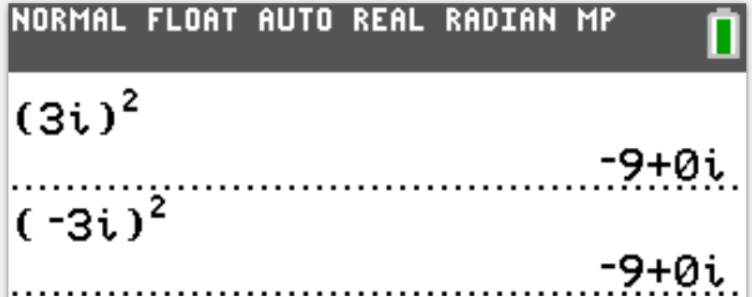
$ z^2 = -9 \\[3ex] z = \pm\sqrt{-9} \\[3ex] z = \pm 3i \\[3ex] $ Check
$z = \pm 3i; \;\; i^2 = -1$
LHS RHS
$ z^2 \\[3ex] (3i)^2 \\[3ex] 3^2 \cdot i^2 \\[3ex] 9i^2 \\[3ex] 9(-1) \\[3ex] -9 $
$ (-3i)^2 \\[3ex] (-3)^2 \cdot i^2 \\[3ex] 9i^2 \\[3ex] 9(-1) \\[3ex] -9 $
$-9$

Number 10
(11.) Linear Functions: A student modeled a set of paired data with the equation $y = 0.25x+25$.
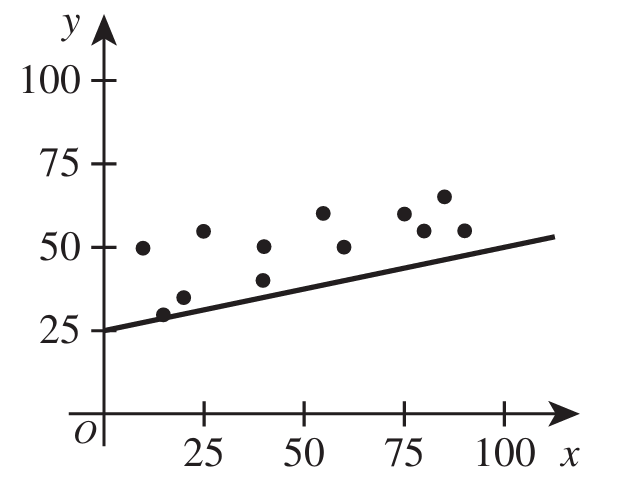
The student’s model and a scatterplot of the paired data are graphed in the standard (x, y) coordinate plane.
Among the following possible changes to the student’s equation, which one will most improve the fit to the paired data?
Number 11

F. Increase the slope by 0.75
G. Decrease the slope by 0.25
H. Increase the y-intercept by 12.5
J. Decrease the y-intercept by 12.5


There are 12 points on the scatterplot.
Right now, the line touches only one point, and all the other points lie above it.
This shows that the line is not a good fit.
The line of best fit should be drawn so that the points are evenly spread on both sides of the line.
Since the line is too low, we need to shift it upward, which means increasing the y‑intercept.
(12.) Probability: A certain committee is composed of 11 juniors and 79 seniors.
Two different members of the committee will be randomly selected, each for a different leadership role.
Given that the Ist member selected is a junior, what is the probability that the 2nd member selected will be a senior?

$ A.\;\; \dfrac{10}{79} \\[5ex] B.\;\; \dfrac{10}{89} \\[5ex] C.\;\; \dfrac{79}{89} \\[5ex] D.\;\; \dfrac{79}{90} \\[5ex] $

n(Juniors) = 11
n(Seniors) = 79
n(Sample Space) = 11 + 79 = 90

Given that the Ist member selected is a junior:
1 person (a junior) is selected
Number of remaining students = 90 – 1 = 89

So, we have: 79 seniors out of 89 students (juniors and seniors)
Probability that the 2nd member selected will be a senior = $\dfrac{79}{89}$
(13.) Linear Functions: This table lists the engine size, x liters, and the weight, w kilograms, of each of 5 vehicles.
A linear model for the data in the table is $\hat{w} =375x + 370$.
The actual weight of the vehicle with the smallest engine size differs from the linear model’s predicted weight of this vehicle by how many kilograms?

Engine size (L) Weight (kg)
2.0 1,041
4.3 2,021
3.4 1,670
2.8 1,547
4.0 1,754

$ F.\;\; 79 \\[3ex] G.\;\; 296 \\[3ex] H.\;\; 370 \\[3ex] J.\;\; 671 \\[3ex] $

$ \text{Smallest Engine Size, } x = 2.0\;L \\[3ex] \text{Actual Weight} = 1041\;kg \\[5ex] \text{Predicted Weight} = 375x + 370 \\[3ex] = 375(2) + 370 \\[3ex] = 1120\;kg \\[5ex] \text{Difference} = 1120 - 1041 \\[3ex] = 79\;kg $
(14.) Relations and Functions: Let d be a function of t.
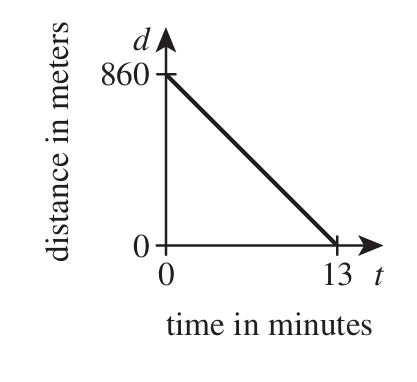
The given graph of the function models the distance, d meters, left to hike on a trail t minutes since beginning the hike.
It took a total of 13 minutes to hike the 860-meter trail.
One of the following intervals is the domain of the function.
Which one?
Number 14

$ A.\;\; [0, 13] \\[3ex] B.\;\; \left[0, 66\dfrac{2}{13}\right] \\[5ex] C.\;\; \left[0, 436\dfrac{1}{2}\right] \\[5ex] D.\;\; [0, 860] \\[3ex] $

The domain is the set of all the input values, t for which the function, d has an output.
The domain in interval notation is: [0, 13]
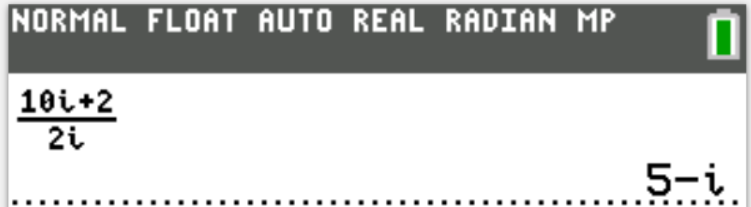
(15.) Complex Numbers: Which of the following numbers is equal to $\dfrac{10i + 2}{2i}$?
(Note: $i^2 = -1$)

$ A.\;\; 5 - i \\[3ex] B.\;\; 6 \\[3ex] C.\;\; 9i \\[3ex] D.\;\; 11i \\[3ex] $

$ \dfrac{10i + 2}{2i} \\[5ex] = \dfrac{2(5i + 1)}{2i} \\[5ex] = \dfrac{5i + 1}{i} \\[5ex] = \dfrac{5i + 1}{i} * \dfrac{i}{i} \\[5ex] = \dfrac{5i^2 + i}{i^2} \\[5ex] = \dfrac{5(-1) + i}{-1} \\[5ex] = \dfrac{-5 + i}{-1} \\[5ex] = 5 - i $
Number 15
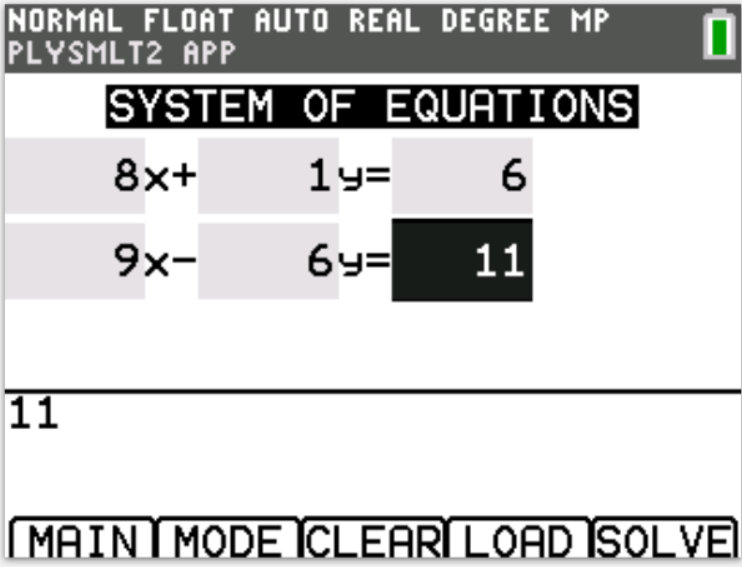
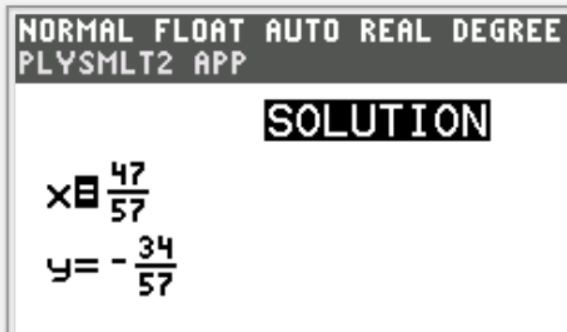
(16.) Linear Systems: What is the value of x in the solution to the given system of linear equations?
$ 8x + y = 6 \\[3ex] 9x - 6y = 11 \\[5ex] F.\;\;\dfrac{25}{39} \\[5ex] G.\;\; \dfrac{47}{57} \\[5ex] H.\;\; \dfrac{57}{47} \\[5ex] J.\;\; \dfrac{39}{25} \\[5ex] $

$ 8x + y = 6...eqn.(1) \\[3ex] 9x - 6y = 11...eqn.(2) \\[5ex] \underline{\text{Substitution Method}} \\[3ex] \text{From } eqn.(1) \\[3ex] y = 6 - 8x \\[5ex] \text{Substitute for } y \text{ in } eqn.(2) \\[3ex] 9x - 6(6 - 8x) = 11 \\[3ex] 9x - 36 + 48x = 11 \\[3ex] 57x = 11 + 36 \\[3ex] 57x = 47 \\[3ex] x = \dfrac{47}{57} $
Number 16-1st

Number 16-2nd
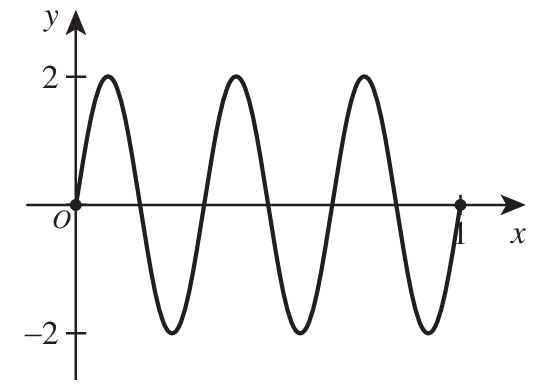
(17.) Trigonometry: Trigonometric Graphs: The function $y = 2\sin(6\pi x)$ is graphed in the standard (x, y) coordinate plane for x radians in the interval $0 \le x \le 1$.
What are the period and amplitude of the function?
Number 17

$ A.\;\; \text{Period: } \dfrac{1}{3} \\[5ex] \hspace{1.8em} \text{Amplitude: } 2 \\[5ex] B.\;\; \text{Period: } \dfrac{1}{3} \\[5ex] \hspace{1.8em} \text{Amplitude: } 4 \\[5ex] C.\;\; \text{Period: } 3 \\[3ex] \hspace{1.8em} \text{Amplitude: } 2 \\[5ex] D.\;\; \text{Period: } 3 \\[3ex] \hspace{1.8em} \text{Amplitude: } 4 \\[3ex] $

The Amplitude of a sinusoidal function is the height/distance from the maximum value of the sinusoidal function to the horizontal axis.
This means that the $\text{Amplitude} = 2$

The Period of a trigonometric function is the length of one cycle of the function (the length before it begins to repeat).
From the graph, there are three cycles of the function which stops at $x = 1$

$ 3 * \text{Period} = 1 \\[3ex] \text{Period} = \dfrac{1}{3} $
(18.) Literal Equations: Let c, h, and q be distinct nonzero real numbers, and let x be a variable.
Which of the following gives the solution to $c(x - h) = q$?

$ F.\;\; \dfrac{q}{c} - h \\[5ex] G.\;\; \dfrac{q}{c} + h \\[5ex] H.\;\; \dfrac{q}{c} + \dfrac{h}{c} \\[5ex] J.\;\; \dfrac{q}{h} + \dfrac{c}{h} \\[5ex] $

Let us solve for x

$ c(x - h) = q \\[3ex] \text{Divide both sides by } c \\[3ex] x - h = \dfrac{q}{c} \\[5ex] \text{Add } h \text{ to both sides} \\[3ex] x = \dfrac{q}{c} + h $
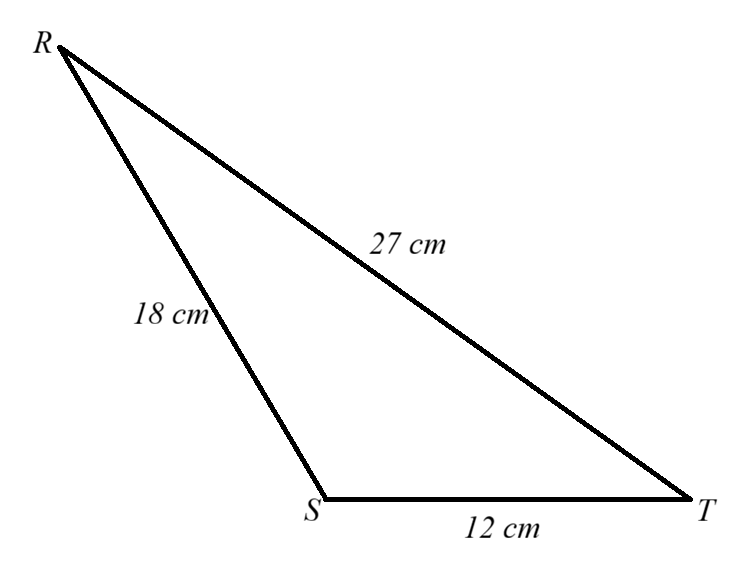
(19.) Trigonometry: Triangles: Given $\triangle RST$ with RS = 18 cm, ST = 12 cm, and RT = 27 cm, which of the following statements is true about the angles of this triangle?

A. The measure of $\angle R$ is the least.
B. The measure of $\angle S$ is the least.
C. The measure of $\angle R$ is the greatest.
D. The measure of $\angle T$ is the greatest.


Let us represent the information diagrammatically as shown:
Number 19

Side Length - Angle Measure Theorem:
If any two side lengths of a triangle are unequal; the angles of the triangle are also unequal, and the measure of an angle is opposite the length of the side facing that angle as regards size.
The measure of the smallest angle is opposite the shortest side length.
The measure of the greatest angle is opposite the longest side length.
The measure of the middle angle is opposite the middle side length.

The measure of $\angle R$ is the least.
(20.) Inverse Functions: Given $f(x) = 2x - 5$, what is the inverse, $f^{-1}(x)$?

$ F.\;\; x + 4 \\[5ex] G.\;\; x + 8 \\[5ex] H.\;\; x - 4 \\[5ex] J.\;\; x - 8 \\[5ex] $

$ f(x) = 2x - 5 \\[3ex] y = 2x - 5 \\[3ex] \text{Interchange } x \text{ and } y \\[3ex] x = 2y - 5 \\[3ex] \text{Solve for } y \\[3ex] 2y - 5 = x \\[3ex] 2y = x + 5 \\[3ex] y = \dfrac{x + 5}{2} \\[3ex] \implies \\[3ex] f^{-1}(x) = \dfrac{x + 5}{2} $
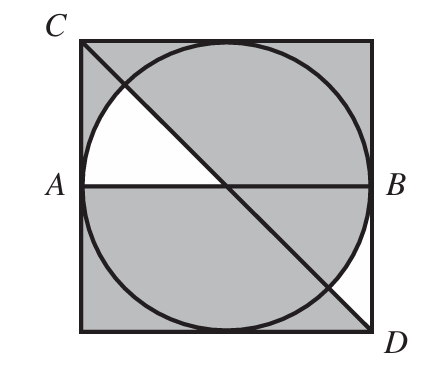
(21.) Mensuration: In the figure shown, a square is circumscribed about a circle with an 8-inch radius.
Diameter $\overline{AB}$ is parallel to 2 sides of the square, and $\overline{CD}$ is a diagonal of the square.
Some regions, bounded by the square, the circle, $\overline{AB}$, and $\overline{CD}$, are shaded.
Which of the following is closest to the total area, in square inches, of the shaded regions?
Number 21

$ A.\;\; 64 \\[3ex] B.\;\; 176 \\[3ex] C.\;\; 224 \\[3ex] D.\;\; 256 \\[3ex] $

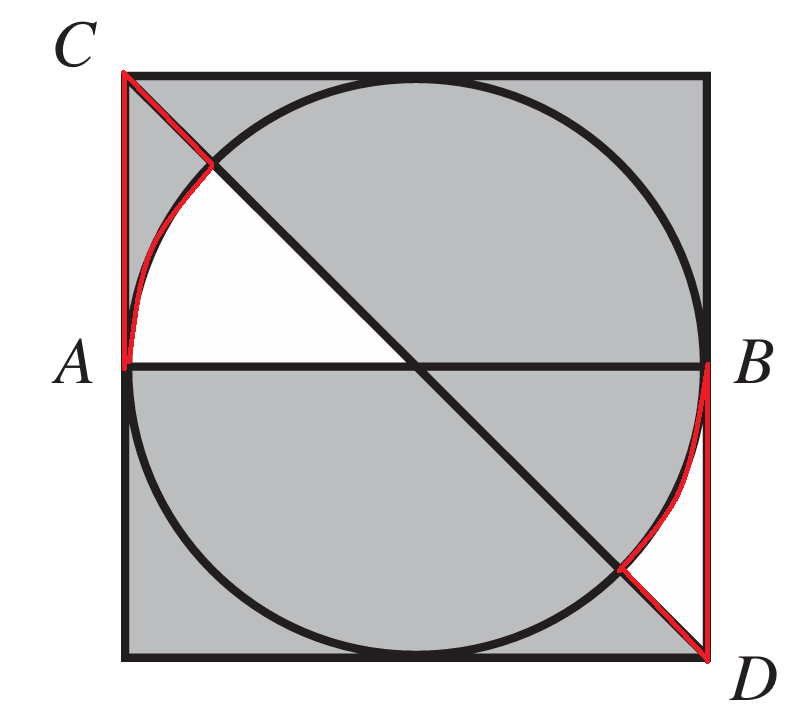
Let us cut out the unshaded region at the bottom right corner and place it in the corresponding shaded region at the top left corner
Number 21-1st

So, now we have an unshaded region that is a triangle.
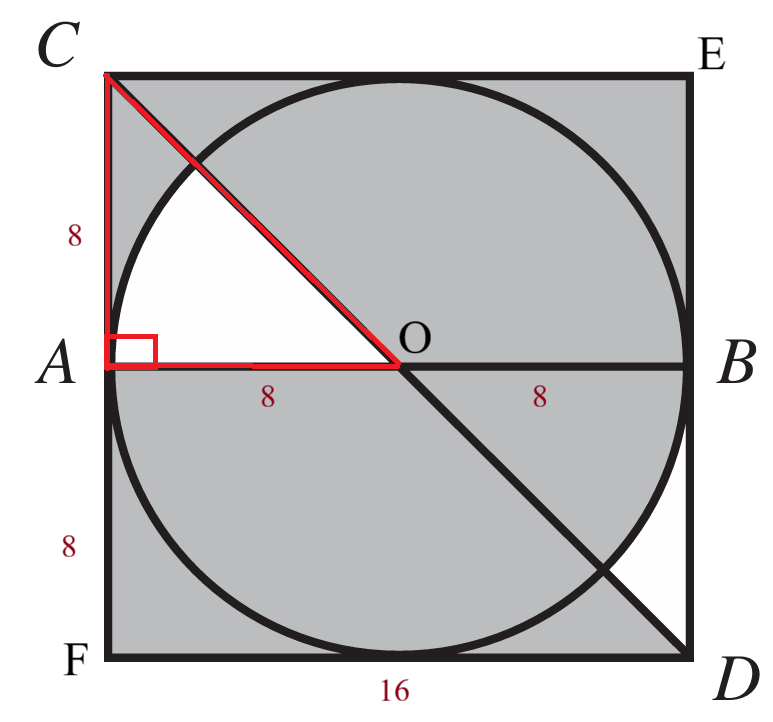
Let the:
center of the circle = O
unlabeled vertices of the square be labeled as: E and F
Number 21-2nd

For a Square circumscribed about a Circle:
The diameter of the circle is the length of the square
The radius of the circle is half the length of the square

$ \angle OAC = 90^\circ \quad\dots\text{radius, |OA| is } \perp \text{ to tangent at point of contact, A} \\[3ex] $ This gives a Right Triangle.
So, the unshaded region is a right triangle.
Hence, the area of the unshaded region is the area of the right triangle.

$ \text{Right Triangle COA} \\[3ex] \text{base} = 8\;inch \\[3ex] \perp \text{height} = 8\;inch \\[3ex] \text{Area} = \dfrac{1}{2} * \text{base} * \perp\text{height} \\[5ex] = \dfrac{1}{2} * 8 * 8 \\[5ex] = 32\;inch^2 \\[5ex] \text{Square CEDF} \\[3ex] \text{length} = 16\;inch \\[3ex] \text{Area} = \text{length}^2 \\[3ex] = 16^2 \\[3ex] = 256\;inch^2 \\[5ex] \text{Area of the shaded region} = \text{Area of Square CEDF} - \text{Area of Right Triangle COA} \\[3ex] = 256 - 32 \\[3ex] = 224\;inch^2 $
(22.) Geometry Transformations: In the standard (x, y) coordinate plane, a certain dilation maps the point $(0, 0)$ to itself and maps the point $(4, -16)$ to the point $(1, -4)$.
This dilation maps the point $(12, -24)$ to the point:

$ F.\;\; (3, -6) \\[3ex] G.\;\; (9, -36) \\[3ex] H.\;\; (15, -36) \\[3ex] J.\;\; (16, -20) \\[3ex] $

$ (x, y) \rightarrow (x', y') \\[3ex] (4, -16) \rightarrow (1, -4) \\[5ex] x * \text{Scale Factor} = x' \\[3ex] 4 * \text{Scale Factor} = 1 \\[3ex] \text{Scale Factor} = \dfrac{1}{4} \\[5ex] \text{To confirm:} \\[3ex] y * \text{Scale Factor} = y' \\[3ex] -16 * \dfrac{1}{4} = -4 \\[5ex] \text{Similarly, for } (12, -24) \\[3ex] 12 * \dfrac{1}{4} = 3 \\[3ex] -24 * \dfrac{1}{4} = -6 \\[3ex] (12, -24) \rightarrow (3, -6) $
(23.) Probability Distributions: A cleaning company sends out advertisements to potential customers.
The table lists the probability of an advertisement leading to a certain amount of revenue.
To the nearest cent, what is the expected value of the revenue generated from an advertisement sent to a potential customer?

Revenue Probability
$400 0.02
$100 0.02
$60 0.04
$0 0.92

$ A.\;\; \$12.40 \\[3ex] B.\;\; \$13.32 \\[3ex] C.\;\; \$35.00 \\[3ex] D.\;\; \$80.00 \\[3ex] $

Revenue, $x$ $P(x)$ $x \cdot P(x)$
$400 0.02 8
$100 0.02 2
$60 0.04 2.4
$0 0.92 0
$\Sigma [x \cdot P(x)] = 12.4$

The expected value of the of the revenue generated from an advertisement sent to a potential customer = $\Sigma [x \cdot P(x)] = \$12.40$
(24.) Normal Distribution: A normal distribution for random variable X is given.
Each percentage shown is the percentage of the area under that portion of the curve.
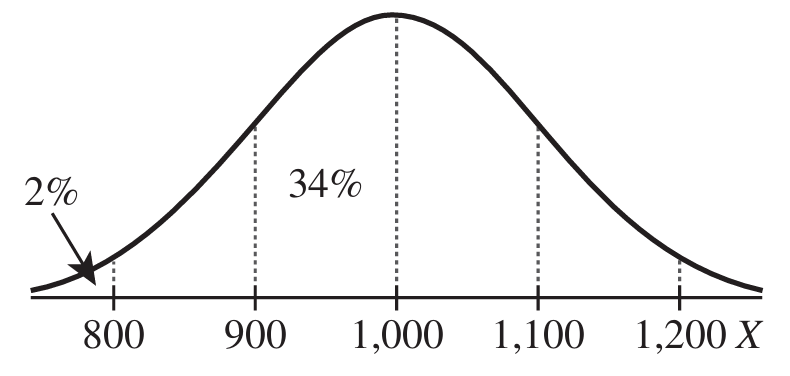
Number 24

One of the following values is the value of $P(1,100 \lt X \lt 1,200)$ to the nearest 1%.
Which one?

$ F.\;\; 14\% \\[3ex] G.\;\; 17\% \\[3ex] H.\;\; 18\% \\[3ex] J.\;\; 30\% \\[3ex] $

(1.) The normal distribution curve is symmetric about the mean.
The mean is the center of the normal distribution = 1,000.
Being symmetric about the mean implies that the area under the curve to the left of the mean is equal to the area under the curve to the right of the mean.

(2.) The total area under the normal curve is 100%.

This implies that 50% of the area is to the left of the mean and 50% is to the right of the mean.
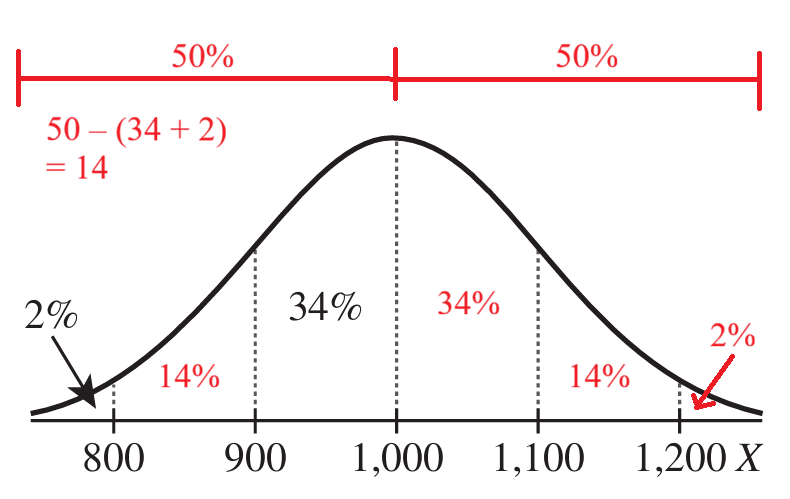
Number 24

$ P(1,100 \lt X \lt 1,200) = 14\% $
(25.) Fractions, Decimals, and Percents: Consider the repeating decimal $0.\overline{7412}$ in expanded form.
What is the 323rd digit to the right of the decimal point?

$ A.\;\; 1 \\[3ex] B.\;\; 2 \\[3ex] C.\;\; 4 \\[3ex] D.\;\; 7 \\[3ex] $

$ 0.\overline{7412} \\[3ex] \text{There are 4 digits before it begins to repeat.} \\[3ex] \text{After the decimal point:} \\[3ex] \text{1st digit} = 7 \\[3ex] \text{2nd digit} = 4 \\[3ex] \text{3rd digit} = 1 \\[3ex] \text{4th digit} = 2 \\[5ex] \dfrac{323}{4} \\[3ex] = 80.75 \\[3ex] = 80 + 0.75 \\[3ex] = 80 + \dfrac{0.75(4)}{4} \\[5ex] = 80 + \dfrac{3}{4} \\[5ex] = 80 \text{ remainder } 3 \\[5ex] \text{Remainder} = \text{3rd digit} = 1 \\[3ex] \therefore \text{323rd digit = 3rd digit} = 1 $
(26.) Trigonometry: Angles of Elevation and Depression: Jabari is walking along a straight sidewalk when he sees a tree directly ahead of him.
He estimates that the angle of elevation from his feet to the top of the tree is 25°.
As he continues walking, he finds that he was about 45 feet from the base of the tree when he estimated the angle of elevation.
Based on Jabari’s estimates, which of the following expressions represents the height, in feet, of the tree?

$ F.\;\; 45\sin 25^\circ \\[3ex] G.\;\; 45\cos 25^\circ \\[3ex] H.\;\; 45\tan 25^\circ \\[3ex] J.\;\; 45\cot 25^\circ \\[3ex] $

Let us represent the information diagrammatically:
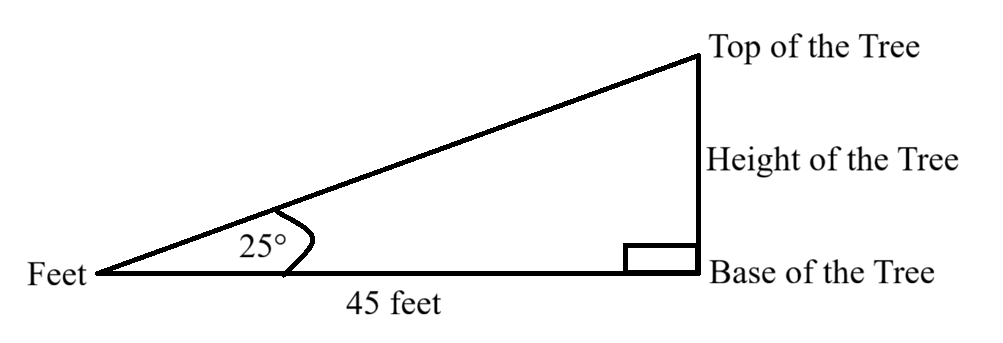
Number 26

$ \tan 25^\circ = \dfrac{\text{Height}}{45}\quad\dots\text{SOHCAHTOA} \\[5ex] \text{Height} = 45\tan 25^\circ $
(27.) Mensuration: A small hole was torn in the bottom corner of an unopened 1.5-pound bag of granulated sugar.
By the time the hole was plugged, the leaked sugar had formed a pile in the shape of a cone with a radius of 3 inches and a height of 2 inches.
Given that granulated sugar weighs 0.025 pounds per cubic inch, which of the following values is closest to the amount of sugar, in pounds, that was left in the bag after the leak was fixed?
(Note: The volume of a cone with radius r and height h is given by $V = \dfrac{\pi}{3}r^2h$.)

$ A.\;\; 0.086 \\[3ex] B.\;\; 1.029 \\[3ex] C.\;\; 1.350 \\[3ex] D.\;\; 1.475 \\[3ex] $

$ \underline{\text{Cone}} \\[3ex] \text{radius, } r = 3\;in \\[3ex] \perp\text{height, } h = 2\;in \\[3ex] \text{Volume, } V = \dfrac{\pi}{3}r^2h \\[5ex] = \dfrac{\pi}{3} * 3^2 * 2 \\[5ex] = 6\pi\;in^3 \\[5ex] \underline{\text{Weight of Granulated Sugar (Leaked)}} \\[3ex] = 0.025\;lbs/in^3 \\[3ex] = \dfrac{0.025\;lbs}{1\;in^3} * 6\pi\;in^3 \\[5ex] = 0.15\pi\;lb \\[5ex] \underline{\text{Weight of Granulated Sugar (Unopened)}} \\[3ex] = 1.5\;lb \\[5ex] \underline{\text{Weight of Remaining Granulated Sugar}} \\[3ex] = \text{Weight of Granulated Sugar (Unopened)} - \text{Weight of Granulated Sugar (Leaked)} \\[3ex] = 1.5 - 0.15\pi \\[3ex] = 1.028761102 \\[3ex] \approx 1.029\;lbs $
(28.) Binomial Expansion: The expression $(x + by)^n$ will be expanded and like terms will be combined.
The resulting terms will be arranged in descending powers of x.
After these steps are done, the 2nd term will be $8x^3y$.
What will be the total number of terms?

$ A.\;\; 5 \\[3ex] B.\;\; 8 \\[3ex] C.\;\; 11 \\[3ex] D.\;\; 12 \\[3ex] $

The 2nd term in the expansion will be $8x^3y = 8x^3y^1$.
This implies that the degree = 3 + 1 = 4

For a nonnegative integer exponent n, the binomial expansion of $(x + y)^n$ has exactly $n + 1$ terms.
Hence, when $n = 4$, the expansion has 4 + 1 = 5 terms.
(29.) Functions: The concentration of a certain medication decreases each hour such that at $t = 0$ hours, the concentration is approximately equal to 850 mg/L; at $t = 6$ hours, the concentration is approximately equal to 151 mg/L; and at $t = 12$ hours, the concentration is approximately equal to 27 mg/L.
One of the following identifies the best type of functional model for the data representing this 12-hour interval and gives a valid reason why that model is best.
Which one?

F. Linear, because over equal time intervals, the concentration decreases by equal factors.
G. Linear, because over equal time intervals, the concentration decreases by equal differences.
H. Exponential, because over equal time intervals, the concentration decreases by equal factors.
J. Exponential, because over equal time intervals, the concentration decreases by equal differences.


Let us represent the information on a table.
Time, t (hours) Approximate Concentration $(mg/L)$
0 6
6 151
12 27

Quick observation of the output trend (approximate concentration) shows a decrease by approximately equal ratios rather than by equal differences.
This points to an Exponential Sequence.
Let's see.

$ \dfrac{151}{850} = 0.1776470588 \\[5ex] \dfrac{27}{151} = 0.178807947 \\[5ex] 0.1776470588 \approx 0.178807947 \\[3ex] $ The model is Exponential, because over equal time intervals, the concentration decreases by equal factors.
(30.) Numbers: Given that n is a rational number, which of the following statements about the number $\dfrac{-4\sqrt{14} - n}{2}$ must be true?

$ A.\;\; \dfrac{-4\sqrt{14} - n}{2} \text{ is positive.} \\[5ex] B.\;\; \dfrac{-4\sqrt{14} - n}{2} \text{ is negative.} \\[5ex] C.\;\; \dfrac{-4\sqrt{14} - n}{2} \text{ is an irrational number.} \\[5ex] D.\;\; \dfrac{-4\sqrt{14} - n}{2} \text{ is a rational number.} \\[5ex] $

Because $-4\sqrt{14}$ is an irrational number, any rational number subtracted from it will make the difference an irrational number.
An irrational number divided by 2 still gives an irrational number.
Let us demonstrate with an example, say the rational number, $n = 1$

$ \dfrac{-4\sqrt{14} - 1}{2} \\[5ex] = -7.983314774\quad\dots\text{an irrational number} $
(31.) Conic Sections: Hyperbola: The graph of $\dfrac{x^2}{9} - \dfrac{y^2}{49} = 1$ in the standard (x, y) coordinate plane has an x-intercept at which of the following points?

$ F.\;\; (0, 0) \\[3ex] G.\;\; (3, 0) \\[3ex] H.\;\; (7, 0) \\[3ex] J.\;\; (9, 0) \\[3ex] $

To find the x-intercept, set y to be zero, and solve for x

$ \dfrac{x^2}{9} - \dfrac{y^2}{49} = 1 \\[5ex] y = 0 \\[3ex] \dfrac{x^2}{9} - \dfrac{0^2}{49} = 1 \\[5ex] \dfrac{x^2}{9} = 1 \\[5ex] x^2 = 1(9) \\[3ex] x = \pm\sqrt{9} \\[3ex] x = \pm 3 \\[3ex] x-\text{intercepts} = (-3, 0) \text{ and } (3, 0) $
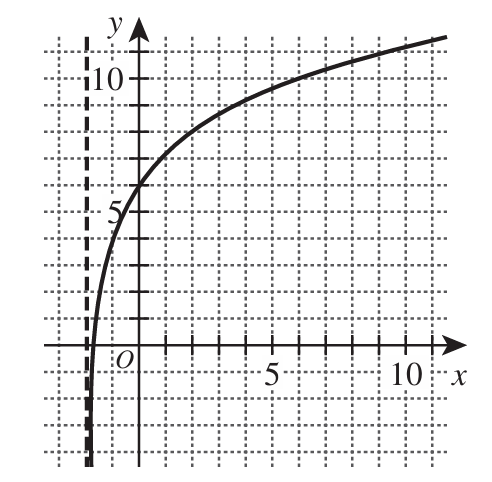
(32.) Logarithmic Functions: One of the following is the equation of this graph in the standard (x, y) coordinate plane.
Which one?

Number 32

$ A.\;\; y = 4(4)^{x - 4} - 2 \\[3ex] B.\;\; y = 4(4)^{x + 2} + 4 \\[3ex] C.\;\; y = 4\log_x{(x - 4)} - 2 \\[3ex] D.\;\; y = 4\log_4{(x + 2)} + 4 \\[3ex] $

This is the graph of a transformed logarithmic function.
The vertical asymptote is $x = -2$
The general form of a transformed logarithmic function is: $y = a\log_p{c(x - h)} + k$ where h is the vertical asymptote

$ h = -2 \\[3ex] (x - h) \\[3ex] = x - (-2) \\[3ex] = (x + 2) \\[3ex] $ The correct answer is Option C.

Student: SamDom For Peace
Teacher: That's me. What's good?
Student: Let's assume that we were not given the multiple choice options.
Could you solve the question?
I understand that we are working with time, but let's also assume we have the time.
Teacher: Sure, let's do it.
What are the transformations that are observable?
Student: From the parent function, I think the transformations are:
Horizontal Shift to the Left and Vertical Shift.
I would also include a Vertical Stretch based on the multiple choice options.


$ \underline{\text{General Form of a Transformed Logarithmic Function}} \\[3ex] y = a\log_p{c(x - h)} + k \\[3ex] \text{where} \\[3ex] y = \text{Dependent Variable} \\[3ex] a = \text{Vertical Stretch/Compression/Reflection} \\[3ex] p = \text{base} \\[3ex] c = \text{Horizontal Stretch/Compression/Reflection} \\[3ex] x = \text{Independent Variable} \\[3ex] h = \text{Horizontal Shift (which is the location of the Vertical Asymptote)} \\[3ex] k = \text{Vertical Shift} \\[5ex] h = -2\quad\dots\text{From the graph} \\[3ex] c = 1 \quad\dots\text{Assume no horizontal stretch/compression/reflection} \\[3ex] \text{Noticeable Points on the Graph are:} (x, y) \\[3ex] (-1, 4) \\[3ex] (2, 8) \\[3ex] (6, 10) \\[5ex] \text{For } (x, y) = (-1, 4) \\[3ex] 4 = a\log_p{1[-1 - (-2)]} + k \\[3ex] 4 = a\log_p{1(-1 + 2)} + k \\[3ex] 4 = a\log_p{1} + k \\[3ex] 4 = a(0) + k \quad\dots\text{Law 3 Log} \\[3ex] 4 = 0 + k \\[3ex] k = 4 \\[5ex] \text{For } (x, y) = (2, 8) \\[3ex] 8 = a\log_p{1[2 - (-2)]} + 4 \\[3ex] 8 = a\log_p{1(2 + 2)} + 4 \\[3ex] 8 = a\log_p{4} + 4 \\[3ex] a\log_p{4} = 8 - 4 \\[3ex] a\log_p{4} = 4...eqn.(1) \\[5ex] \text{For } (x, y) = (6, 10) \\[3ex] 10 = a\log_p{1[6 - (-2)]} + 4 \\[3ex] 10 = a\log_p{1(6 + 2)} + 4 \\[3ex] 10 = a\log_p{8} + 4 \\[3ex] a\log_p{8} = 10 - 4 \\[3ex] a\log_p{8} = 6...eqn.(2) \\[5ex] eqn.(2) \div eqn.(1) \implies \\[3ex] \dfrac{a\log_p{8}}{a\log_p{4}} = \dfrac{6}{4} \\[5ex] \dfrac{\log_p{8}}{\log_p{4}} = \dfrac{3}{2} \\[5ex] \dfrac{\log_p{2^3}}{\log_p{2^2}} = \dfrac{3}{2} \\[5ex] \dfrac{3\log_p{2}}{2\log_p{2}} = \dfrac{3}{2} \\[5ex] \dfrac{3}{2} = \dfrac{3}{2} \\[5ex] $ Because the base cancels out, any valid base would work in this case.
In other words, p can be any valid base: $p \gt 0; \; p \ne 1$
Since any valid base works, let us choose a convenient base by setting the denominator equal to 2 (or the numerator equal to 3).

$ \text{Begin with the Numerator} \\[3ex] \log_p{8} = 3 \\[3ex] p^3 = 8 \quad\dots\text{Logarithm–Exponent Relationship} \\[3ex] p = \sqrt[3]{8} \\[3ex] p = 2 \\[5ex] \text{Check with the Denominator} \\[3ex] \log_p{4} = 2 \\[3ex] p^2 = 4 \quad\dots\text{Logarithm–Exponent Relationship} \\[3ex] p = \sqrt{4} \\[3ex] p = 2 \\[5ex] \text{Substitute for } p \text{ in } eqn.(1) \\[3ex] a\log_2{4} = 4 \\[3ex] a * 2 = 4 \\[3ex] a = \dfrac{4}{2} \\[5ex] a = 2 \\[5ex] \implies \\[3ex] y = 2\log_2{1[x - (-2)]} + 4 \\[3ex] y = 2\log_2{(x + 2)} + 4 \\[3ex] $ Student: Hmmmm...but that is not among the options.
But I do understand that any base would work.
Teacher: Would you like us to get the exact answer as the option?
Student: Yes, we probably need to do.
Teacher: Change of Base of Logarithms.


$ y = 2\log_2{(x + 2)} + 4 \\[3ex] @@@@@@@@@@@@@@@@@@@@@@@@@ \\[3ex] \text{For } \log_2{(x + 2)} \\[3ex] \text{Change from base 2 to base 4} \\[3ex] \log_2{(x + 2)} \\[5ex] = \dfrac{\log_4{(x + 2)}}{\log_4{2}}\quad\dots\text{Law 6 Log} \\[5ex] ........................................ \\[3ex] \log_4{2} = \dfrac{\log_2{2}}{\log_2{4}} \quad\dots\text{Law 6 Log} \\[5ex] = \dfrac{1}{2} \\[5ex] ........................................ \\[3ex] = \log_4{(x + 2)} \div \dfrac{1}{2} \\[5ex] = \log_4{(x + 2)} * 2 \\[3ex] = 2\log_4{(x + 2)} \\[3ex] @@@@@@@@@@@@@@@@@@@@@@@@@ \\[3ex] y = 2 * 2\log_4{(x + 2)} + 4 \\[3ex] y = 4\log_4{(x + 2)} + 4 $
(33.) Sets: Event W consists of 14 simple events.
Event X consists of 11 simple events, none of which are in event W.
Event Y is the intersection of events W and X, and event Z is the union of events W and X.
Which of the following statements is true?
(Note: Given that event E consists of n simple events, $|E| = n$)

$ F.\;\; |X| \lt |W| \lt |Y| \lt |Z| \\[3ex] G.\;\; |X| \lt |W| \lt |Z| \lt |Y| \\[3ex] H.\;\; |Y| \lt |X| \lt |W| \lt |Z| \\[3ex] J.\;\; |Y| \lt |Z| \lt |X| \lt |W| \\[3ex] $

$ n(W) = 14 \\[3ex] n(X) = 11 \\[3ex] n(W \cap X) = 0 \\[3ex] Y = W \cap X \\[3ex] \implies n(Y) = 0 \\[3ex] Z = W \cup X \\[3ex] n(Z) = n(W) + n(X) - n(W \cap X)\quad\dots\text{Addition Rule} \\[3ex] n(Z) = 14 + 11 - 0 \\[3ex] n(Z) = 25 \\[3ex] $ Given that event E consists of n simple events, $|E| = n$

$ |W| = 14 \\[3ex] |X| = 11 \\[3ex] |Y| = 0 \\[3ex] |Z| = 14 + 11 - 0 = 25 \\[3ex] \implies \\[3ex] 0 \lt 11 \lt 14 \lt 25 \\[3ex] |Y| \lt |X| \lt |W| \lt |Z| $
(34.) Trigonometry: Triangles: An isosceles triangle, $\triangle ABC$, with $\overline{AB} \cong \overline{CB}$ is shown.
Points D, E, and H are the midpoints of $\overline{AB}, \overline{CB}$, and $\overline{AC}$, respectively.
Points F and G are the midpoints of $\overline{DH}$ and $\overline{EH}$, respectively.
What is the ratio of the area of $\triangle ABC$ to the area of $\triangle FGH$?
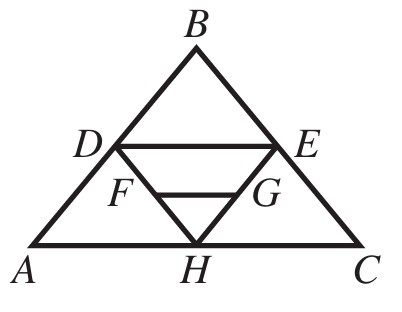
Number 34

$ A.\;\; 4:1 \\[3ex] B.\;\; 8:1 \\[3ex] C.\;\; 16:1 \\[3ex] D.\;\; 64:1 \\[3ex] $

For Triangles ABC, ADH, DBE, DEH, HEC:
Triangle Midpoint Segment Theorem
States that: If a line segment joins the midpoints of any two sides of a triangle, then the line segment: (a.) is parallel to the third side.
(b.) is half the length of the third side.
This implies that:

$ |DE| = \dfrac{|AC|}{2} = |AH| = |HC| \\[5ex] |DH| = \dfrac{|BC|}{2} = |BE| = |EC| \\[5ex] |EH| = \dfrac{|AB|}{2} = |AD| = |DB| \\[5ex] $ Side – Side – Side Congruency Theorem
States that: Two triangles are congruent if the three sides of one triangle are equal to the three sides of another triangle.
This implies that:

$ \triangle DEH \cong \triangle ADH \cong \triangle EHC \cong \triangle DBE \\[3ex] \text{Consequently} \\[3ex] \text{Area of }\triangle DEH \\[3ex] = \text{Area of }\triangle ADH \\[3ex] = \text{Area of }\triangle EHC \\[3ex] = \text{Area of }\triangle DBE \\[5ex] \underline{\text{Diagram}} \\[3ex] \text{Area of }\triangle ABC \\[3ex] = \text{Area of }\triangle DEH \\[3ex] + \text{Area of }\triangle ADH \\[3ex] + \text{Area of }\triangle EHC \\[3ex] + \text{Area of }\triangle DBE \\[5ex] \text{Area of }\triangle ABC \\[3ex] = \text{Area of }\triangle DEH \\[3ex] + \text{Area of }\triangle DEH \\[3ex] + \text{Area of }\triangle DEH \\[3ex] + \text{Area of }\triangle DEH \\[5ex] 4 * \text{Area of }\triangle DEH = \text{Area of }\triangle ABC \\[3ex] \text{Area of }\triangle DEH = \dfrac{\text{Area of }\triangle ABC}{4}...eqn.(1) \\[5ex] $ For Triangles DEH, FGH:
Points F and G are the midpoints of $|DH|$ and $|EH|$, respectively.

Side – Angle – Side Similarity
States that: Two triangles are similar if two sides of one triangle are proportional to the two sides of the triangle and their included angles are equal.

$ \text{Because} \\[3ex] |HF| = \dfrac{|HD|}{2} \\[5ex] |HG| = \dfrac{|HE|}{2} \\[5ex] |HE| = 2 * |HG| ...eqn.(2) \\[5ex] \text{and} \\[3ex] m\angle FHG = m\angle DHE .\quad\dots\text{same vertex} \\[3ex] \triangle FGH \sim \triangle DEH \\[3ex] $ Similarity and Area Theorem
States that: If two polygons are similar, the ratio of their areas is equal to the square of the ratio of their corresponding linear side lengths.
This implies that:

$ \dfrac{\text{Area of }\triangle DEH}{\text{Area of }\triangle FGH} = \left(\dfrac{|HE|}{|HG|}\right)^2 \\[5ex] = \left(\dfrac{2 * |HG|}{|HG|}\right)^2 \quad\dots\text{From } eqn.(2) \\[5ex] = 2^2 \\[3ex] = 4 \\[3ex] \implies \\[3ex] \text{Area of }\triangle DEH = 4 * \text{Area of }\triangle FGH \\[5ex] \dfrac{\text{Area of }\triangle ABC}{4} = 4 * \text{Area of }\triangle FGH \quad\dots\text{From } eqn.(1) \\[5ex] \dfrac{\text{Area of }\triangle ABC}{\text{Area of }\triangle FGH} = 4 * 4 \\[5ex] = 16 \\[3ex] = \dfrac{16}{1} \\[5ex] = 16:1 $
(35.) Linear Functions: Two perpendicular lines in the standard (x, y) coordinate plane each have nonzero slopes.
What is the product of their slopes?

$ A.\;\; -2 \\[3ex] B.\;\; -1 \\[3ex] C.\;\; 1 \\[3ex] D.\;\; 2 \\[3ex] $

Two non-vertical straight lines are perpendicular to each other if the product of their slopes is $-1$
(36.) Numbers: For integers m and n such that $-3 \le m \le 4$ and $-10 \le n \le 9$, what is the greatest possible value of $|m - n|$?

$ F.\;\; 5 \\[3ex] G.\;\; 7 \\[3ex] H.\;\; 12 \\[3ex] J.\;\; 14 \\[3ex] $

Let us consider the minimum and maximum values of m and n to determine the greatest possible value of the absolute value of their difference.

$ -3 \le m \le 4 \\[3ex] \text{minimum } m = -3 \\[3ex] \text{maximum } m = 4 \\[5ex] -10 \le n \le 9 \\[3ex] \text{minimum } n = -10 \\[3ex] \text{maximum } n = 9 \\[5ex] \text{Check all possibilities} \\[3ex] |m - n| \\[3ex] = |-3 - (-10)| = |-3 + 10| = |7| = 7 \\[3ex] = |-3 - 9| = |-12| = 12 \\[3ex] = |4 - (-10)| = |4 + 10| = |14| = 14 \\[3ex] = |4 - 9| = |-5| = 5 \\[5ex] 14 \gt 12 \gt 7 \ht 5 \\[3ex] $ Therefore, the greatest possible value of $|m - n| = 14$
(37.) Quadratic Functions: A factor of $2.5x^2 - 30x + c$ is $x + 4$.
What is the value of c?

$ A.\;\; -160 \\[3ex] B.\;\; -26 \\[3ex] C.\;\; 80 \\[3ex] D.\;\; 110 \\[3ex] $

$ f(x) = 2.5x^2 - 30x + c \\[3ex] \text{Factor: } x + 4 \\[3ex] \text{Zero: } x + 4 = 0 \\[3ex] x = -4 \\[5ex] f(-4) = 2.5(4)^2 - 30(-4) + c = 0 \\[3ex] 2.5(16) + 120 + c = 0 \\[3ex] 40 + 120 + c = 0 \\[3ex] 160 + c = 0 \\[3ex] c = -160 $
(38.) Combinatorics: A company designed a questionnaire to be completed by its employees.
The questionnaire has 5 questions with the answer choices of only “yes” or “no.”
Given that every question must be answered and an employee can only choose 1 answer to each question, in how many ways can an employee answer all 5 questions on the questionnaire?

$ F.\;\; 7 \\[3ex] G.\;\; 25 \\[3ex] H.\;\; 32 \\[3ex] J.\;\; 64 \\[3ex] $

The Generalized Multiplication Principle (Fundamental Counting Principle) states that the total number of ways of doing multiple tasks in succession is the product of the number of ways of doing each task individually.
5 questions with the answer choices of only “yes” or “no.”
1st question can be answered in two ways.
2nd question can be answered in two ways.
The same goes for the rest of the questions.
An employee can answer all 5 questions on the questionnaire in:
$2 \cdot 2 \cdot 2 \cdot 2 \cdot 2 = 2^5 = 32$ ways.
(39.) Fractions, Decimals, and Percents: Consider quantities a, b, and m.
Given that 40% of m is equal to $a$ and that $b = \dfrac{7a}{10}$, which of the following expressions gives 112% of m in terms of b?

$ A.\;\; 4b \\[3ex] B.\;\; 12b \\[3ex] C.\;\; 40b \\[3ex] D.\;\; 84b \\[3ex] $

$ 40\% = \dfrac{40}{100} = 0.4 \\[5ex] 112\% = \dfrac{112}{100} = 1.12 \\[5ex] 40\% \text{ of } m = a \\[3ex] a = 0.4m...eqn.(1) \\[5ex] b = \dfrac{7a}{10} \\[5ex] b = 0.7a \\[3ex] \text{Substitute for } b \\[3ex] b = 0.7(0.4m) \\[3ex] b = 0.28m \\[5ex] 112\% \text{ of } m \\[3ex] = 1.12m \\[3ex] ....................................... \\[3ex] \text{In terms of } b \\[3ex] 0.28m * what = 1.12m \\[3ex] what = \dfrac{1.12m}{0.28m} \\[5ex] what = 4 \\[3ex] ....................................... \\[3ex] = 4(0.28m) \\[3ex] = 4b $
(40.) Arithmetic Sequences: The sum of the first 15 positive integers is 120.
Which of the following values is the sum of the first 75 positive integers?

$ F.\;\; 600 \\[3ex] G.\;\; 1,140 \\[3ex] H.\;\; 2,775 \\[3ex] J.\;\; 2,850 \\[3ex] $

This is an Arithmetic (Linear) Sequence because the first difference between two consecutive terms is the same (common difference).
Let the:
first term = a
common difference = d
number of terms = n
sum of the first n terms = $SAS_n$

$ \text{Using the Formula for Arithmetic Sequence} \\[3ex] \underline{\text{First 75 Positive Integers:}} 1, 2, 3, ..., 75 \\[3ex] \text{First Term, } a = 1 \\[3ex] \text{Common Difference, } d = 2 - 1 = 1 \\[3ex] \text{Number of Terms, } n = 75 \\[3ex] \text{Sum of the First n Terms, } SAS_n \\[5ex] SAS_{75} = \dfrac{n}{2}[2a + d(n - 1)] \\[5ex] = \dfrac{75}{2}[2(1) + 1(75 - 1)] \\[5ex] = \dfrac{75}{2}[2 + 74] \\[5ex] = \dfrac{75}{2} * 76 \\[5ex] = 2850 \\[3ex] $ Student: Is it not interesting that they will give us a value in a question and we don't get to use it?
Is it done to confuse us?
Teacher: Hmmm...not really.
But, some exams do.
For ACT, I don't think so.
Student: SamDom For Peace, what if I do not know the formula for the sum of an A.P off hand?
How can I solve this question?
Teacher: You asked a very good question.
ACT gave us that information so we can use it, rather than using the formula.
So, let's use it.


$ \underline{\text{First 15 terms}} \\[3ex] 1 + 2 + 3 + ... + 15 = 120 \\[5ex] \underline{\text{Next 15 terms}} \\[3ex] 16 + 17 + 18 + ... + 30 = 15(23) = 345 \\[5ex] \underline{\text{Next 15 terms}} \\[3ex] 31 + 32 + 33 + ... + 45 = 15(23 + 15) = 570 \\[5ex] \underline{\text{Next 15 terms}} \\[3ex] 15(23 + 15 + 15) = 15[23 + 2(15)] = 795 \\[5ex] \underline{\text{Next 15 terms}} \\[3ex] 15[23 + 3(15)] = 1020 \\[5ex] \underline{\text{First 75 terms}} \\[3ex] 120 + 345 + 570 + 795 + 1020 = 2850 \\[3ex] $ Student: Nice work.
But, I'm not sure if I can do this in a minute without having to use the formula.
And I really want to do it without the formula.
I understand these are the kind of questions I'll do at the end. Teacher: Well, guess what?
Use the calculator. The question can be done in less than a minute using the calculator.
Also, there is another formula that we can use that will take less than a minute.
The formula is easier to memorize but I would you suggest you use the calculator in this case to solve the question in less than a minute.
Student: Is the formula easier than the one we already used?
Teacher: Yes, it is easier.
It is known as:


The formula for the sum of the first $n$ positive integers.
Sum of the first $n$ positive integers, $Sum_n = \dfrac{n(n + 1)}{2}$

$ Sum_{75} = \dfrac{75(75 + 1)}{2} \\[5ex] = \dfrac{75(76)}{2} \\[5ex] = 2850 $
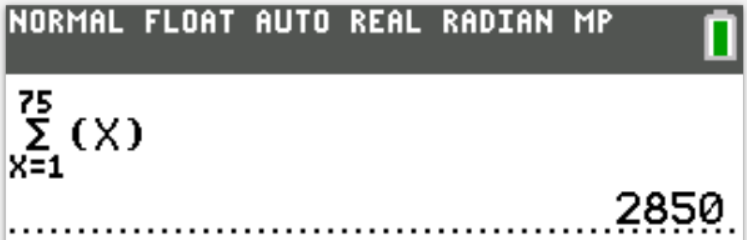
Number 40
(41.) Rational Functions: What are the equations of all the asymptotes in the standard (x, y) coordinate plane for the function $y = f(x) = \dfrac{3x^2}{x^2 - 9}$?

$ A.\;\; x = -3 \text{ and } y = 3 \\[3ex] B.\;\; x = 3 \text{ and } y = 0 \\[3ex] C.\;\; x = -3, \; x = 3, \text{ and } y = 0 \\[3ex] D.\;\; x = -3, \; x = 3, \text{ and } y = 3 \\[3ex] $

To Find the Vertical Asymptote (VA):
(1.) Simplify the function
(2.) Set the denominator to zero (if applicable after simplifying the function)
(3.) Solve for the value of $x$
(4.) $VA: x = value$

To Find the Horizontal Asymptote (HA):
(1.) Arrange the numerator in standard form
(2.) Arrange the denominator in standard form
(3.) If the degree of the numerator is less than the degree of the denominator, $HA: y = 0$
(4.) If the degree of the numerator is the same as the degree of the denominator,

$HA: y = \dfrac{\text{leading coefficient of the numerator}}{\text{leading coefficient of the denominator}}$

$ \underline{\text{Vertical Asymptote}} \\[3ex] x^2 - 9 = 0 \\[3ex] x^2 = 9 \\[3ex] x = \pm\sqrt{9} \\[3ex] x = \pm 3 \\[5ex] \underline{\text{Horizontal Asymptote}} \\[3ex] y = \dfrac{3}{1} \\[5ex] y = 3 $