Eswatini General Certificate of Secondary Education: Mathematics: Paper 3 Short-Answer Questions (Extended)
The Joy of the Teacher is the Success of the Students. – Samuel Dominic Chukwuemeka (SamDom For Peace)
Welcome to Our Site
I greet you this day,
These are the solutions to the EGCSE Mathematics Paper 3 questions.
Please review the Formulas, rules/laws, and theorems on the website for each topic as applicable.
If time permits and there is sufficient interest, video solutions may be provided. Please subscribe to the
YouTube channel to be notified of upcoming livestreams.
You are welcome to ask questions during the video livestreams.
If you find these resources valuable and if any of these resources were helpful in your passing the
Mathematics tests/exams, please consider making a donation:
Cash App: $ExamsSuccess or
cash.app/ExamsSuccess
PayPal: @ExamsSuccess or
PayPal.me/ExamsSuccess
Venmo: @ExamsSuccess or
Venmo.com/u/ExamsSuccess
Square: Exams Success
Buy Me a Coffee: Exams Success
Buy Me a Coffee @ Ko-Fi: Exams Success
Your donation is appreciated.
Comments, ideas, areas of improvement, questions, and constructive
criticisms are welcome.
Feel free to contact me. Please be positive in your message.
I wish you the best.
Thank you.
Examinations Council of Eswatini
Eswatini General Certificate of Secondary Education
Mathematics
Paper 3 Short-Answer Questions (Extended)
Time: 2 hours 30 minutes
Candidates answer on the Question Paper.
Additional Materials: Scientific calculator, Geometrical instruments
Read These Instructions First
(1.) Write your name, centre number and candidate number in the spaces provided.
(2.) Write in dark blue or black pen.
(3.) You may use a soft pencil for any diagrams, graphs or rough working.
(4.) Do not use staples, paper clips, highlighters, glue or correction fluid.
(5.) Answer all questions.
(6.) If working is needed for any question it must be shown below that question.
(7.) The number of marks is given in brackets [ ] at the end of each question or part
question.
(8.) If the degree of accuracy is not specified in the question, and if the answer
is not exact, give the answer to three significant figures.
Give answers in degrees to one decimal place.
For π, use either your calculator value or 3.142.
(9.) The total of the marks for this paper is 80.
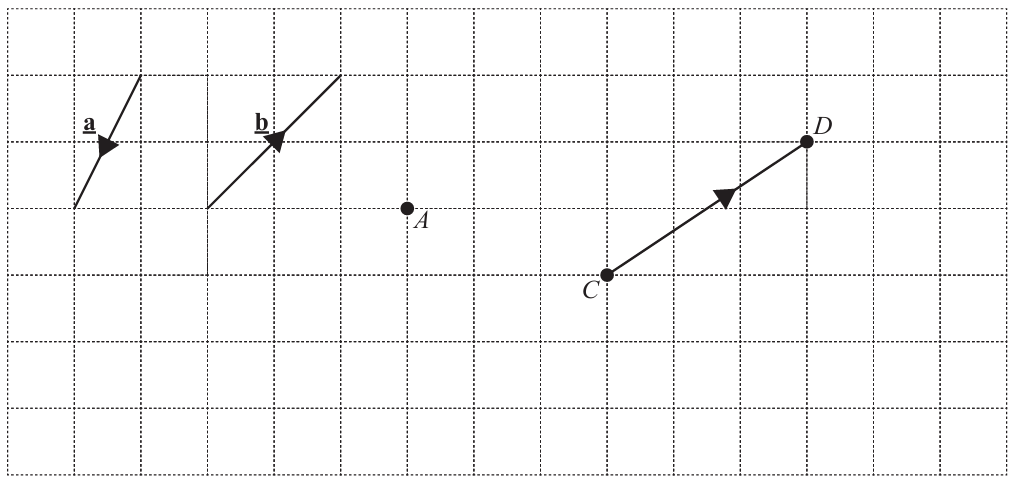
(a.) Draw $\overrightarrow{AB}$ on the same grid such that:
$\overrightarrow{AB} = 2\underline{a} + \underline{b}$
(b.) $\overrightarrow{CD} = h\underline{a} + k\underline{b}$
Find the values of h and k.
$ O \text{ is the origin, } (0, 0) \\[3ex] OA \text{ is the position vector of point $A$ relative to the origin} \\[3ex] OB \text{ is the position vector of point $B$ relative to the origin} \\[3ex] OC \text{ is the position vector of point $C$ relative to the origin} \\[3ex] OD \text{ is the position vector of point $D$ relative to the origin} \\[5ex] \underline{\text{Points as Position Column Vectors}} \\[3ex] \underline{\text{1st Line Segment, }} \vec{a} \\[3ex] \text{Initial Point} = \begin{pmatrix} 2 \\ 6 \end{pmatrix} \\[5ex] \text{Terminal Point} = \begin{pmatrix} 1 \\ 4 \end{pmatrix} \\[5ex] \vec{a} = \begin{pmatrix} 1 \\ 4 \end{pmatrix} - \begin{pmatrix} 2 \\ 6 \end{pmatrix} \\[5ex] = \begin{pmatrix} 1 - 2 \\ 4 - 6 \end{pmatrix} \\[5ex] = \begin{pmatrix} -1 \\ -2 \end{pmatrix} \\[5ex] \underline{\text{2nd Line Segment, }} \vec{b} \\[3ex] \text{Initial Point} = \begin{pmatrix} 3 \\ 4 \end{pmatrix} \\[5ex] \text{Terminal Point} = \begin{pmatrix} 5 \\ 6 \end{pmatrix} \\[5ex] \vec{b} = \begin{pmatrix} 5 \\ 6 \end{pmatrix} - \begin{pmatrix} 3 \\ 4 \end{pmatrix} \\[5ex] = \begin{pmatrix} 5 - 3 \\ 6 - 4 \end{pmatrix} \\[5ex] = \begin{pmatrix} 2 \\ 2 \end{pmatrix} \\[5ex] \underline{\text{Scalar Multiplication and Addition}} \\[3ex] 2\vec{a} = 2\begin{pmatrix} -1 \\ -2 \end{pmatrix} \\[5ex] = \begin{pmatrix} -2 \\ -4 \end{pmatrix} \\[5ex] \overrightarrow{AB} = 2\vec{a} + \vec{b} \\[3ex] = \begin{pmatrix} -2 \\ -4 \end{pmatrix} + \begin{pmatrix} 2 \\ 2 \end{pmatrix} \\[5ex] = \begin{pmatrix} -2 + 2 \\ -4 + 2 \end{pmatrix} \\[5ex] = \begin{pmatrix} 0 \\ -2 \end{pmatrix} \\[5ex] \underline{\text{Finding the Terminal Position } B} \\[3ex] \text{Position Vector } \overrightarrow{OA} = \begin{pmatrix} 6 \\ 4 \end{pmatrix} \\[5ex] \overrightarrow{AB} = \overrightarrow{OB} - \overrightarrow{OA} \\[3ex] \overrightarrow{OB} = \overrightarrow{AB} + \overrightarrow{OA} \\[3ex] = \begin{pmatrix} 0 \\ -2 \end{pmatrix} + \begin{pmatrix} 6 \\ 4 \end{pmatrix} \\[5ex] = \begin{pmatrix} 0 + 6 \\ -2 + 4 \end{pmatrix} \\[5ex] = \begin{pmatrix} 6 \\ 2 \end{pmatrix} \\[5ex] $ (a.) The representation of $\overrightarrow{AB}$ on the same grid is:
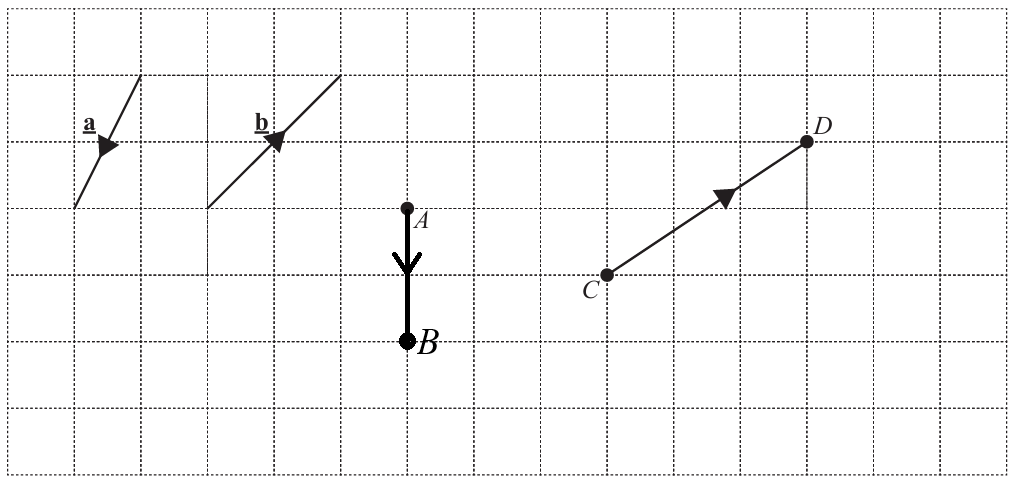
$ \underline{\text{Line Segment, }} \overrightarrow{CD} \\[3ex] \overrightarrow{OC} = \text{Initial Point} = \begin{pmatrix} 9 \\ 3 \end{pmatrix} \\[5ex] \overrightarrow{OD} = \text{Terminal Point} = \begin{pmatrix} 12 \\ 5 \end{pmatrix} \\[5ex] \overrightarrow{CD} = \overrightarrow{OD} - \overrightarrow{OC} \\[3ex] = \begin{pmatrix} 12 \\ 5 \end{pmatrix} - \begin{pmatrix} 9 \\ 3 \end{pmatrix} \\[5ex] = \begin{pmatrix} 12 - 9 \\ 5 - 3 \end{pmatrix} \\[5ex] = \begin{pmatrix} 3 \\ 2 \end{pmatrix} \\[5ex] \underline{\text{Scalar Multiplication and Addition}} \\[3ex] h\vec{a} = h\begin{pmatrix} -1 \\ -2 \end{pmatrix} \\[5ex] = \begin{pmatrix} -h \\ -2h \end{pmatrix} \\[5ex] k\vec{b} = k\begin{pmatrix} 2 \\ 2 \end{pmatrix} \\[5ex] = \begin{pmatrix} 2k \\ 2k \end{pmatrix} \\[5ex] \overrightarrow{CD} = h\vec{a} + k\vec{b} \\[3ex] = \begin{pmatrix} -h \\ -2h \end{pmatrix} + \begin{pmatrix} 2k \\ 2k \end{pmatrix} \\[5ex] = \begin{pmatrix} -h + 2k \\ -2h + 2k \end{pmatrix} \\[5ex] (b.) \\[3ex] \implies \\[3ex] \begin{pmatrix} -h + 2k \\ -2h + 2k \end{pmatrix} = \begin{pmatrix} 3 \\ 2 \end{pmatrix} \\[5ex] -h + 2k = 3 \quad...eqn.(1) \\[3ex] -2h + 2k = 2 \quad...eqn.(2) \\[5ex] \underline{\text{Elimination Method}} \\[3ex] eqn.(1) - eqn.(2) \implies \\[3ex] -h - (-2h) = 3 - 2 \\[3ex] -h + 2h = 1 \\[3ex] h = 1 \\[5ex] 2 \times eqn.(1) \implies \\[3ex] -2h + 4k = 6 \quad...eqn.(3) \\[3ex] eqn.(3) - eqn.(2) \implies \\[3ex] 2k = 4 \\[3ex] k = \dfrac{4}{2} \\[5ex] k = 2 $



