☰ Please Read Me.

Certificate of Secondary Education Examination: Basic Mathematics

The Joy of the Teacher is the Success of the Students. – Samuel Chukwuemeka
⚠️ Page Update Notice: This webpage is still being developed. Questions and answers are added regularly. Please check back for updates.

Welcome to Our Site


I greet you this day,
These are the solutions to the CSEE Basic Mathematics questions.
Please review the Formulas, rules/laws, and theorems on the website for each topic as applicable.
If time permits and there is sufficient interest, video solutions may be provided. Please subscribe to the YouTube channel to be notified of upcoming livestreams. You are welcome to ask questions during the video livestreams.
If you find these resources valuable and if any of these resources were helpful in your passing the Mathematics tests/exams, please consider making a donation:

Cash App: $ExamsSuccess or
cash.app/ExamsSuccess

PayPal: @ExamsSuccess or
PayPal.me/ExamsSuccess

Venmo: @ExamsSuccess or
Venmo.com/u/ExamsSuccess

Your donation is appreciated.
Comments, ideas, areas of improvement, questions, and constructive criticisms are welcome.
Feel free to contact me. Please be positive in your message.
I wish you the best.
Thank you.

The United Republic of Tanzania
National Examinations Council of Tanzania (NECTA)
Certificate of Secondary Education Examination (CSEE)
Basic Mathematics

Duration: 3 hours

Instructions
(1.) This paper consists of sections A and B with a total of fourteen (14) questions.
(2.) Answer all questions in each section.
(3.) Section A carries sixty (60) marks and section B carries forty (40) marks.
(4.) All writing must be in blue or black ink except drawing which must be in pencil.
(5.) All necessary working and answers for each question must be shown clearly.
(6.) NECTA mathematical tables and non-programmable calculators may be used.
(7.) Communication devices and any unauthorized materials are not allowed in the examination room.
(8.) Write your Examination Number on every page of your answer booklet(s).

Mathematical Tables and Formulae (Colored)
Mathematical Tables and Formulae (Black and White)
(1.) Fractions, Decimals, and Percents: (a.) Express $0.11\dot{3}\dot{6}$ in a simple fraction.

(b.) Round off:
(i.) 0.00070482 to 3 significant figures.
(ii.) 1233388 to the nearest ten thousands.

(c.) Three-fifths of the pupils in a certain school come from the city centre.
What is the percentage of pupils who do not come from the city centre?


$ (a.) \\[3ex] 0.11\dot{3}\dot{6} \quad(\text{also written as } 0.11\overline{36}) \\[3ex] \text{Let } p = 0.11\overline{36} \quad\dots eqn.(1) \\[3ex] \text{Because of the two repeating digits, multiply both sides by 100} \\[3ex] 100p = 11.\overline{36} \quad\dots eqn.(2) \\[3ex] eqn.(2) - eqn.(1) \implies \\[3ex] 100p - p = 11.\overline{36} - 0.11\overline{36} \\[3ex] 99p = 11.25 \\[3ex] p = \dfrac{11.25}{99} \\[5ex] = \dfrac{11.25 \times 100}{99 \times 100} \\[5ex] = \dfrac{1125}{9900} \\[5ex] = \dfrac{1125 \div 5}{9900 \div 5} \\[5ex] = \dfrac{225 \div 15}{1980 \div 15} \\[5ex] = \dfrac{15 \div 3}{132 \div 3} \\[5ex] = \dfrac{5}{44} \\[5ex] \underline{\text{Check}} \\[3ex] \dfrac{5}{44} = 0.11363636... = 0.11\dot{3}\dot{6} \\[3ex] $ (b.) For rounding rules to significant digits:
If the deciding digit is greater than or equal to 5 (at least 5), round up by adding 1 to the target digit, then discard the remaining digits.
If the deciding digit is less than 5, keep the target digit and discard the remaining digits.

$ (i.) \\[3ex] 0.00070482 \\[3ex] \text{target digit} = \text{3rd significant digit} = 4 \\[3ex] \text{deciding digit} = \text{4th significant digit} = 8 \\[3ex] 8 \ge 5 \\[3ex] 4 + 1 = 5 \\[3ex] 0.00070482 \approx 0.000705 \quad\text{(to 3 significant figures)} \\[3ex] $ For rounding rules to the nearest multiple of ten:
If the deciding digit is greater than or equal to 5, round up by adding 1 to the target digit, then replace the remaining digits with zeros.
If the deciding digit is less than 5, keep the target digit and replace the remaining digits with zeros.

$ (ii.) \\[3ex] 1233388 \\[3ex] \text{ten thousand} = 4 \text{ zeros} \\[3ex] \text{target digit} = \text{5th digit counting backwards} = 3 \\[3ex] \text{deciding digit} = \text{4th digit counting backwards} = 3 \\[3ex] 3 \lt 5 \\[3ex] 1233388 \approx 1230000 \quad\text{(to the nearest ten thousands)} \\[5ex] (c.) \\[3ex] \text{Pupils in a certain school who come from the city centre} = \dfrac{3}{5} \\[5ex] \text{Pupils in a certain school who come from the city centre} = 1 - \dfrac{3}{5} \\[5ex] = \dfrac{2}{5} \\[5ex] = \dfrac{2}{5} \times 100 \\[5ex] = 2 \times 20 \\[3ex] = 40\% $
(2.) (a.) Exponents: Write the expression $27^n \times 9^{2n} \times 3$

(b.) Radical Expressions: Rationalize the denominator of $\dfrac{\sqrt{2} + 1}{\sqrt{2} - \sqrt{5}}$

(c.) Logarithms: By using $\log 2 = 0.3010$ and $\log 3 = 0.4771$, find $\log 72$


$ (a.) \\[3ex] 27^n \times 9^{2n} \times 3 \\[4ex] (3^3)^n \times (3^2)^{2n} \times 3 \\[4ex] 3^{3n} \times 3^{4n} \times 3^1 \quad\text{(Laws 4 and 5 Exp)} \\[4ex] 3^{3n + 4n + 1} \quad\text{(Law 1 Exp)} \\[4ex] 3^{7n + 1} \\[5ex] (b.) \\[3ex] \dfrac{\sqrt{2} + 1}{\sqrt{2} - \sqrt{5}} \\[5ex] \text{Conjugate} = \sqrt{2} + \sqrt{5} \\[3ex] = \dfrac{\sqrt{2} + 1}{\sqrt{2} - \sqrt{5}} \times \dfrac{\sqrt{2} + \sqrt{5}}{\sqrt{2} + \sqrt{5}} \\[5ex] = \dfrac{2 + \sqrt{10} + \sqrt{2} + \sqrt{5}}{(\sqrt{2})^2 - (\sqrt{5})^2} \\[5ex] = \dfrac{2 + \sqrt{2} + \sqrt{5} + \sqrt{10}}{2 - 5} \\[5ex] = \dfrac{2 + \sqrt{2} + \sqrt{5} + \sqrt{10}}{-3} \\[5ex] = -\dfrac{(2 + \sqrt{2} + \sqrt{5} + \sqrt{10})}{3} \\[5ex] (c.) \\[3ex] \log 2 = 0.3010 \\[3ex] \log 3 = 0.4771 \\[3ex] \log 72 \\[3ex] = \log (8 \times 9) \\[3ex] = \log 8 + \log 9 \quad\text{(Law 1 Log)} \\[3ex] = \log 2^3 + \log 3^2 \\[4ex] = 3\log 2 + 2\log 3 \quad\text{(Law 5 Log)} \\[3ex] = 3(0.301) + 2(0.4771) \\[3ex] = 0.903 + 0.9542 \\[3ex] = 1.8572 $
(3.) (a.) Set Theory: A certain school has 260 students.
Out of these students, 130 study Physics, 150 study Chemistry and 40 study both Physics and Chemistry.
By using formula, find the number of students who study:
(i.) Physics only
(ii.) neither Physics nor Chemistry.

(b.) Probability: In a sample of 35 animal keepers, 18 keep goats, 20 keep cows and 3 keep both goats and cows.
By using a Venn diagram, find the probability of getting a person who keep goats only.


$ (a.) \\[3ex] \text{Let the number of students who study:} \\[3ex] \text{Physics} = P \\[3ex] \text{Chemistry} = C \\[3ex] \text{Physics only} = n(P \cap C') \\[3ex] \text{Chemistry only} = n(P' \cap C) \\[3ex] \text{Both Physics and Chemistry} = n(P \cap C) \\[3ex] \text{Neither Physics nor Chemistry} = n(P' \cap C') \quad\text{or}\quad n(P \cup C)' \\[5ex] \underline{\text{Given}} \\[3ex] n(\mu) = 260 \\[3ex] n(P) = 130 \\[3ex] n(C) = 150 \\[3ex] n(P \cap C) = 40 \\[5ex] (i.) \\[3ex] n(P \cap C') = n(P) - n(P \cap C) \\[3ex] = 130 - 40 \\[3ex] = 90\text{ students} \\[5ex] \text{Similarly} \\[3ex] n(P' \cap C) = n(C) - n(P \cap C) \\[3ex] = 150 - 40 \\[3ex] = 110\text{ students} \\[5ex] (ii.) \\[3ex] n(P \cap C') + n(P' \cap C) + n(P \cap C) + n(P' \cap C') = n(\mu) \\[3ex] 90 + 110 + 40 + n(P' \cap C') = 260 \\[3ex] 240 + n(P' \cap C') = 260 \\[3ex] n(P' \cap C') = 260 - 240 \\[3ex] n(P' \cap C') = 20\text{ students} \\[5ex] (b.) \\[3ex] \text{Let the number of animal keepers who keep:} \\[3ex] \text{Goat} = G \\[3ex] \text{Cow} = C \\[3ex] n(G) = 18 \\[3ex] n(C) = 20 \\[3ex] n(G \cap C) = 3 \\[3ex] n(\mu) = 35 \\[3ex] $ The Venn diagram representing the information is drawn as shown:
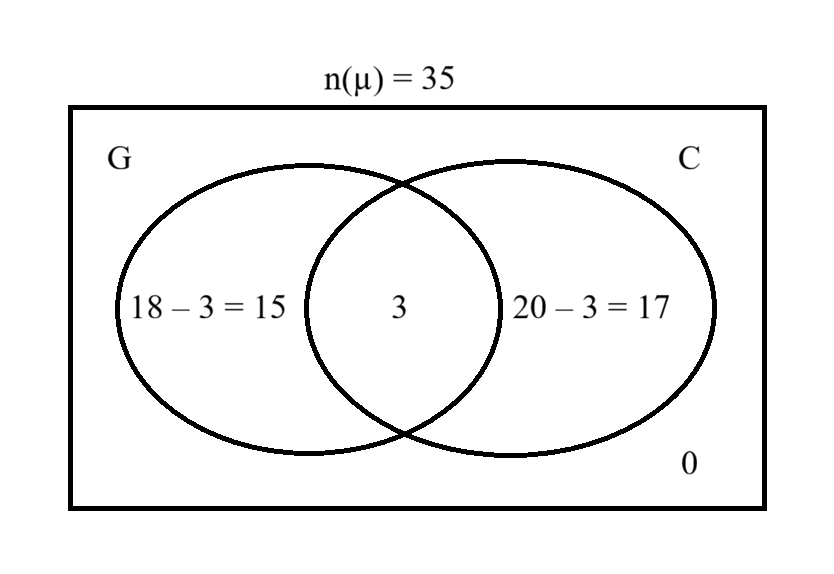
Number 3

$ n(\text{Sample Space}) = n(\mu) = 35 \\[3ex] n(\text{Goats only}) = 15 \\[3ex] P(\text{Goats only}) = \dfrac{n(\text{Goats only})}{n(\text{Sample Space})} \\[5ex] = \dfrac{15}{35} \\[5ex] = \dfrac{15 \div 5}{35 \div 5} \\[5ex] = \dfrac{3}{7} $
(4.)


(5.)


(6.)


(7.)


(8.)

(9.)


(10.)


(11.)


(12.)


Cash App: Your donation is appreciated. PayPal: Your donation is appreciated. Venmo: Your donation is appreciated. YouTube: Please Subscribe, Share, and Like my Channel