☰ Please Read Me.

General Certificate of Education Examination: Ordinary Level: Mathematics 2

The Joy of the Teacher is the Success of the Students. – Samuel Chukwuemeka

Welcome to Our Site


I greet you this day,
These are the solutions to the Ordinary Level Mathematics Paper 2 questions from the General Certificate of Education Board.
Please review the formulas, rules/laws, and theorems on the website for each topic as applicable.
If time permits and there is sufficient interest, video solutions may be provided. Please subscribe to the YouTube channel to be notified of upcoming livestreams. You are welcome to ask questions during the video livestreams.
If you find these resources valuable and if any of these resources were helpful in your passing the Mathematics tests/exams, please consider making a donation:

Cash App: $ExamsSuccess or
cash.app/ExamsSuccess

PayPal: @ExamsSuccess or
PayPal.me/ExamsSuccess

Venmo: @ExamsSuccess or
Venmo.com/u/ExamsSuccess

Square: Exams Success

Buy Me a Coffee: Exams Success

Buy Me a Coffee @ Ko-Fi: Exams Success

Your donation is appreciated.
Comments, ideas, areas of improvement, questions, and constructive criticisms are welcome.
Feel free to contact me. Please be positive in your message.
I wish you the best.
Thank you.

General Certificate of Education Board
Ordinary Level Examination
Mathematics Paper 2

Duration: Two and a Half Hours

Enter the information required in the boxes above.
This paper is arranged in two sections, A and B.
Answer ALL questions in Sections A and B.

Section A: Answer All the questions in the spaces provided.
The mark allocation for each question is indicated.

Section B: All questions in section B carry equal marks.
You are reminded of the necessity for good English and orderly presentation in your answers.
In calculations, you are advised to show all the steps in your working, giving your answer at each stage.
Non-programmable calculators are allowed.

SECTION A
(1.) Order of Operations: Evaluate $9 + 12 \div 4 - 2 \times 5$


$ 9 + 12 \div 4 - 2 \times 5 \\[3ex] = 9 + (12 \div 4) - (2 \times 5) \\[3ex] = 9 + 3 - 10 \\[3ex] = 12 - 10 \\[3ex] = 2 $
(2.) Factors and Multiples: (a.) Express 125 as a product of its primes
(b.) Hence, find the cube root of 125
(c.) Find the L.C.M of 18 and 24


$ (a.) \\[3ex] 125 = 5 \times 5 \times 5 \\[3ex] (b.) \\[3ex] \sqrt[3]{125} \\[3ex] = \sqrt[3]{5 \times 5 \times 5} \\[3ex] = 5 \\[3ex] $ (c.) Common factors of both numbers (indicated in black color) are counted only time.

$ 18 = \color{black}{2} \times 3 \times \color{black}{3} \\[3ex] 24 = \color{black}{2} \times 2 \times 2 \times \color{black}{3} \\[5ex] LCM = \color{black}{2} \times \color{black}{3} \times 3 \times 2 \times 2 \\[3ex] = 72 $
(3.) Mathematical Logic: Given two statements p and q.
Draw a truth table for $\neg p \land \neg q$, using T for True and F for False.


$p$ $q$ $\neg p$ $\neg q$ $\neg p \land \neg q$
$T$ $T$ $F$ $F$ $F$
$T$ $F$ $F$ $T$ $F$
$F$ $T$ $T$ $F$ $F$
$F$ $F$ $T$ $T$ $T$
(4.) Trigonometry: Bearings and Distances: Given that R is 30 km East of P and Q is 40 km South of R.
Calculate:
(a.) the distance PQ
(b.) the angle QPR


Let us represent the information diagrammatically.
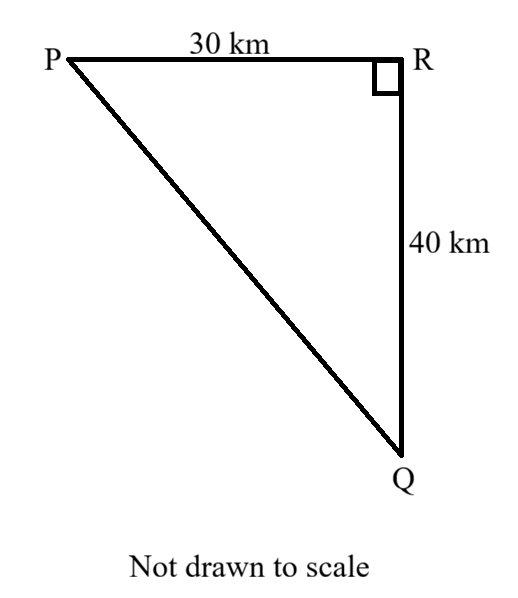
Number 4

$ (a.) \\[3ex] |PQ|^2 = 30^2 + 40^2 \quad(\text{Pythagorean Theorem}) \\[3ex] |PQ| = \sqrt{900 + 1600} \\[3ex] = \sqrt{2500} \\[3ex] = 50\;km \\[5ex] (b.) \\[3ex] \tan\angle QPR = \dfrac{40}{30} \quad(\text{SOHCAHTOA}) \\[5ex] \angle QPR = \tan^{-1}\left(\dfrac{4}{3}\right) \\[5ex] = 53.13010235^\circ $
(5.) Matrix Algebra: Given the matrices $P = \begin{pmatrix} 2 & 1 \\ 5 & 4 \end{pmatrix}$ and $Q = \begin{pmatrix} -3 & 1 \\ -2 & 4 \end{pmatrix}$
Find:

$ (a.)\;\; P - Q \\[3ex] (b.)\;\; 2P + Q \\[3ex] $

$ (a.) \\[3ex] P - Q \\[3ex] = \begin{pmatrix} 2 & 1 \\ 5 & 4 \end{pmatrix} - \begin{pmatrix} -3 & 1 \\ -2 & 4 \end{pmatrix} \\[5ex] = \begin{bmatrix} 2 -(-3) & 1 - 1 \\ 5 -(-2) & 4 - 4 \end{bmatrix} \\[5ex] = \begin{bmatrix} 5 & 0 \\ 7 & 0 \end{bmatrix} \\[7ex] 2P = 2\begin{pmatrix} 2 & 1 \\ 5 & 4 \end{pmatrix} \\[5ex] = \begin{bmatrix} 2(2) & 2(1) \\ 2(5) & 2(4) \end{bmatrix} \\[5ex] = \begin{bmatrix} 4 & 2 \\ 10 & 8 \end{bmatrix} \\[7ex] (b.) \\[3ex] 2P + Q \\[3ex] = \begin{bmatrix} 4 & 2 \\ 10 & 8 \end{bmatrix} + \begin{pmatrix} -3 & 1 \\ -2 & 4 \end{pmatrix} \\[5ex] = \begin{bmatrix} 4 +(-3) & 2 + 1 \\ 10 +(-2) & 8 + 4 \end{bmatrix} \\[5ex] = \begin{bmatrix} 1 & 3 \\ 8 & 12 \end{bmatrix} $
(6.) Probability: A bag contains 6 black pens and 4 red pens.
Given that a pen is chosen at random from the bag.
Find the probability that:
(a.) the pen is red
(b.) the pen is either red or black.


Let:
black = B
red = R
sample space = S

$ n(B) = 6 \\[3ex] n(R) = 4 \\[3ex] S = \{6B, 4R\} \\[3ex] n(S) = 6 + 4 = 10 \\[5ex] (a.) \\[3ex] P(R) = \dfrac{n(R)}{n(S)} \\[5ex] = \dfrac{4}{10} \\[5ex] = \dfrac{2}{5} \\[5ex] (b.) \\[3ex] P(\text{R OR B}) = \dfrac{4}{10} + \dfrac{6}{10} - 0 \quad(\text{Addition Rule for Mutually Exclusive Events}) \\[5ex] = \dfrac{10}{10} \\[5ex] = 1 $
(7.) Graph Theory: In a network, two roads link town A to town B, one road links town A to town C and two roads link town B to town C.
Find the number of:
(a.) nodes (towns)
(b.) arcs (roads)
(c.) regions


Let us represent the information diagrammatically.
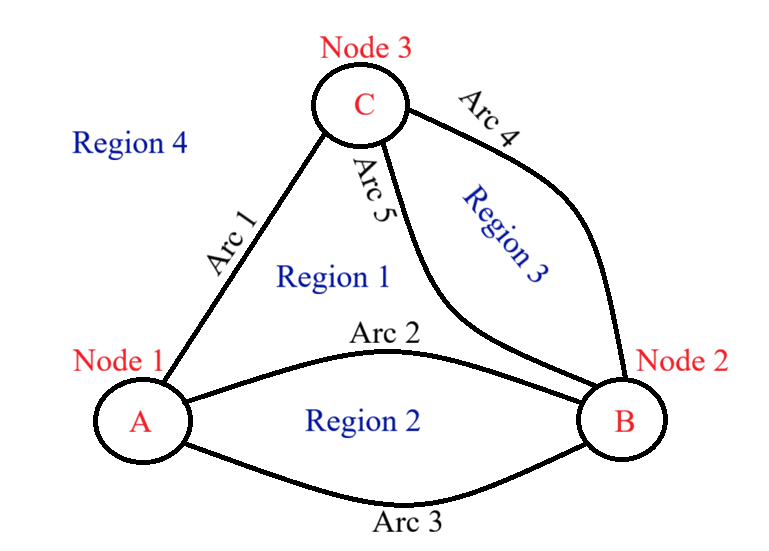
Number 7

(a.) The nodes (vertices) are the towns: A, B, C
There are 3 nodes.

(b.) The arcs (edges) are the roads connecting the towns:
two roads link town A to town B,
one road links town A to town C, and
two roads link town B to town C
2 + 1 + 2 = 5
There are 5 arcs.

(c.) The number of regions (faces) are the distinct bounded regions plus one unbounded (exterior) region.
Region 1 (Interior Triangle): The enclosed area by the inner roads connecting A → B, B → C, and C → A.
Region 2 (Lower Loop): The enclosed area between the two roads connecting A and B.
Region 3 (Right Loop): The enclosed area between the two roads connecting B and C.
Region 4 (Infinite Exterior): The entire area outside the network graph.
There are 4 regions.

Alternatively, we can use Euler's Formula for Planar Graphs.
Euler's Formula for Planar Graphs: For any connected planar network (or map) drawn on a plane, the number of faces/regions (F), vertices/nodes (V), and edges/arcs (E) are related by the formula: $F + V = E + 2$

$ F + V = E + 2 \\[3ex] F = E - V + 2 \\[3ex] = 5 - 3 + 2 \\[3ex] = 4 $
(8.) Circle Theorems: In a cyclic quadrilateral, ABCD, AC is a chord.
Given that angle ABC = x is opposite to angle ADC = 94° and that angle CAD = 46° while angle ACD = y.
Find angle:
(a.) x
(b.) y


Let us represent the information diagrammatically.
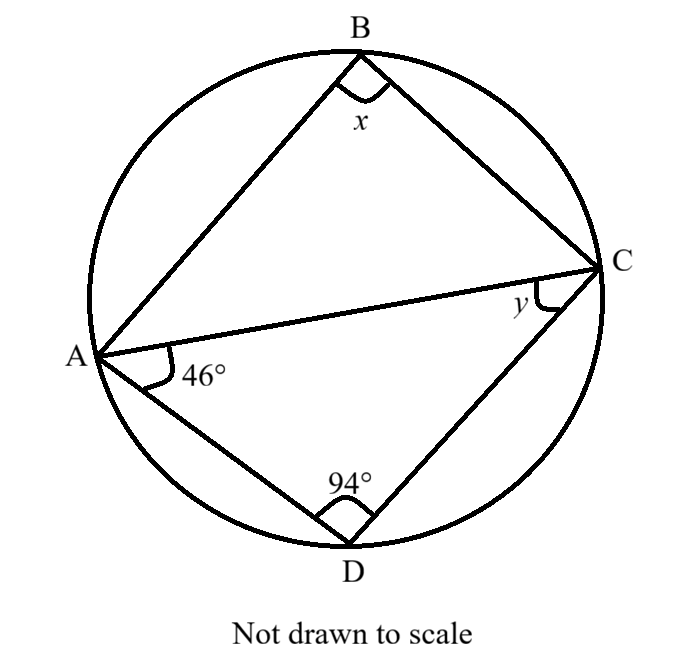
Number 8

$ (a.) \\[3ex] \underline{\text{Cyclic Quadrilateral ABCD}} \\[3ex] x + 94^\circ = 180^\circ \quad(\text{opposite angles of a cyclic quad are supplementary}) \\[3ex] x = 180 - 94 \\[3ex] x = 86^\circ \\[5ex] (b.) \\[3ex] \underline{\triangle \text{ACD}} \\[3ex] y + 46^\circ + 94^\circ = 180^\circ \quad(\text{sum of interior angles of a triangle}) \\[3ex] y + 140 = 180 \\[3ex] y = 180 - 140 \\[3ex] y = 40^\circ $
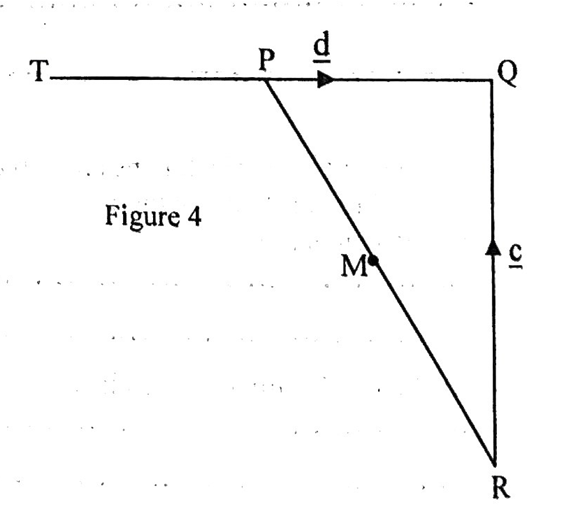
(9.) Vectors: Given the vector diagram in figure 4, $\overrightarrow{PQ} = \underline{d}$, $\overrightarrow{RQ} = \underline{c}$, $\overrightarrow{TP} = \overrightarrow{PQ}$ and M is the mid-point of $\overrightarrow{PR}$

Number 9

Find the vector:

$ (a.)\;\; \overrightarrow{PR} \\[3ex] (b.)\;\; \overrightarrow{PM} \\[3ex] $

$ (a.) \\[3ex] \overrightarrow{PR} + \overrightarrow{RQ} = \overrightarrow{PQ} \\[3ex] \overrightarrow{PR} + \underline{c} = \underline{d} \\[3ex] \overrightarrow{PR} = \underline{d} - \underline{c} \\[5ex] (b.) \\[3ex] \overrightarrow{PM} = \dfrac{1}{2} \overrightarrow{PR} \quad(\text{M is the mid-point of $\overrightarrow{PR}$}) \\[5ex] = \dfrac{\underline{d} - \underline{c}}{2} $
(10.) Geometric Sequences: Given the geometric Sequence: 3, 9, 27,...
Find:
(a.) the common ratio
(b.) the sum of the first three terms.


$ (a.) \\[3ex] \text{common ratio} = \dfrac{9}{3} \\[5ex] = 3 \\[5ex] (b.) \\[3ex] \text{sum of the first 3 terms} \\[3ex] = 3 + 9 + 27 \\[3ex] = 39 $
SECTION B
(1.) Quantitative Reasoning: Fractions, Decimals, Percents: (i.) A palm wine seller buys overnight palm wine at 200 FCFA per litre and fresh palm wine at 400 FCFA a litre.
He mixes the overnight palm wine and fresh palm wine in the ratio 2 : 3 before selling to customers.
Given that he sells 100 litres of the mixture daily at 500 FCFA per litre.
Find:
(a.) the number of litres of fresh palm wine in the mixture that he sells daily.
(b.) the total cost of 100 litres of the mixture.
(c.) his daily percentage profit.

Polynomials: (ii.) The polynomial $f(x)$ is given as $f(x) = x^3 + x^2 - 4x - 4$.
(a.) Show that $(x - 2)$ is a factor of $f(x)$
(b.) Factorize $f(x)$ completely.
(c.) Hence, solve the equation $f(x) = 0$.


Let:
overnight palm wine = OPW
fresh palm wine = FPW
He mixes the overnight palm wine and fresh palm wine in the ratio 2 : 3 before selling to customers.
$OPW : FPW = 2 : 3$

Given that he sells 100 litres of the mixture daily

$ (a.) \\[3ex] \text{sum of ratios} = 2 + 3 = 5 \\[3ex] \text{number of FPW litres in the mixture that he sells daily} \\[3ex] = \dfrac{3}{5} \times 100 \\[5ex] = 3 \times 20 \\[3ex] = 60\text{ litres} \\[3ex] $ Given that he sells 100 litres of the mixture daily at 500 FCFA per litre.

$ (b.) \\[3ex] \underline{\text{Selling 100 litres of the mixture}} \\[3ex] 100\text{ litres } @ \text{ 500 FCFA per litre} \\[3ex] = 100 \times 500 \\[3ex] = 50000\text{ FCFA} \\[3ex] $ We found out how much he sells 100 litres of the mixture daily.
But, how much does he buy 100 litres of the mixture?

$ \underline{\text{Buying 100 litres of the mixture}} \\[3ex] 60\text{ litres of FPW} \\[3ex] 100 - 60 = 40\text{ litres of OPW} \\[5ex] 40\text{ litres of OPW } @ \text{ 200 FCFA per litre} \\[3ex] = 40 \times 200 \\[3ex] = 8000\text{ FCFA} \\[5ex] 60\text{ litres of OPW } @ \text{ 400 FCFA per litre} \\[3ex] = 60 \times 400 \\[3ex] = 24000\text{ FCFA} \\[5ex] \text{Total cost} = 8000 + 24000 \\[3ex] = 32000\text{ FCFA} \\[5ex] (c.) \\[3ex] \text{Cost Price} = 32000\text{ FCFA} \\[3ex] \text{Selling Price} = 50000\text{ FCFA} \\[3ex] \text{Profit} = 50000 - 32000 \\[3ex] = 18000\text{ FCFA} \\[3ex] \text{Percentage Profit} = \dfrac{\text{Profit}}{\text{Cost Price}} \times 100\% \\[5ex] = \dfrac{18000}{32000} \times 100\% \\[5ex] = 56.25\% \\[5ex] (ii.) \\[3ex] f(x) = x^3 + x^2 - 4x - 4 \\[3ex] (a.) \\[3ex] \text{Factor} = x - 2 \\[3ex] \text{Root: } x - 2 = 0 \\[3ex] x = 2 \\[3ex] \underline{\text{Factor Theorem}} \\[3ex] f(2) = 2^3 + 2^2 - 4(2) - 4 \\[3ex] = 8 + 4 - 8 - 4 \\[3ex] = 0 \\[3ex] $ This implies that 2 is a root and $x - 2$ is a factor.

$ (b.) \\[3ex] f(x) = x^3 + x^2 - 4x - 4 \\[3ex] = x^2(x + 1) - 4(x + 1) \quad[\text{Factor by Grouping}] \\[3ex] = (x + 1)(x^2 - 4) \\[3ex] ............................................................ \\[3ex] x^2 - 4 \\[3ex] = x^2 - 2^2 \\[3ex] = (x + 2)(x - 2) \quad[\text{Factor by Difference of Two Squares}] \\[3ex] ............................................................ \\[3ex] = (x + 1)(x + 2)(x - 2) \\[5ex] (c.) \\[3ex] f(x) = 0 \\[3ex] (x + 1)(x + 2)(x - 2) = 0 \\[3ex] x + 1 = 0 \text{ OR } x + 2 = 0 \text{ OR } x - 2 = 0 \quad{\text{Zero Product Property}} \\[3ex] x = -1 \text{ OR } x = -2 \text{ OR } x = 2 $
(2.) Statistics: Data Organization: (i.) The scores of students in an examination are recorded as follows

Score (x) Frequency (f)
$8 - 12$ 6
$13 - 17$ 8
$18 - 22$ 12
$23 - 27$ 8
$28 - 32$ 6

State:
(a.) the number of classes or intervals in the distribution
(b.) the upper limit of 23 —27
(c.) the lower and upper class boundaries of 13 — 17
(d.) the modal class
Find:
(e.) the total number of students who wrote the examination
(f.) the class mark of the class 18—22.

Set Theory: (ii.) In a certain class of 40 students, where they speak both English and French,
18 students speak English (E) only
10 students speak French (F) only
3 do not speak neither English nor French
By drawing a Venn diagram or otherwise,
Find the number of students speaking both English and French


(i.)
(a.) There are 5 classes in the distribution.
(b.) The upper class limit of $23 - 27$ is 27

$ (c.) \\[3ex] \text{Class Interval: } 13 - 17 \\[3ex] \text{Lower Class Boundary} = \dfrac{12 + 13}{2} = \dfrac{25}{2} = 12.5 \\[5ex] \text{Upper Class Boundary} = \dfrac{17 + 18}{2} = \dfrac{35}{2} = 17.5 \\[5ex] $ (d.) The modal class is $18 - 22$ because it is the class with the highest frequency.
(e.) The total number of students who wrote the examination = sum of the frequencies, Σf

$ \Sigma f = 6 + 8 + 12 + 8 + 6 = 40\text{ students} \\[3ex] (f.) \\[3ex] \text{Class mark of } 18 - 22 \\[3ex] = \dfrac{18 + 22}{2} \\[5ex] = \dfrac{40}{2} \\[5ex] = 20 \\[3ex] $ (ii.) The Venn diagram is drawn as shown.
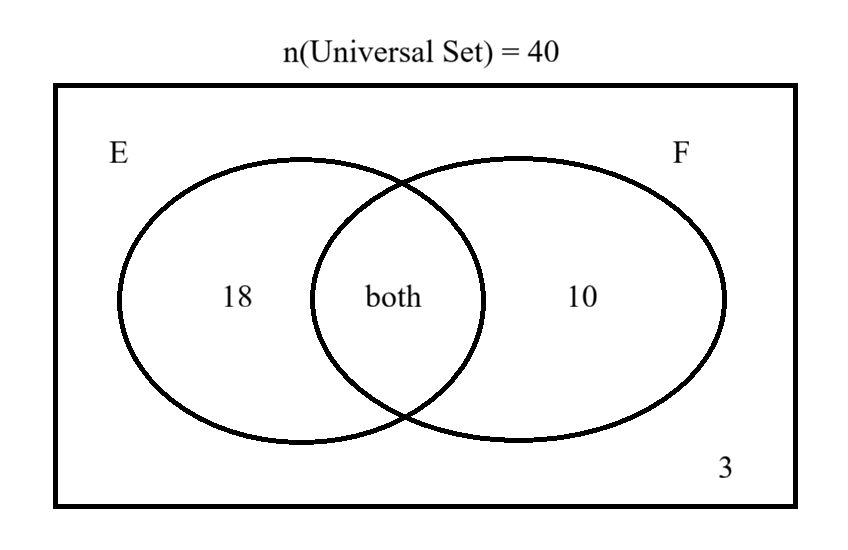
Number B2

$ 18 + 10 + \text{both} + 3 = 40 \\[3ex] \text{both} + 31 = 40 \\[3ex] \text{both} = 40 - 31 \\[3ex] \text{both} = n(E \cap F) = 9\text{ students} $
(3.) Arithmetic Operations on Functions and Composition of Functions: (i.) Given the functions f and g such that $f: x \rightarrow 2x + 3$ and $g : x \rightarrow x - 1$
Find,
(a.) $f(-2)$
(b.) $g^{-1}(x)$
(c.) $fg(x)$
(d.) the value of x, for which $f(x) = g(x)$

Locus and Construction: (ii.) Using only a pencil, ruler and a pair of compasses,
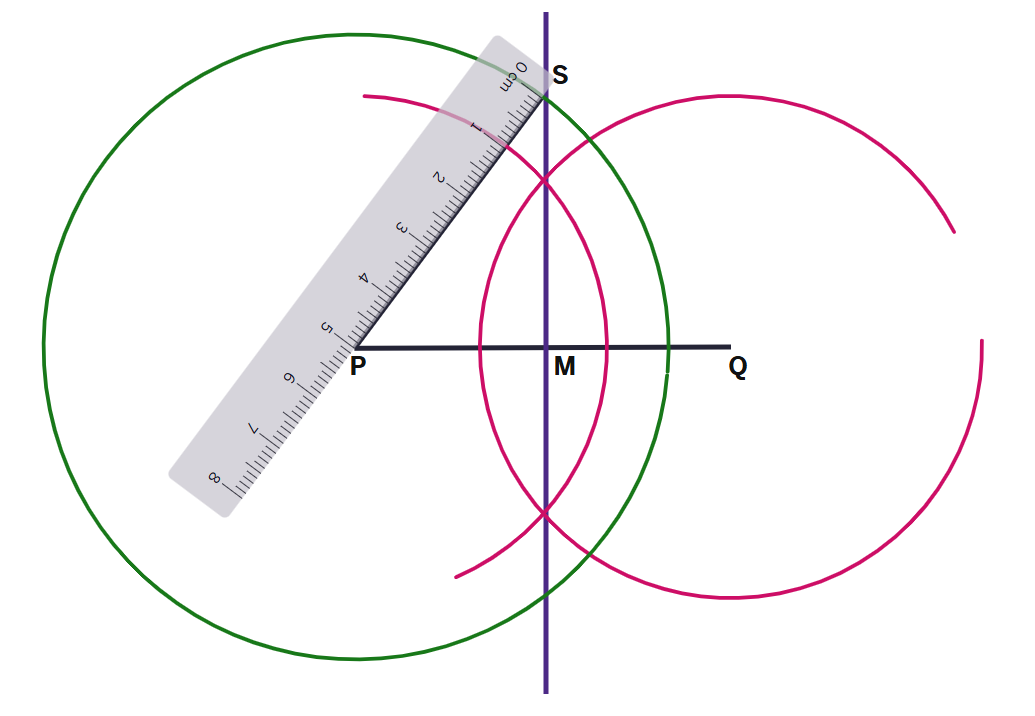
(a.) Draw the line PQ = 6cm
(b.) Construct the perpendicular bisector of PQ to meet PQ at M
(c.) Draw the line PS = 5cm, where S is a point on the perpendicular bisector


$ (i.) \\[3ex] f: x \rightarrow 2x + 3 \\[3ex] g : x \rightarrow x - 1 \\[5ex] (a.) \\[3ex] f(x) = 2x + 3 \\[3ex] f(-2) = 2(-2) + 3 \\[3ex] = -4 + 3 \\[3ex] = -1 \\[5ex] (b.) \\[3ex] g(x) = x - 1 \\[3ex] \text{Let } y = x - 1 \\[3ex] \text{Interchange $x$ and $y$}: \\[3ex] x = y - 1 \\[3ex] \text{Solve for $y$}: \\[3ex] y - 1 = x \\[3ex] y = x + 1 \\[3ex] \implies \\[3ex] g^{-1}(x) = x + 1 \\[5ex] (c.) \\[3ex] \text{Is this } f[g(x)] \text{ or } (fg)(x)? \\[3ex] \text{Let us do both just to be on the safe side.} \\[5ex] \underline{\text{Composition of Functions}} \\[3ex] f[g(x)] \\[3ex] = f(x - 1) \\[3ex] = 2(x - 1) + 3 \\[3ex] = 2x - 2 + 3 \\[3ex] = 2x + 1 \\[5ex] \underline{\text{Multiplication of Functions}} \\[3ex] (fg)(x) \\[3ex] = f(x) \times g(x) \\[3ex] = (2x + 3)(x - 1) \\[3ex] = 2x^2 - 2x + 3x - 3 \\[3ex] = 2x^2 + x - 3 \\[5ex] (d.) \\[3ex] f(x) = g(x) \\[3ex] 2x + 3 = x - 1 \\[3ex] 2x - x = -1 - 3 \\[3ex] x = -4 \\[3ex] $ (ii.) (a.) We begin by using the ruler to measure a length of PQ = 6 cm
(b.) Using a compass, we measure a length greater than half the length of 6 cm.
In other words, we measure a length greater than 3 cm.
(c.) At point P, we draw two arcs (top and bottom)
(d.) Using the same length on the compass, at Point Q, we draw two arcs to intersect the previous two arcs we drew.
(e.) With the ruler, we draw the straight line that joins the two intersected arcs at the top and the at the bottom.
The straight line is the perpendicular bisector of the line, PQ.
(f.) We use our compass to measure 5cm on the ruler.
Then, at point P, we draw a circle such that the radius of the circle is 5 cm.

The construction is shown:
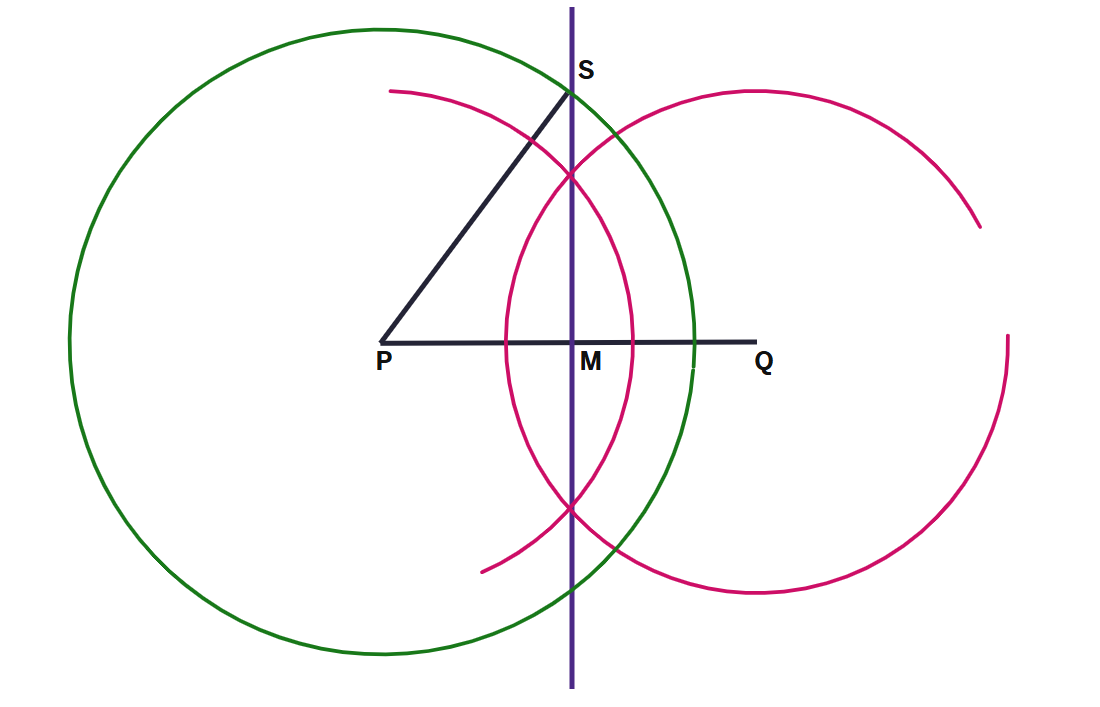
Number B3ii-1st

Number B3ii-2nd
(4.) Quadratic Functions: (i.) Given the function $f(x) = x^2 - 3x - 4$ for $-2 \le x \le 5$:
(a.) Copy and complete the following table

$x$ $-2$ $-1$ $0$ $1$ $2$ $3$ $4$ $5$
$y = f(x)$ $-4$ $6$

By drawing a graph of $y = f(x)$ using 1 cm to represent 1 unit on both axes, or otherwise,
(b.) Find the minimum value of $y = f(x)$ and the corresponding value of x
(c.) Solve the equation $f(x) = 0$

Matrix Algebra: (ii.) Given a 2 × 2 matrix, P defined by $P = \begin{pmatrix} 3 & 2k \\ k & 6 \end{pmatrix}$, where k is a constant.
(a.) Find P when $k = 2$
(b.) Hence or otherwise, find Adj. P, the adjoint of P


(a.) The completed table is:

$f(x) = x^2 - 3x - 4$
$x$ $-2$ $-1$ $0$ $1$ $2$ $3$ $4$ $5$
$x^2$ $4$ $1$ $0$ $1$ $4$ $9$ $16$ $25$
$-3x$ $6$ $3$ $0$ $-3$ $-6$ $-9$ $-12$ $-15$
$-4$ $-4$ $-4$ $-4$ $-4$ $-4$ $-4$ $-4$ $-4$
$y = f(x)$ $6$ $0$ $-4$ $-6$ $-6$ $-4$ $0$ $6$

Because the question stated "By drawing a graph of ..., or otherwise"",
and because the function is a quadratic function, let us use a better alternative than graph:

$ \underline{\text{Standard Form of a Quadratic Function:}} \\[3ex] f(x) = ax^2 + bx + c \\[3ex] \text{Comparing: } f(x) = x^2 - 3x - 4 \\[3ex] a = 1 \\[3ex] b = -3 \\[3ex] c = -4 \\[5ex] \text{Vertex } (x, y) \\[3ex] \text{$x$-coordinate of the Vertex} = -\dfrac{b}{2a} \\[5ex] = -\dfrac{-3}{2(1)} \\[5ex] = \dfrac{3}{2} \\[5ex] \text{$y$-coordinate of the Vertex} \\[3ex] = f\left(\dfrac{3}{2}\right) \\[5ex] = \left(\dfrac{3}{2}\right)^2 - 3\left(\dfrac{3}{2}\right) - 4 \\[5ex] = \dfrac{9}{4} - \dfrac{9}{2} - \dfrac{4}{1} \\[5ex] = \dfrac{9 - 18 - 16}{4} \\[5ex] = -\dfrac{25}{4} \\[5ex] (b.) \\[3ex] \text{Minimum value of } y = -\dfrac{25}{4} \\[5ex] \text{Corresponding value of } x = \dfrac{3}{2} \\[5ex] (c.) \\[3ex] f(x) = 0 \\[3ex] x^2 - 3x - 4 = 0 \\[3ex] (x + 1)(x - 4) = 0 \quad[\text{Shortcut Approach}] \\[3ex] x + 1 = 0 \text{ OR } x - 4 = 0 \quad(\text{Zero Product Property}) \\[3ex] x = -1 \text{ OR } x = 4 \\[5ex] (ii) \\[3ex] P = \begin{pmatrix} 3 & 2k \\ k & 6 \end{pmatrix} \\[5ex] (a.) \\[3ex] \text{For } k = 2 \\[3ex] P = \begin{bmatrix} 3 & 2(2) \\ 2 & 6 \end{bmatrix} \\[5ex] = \begin{pmatrix} 3 & 4 \\ 2 & 6 \end{pmatrix} \\[5ex] (b.) \\[3ex] \underline{\text{Minors of Matrix P}} \\[3ex] P_{11} = 6 \\[3ex] P_{12} = 2 \\[3ex] P_{21} = 4 \\[3ex] P_{22} = 3 \\[5ex] \underline{\text{Cofactors of Matrix P, say } C} \\[3ex] C_{11} = P_{11} = 6 \\[3ex] C_{12} = -P_{12} = -2 \\[3ex] C_{21} = -P_{21} = -4 \\[3ex] C_{22} = P_{22} = 3 \\[3ex] \text{Matrix of Cofactors, } C = \begin{pmatrix} 6 & -2 \\ -4 & 3 \end{pmatrix} \\[5ex] \underline{\text{Adjoint Matrix}} \\[3ex] Adj.\;P = C^T \\[3ex] = \begin{pmatrix} 6 & -4 \\ -2 & 3 \end{pmatrix} $