General Certificate of Education Examination: Ordinary Level: Mathematics 1
The Joy of the Teacher is the Success of the Students. – Samuel Dominic Chukwuemeka
Welcome to Our Site
I greet you this day,
These are the solutions to the Ordinary Level Mathematics Paper 1 (Multiple Choice) questions from the General
Certificate of Education Board.
Please review the formulas, rules/laws, and theorems on the website for each topic as applicable.
If time permits and there is sufficient interest, video solutions may be provided. Please subscribe to the
YouTube channel to be notified of upcoming livestreams.
You are welcome to ask questions during the video livestreams.
If you find these resources valuable and if any of these resources were helpful in your passing the
Mathematics tests/exams, please consider making a donation:
Cash App: $ExamsSuccess or
cash.app/ExamsSuccess
PayPal: @ExamsSuccess or
PayPal.me/ExamsSuccess
Venmo: @ExamsSuccess or
Venmo.com/u/ExamsSuccess
Square: Exams Success
Buy Me a Coffee: Exams Success
Buy Me a Coffee @ Ko-Fi: Exams Success
Your donation is appreciated.
Comments, ideas, areas of improvement, questions, and constructive
criticisms are welcome.
Feel free to contact me. Please be positive in your message.
I wish you the best.
Thank you.
General Certificate of Education Board
General Certificate of Education Examination
Ordinary Level: Mathematics Paper 1
Multiple Choice Question Paper
Mobile phones are NOT allowed in the examination room.
Duration: One and a Half Hours
Instructions to Candidates
Read the following instructions carefully before you start answering the questions in this paper. Make sure you
have a Soft HB pencil and an eraser for this examination.
(1.) Use a soft HB PENCIL throughout the examination.
(2.) Do not open this booklet until you are told to do so.
Before the examination begins:
(3.) Check that this question booklet is headed "ORDINARY LEVEL - 0570 MATHEMATICS 1"
(4.) Fill in the information required in the spaces above.
(5.) Fill in the information required in the spaces provided on the answer sheet using your HB pencil:
Candidate Name, Exam Session, Subject Code and Candidate Identification Number.
Take care that you do not crease or fold the answer sheet or make any marks on it other than those asked for in
these instructions.
How to answer the questions in this examination:
(6.) Answer ALL the 50 questions in this Examination. All questions carry equal marks.
(7.) Non-programmable Calculators are allowed.
(8.) Each question has FOUR suggested answers: A, B, C and D. Decide which answer is appropriate. Find the
number of the question on the Answer Sheet and draw a horizontal line across the letter to join the square
brackets for the answer you have chosen.
For example, if C is your correct answer, mark C as shown below:
$$
[A]\;\;[B]\;\;[\require{enclose}\enclose{horizontalstrike}{C}]\;\;[D]
$$
(9.) Mark only one answer for each question. If you mark more than one answer, you will score a zero for that
question. If you change your mind about an answer, erase the first mark carefully, then mark your new answer.
(10.) Avoid spending too much tithe on any one question. If you find a question difficult, move on to the next
question. You can come back to this question later.
(11.) Do all your rough work using the blank spaces in the question booklet.
(12.) At the end Of the examination, the invigilator shall collect the answer sheet first and then the question
booklet.
Do not attempt to leave the Examination Hall with it.
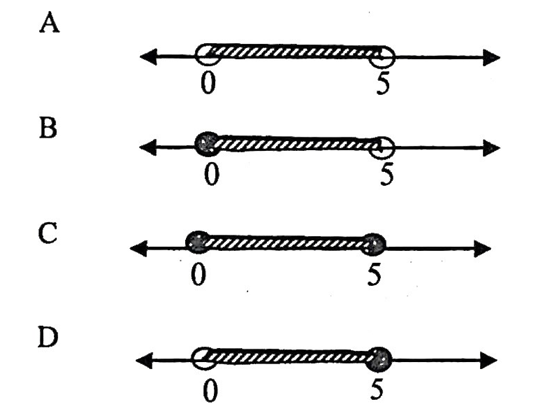
For the graph of linear inequalities:
Closed Interval: 2 closed circles: Both end points are included
Open Interval: 2 open circles: Both endpoints are excluded
Half-closed, Half-open Interval: 1 closed circle, 1 open circle: Left endpoint is included, Right endpoint is excluded
Half-open, Half-closed Interval: 1 open circle, 1 closed circle: Left endpoint is excluded, Right endpoint is included
The inequality, $T = \{x: 0 \le x \le 5\}$ shows that both endpoints, 0 and 5 are included (because of the less than or equal to signs)
Hence, the diagram should display two closed circles at those endpoints: Option C.



