Bahamas General Certificate of Secondary Education: Mathematics: Paper 3 (Core/Extended)
The Joy of the Teacher is the Success of the Students. – Samuel Chukwuemeka
Welcome to Our Site
I greet you this day,
These are the solutions to the BGCSE Mathematics Paper 3 questions.
Please review the Formulas, rules/laws, and theorems on the website for each topic as applicable.
If time permits and there is sufficient interest, video solutions may be provided. Please subscribe to the
YouTube channel to be notified
of upcoming livestreams.
You are welcome to ask questions during the video livestreams.
If you find these resources valuable and if any of these resources were helpful in your passing the
Mathematics tests/exams, please consider making a donation:
Cash App: $ExamsSuccess or
cash.app/ExamsSuccess
PayPal: @ExamsSuccess or
PayPal.me/ExamsSuccess
Venmo: @ExamsSuccess or
Venmo.com/u/ExamsSuccess
Square: Exams Success
Buy Me a Coffee: Exams Success
Buy Me a Coffee @ Ko-Fi: Exams Success
Your donation is appreciated.
Comments, ideas, areas of improvement, questions, and constructive
criticisms are welcome.
Feel free to contact me. Please be positive in your message.
I wish you the best.
Thank you.
Ministry of Education National Examinations
Bahamas General Certificate of Secondary Education
Mathematics
Paper 3 (Core/Extended)
Time: 1:00 pm – 2:30 pm
Instructions to Candidates
(1.) Do not open this booklet until you are told to do so.
(2.) Write your school number, candidate number, surname and initials in the spaces provided on each answer
booklet.
(3.) Remove the graph paper from the question paper. Write your school number, candidate number, surname and
initials, signature and date on the graph paper. Place the graph paper in the answer booklet.
(4.) Answer ALL questions in the answer booklet.
(5.) ALL working must be shown.
(6.) ALL working must be done in blue or black ink, except for drawings, lines and constructions which may be
done in pencil.
Information for Candidates
(1.) Calculators may be used. (No Graphing Calculators allowed).
(2.) Tracing paper and geometrical instruments may be used.
(3.) The mark for each question, or part question, is shown in brackets [ ].
(4.) The total number of marks for this paper is 100.
Formula Sheet: Information and Formulae
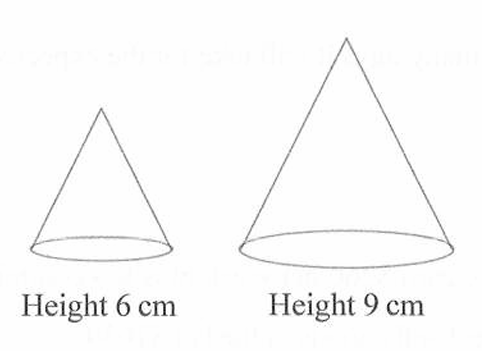
Two similar cones are shown.
The surface area of the larger cone is 54 cm².
(a.) Find the surface area of the smaller cone.
The volume of the smaller cone is 24 cm³.
(b.) Find the volume of the larger cone.
Scale Factor, Perimeter Ratio, Area Ratio, and Volume Ratio of Similar Figures Theorem
It states that for two similar figures, the ratio of the perimeters is the same as the scale factor; the ratio of the areas is the ratio of the square of the scale factor, and the ratio of the volumes is the ratio of the cubes of the scale factor.
$ \underline{\text{Similar Cones: Left to Right: Smaller Cone A to Larger Cone}} \\[3ex] \text{Height of Smaller Cone} = 6\;cm \\[3ex] \text{Height of Larger Cone} = 9\;cm \\[5ex] \text{Scale Factor} \\[3ex] = \dfrac{\text{Height of Smaller Cone}}{\text{Height of Larger Cone}} \\[5ex] = \dfrac{6}{9} \\[5ex] = \dfrac{2}{3} \\[5ex] (a.) \\[3ex] \text{Ratio of the Surface Areas} \\[3ex] = \dfrac{\text{Surface Area of Smaller Cone}}{\text{Surface Area of Larger Cone}} = \text{Scale Factor}^2 \\[5ex] \implies \\[3ex] \dfrac{\text{Surface Area of the Smaller Cone}}{54} = \left(\dfrac{2}{3}\right)^2 \\[5ex] \text{Surface Area of the Smaller Cone} = 54 \times \dfrac{4}{9} \\[5ex] = 6 \times 4 \\[3ex] = 24\;cm^2 \\[5ex] (b.) \\[3ex] \text{Ratio of the Volumes} \\[3ex] = \dfrac{\text{Volume of Smaller Cone}}{\text{Volume of Larger Cone}} = \text{Scale Factor}^3 \\[5ex] \dfrac{24}{\text{Volume of the Larger Cone}} = \left(\dfrac{2}{3}\right)^3 \\[5ex] \dfrac{\text{Volume of the Larger Cone}}{24} = \left(\dfrac{3}{2}\right)^3 \\[5ex] \text{Volume of the Larger Cone} = 24 \times \dfrac{27}{8} \\[5ex] = 3 \times 27 \\[3ex] = 81\;cm^3 $
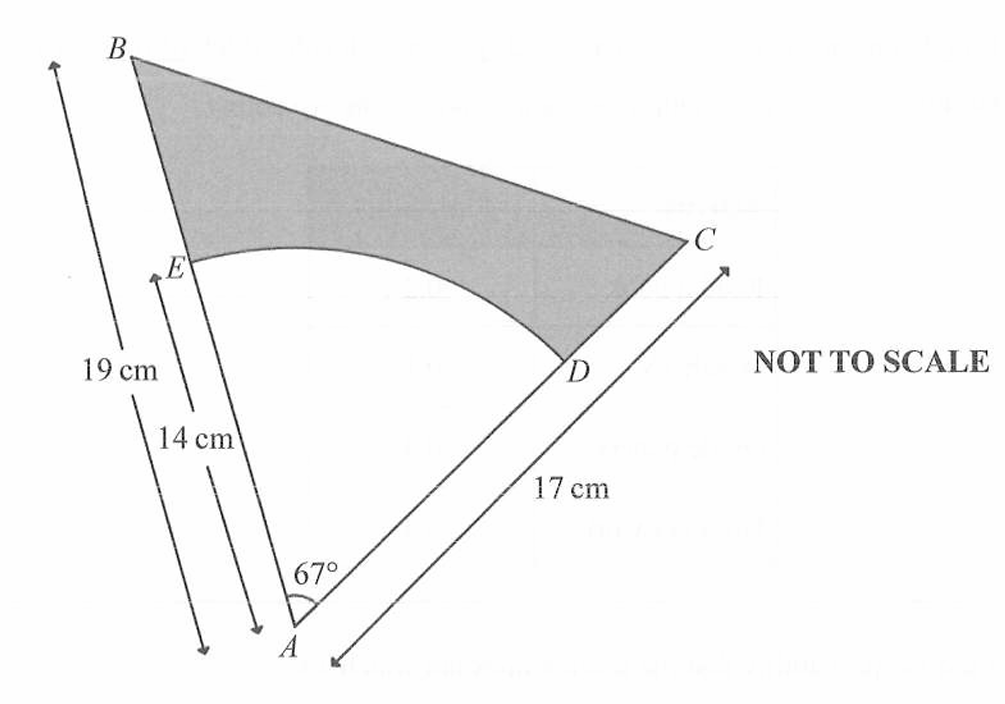
In the diagram, ABC is a triangle and ADE is a sector.
Find correct to the nearest whole number,
(a.) the area of traingle ABC,
(b.) the area of sector, ADE,
(c.) the area of shaded region BCDE,
(d.) the length BC,
(e.) the size of angle ABC.
$ (a.) \\[3ex] \text{Area of } \triangle ABC \\[3ex] = \dfrac{1}{2} \times |AB| \times |AC| \times \sin\angle BAC \\[5ex] = 0.5 \times 19 \times 17 \times \sin 67^\circ \\[3ex] = 161.5 \times 0.9205048535 \\[3ex] = 148.6615338 \\[3ex] \approx 149\;cm^2 \\[5ex] (b.) \\[3ex] \text{Area of sector } ADE \\[3ex] = \dfrac{\text{central angle}}{360} \times \pi \times \text{radius}^2 \\[5ex] = \dfrac{67}{360} \times \pi \times 14^2 \\[5ex] = \dfrac{67 \times \pi \times 196}{360} \\[5ex] = \dfrac{41255.39473}{360} \\[5ex] = 114.5983187 \\[3ex] \approx 115\;cm^2 \\[5ex] (c.) \\[3ex] \text{Area of the shaded region } BCDE \\[3ex] = \text{Area of } \triangle ABC - \text{Area of sector } ADE \\[3ex] = 148.6615338 - 114.5983187 \\[3ex] = 34.06321511 \\[3ex] \approx 34\;cm^2 \\[5ex] (d.) \\[3ex] |BC|^2 = |AB|^2 + |AC|^2 - 2 \times |AB| \times |AC| \times \cos\angle BAC \quad\text{[Cosine Law]} \\[3ex] = 19^2 + 17^2 - (2 \times 19 \times 17 \times \cos 67^\circ) \\[3ex] = 361 + 289 - (646 \times 0.3907311285) \\[3ex] = 650 - 252.412309 \\[3ex] = 397.587691 \\[3ex] |BC| = \sqrt{397.587691} \\[3ex] = 19.93960107 \\[3ex] \approx 20\;cm \\[5ex] (e.) \\[3ex] \dfrac{\sin \angle ABC}{|AC|} = \dfrac{\sin \angle BAC}{|BC|} \quad\text{[Sine Law]} \\[5ex] \dfrac{\sin \angle ABC}{17} = \dfrac{\sin 67^\circ}{19.93960107} \\[5ex] \sin\angle ABC = \dfrac{17 \times \sin 67^\circ}{19.93960107} \\[5ex] = \dfrac{17 \times 0.9205048535}{19.93960107} \\[5ex] = \dfrac{15.64858251}{19.93960107} \\[5ex] = 0.784799177 \\[3ex] \angle ABC = \sin^{-1}(0.784799177) \\[3ex] = 51.7021084 \\[3ex] \approx 52^\circ $
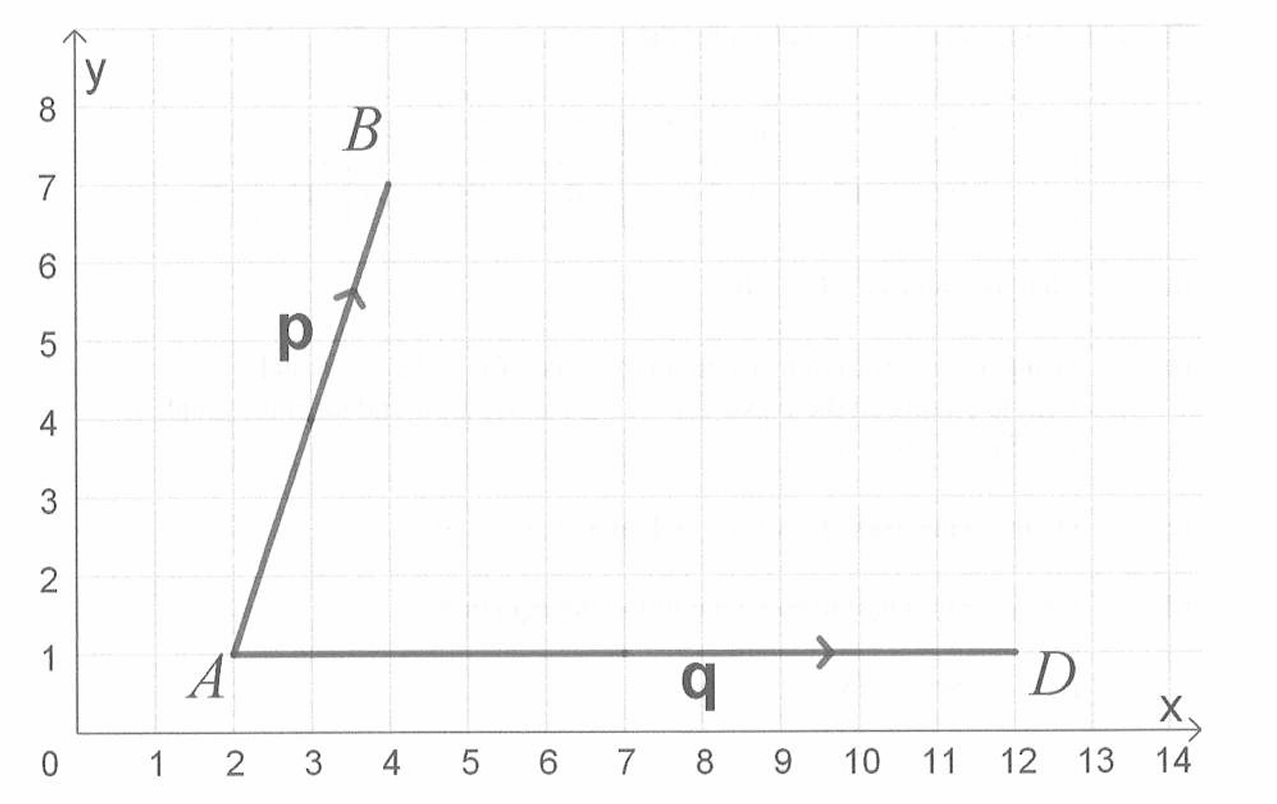
The diagram shows a part of a parallelogram ABCD.
AB = p and AD = q.
(a.) Using a scale of 1 cm to 1 unit on each axis for $0 \le x \le 16$ and $0 \le y \le 16$, draw and label the vectors shown onto your graph paper.
(b.) Plot the point C and complete the parallelogram ABCD.
N lies on BC such that $BN = \dfrac{2}{5}BC$.
(c.) Mark and label the point N.
(d.) Write $\overrightarrow{AC}$ in terms of p and q.
(e.) Write $\overrightarrow{ND}$ as a column vector.
Point X lies on AB produced such that $AX = 2AB$.
(f.) (i.) Mark the point X.
(ii.) Write $\overrightarrow{XN}$ in terms of p and q.
$ \underline{\text{Coordinates of Points: A, B, D}} \\[3ex] A(2, 1) \\[3ex] B(4, 7) \\[3ex] D(12, 1) \\[3ex] \overrightarrow{AB} = \vec{p} \\[3ex] \overrightarrow{AD} = \vec{q} \\[3ex] \overrightarrow{BC} = \vec{q} \quad[\text{opposite side of a parallelogram}] \\[3ex] \overrightarrow{BN} = \dfrac{2}{5} \times \overrightarrow{BC} = \dfrac{2}{5}\vec{q} \\[5ex] $ (a.), (b.), (c.) (f.)(i.)
The parallelogram is drawn, and the points are labelled as shown:
Hand-drawn and Software-drawn
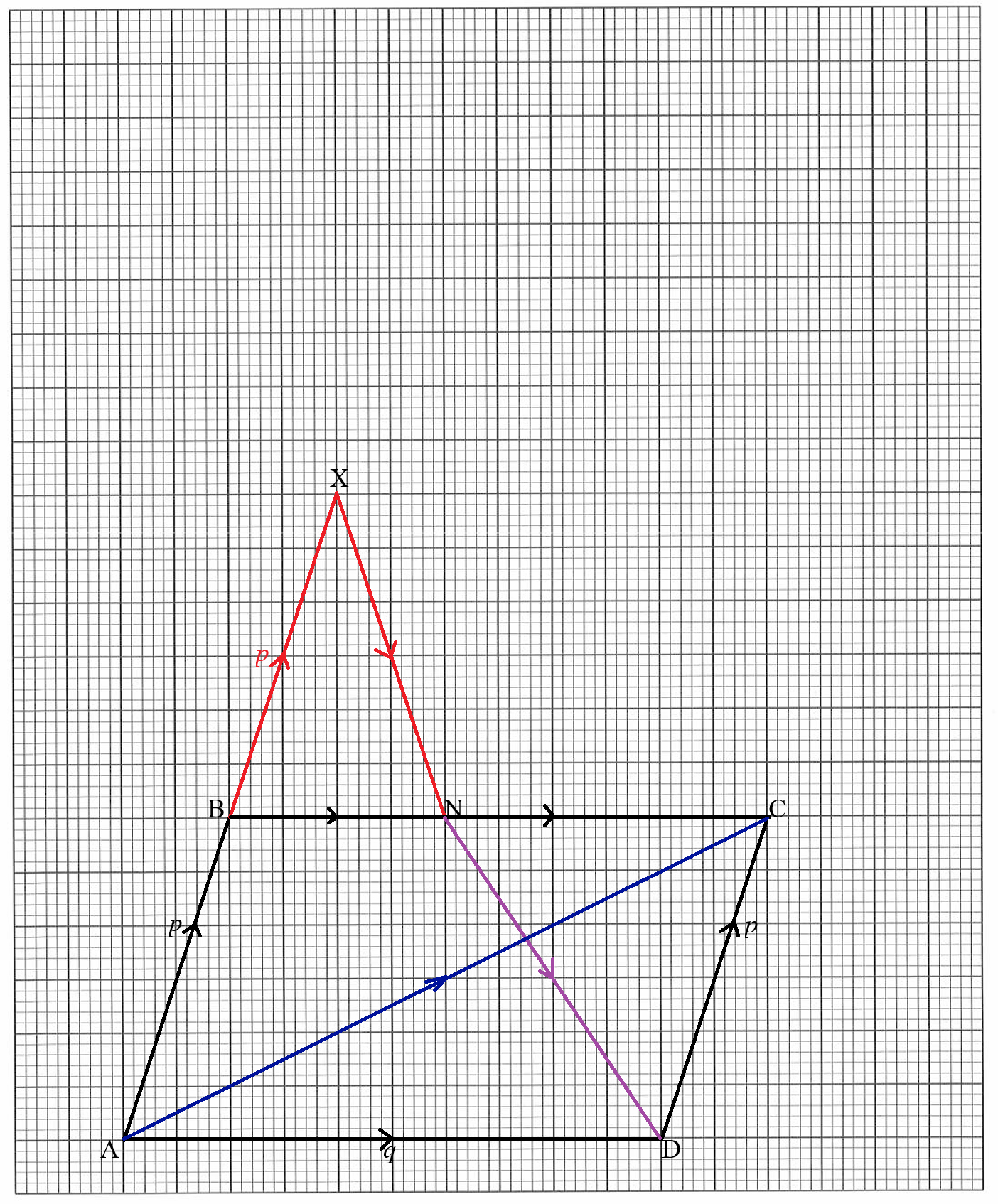
Hand-drawn and Pencil
$ (d.) \\[3ex] \overrightarrow{AC} = \overrightarrow{AB} + \overrightarrow{BC} \\[3ex] = \vec{p} + \vec{q} \\[5ex] (e.) \\[3ex] \underline{\text{Point Position Vectors}} \\[3ex] \vec{D} = \begin{pmatrix} 12 \\ 1 \end{pmatrix} \\[5ex] \vec{N} = \begin{pmatrix} 8 \\ 7 \end{pmatrix} \\[5ex] \overrightarrow{ND} = \vec{D} - \vec{N} \\[3ex] = \begin{pmatrix} 12 \\ 1 \end{pmatrix} - \begin{pmatrix} 8 \\ 7 \end{pmatrix} \\[5ex] = \begin{pmatrix} 12 - 8 \\ 1 - 7 \end{pmatrix} \\[5ex] = \begin{pmatrix} 4 \\ -6 \end{pmatrix} \\[5ex] (f.)(ii.) \\[3ex] AX = 2AB \quad[\text{Given}] \\[3ex] \overrightarrow{AX} = \overrightarrow{AB} + \overrightarrow{BX} \\[3ex] \implies \\[3ex] \overrightarrow{BX} = \overrightarrow{AB} = \vec{p} \\[5ex] \overrightarrow{BX} + \overrightarrow{XN} = \overrightarrow{BN} \\[3ex] \overrightarrow{XN} = \overrightarrow{BN} - \overrightarrow{BX} \\[3ex] = \dfrac{2}{5}\vec{q} - \vec{p} \\[5ex] = \dfrac{2\vec{q} - 5\vec{p}}{5} $
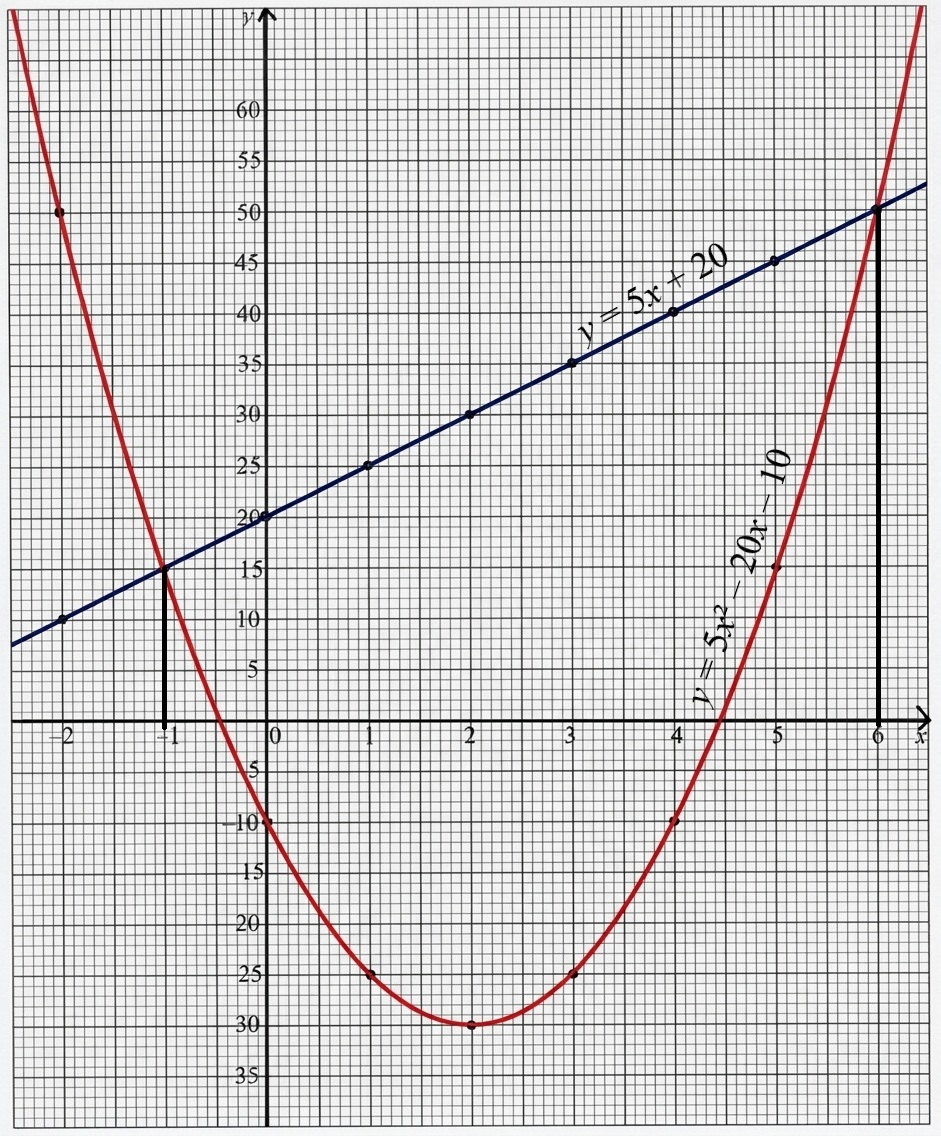
The table below shows some values for the equation $y = 5x^2 - 20x - 10$.
| $x$ | $-2$ | $-1$ | $0$ | $1$ | $2$ | $3$ | $4$ | $5$ | $6$ |
| $y$ | $50$ | $15$ | $A$ | $-25$ | $B$ | $-25$ | $-10$ | $15$ | $50$ |
(a.) Find the values of $A$ and $B$.
(b.) Using a scale of 2 cm to 1 unit on the x-axis for $-2 \le x \le 6$ and 1 cm to 5 units on the y-axis for $-35 \le y \le 60$, draw and label the graph of $y = 5x^2 - 20x - 10$.
(c.) On the same axes, draw the graph of $y = 5x + 20$.
(d.) Use your graph(s) to solve the following equations:
$ (i.)\;\; 5x^2 - 20x - 10 = 0 \\[3ex] (ii.)\;\; 5x^2 - 20x - 10 = 5x + 20 \\[3ex] $
(a.) The completed table is:
| $x$ | $-2$ | $-1$ | $0$ | $1$ | $2$ | $3$ | $4$ | $5$ | $6$ |
| $x^2$ | $4$ | $1$ | $0$ | $1$ | $4$ | $9$ | $16$ | $25$ | $36$ |
| $5x^2$ | $20$ | $5$ | $0$ | $5$ | $20$ | $45$ | $80$ | $125$ | $180$ |
| $-20x$ | $40$ | $20$ | $0$ | $-20$ | $-40$ | $-60$ | $-80$ | $-100$ | $-120$ |
| $-10$ | $-10$ | $-10$ | $-10$ | $-10$ | $-10$ | $-10$ | $-10$ | $-10$ | $-10$ |
| $y$ | $50$ | $15$ | $-10$ | $-25$ | $-30$ | $-25$ | $-10$ | $15$ | $50$ |
$ A = -10 \\[3ex] B = -30 \\[3ex] $
| $x$ | $-2$ | $-1$ | $0$ | $1$ | $2$ | $3$ | $4$ | $5$ | $6$ |
| $5x$ | $-10$ | $-5$ | $0$ | $5$ | $10$ | $15$ | $20$ | $25$ | $30$ |
| $20$ | $20$ | $20$ | $20$ | $20$ | $20$ | $20$ | $20$ | $20$ | $20$ |
| $y$ | $10$ | $15$ | $20$ | $25$ | $30$ | $35$ | $40$ | $45$ | $50$ |
(b.) and (c.)
Both graphs are drawn as shown:
Hand-drawn and Software-drawn
Hand-drawn and Pencil
(d.) From the graphs, the solutions of:
$ (i.)\;\; 5x^2 - 20x - 10 = 0 \text{ are: } \\[3ex] x_1 \approx -0.45 \\[3ex] x_2 \approx 4.45 \\[5ex] (ii.)\;\; 5x^2 - 20x - 10 = 5x + 20 \text{ are: } \\[3ex] x_1 = -1 \\[3ex] x_2 = 6 \\[3ex] $ Check for $5x^2 - 20x - 10 = 0$
| LHS | RHS |
|---|---|
| $5x^2 - 20x - 10$ | $0$ |
|
$
x \approx -0.45 \\[3ex]
5(-0.45)^2 - 20(-0.45) - 10 \\[3ex]
5(0.2025) + 9 - 10 \\[3ex]
1.0125 + 9 - 10 \\[3ex]
0.0125
$
$ x \approx 4.45 \\[3ex] 5(4.45)^2 - 20(4.45) - 10 \\[3ex] 5(19.8025) - 89 - 10 \\[3ex] 99.0125 - 89 - 10 \\[3ex] 0.0125 $ |
$0$ |
Check for $5x^2 - 20x - 10 = 5x + 20$
| LHS | RHS |
|---|---|
| $5x^2 - 20x - 10$ | $5x + 20$ |
|
$
x = -1 \\[3ex]
5(-1)^2 - 20(-1) - 10 \\[3ex]
5(1) + 20 - 10 \\[3ex]
5 + 20 - 10 \\[3ex]
15
$
$ x = 6 \\[3ex] 5(6)^2 - 20(6) - 10 \\[3ex] 5(36) - 120 - 10 \\[3ex] 180 - 120 - 10 \\[3ex] 50 $ |
$
x = -1 \\[3ex]
5(-1) + 20 \\[3ex]
-5 + 20 \\[3ex]
15
$
$ x = 6 \\[3ex] 5(6) + 20 \\[3ex] 30 + 20 \\[3ex] 50 $ |



