Botswana General Certificate of Secondary Education: Mathematics: Paper 2
The Joy of the Teacher is the Success of the Students. – Samuel Chukwuemeka
Welcome to Our Site
I greet you this day,
These are the solutions to the BGCSE Mathematics Paper 2 questions.
Please review the Formulas, rules/laws, and theorems on the website for each topic as applicable.
If time permits and there is sufficient interest, video solutions may be provided. Please subscribe to the
YouTube channel to be notified
of upcoming livestreams.
You are welcome to ask questions during the video livestreams.
If you find these resources valuable and if any of these resources were helpful in your passing the
Mathematics tests/exams, please consider making a donation:
Cash App: $ExamsSuccess or
cash.app/ExamsSuccess
PayPal: @ExamsSuccess or
PayPal.me/ExamsSuccess
Venmo: @ExamsSuccess or
Venmo.com/u/ExamsSuccess
Your donation is appreciated.
Comments, ideas, areas of improvement, questions, and constructive
criticisms are welcome.
Feel free to contact me. Please be positive in your message.
I wish you the best.
Thank you.
Botswana Examinations Council
Botswana General Certificate of Secondary Education
Mathematics
Paper 2
Candidates answer on the Question Paper.
No Additional Materials are required.
2 hours
Instructions
(1.) Write your name, Centre number and candidate number in the spaces provided at the top of this page.
(2.) Answer all questions.
(3.) Write your answers in the spaces provided on the question paper.
(4.) If working is needed for any question, it must be shown below that question. Omission of essential working
will result in the loss of marks.
(5.) Do not use staples, paper clips, highlighters, glue or correction fluid.
(6.) If the degree of accuracy is not specified in the question and if the answer is not exact, the answer
should be given to three significant figures.
Answers in degrees should be given to one decimal place.
(7.) In any question where the value of π is required, use the value from your calculator or take π as
3.142.
Information
(1.) The number of marks for each question or part question is shown in brackets [ ].
(2.) The total mark for this paper is 75.
(3.) Electronic calculators may be used.
Because electronic calculators are permitted, the TI-84 Plus CE calcuator will be used.
Formula Sheet: Information and Formulae
The car leaves town A and travels at a constant speed covering 40km in 30 minutes.
It then had a breakdown and stops for 15 minutes.
After the breakdown, the car continues at a constant speed for another 10 minutes to reach town B.
(a.) Draw a distance-time graph to represent the journey from town A to town B.
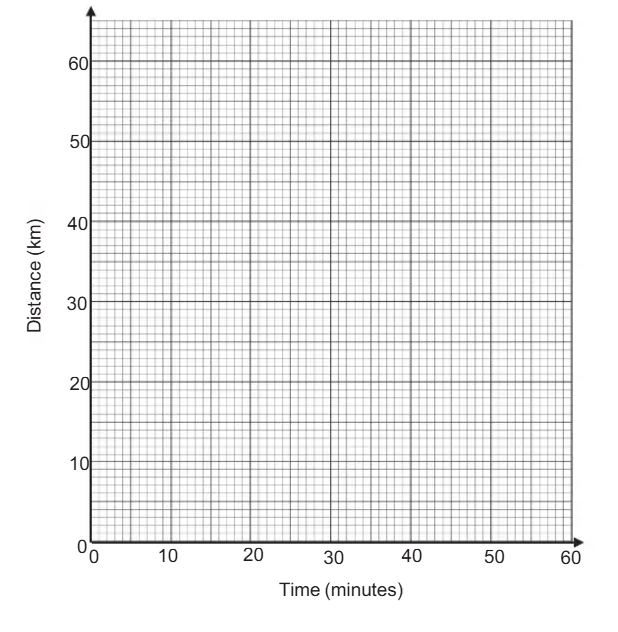
(b.) What happens to the speed of the car after the breakdown?
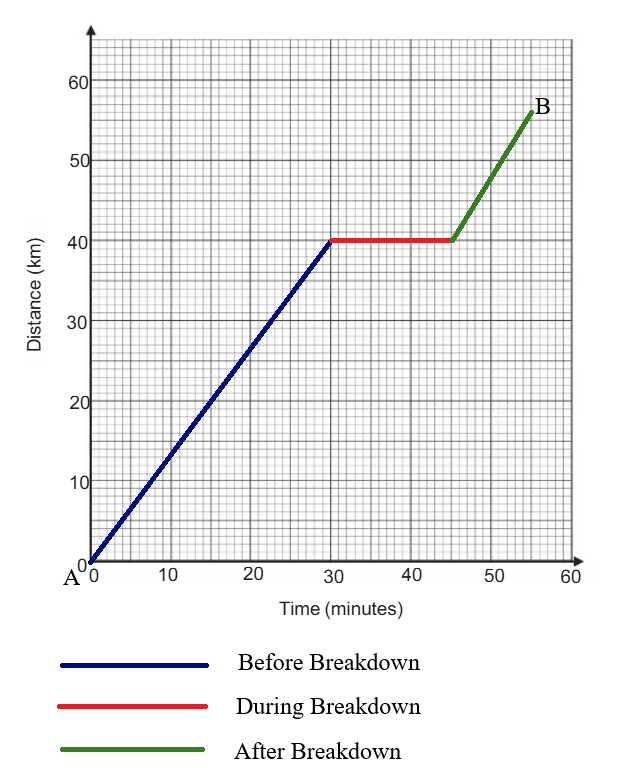
(time, distance)
Before Breakdown
From town A: (0, 0)
distance = 40km
time = 30 minutes
(30, 40)
During Breakdown
Stops for 15 minutes; no distance covered.
distance = 40km
time = 30 + 15 = 45 minutes
(45, 40)
After Breakdown
The car continues at a constant speed for another 10 minutes to reach town B.
Reaches town B, a distance of 56km from town A
total distance = 56km
time = 45 + 10 = 55 minutes
(55, 56)
The distance-time graph to represent the journey from town A to town B is drawn as shown:
$ s.......t.......d \\[3ex] \text{speed, }s \times \text{ time, }t = \text{ distance, }d \\[3ex] s = \dfrac{d}{t} \\[5ex] (b.) \\[3ex] \text{Before Breakdown: } (30, 40) \\[3ex] d = 40km \\[3ex] t = 30min \\[3ex] = 30min \times \dfrac{1hr}{60min} = 0.5min \\[5ex] s = \dfrac{40}{0.5} = 80km/hr \\[5ex] \text{During Breakdown: } (45, 40) \\[3ex] s = 0km/hr \quad\text{the car stopped} \\[5ex] \text{After Breakdown: } (55, 56) \\[3ex] d = 56 - 40 = 16km \\[3ex] t = 10min \\[3ex] = 10min \times \dfrac{1hr}{60min} = \dfrac{1}{6}hr \\[5ex] s = 16 \div \dfrac{1}{6} \\[5ex] = 16 \times 6 \\[3ex] = 96km/hr \\[3ex] $ After the breakdown, the speed of the car increased to 96km/hr
The campsite is 5.2km from the tower on a bearing of 134°.
The waterhole is 6.8km from the campsite on a bearing of 044°.
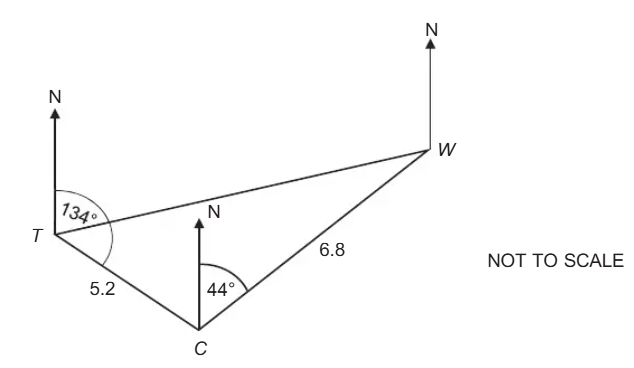
(a.) Show that the size of angle TCW is 90°
(b.) Calculate the bearing of the waterhole, W, from the tower, T.
Let us do some constructions as shown in the diagram
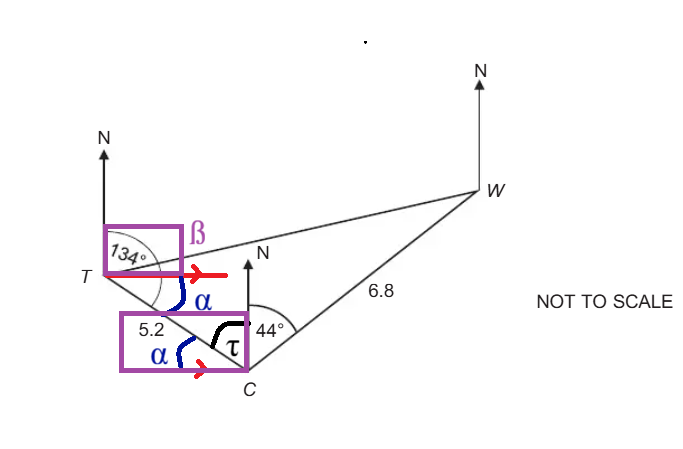
$ \underline{\text{Diagram}} \\[3ex] \beta = 90^\circ \quad(\text{Right Angle}) \\[3ex] \alpha + \beta = 134^\circ \\[3ex] \alpha + 90 = 134 \\[3ex] \alpha = 134 - 90 \\[3ex] \alpha = 44^\circ \\[5ex] \underline{\text{Angle Between Parallel Lines}} \\[3ex] \alpha = \alpha = 44^\circ \quad(\text{alternate angles are equal}) \\[5ex] \underline{\text{Diagram}} \\[3ex] \alpha + \tau = 90^\circ \quad(\text{Right Angle}) \\[3ex] \tau = 90 - \alpha \\[3ex] = 90 - 44 \\[3ex] = 46^\circ \\[5ex] (a.) \\[3ex] \angle TCW = \tau + 44^\circ \\[3ex] = 46 + 44 \\[3ex] = 90^\circ \\[5ex] (b.) \\[3ex] \triangle TCW \text{ is a right triangle} \\[3ex] \tan \angle WTC = \dfrac{opp}{adj} \quad(\text{SOHCAHTOA}) \\[5ex] \tan \angle WTC =\dfrac{6.8}{5.2} \\[5ex] \angle WTC = \tan^{-1} \left(\dfrac{6.8}{5.2}\right) \\[5ex] \angle WTC = 52.59464337^\circ \\[3ex] $ The bearing of the waterhole, W, from the tower, T is angle φ as shown in the diagram
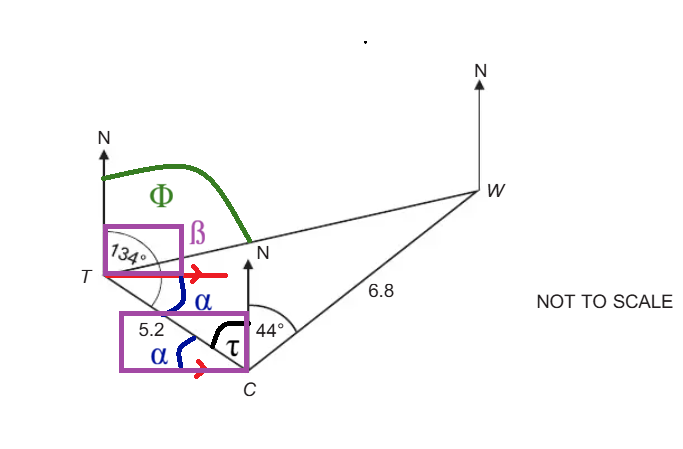
$ \underline{\text{Diagram}} \\[3ex] \phi + \angle WTC = 134^\circ \\[3ex] \phi + 52.59464337 = 134 \\[3ex] \phi = 134 - 52.59464337 \\[3ex] \phi = 81.40535663 \\[3ex] \phi \approx 81.4^\circ \quad(\text{to one decimal place}) $
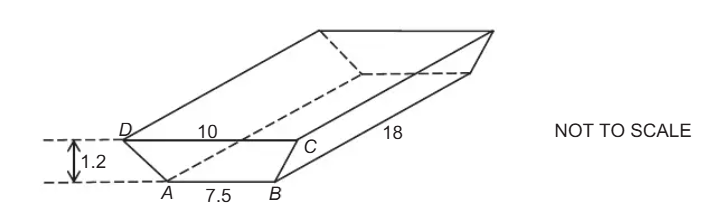
The height of the chocolate bar is 1.2cm and its length is 18cm.
AB = 7.5cm and CD = 10cm.
Calculate
(a.) the area of cross-section, ABCD
(b.) the volume of the chocolate bar,
(c.) the number of chocolate bars that can be made using 5 litres of chocolate.
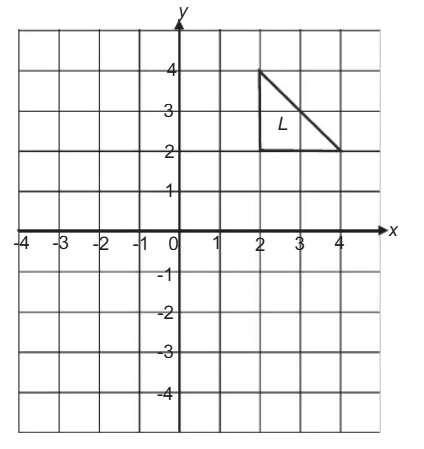
Draw the image of triangle L after a reflection in the y-axis.
Angle JML = angle KML = angle JMK = 90°.
$JM = KM = LM = 12cm$
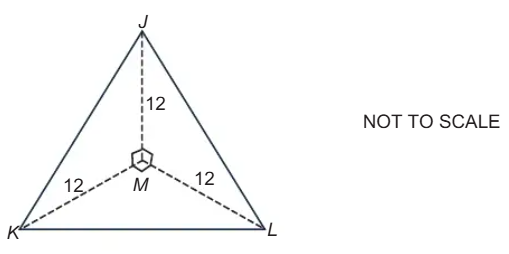
(a.) What is the geometrical relationship between triangle JMK, triangle JML and triangle KML?
(b.) Calculate
(i.) the length of JK,
(ii.) the total surface area of the pyramid.
| $x$ | $-4$ | $-3$ | $-2$ | $-1$ | $0$ | $1$ | $2$ |
| $y$ | $-5$ | $0$ | $3$ | $4$ | $3$ | $0$ | $-5$ |
(a.) Draw the graph of $y = 3 - 2x - x^2$ for values of x from –4 to 2.
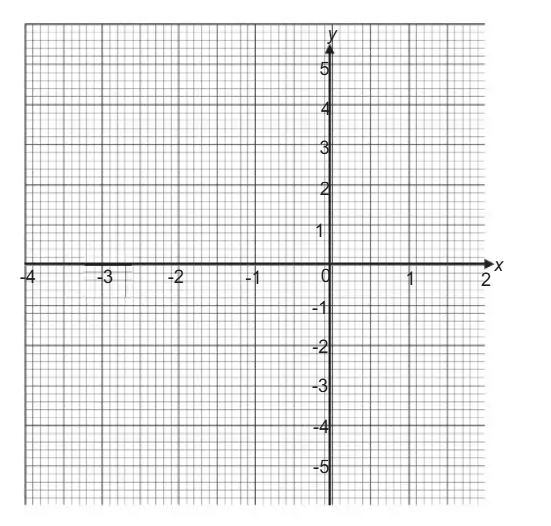
(b.) Use the graph to solve the equation $3 - 2x - x^2 = 0$.
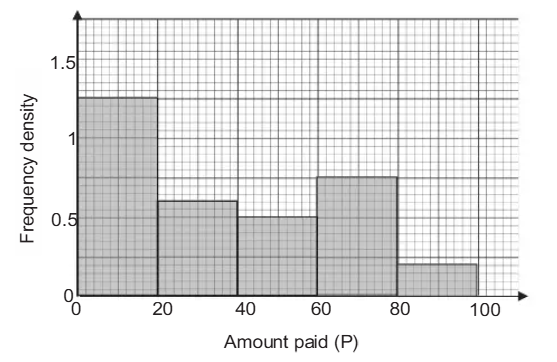
(a.) How many customers paid P20 or less?
(b.) How many customers in total, bought goods at the supermarket that morning?
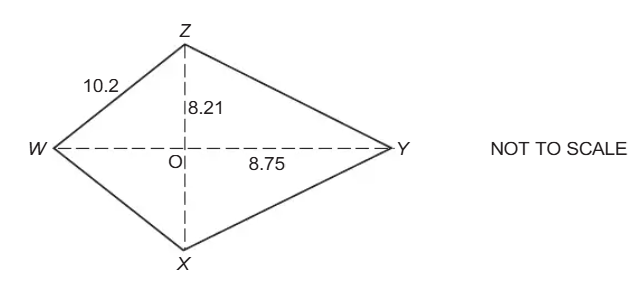
O is the point of intersection of the diagonals of the kite.
$WZ = 10.2cm$, $OZ = 8.21cm$ and $OY = 8.75cm$.
Calculate
(a.) YZ,
(b.) angle ZWX.


