Please Read Me.

ACT Mathematics Tests 2025

The Joy of the Teacher is the Success of the Students. – Samuel Chukwuemeka

Welcome to Our Site


I greet you this day,
These are the solutions to the Enhanced American College Testing (ACT) Mathematics Tests.
If you find these resources valuable and if any of these resources were helpful in your passing the the test, please consider making a donation:

Cash App: $ExamsSuccess or
cash.app/ExamsSuccess

PayPal: @ExamsSuccess or
PayPal.me/ExamsSuccess

Venmo: @ExamsSuccess or
Venmo.com/u/ExamsSuccess

Your donation is appreciated.
Comments, ideas, areas of improvement, questions, and constructive criticisms are welcome.
Feel free to contact me. Please be positive in your message.
I wish you the best.
Thank you.

MATHEMATICS TEST

60 Minutes — 60 Questions
DIRECTIONS: Solve each problem, choose the correct answer, and then fill in the corresponding oval on your answer document.
Do not linger over problems that take too much time.
Solve as many as you can; then return to the others in the time you have left for this test.
You are permitted to use a calculator on this test. You may use your calculator for any problems you choose, but some of the problems may best be done without using a calculator.
Note: Unless otherwise stated, all of the following should be assumed.
(1.) Illustrative figures are NOT necessarily drawn to scale.
(2.) Geometric figures lie in a plane.
(3.) The word line indicates a straight line.
(4.) The word average indicates arithmetic mean.

(1.) Algebra Transformations: A point at $(-4, 10)$ in the standard $(x, y)$ coordinate plane is translated right 10 coordinate units and down 4 coordinate units.
What are the coordinates of the point after the translation?

$ A.\;\; (-14, 14) \\[3ex] B.\;\; (0, 0) \\[3ex] C.\;\; (6, 6) \\[3ex] D.\;\; (6, 14) \\[3ex] E.\;\; (14, 14) \\[3ex] $

$ \underline{\text{Translated right 10 units}} \\[3ex] (-4, 10) \rightarrow (-4 + 10, 10) \\[3ex] \hspace{3.5em} \rightarrow (6, 10) \\[5ex] \underline{\text{Translated down 4 units}} \\[3ex] (6, 10) \rightarrow (6, 10 - 4) \\[3ex] \hspace{3.5em} \rightarrow (6, 6) $
(2.) Relations and Functions: A function, f, is defined by $f(x, y) = 3x^2 - 2y$.
What is the value of $f(2, 3)$?

$ F.\;\; 6 \\[3ex] G.\;\; 12 \\[3ex] H.\;\; 23 \\[3ex] J.\;\; 30 \\[3ex] K.\;\; 77 \\[3ex] $

$ f(x, y) = 3x^2 - 2y \\[3ex] f(2, 3) \\[3ex] = 3(2)^2 - 2(3) \\[3ex] = 3(4) - 6 \\[3ex] = 12 - 6 \\[3ex] = 6 $
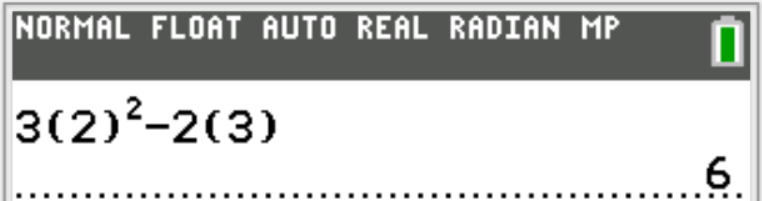
Number 2
(3.) Linear Equations: What is the value of x when $9 - 11x = 13 - 9x$ is true?

$ A.\;\; -2 \\[3ex] B.\;\; -0.5 \\[3ex] C.\;\; 0.5 \\[3ex] D.\;\; 1.1 \\[3ex] E.\;\; 2 \\[3ex] $

$ 9 - 11x = 13 - 9x \\[3ex] 9 - 13 = -9x + 11x \\[3ex] -4 = 2x \\[3ex] 2x = -4 \\[3ex] x = -\dfrac{4}{2} \\[5ex] x = -2 $
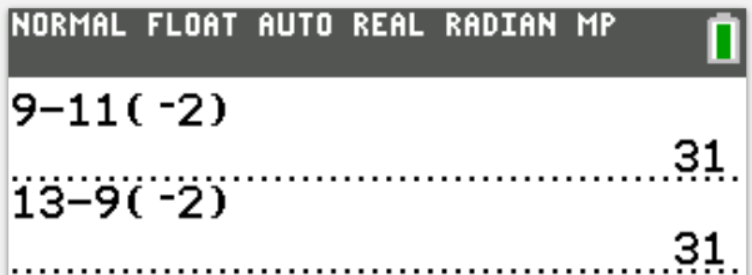
Number 3
(4.) Arithmetic Expressions: A company reimburses its employees for use of a personal vehicle for company travel at the rate of $10.00 per day plus $0.445 per mile.
Jorge, an employee of the company, traveled exactly 120 miles on Monday and exactly 100 miles on Tuesday using his personal vehicle for company travel.
For these 2 days, what was the amount of Jorge's reimbursement?

$ F.\;\; \$ 54.50 \\[3ex] G.\;\; \$ 63.40 \\[3ex] H.\;\; \$ 97.90 \\[3ex] J.\;\; \$ 107.90 \\[3ex] K.\;\; \$ 117.90 \\[3ex] $

$ \$10 \text{ per day for 2 days } = 10(2) = \$20 \\[3ex] \$0.445 \text{ per mile for 120 miles } = 0.445(120) = \$53.4 \\[3ex] \$0.445 \text{ per mile for 100 miles } = 0.442(100) = \$44.5 \\[3ex] \text{Amount of Jorge's reimbursement} \\[3ex] = 20 + 53.4 + 44.2 \\[3ex] = \$117.90 $
(5.) Binary Operations: Given that $a \triangle b = a^2 + b - \dfrac{a}{b}$, what is the value of $a \triangle b$ when $a = 5$ and $b = \dfrac{1}{2}$

$ A.\;\; \dfrac{1}{2} \\[5ex] B.\;\; 8 \\[3ex] C.\;\; 10\dfrac{1}{4} \\[5ex] D.\;\; 15\dfrac{1}{2} \\[5ex] E.\;\; 23 \\[3ex] $

$ a \triangle b = a^2 + b - \dfrac{a}{b} \\[5ex] a \triangle b = a^2 + b - (a \div b) \\[5ex] 5 \triangle \dfrac{1}{2} \\[5ex] = 5^2 + \dfrac{1}{2} - \left(5 \div \dfrac{1}{2}\right) \\[5ex] = 25 + \dfrac{1}{2} - \left(5 * \dfrac{2}{1}\right) \\[5ex] = \dfrac{50}{2} + \dfrac{1}{2} - \dfrac{20}{2} \\[5ex] = \dfrac{50 + 1 - 20}{2} \\[5ex] = \dfrac{31}{2} \\[5ex] = 15\dfrac{1}{2} $
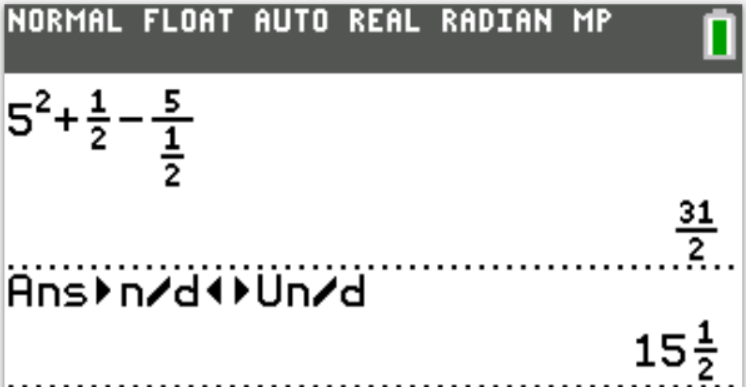
Number 5
(6.) Linear Expressions: Before opening her lemonade stand, Haley purchased lemonade mix for $2.30 and a package of cups for $1.50.
Haley sells each cup of lemonade for $0.50.
Which of the following expressions gives Haley’s total profit, in dollars, from selling x cups of lemonade?

$ F.\;\; 0.5x - 3.8 \\[3ex] G.\;\; 0.5x + 0.8 \\[3ex] H.\;\; 0.5x + 3.8 \\[3ex] J.\;\; 0.8x + 0.5 \\[3ex] K.\;\; 3.8x - 0.5 \\[3ex] $

Haley purchased lemonade mix for $2.30 and a package of cups for $1.50.
Cost Price: = 2.30 + 1.50 = $3.80

Haley sells each cup of lemonade for $0.50.
Selling Price: x cups of lemonade @ $0.50 per cup = $0.5x

$ \text{Profit} = \text{Selling Price} - \text{Cost Price} \\[3ex] = 0.5x - 3.8 $
(7.) Trigonometry: Triangles: In $\triangle ABC$, the measure of $\angle B$ is 90°, and the measure of $\angle A$ is 4 times the measure of $\angle C$.
What is the measure of $\angle C$?

$ A.\;\; 18^\circ \\[3ex] B.\;\; 22.5^\circ \\[3ex] C.\;\; 36^\circ \\[3ex] D.\;\; 45^\circ \\[3ex] E.\;\; 72^\circ \\[3ex] $

$ \underline{\text{Given}} \\[3ex] \angle B = 90^\circ \\[3ex] \angle A = 4 * \angle C \quad\dots\text{Given} \\[5ex] \angle A + \angle B + \angle C = 180^\circ \quad\dots\text{sum of angles of a triangle} \\[3ex] 4 * \angle C + 90 + \angle C = 180 \\[3ex] 5\angle C = 180 - 90 \\[3ex] \angle C = \dfrac{90}{5} \\[5ex] \angle C = 18^\circ $
(8.) Linear Inequalities: The Sheffield High School girls’ softball team currently has a record of 11 wins, 8 losses, and 0 ties.
What is the least number of its remaining 14 games the team must win to finish the season winning more than 50% of all the team’s games?

$ F.\;\; 3 \\[3ex] G.\;\; 6 \\[3ex] H.\;\; 7 \\[3ex] J.\;\; 8 \\[3ex] K.\;\; 10 \\[3ex] $

$ 11\text{ wins} \\[3ex] 8\text{ losses} \\[3ex] 0\text{ ties} \\[3ex] 14\text{ remaining games} \\[3ex] \text{Total number of games} = 11 + 8 + 14 = 33 \\[3ex] 50\%\text{ of all the team's games} \\[3ex] = \dfrac{50}{100} * 33 \\[5ex] = \dfrac{33}{2} \\[5ex] $ Let the least number of its remaining 14 games the team must win to finish the season winning more than 50% of all the team’s games = x

$ 11 + x \gt \dfrac{33}{2} \\[5ex] 2(11 + x) \gt 33 \\[3ex] 22 + 2x \gt 33 \\[3ex] 2x \gt 33 - 22 \\[3ex] 2x \gt 11 \\[3ex] x \gt \dfrac{11}{2} \\[5ex] x \gt 5.5 \\[3ex] x \ge 6 \\[3ex] \text{Least number} = 6 \\[3ex] $ To finish the season winning more than 50% of all the team’s games, the team must win at least 6 games.
(9.) Linear Functions: A line in the standard (x, y) coordinate plane passes through the point (3, 4).
The slope of the line:

A. is positive.
B. is zero.
C. is negative.
D. is undefined.
E. cannot be determined from the given information.


Only one point is insufficient to determine the nature of the slope.
The slope of the line cannot be determined from the given information.
(10.) Probability: The probability that a certain basketball player will make any given free throw is 0.8.
Based on this probability, how many free throws should this player expect to have to attempt in order to make 20 free throws?

$ F.\;\; 36 \\[3ex] G.\;\; 28 \\[3ex] H.\;\; 25 \\[3ex] J.\;\; 24 \\[3ex] K.\;\; 22 \\[3ex] $

S = Sample Space = all available free throws

$ P(\text{make a free throw}) = \dfrac{n(\text{free throws made})}{n(S)} \\[5ex] 0.8 = \dfrac{20}{n(S)} \\[5ex] 0.8 * n(S) = 20 \\[3ex] n(S) = \dfrac{20}{0.8} \\[5ex] n(S) = 25 $
(11.) Measurements and Units: Jerrica drives to and from school once per day in a car that travels 20 miles on 1 gallon of gas.
A trip from Jerrica’s house to school and back is 6 miles.
Gas costs $5 per gallon.
Suppose Jerrica rides her bike to and from school for 10 school days.
How much money will Jerrica save on gas by not driving to and from school those days?

$ A.\;\; \$ 3 \\[3ex] B.\;\; \$ 6 \\[3ex] C.\;\; \$ 15 \\[3ex] D.\;\; \$ 24 \\[3ex] E.\;\; \$ 30 \\[3ex] $

$ \underline{\text{Cost for 1 day using the Unity Fraction Method}} \\[3ex] \text{Set up units:} \\[3ex] \dfrac{...\text{ gallon}}{...\text{ miles}} * ...\text{ miles} * \dfrac{...\$}{...\text{ gallon}} \\[5ex] \text{Set up measurements and units:} \\[3ex] \dfrac{1\text{ gallon}}{20\text{ miles}} * 6\text{ miles} * \dfrac{\$ 5}{1\text{ gallon}} \\[5ex] = \$ 1.5 \\[5ex] \text{Cost for 10 days @ } \$ 1.5 \text{ per day} \\[3ex] = 10(1.5) \\[3ex] = \$ 15 $
(12.) Quadratic Equations: If $x \gt 0$ and $2x^2 + 5x = 3$, what is the value of x?

$ F.\;\; 1 \\[3ex] G.\;\; 3 \\[3ex] H.\;\; \dfrac{1}{2} \\[5ex] J.\;\; \dfrac{3}{2} \\[5ex] K.\;\; \dfrac{5}{2} \\[5ex] $

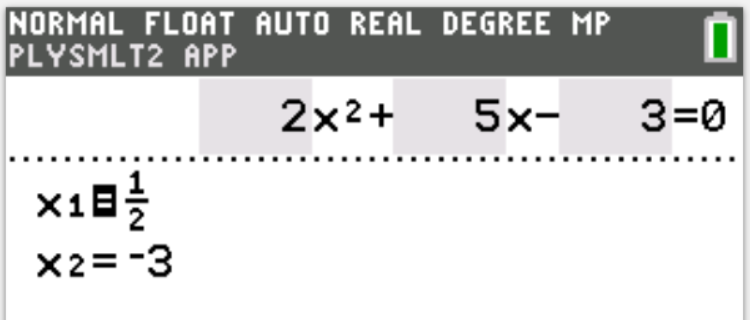
$ 2x^2 + 5x = 3 \\[3ex] 2x^2 + 5x - 3 = 0 \\[3ex] ............................................ \\[3ex] 2x^2(-3) = -6x^2 \\[3ex] \text{Factors are: } 6x \text{ and } -x \\[3ex] ............................................ \\[3ex] 2x^2 + 6x - x - 3 = 0 \\[3ex] 2x(x + 3) - 1(x + 3) = 0 \\[3ex] (x + 3)(2x - 1) = 0 \\[3ex] x + 3 = 0 \hspace{1em} or \hspace{1em} 2x - 1 = 0 \\[3ex] x = -3 \hspace{1em} or \hspace{1em} 2x = 1 \\[3ex] \hspace{4em} or \hspace{1em} x = \dfrac{1}{2} \\[5ex] \text{Because } x \gt 0: \\[3ex] x = \dfrac{1}{2} $
Number 12
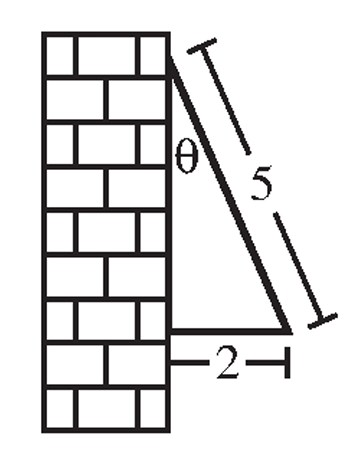
(13.) Trigonometry: A 5-foot awning extends 2 feet horizontally over the entrance to the vertical building shown below.
Which of the following expressions has a value equal to the measure of the angle θ between the building and the awning?
Number 13

$ A.\;\; \sin^{-1}\left(\dfrac{2}{5}\right) \\[5ex] B.\;\; \cos^{-1}\left(\dfrac{2}{\sqrt{21}}\right) \\[5ex] C.\;\; \cos^{-1}\left(\dfrac{2}{5}\right) \\[5ex] D.\;\; \tan^{-1}\left(\dfrac{\sqrt{21}}{2}\right) \\[5ex] E.\;\; \tan^{-1}\left(\dfrac{2}{5}\right) \\[5ex] $

The rate of change of y with respect to x is the slope of the function.
Let us represent the function in slope–intercept form so that we can determine the slope.

$ \sin\theta = \dfrac{opp}{hyp} \quad\dots\text{SOHCAHTOA} \\[5ex] \sin\theta = \dfrac{2}{5} \\[5ex] \theta = \sin^{-1}\left(\dfrac{2}{5}\right) $


Use the following information to answer questions 14 – 16.

The results for the 200-meter dash at the Shamrock High School (SHS) track meet are shown in the table below.
The SHS track is unique in that it is circular and has an outer diameter of 240 meters.
The stadium has a capacity of 5,000 people.

200-meter dash
Name Time (seconds)
Anthony
Burke
Cory
Kate
Lindsey
Nathan
Rebecca
Sam
21.20
22.01
21.33
22.13
21.20
21.50
21.48
22.19


(14.) Statistics: What is the mean, in seconds, of the times listed in the table for the 200-meter dash?

$ F.\;\; 21.20 \\[3ex] G.\;\; 21.27 \\[3ex] H.\;\; 21.49 \\[3ex] J.\;\; 21.63 \\[3ex] K.\;\; 22.07 \\[3ex] $

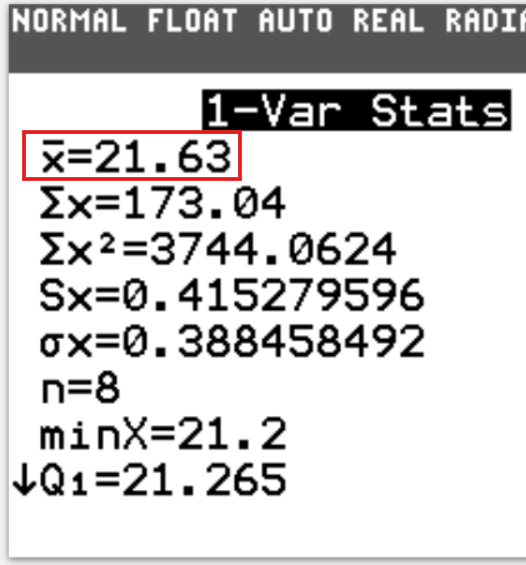
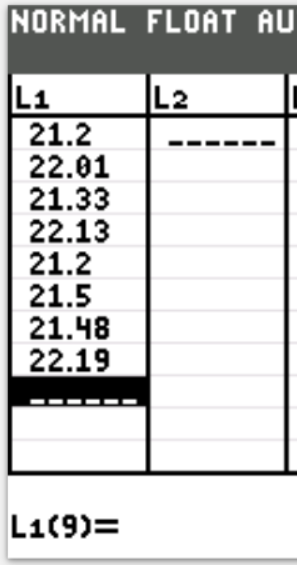
$ \text{Mean} = \dfrac{21.2 + 22.01 + 21.33 + 22.13 + 21.2 + 21.5 + 21.48 + 22.19}{8} \\[5ex] = \dfrac{173.04}{8} \\[5ex] = 21.63\text{ seconds} $

Because of time, I suggest you use this approach to check your work (if you have time).
Number 14-1st

Number 14-2nd
(15.) Fractions, Decimals, and Percents: Each ticket for the track meet had a price of $8.
Tickets were sold for exactly 85% of the stadium's capacity.
How many dollars did SHS collect through ticket sales for this meet?

$ A.\;\; \$ 3,400 \\[3ex] B.\;\; \$ 34,000 \\[3ex] C.\;\; \$ 39,915 \\[3ex] D.\;\; \$ 40,085 \\[3ex] E.\;\; \$ 340,000 \\[3ex] $

$ \text{Stadium's capacity} = 5000\text{ people} \\[3ex] \text{Price of ticket} = \$8 \\[3ex] \text{Number of tickets} = 85\% \text{ of the stadium's capacity} \\[3ex] = \dfrac{85}{100} * 5000 \\[5ex] = 4250\text{ tickets} \\[5ex] 4250\text{ tickets @ } \$8 \text{ per ticket} = 4250(8) = \$ 34,000 $
(16.) Mensuration: The circular region containing the track and the infield (the grassy region enclosed by the track) is divided into sectors that each have a central angle of 60°.
Each sector is a different color.
What is the area, in square meters, of each sector?

$ F.\;\; 2,400\pi \\[3ex] G.\;\; 4,800\pi \\[3ex] H.\;\; 9,600\pi \\[3ex] J.\;\; 14,400\pi \\[3ex] K.\;\; 19,200\pi \\[3ex] $

$ \underline{\text{SHS track}} \\[3ex] \text{diameter} = d = 240\;m \\[3ex] \text{radius} = r = \dfrac{d}{2} = \dfrac{240}{2} = 120\;m \\[5ex] \text{angle} = \theta = 60^\circ \\[5ex] \text{Area of a sector} = \dfrac{\pi r^2\theta}{360} \\[5ex] = \dfrac{\pi * 120^2 * 60}{360} \\[5ex] = 2400\;pi\;\;m^2 $
(17.) System of Linear Inequalities: The solution set of the system of inequalities below includes which of the following (x, y) pairs? $$ x \gt y \\[3ex] x + y \gt 3 $$ $ A.\;\; (0, 4) \\[3ex] B.\;\; (1, 3) \\[3ex] C.\;\; (2, 1) \\[3ex] D.\;\; (3, 0) \\[3ex] E.\;\; (4, 1) \\[3ex] $

Let us review each option to find the correct answer.
Note thet the correct pair must satisfy both inequalities.

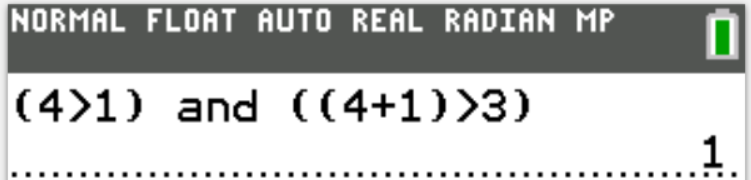
$ \underline{\text{Process of Elimination}} \\[3ex] \text{Testing each } (x, y) \text{ pair} \\[3ex] \text{1st Inequality: } x \gt y \\[3ex] (0, 4) \implies 0 \gt 4 \quad\dots\text{Not true, Discard} \\[3ex] (1, 3) \implies 1 \gt 3 \quad\dots\text{Not true, Discard} \\[3ex] (2, 1) \implies 2 \gt 1 \quad\dots\text{okay} \\[3ex] (3, 0) \quad\dots\text{okay} \\[3ex] (4, 1) \quad\dots\text{okay} \\[5ex] \text{2nd Inequality: } x \gt y \\[3ex] x + y \gt 3 \\[3ex] (2, 1) \implies 2 + 1 \gt 3 \quad\dots\text{Not true, Discard} \\[3ex] (3, 0) \implies 3 + 0 \gt 3 \quad\dots\text{Not true, Discard} \\[3ex] $ The correct answer is option E.
But if you want to confirm:

$ (4, 1) \implies 4 + 1 \gt 3 \quad\dots\text{True} $
Number 17
(18.) Mensuration: The area of the trapezoid shown below is 20 square feet, the height is 5 feet, and the length of one base is 2 feet.
What is b, the length of the other base, in feet?
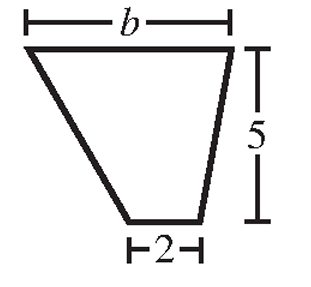
Number 18

$ F.\;\; 6 \\[3ex] G.\;\; 8 \\[3ex] H.\;\; 13 \\[3ex] J.\;\; 15 \\[3ex] K.\;\; 23 \\[3ex] $

$ \text{Area of the trapezoid} = \dfrac{h(a + b)}{2} \\[5ex] \text{where} \\[3ex] h = \perp\text{height} = 5\;feet \\[3ex] a = \text{length of one base} = 2\;feet \\[3ex] b = \text{length of the other base} = ? \\[3ex] \text{Area} = 20\;ft^2 \\[3ex] \implies \\[3ex] 20 = \dfrac{5(2 + b)}{2} \\[5ex] 5(2 + b) = 20(2) \\[3ex] 2 + b = \dfrac{20(2)}{5} \\[5ex] 2 + b = 8 \\[3ex] b = 8 - 2 \\[3ex] b = 6\;feet $
(19.) Mensuration: A square and a rectangle have the same area.
The length of the rectangle is 196 centimeters, and the width of the rectangle is 4 centimeters.
What is the length, in centimeters, of a side of the square?

$ A.\;\; 20 \\[3ex] B.\;\; 28 \\[3ex] C.\;\; 100 \\[3ex] D.\;\; 400 \\[3ex] E.\;\; 784 \\[3ex] $

$ \underline{\text{Rectangle}} \\[3ex] L = \text{Length} = 196\;cm \\[3ex] W = \text{Width} = 4\;cm \\[3ex] A_R = \text{Area} = L * W \\[3ex] = 196 * 4 \\[3ex] = 784\;cm^2 \\[5ex] \underline{\text{Square}} \\[3ex] S = \text{Side} = ? \\[3ex] A_S = \text{Area} = S^2 \\[5ex] \text{A square and a rectangle have the same area.} \\[3ex] A_S = A_R \\[3ex] S^2 = 784 \\[3ex] S = \sqrt{784} \\[3ex] S = 28\;cm $
(20.) Quadratic Functions: Let $(3x - 1)(2x - 5) = ax^2 + bx + c$.
What is the value of $a + b + c$?

$ F.\;\; -16 \\[3ex] G.\;\; -7 \\[3ex] H.\;\; -6 \\[3ex] J.\;\; -2 \\[3ex] K.\;\; 24 \\[3ex] $

$ (3x - 1)(2x - 5) = ax^2 + bx + c \\[3ex] 6x^2 - 15x - 2x + 5 = ax^2 + bx + c \\[3ex] ax^2 + bx + c = 6x^2 - 17x + 5 \\[3ex] \implies \\[3ex] a = 6 \\[3ex] b = -17 \\[3ex] c = 5 \\[5ex] a + b + c \\[3ex] = 6 + (-17) + 5 \\[3ex] = -6 $
(21.) Exponents: For $a \ne 0$ and any real number n, the expression $\dfrac{a^{2n + 1}}{a^n}$ is equivalent to which of the following?

$ A.\;\; a \\[3ex] B.\;\; a^3 \\[3ex] C.\;\; a^n \\[3ex] D.\;\; a^{n + 1} \\[3ex] E.\;\; a^{3n + 1} \\[3ex] $

$ \dfrac{a^{2n + 1}}{a^n} \\[5ex] = a^{(2n + 1) - n} \quad\dots\text{Law 2 Exp} \\[3ex] = a^{2n + 1 - n} \\[3ex] = a^{n + 1} $
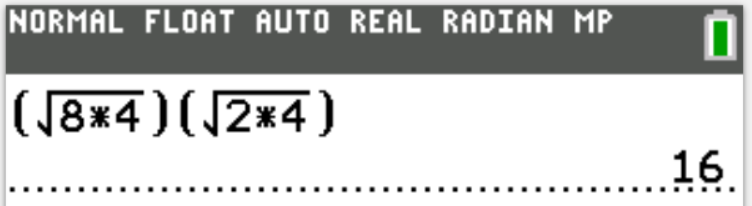
(22.) Radical Equations: For what positive value of a is it true that $(\sqrt{8a})(\sqrt{2a}) = 16$?

$ F.\;\; \dfrac{1}{2} \\[5ex] G.\;\; 1 \\[3ex] H.\;\; 2 \\[3ex] J.\;\; 4 \\[3ex] K.\;\; 16 \\[3ex] $

$ (\sqrt{8a})(\sqrt{2a}) = 16 \\[3ex] \sqrt{16a^2} = 16 \\[3ex] 4a = 16 \\[3ex] a = \dfrac{16}{4} \\[5ex] a = 4 $
Number 22
(23.) Probability: A basket contains 3 red apples, 4 green apples, and 2 yellow apples.
An apple is drawn at random, eaten, and then another apple is randomly drawn.
If the first apple is red, what is the probability the second apple is yellow?

$ A.\;\; \dfrac{1}{12} \\[5ex] B.\;\; \dfrac{1}{8} \\[5ex] C.\;\; \dfrac{1}{4} \\[5ex] D.\;\; \dfrac{2}{9} \\[5ex] E.\;\; \dfrac{5}{81} \\[5ex] $

Let:
red = R
m(R) = 3

green = G
n(G) = 4

yellow = Y
n(Y) = 2

sample space = S = {3R, 4G, 2Y}
n(S) = 3 + 4 + 2 = 9 apples

An apple is drawn at random, eaten, and then another apple is randomly drawn.
That first apple is red.
So, 8 apples remain.
What is the probability of selecting a yellow out of 8 apples that consists of 2 red, 4 green, and 2 yellow apples?

$ P(RY) = \dfrac{2}{8} \\[5ex] = \dfrac{1}{4} $
(24.) Numbers: Which of the following numbers is irrational?

$ F.\;\; \pi \\[3ex] G.\;\; 3\dfrac{1}{3} \\[5ex] H.\;\; 2.193876 \\[3ex] J.\;\; \sqrt{144} \\[3ex] K.\;\; 4 \\[3ex] $

Irrational numbers cannot be expressed as a fraction/ratio of two numbers.
They are non-terminating non-repeating decimals.

$\pi = 3.141592654...$ is irrational because it is non-terminating and non-repeating.

$3\dfrac{1}{3} = \dfrac{10}{3}$ is rational because it is expressed as a fraction.

$2.193876 = \dfrac{2193876}{1000000} = \dfrac{548469}{250000}$ is expressed as a fraction.

$\sqrt{144} = 12 = \dfrac{12}{1}$ is expressed as a fraction.

$4 = \dfrac{4}{1}$ is expressed as a fraction.
(25.) Linear Expressions: The expression $7[3 - 2(x - 4)]$ is equivalent to:

$ A.\;\; -14x - 35 \\[3ex] B.\;\; -14x - 7 \\[3ex] C.\;\; -14x + 77 \\[3ex] D.\;\; 5x - 1 \\[3ex] E.\;\; 5x + 11 \\[3ex] $

$ 7[3 - 2(x - 4)] \\[3ex] = 7[3 - 2x + 8] \\[3ex] = 7[-2x + 11] \\[3ex] = -14x + 77 $
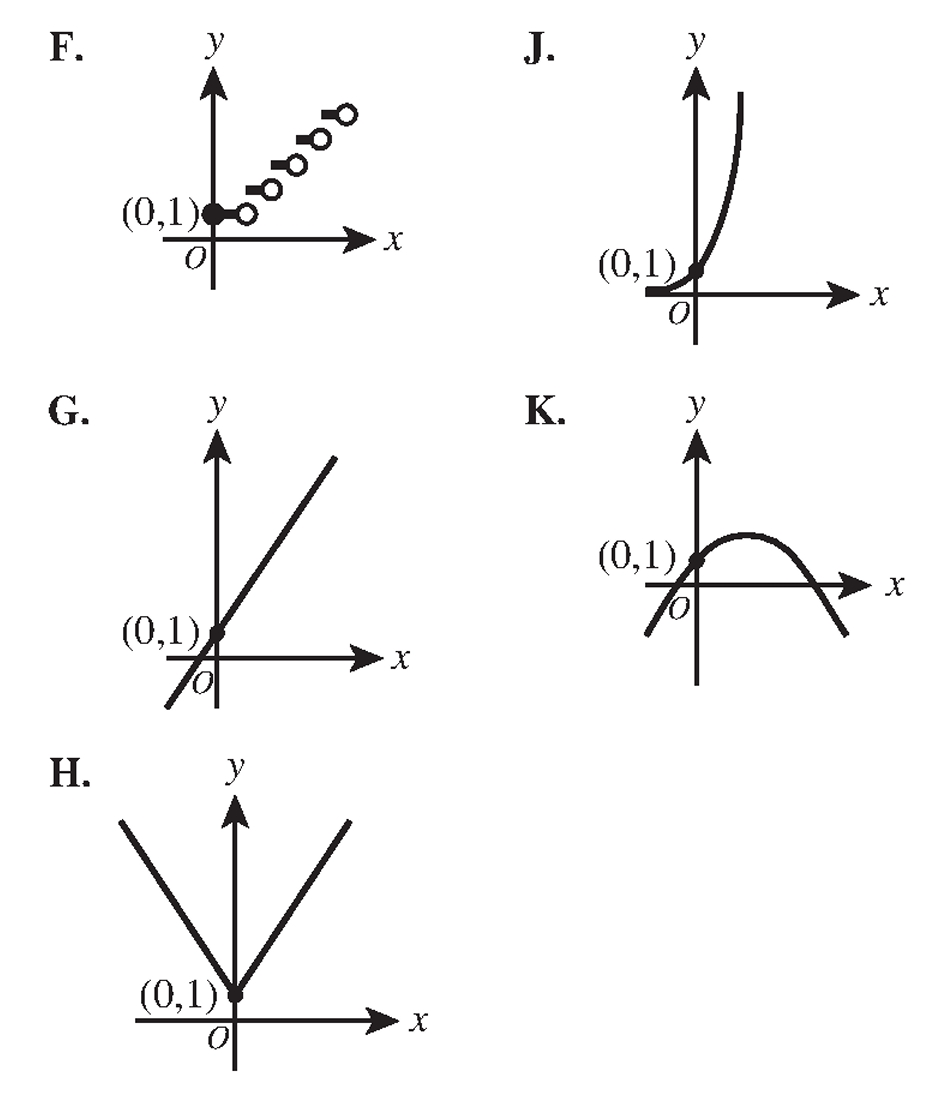
(26.) Relations and Functions: Rate of change is defined to be the vertical change between any 2 points divided by the horizontal change between the same 2 points.
A function containing the point $(0, 1)$ has a constant rate of change equal to $\dfrac{3}{2}$.
The function is shown in one of the standard $(x, y)$ coordinate plane graphs below.
Which one?
Number 26


The rate of change of a function is its slope.
A linear function (straight-line graph) has a constant slope.
Option G. is the correct answer.

Student: SamDom For Peace
Teacher: What's good?
Student: Could you give the type of function graphs?
Teacher: Sure.
The functions whose graphs are represented in options:


F. is a piecewise function.
J. is an exponential function.
G. is a linear function.
K. is a quadratic function.
H. is an absolute value function.
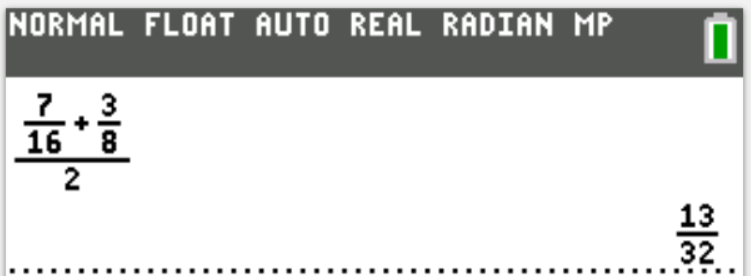
(27.) Coordinate Geometry: What rational number is exactly halfway between $\dfrac{3}{8}$ and $\dfrac{7}{16}$ on the real number line?

$ A.\;\; \dfrac{13}{8} \\[5ex] B.\;\; \dfrac{13}{16} \\[5ex] C.\;\; \dfrac{5}{24} \\[5ex] D.\;\; \dfrac{1}{32} \\[5ex] E.\;\; \dfrac{13}{32} \\[5ex] $

The rational number = x-coordinate of the Midpoint = x
On the number line, the horizontal distance between $\dfrac{3}{8}$ and the rational number is the same as the horizontal distance between the rational number and $\dfrac{7}{16}$.

$ x - \dfrac{3}{8} = \dfrac{7}{16} - x \\[5ex] 2x = \dfrac{7}{16} + \dfrac{3}{8} \\[5ex] x = \left(\dfrac{7}{16} + \dfrac{6}{16}\right) \div 2 \\[5ex] x = \dfrac{13}{16} * \dfrac{1}{2} \\[5ex] x = \dfrac{13}{32} $
Number 27
(28.) Least Common Multiple: One neon sign flashes every 4 seconds, and another neon sign flashes every 6 seconds.
At a certain instant, the 2 signs flash at the same time.
How many seconds elapse until the 2 signs next flash at the same time?

$ F.\;\; 2 \\[3ex] G.\;\; 5 \\[3ex] H.\;\; 10 \\[3ex] J.\;\; 12 \\[3ex] K.\;\; 24 \\[3ex] $

The question is asking for the Least Common Multiple (LCM) of 4 and 10

The colors besides red indicate the common factors that should be counted only one time.
Begin with them in the multiplication for the LCM.
Then, include the rest.

$ Numbers = 4, 6 \\[3ex] 4 = \color{black}{2} * 2 \\[3ex] 6 = \color{black}{2} * 3 \\[5ex] LCM = \color{black}{2} * 2 * 3 \\[3ex] LCM = 12 \\[3ex] $ 12 seconds will elapse until the 2 signs next flash at the same time.
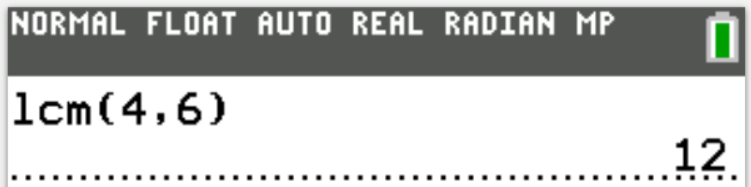
Number 28


Use the following information to answer questions 29 – 31.

Jerry is building a rectangular patio against one side of his house.
The top surface of the patio, along with its width and diagonal, is shown in the figure below.
To build the patio, he will first dig a rectangular hole to a uniform depth of 8 inches.
He will then fill the hole with gravel to a uniform depth of 3 inches.
He will purchase gravel from his local rock quarry for $54 per cubic yard (1 cubic yard = 27 cubic feet).
Next, he will pour concrete on top of the gravel to obtain a smooth surface for the patio.
Finally, he will frame and build a rectangular concrete step with the dimensions shown below.
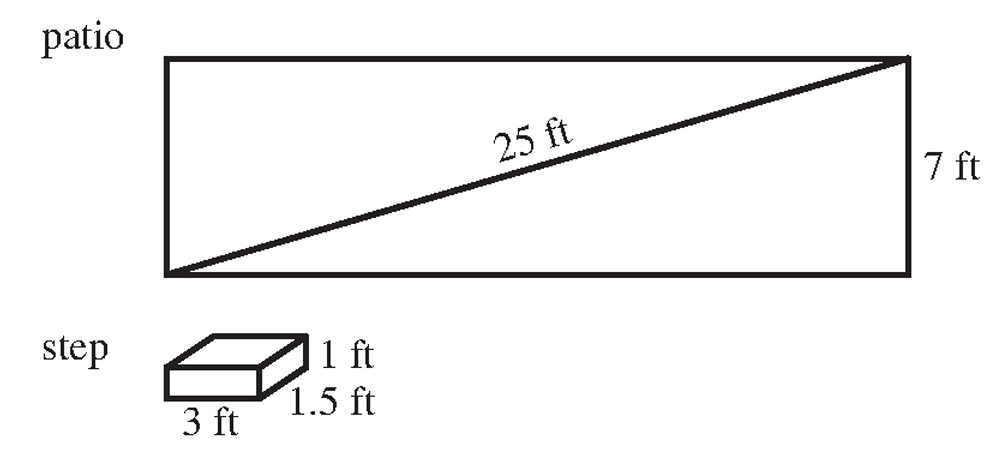
Numbers 29-31


(29.) Measurements and Units: Jerry will purchase 42 cubic feet of gravel for his patio.
The local rock quarry will sell gravel in the exact volume needed by the customer.
What is the cost, in dollars, to purchase the gravel from the local rock quarry?

$ A.\;\; \$ 54 \\[3ex] B.\;\; \$ 84 \\[3ex] C.\;\; \$ 162 \\[3ex] D.\;\; \$ 270 \\[3ex] E.\;\; \$ 432 \\[3ex] $

$ \text{Set up Units: } \dfrac{\$...}{...yd^3} * \dfrac{...yd^3}{...ft^3} * ...ft^3 \\[5ex] \text{Set up Measurements and Units: } \dfrac{\$54}{1\;yd^3} * \dfrac{1\;yd^3}{27\;ft^3} * 42\;ft^3 \\[5ex] = \$84 $
(30.) Mensuration: What is the area, in square feet, of the top surface of Jerry's patio?

$ F.\;\; 18 \\[3ex] G.\;\; 24 \\[3ex] H.\;\; 168 \\[3ex] J.\;\; 175 \\[3ex] K.\;\; 576 \\[3ex] $

The patio is a rectangle.
Let us find the area of the rectangle.

$ \underline{\text{Rectangular Patio}} \\[3ex] \text{diagonal} = 25\;ft \\[3ex] \text{width} = 7\;ft \\[3ex] \text{length} = ? \\[5ex] \text{length}^2 + \text{width}^2 = \text{diagonal}^2 \quad\dots\text{Pythagorean Theorem} \\[3ex] \text{length}^2 + 7^2 = 25^2 \\[3ex] \text{length} = \sqrt{25^2 - 7^2} \\[3ex] \text{length} = 24\;ft \\[5ex] \text{Area} = \text{length} * \text{width} \\[3ex] = 24 * 7 \\[3ex] = 168\;ft^2 $
(31.) Measurements and Units: Jerry will use bags of concrete mix to make the step.
Each bag makes 0.4 cubic feet of concrete.
To the nearest 0.1 bag, how many bags of concrete mix will he need for the step?

$ A.\;\; 1.8 \\[3ex] B.\;\; 4.5 \\[3ex] C.\;\; 5.5 \\[3ex] D.\;\; 11.3 \\[3ex] E.\;\; 18.0 \\[3ex] $

$ \underline{\text{Rectangular Prism Concrete Step}} \\[3ex] \text{Volume} = 3 * 1.5 * 1 \\[3ex] = 4.5\;ft^3 \\[5ex] \underline{\text{Bags of Concrete Mix}} \\[3ex] \text{Set up Units: } \dfrac{...\text{bag}}{...ft^3} * ...ft^3 \\[5ex] \text{Set up Measurements and Units: } \dfrac{1\text{ bag}}{0.4\;ft^3} * 4.5\;ft^3 \\[5ex] = 11.25 \\[3ex] \approx 11.3\text{ bags} \quad\dots\text{to the nearest } 0.1 \text{ bag} $
(32.) Fractions: A carpenter needs a board $35\dfrac{5}{8}$ inches long and another board $27\dfrac{1}{2}$ inches long.
Both pieces are to be cut from a single board $72$ inches long.
Together, the 2 cuts subtract a total of $\dfrac{1}{8}$ inch.
What length of board is left over, in inches?

$ F.\;\; 8\dfrac{1}{4} \\[5ex] G.\;\; 8\dfrac{3}{4} \\[5ex] H.\;\; 8\dfrac{13}{16} \\[5ex] J.\;\; 9\dfrac{27}{80} \\[5ex] K.\;\; 9\dfrac{3}{4} \\[5ex] $

Length of single board = 72 inches
Length of 1st piece to be cut from the single board = $35\dfrac{5}{8}$ inches

Length of 2nd piece to be cut from the single board = $27\dfrac{1}{2}$ inches

Length of the 2 cuts (kerf or offcut of the 2 cuts) = $\dfrac{1}{8}$ inch

$ \underline{\text{Total Length of 2 pieces and 2 cuts}} \\[3ex] 35\dfrac{5}{8} + 27\dfrac{1}{2} + \dfrac{1}{8} \\[5ex] = 35 + \dfrac{5}{8} + 27 + \dfrac{1}{2} + \dfrac{1}{8} \\[5ex] = 35 + 27 + \dfrac{5}{8} + \dfrac{4}{8} + \dfrac{1}{8} \\[5ex] = 62 + \dfrac{10}{8} \\[5ex] = 62 + \dfrac{5}{4} \\[5ex] = 62 + 1\dfrac{1}{4} \\[5ex] = 62 + 1 + \dfrac{1}{4} \\[5ex] = 63 + \dfrac{1}{4}\;inches \\[5ex] \underline{\text{Left Over}} \\[3ex] \text{Remaining} = 72 - \left(63 + \dfrac{1}{4}\right) \\[5ex] = 72 - 63 - \dfrac{1}{4} \\[5ex] = 9 - \dfrac{1}{4} \\[5ex] = 8\dfrac{3}{4}\;inches $
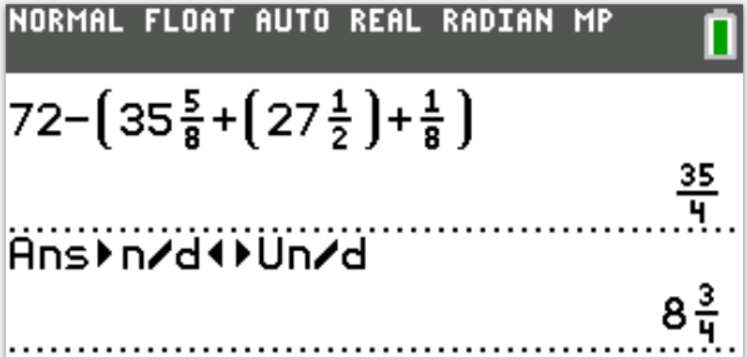
Number 32
(33.) Matrices: Given matrices A and B such that $A = \begin{bmatrix} -7 & 2 & 4 \\[2ex] -1 & 0 & -3 \end{bmatrix}$ and $B - A = \begin{bmatrix} 6 & 7 & 4 \\[2ex] 1 & -1 & -4 \end{bmatrix}$, what is matrix B?

$ A.\;\; \begin{bmatrix} -13 & -5 & 0 \\[2ex] -2 & 1 & 1 \end{bmatrix} \\[7ex] B.\;\; \begin{bmatrix} -1 & 9 & -8 \\[2ex] 0 & 1 & -7 \end{bmatrix} \\[7ex] C.\;\; \begin{bmatrix} -1 & 9 & 8 \\[2ex] 0 & -1 & -7 \end{bmatrix} \\[7ex] D.\;\; \begin{bmatrix} 13 & 5 & 0 \\[2ex] 2 & -1 & -7 \end{bmatrix} \\[7ex] E.\;\; \begin{bmatrix} 13 & 9 & 8 \\[2ex] 2 & 1 & 7 \end{bmatrix} \\[7ex] $

$ B - A = difference \\[3ex] B = difference + A \\[5ex] = \begin{bmatrix} 6 & 7 & 4 \\[2ex] 1 & -1 & -4 \end{bmatrix} + \begin{bmatrix} -7 & 2 & 4 \\[2ex] -1 & 0 & -3 \end{bmatrix} \\[7ex] = \begin{bmatrix} 6 + -7 & 7 + 2 & 4 + 4 \\[2ex] 1 + -1 & -1 + 0 & -4 + -3 \end{bmatrix} \\[7ex] = \begin{bmatrix} -1 & 9 & 8 \\[2ex] 0 & -1 & -7 \end{bmatrix} $
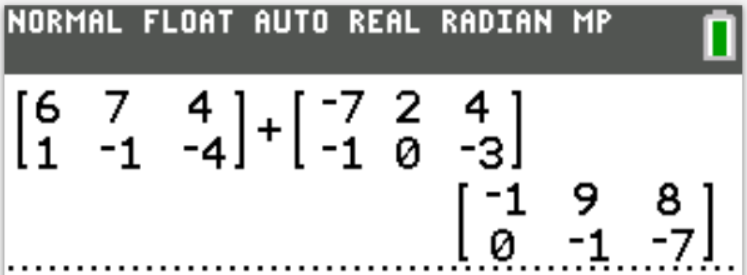
Number 33
(34.) Ratios: A Chinese language proficiency test was given to 60 university students.
The students’ scores were recorded as integers.
The table below shows the frequency and cumulative frequency of test scores in certain ranges.

Range of scores Frequency Cumulative Frequency
50 – 59
60 – 69
70 – 79
80 – 89
90 – 100
6
16
16
12
10
6
22
38
50
60

To be classified as proficient, a student must score 70 or higher on the test.
What is the ratio of the number of students who were classified as proficient to the number who were NOT classified as proficient?

$ F.\;\; 19:3 \\[3ex] G.\;\; 19:11 \\[3ex] H.\;\; 25:11 \\[3ex] J.\;\; 30:11 \\[3ex] K.\;\; 30:19 \\[3ex] $

$ \text{Proficient} = 16 + 12 + 10 = 38 \\[3ex] \text{Not Proficient} = 6 + 16 = 22 \\[3ex] \text{Ratio of Proficient to Not Proficient} = \dfrac{38}{22} \\[5ex] = \dfrac{19}{11} \\[5ex] = 19 : 11 $
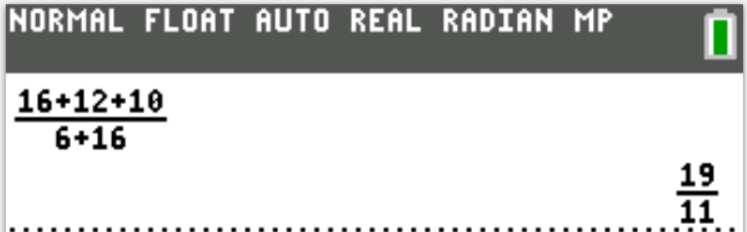
Number 34
(35.) Combinatorics: A group of 4 friends decide to go to a movie.
After buying their tickets, they find 5 empty chairs in the theater.
How many different seating arrangements are possible if the 4 friends sit, at most 1 person per chair, in these 5 chairs?

$ A.\;\; 5 \\[3ex] B.\;\; 15 \\[3ex] C.\;\; 24 \\[3ex] D.\;\; 120 \\[3ex] E.\;\; 240 \\[3ex] $

This is a case of the Fundamental Counting Principle.
4 friends to be seated, out of 5 chairs available.

The first friend may sit on any of the 5 seats.
The 2nd friend may sit on any of the remaining 4 (5 − 1) seats
The 3rd friend may sit on any of the remaining 3 (4 − 1) seats
The last friend may sit on any of the remaining 2 (3 − 1) seats

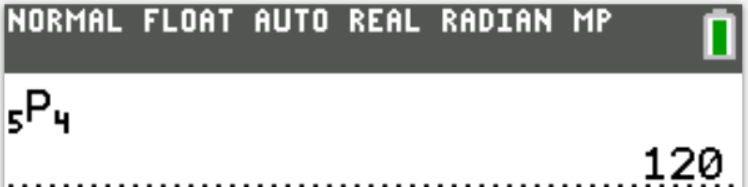
$ \begin{array}{c c c c} \text{1st Friend} & \text{2nd Friend} & \text{3rd Friend} & \text{4th Friend} \\ \rule{3cm}{0.5mm} & \rule{3cm}{0.5mm} & \rule{3cm}{0.5mm} & \rule{3cm}{0.5mm} \\ 5 & 4 & 3 & 2 \\[3ex] \end{array} \\[5ex] \text{Number of different seating arrangements} = 5 * 4 * 3 * 2 = 120 \text{ arrangements.} \\[5ex] $ Alternatively, we can use the Permutation formula.
This is also a case of Permutations because the order of seating matters.

$ \text{Perm 4 from 5} \\[3ex] P(n, r) = \dfrac{n!}{(n - r)!} \\[5ex] P(5, 4) = \dfrac{5!}{(5 - 4)!} \\[5ex] = \dfrac{5!}{1!} \\[5ex] = 120\;\text{ arrangements} \\[3ex] $ Student: SamDom For Peace, I thought this was a case of Combination.
But you did it as a Permutation.
May you explain?
Teacher: Here is something to bear in mind when deciding whether order matters or not.
Let's say Friend 1 sits on Seat 1 and Friend 2 sits on Seat 2
If Friend 1 sits on Seat 2 and Friend 2 sits on Seat 1, would it be considered a different seating arrangement or not?
Student: It is a different seating arrangement.
Teacher: Good.
In that case, the seating arrangement (order in which they are seated) is important.
Hence, it is a Permutation.
Student: Can you reword the same question to illustrate a case of Combination?
Teacher: Sure... here is a reworded question that illustrates a Combination
A group of 4 friends decide to go to a movie.
After buying their tickets, they find 5 empty chairs in the theater.
How many different sets of 4 chairs can be chosen from the 5 available chairs for the friends to sit in?
It can also be worded as:
A group of 4 friends find 5 empty chairs in a theater.
In how many ways can 1 empty chair be left over after they all sit down?
In this case, any one of them can sit in any one chair.
Instead of focusing on who sits where, the question asks which 4 chairs will be occupied, without worrying about specific seating order.
Number 35
(36.) Probability: Carina rolls 2 cubes.
Each has the whole numbers from 1 through 6 on its faces, 1 per face.
The faces of each cube are equally likely to land up.
What is the probability that the sum of the numbers on the faces landing up is 3 or more?

$ F.\;\; \dfrac{1}{36} \\[5ex] G.\;\; \dfrac{1}{18} \\[5ex] H.\;\; \dfrac{1}{11} \\[5ex] J.\;\; \dfrac{10}{11} \\[5ex] K.\;\; \dfrac{35}{36} \\[5ex] $

We can solve this question using at least 2 approaches
Use any approach you prefer, however, it is highly recommended that you use the first approach.

$ \text{Let } S = \text{sample space} \\[3ex] n(S) = faces^{tosses} \\[4ex] n(S) = 6^2 = 36 \\[3ex] $ Assume event, E = sum of the numbers on the faces landing up is 3 or more
Complement of the event, E' = sum of the numbers on the faces landing up is less than 3

$ \underline{\text{1st Approach: Complementary Rule}} \\[3ex] \text{1st cube} = \{1, 2, 3, 4, 5, 6\} \\[3ex] \text{2nd cube} = \{1, 2, 3, 4, 5, 6\} \\[3ex] $ Let us find all the possible event spaces where the sum of the numbers on both cubes is less than 3

$ 1 + 1 = 2\quad\dots\text{only one possibility} \\[3ex] n(E') = 1 \\[3ex] n(E) + n(E') = n(S) \\[3ex] P(E) + P(E') = 1 \quad\dots\text{Complementary Rule} \\[3ex] P(E) = 1 - P(E') \\[3ex] = 1 - \dfrac{n(E')}{n(S)} \\[5ex] = 1 - \dfrac{1}{36} \\[5ex] = \dfrac{36}{36} - \dfrac{1}{36} \\[5ex] = \dfrac{35}{36} \\[5ex] $ 2nd Approach: Punnett Square
Sample Space for a Toss of Two Fair Cubes
A Cube in the Column and A Cube in the Row
1 Cube →
(+)
1 Cube ↓
1 2 3 4 5 6
1 2 3 4 5 6 7
2 3 4 5 6 7 8
3 4 5 6 7 8 9
4 5 6 7 8 9 10
5 6 7 8 9 10 11
6 7 8 9 10 11 12

$ n(E) = 35 \\[3ex] P(E) = \dfrac{n(E)}{n(S)} \\[5ex] P(E) = \dfrac{35}{36} $
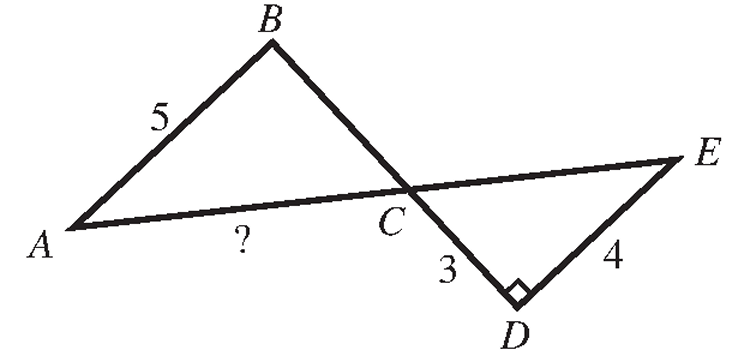
(37.) Trigonometry: In the figure shown below, $\overline{AB} || \overline{DE}$, C is the intersection of $\overline{AE}$ and $\overline{BD}$, $\angle D$ is a right angle, and the given side lengths are in inches.
What is the length of $\overline{AC}$, in inches?
Number 37

$ A.\;\; \dfrac{15}{4} \\[5ex] B.\;\; 4 \\[3ex] C.\;\; 5 \\[3ex] D.\;\; \dfrac{25}{4} \\[5ex] E.\;\; \dfrac{25}{3} \\[5ex] $

We can solve the question using at least two approaches.
Because of the time limit of about 1 minute per question on the ACT, I recommend the first approach.

$ \triangle ECD \\[3ex] \overline{EC}^2 = \overline{ED}^2 + \overline{DC}^2 \quad\dots\text{Pythagorean Theorem} \\[3ex] \overline{EC}^2 = 4^2 + 3^2 \\[3ex] \overline{EC}^2 = 16 + 9 \\[3ex] \overline{EC}^2 = 25 \\[3ex] \overline{EC} = \sqrt{25} \\[3ex] \overline{EC} = 5 \\[5ex] \underline{\text{1st Approach: Similar Triangles}} \\[3ex] \triangle ACB\;\;and\;\;\triangle ECD \\[3ex] \overline{AB} || \overline{DE} \\[3ex] \angle ABC = \angle EDB = 90^\circ \quad\dots\text{alternate angles are congruent} \\[3ex] \angle ACB = \angle ECD \quad\dots\text{vertical angles are congruent} \\[3ex] \angle BAC = \angle DEC \quad\dots\text{alternate angles are congruent} \\[3ex] \triangle ACB \sim \triangle ECD \quad\dots\text{Angle — Angle Similarity} \\[3ex] $ Because the triangles are similar, the corresponding sides will have the same ratio.

$ \underline{\text{Ratio of Corresponding Sides}} \\[3ex] \dfrac{\overline{AC}}{\overline{AB}} = \dfrac{\overline{EC}}{\overline{ED}} \\[5ex] \dfrac{\overline{AC}}{5} = \dfrac{5}{4} \\[5ex] \overline{AC} = \dfrac{5 \cdot 5}{4} \\[5ex] \overline{AC} = \dfrac{25}{4}\;inches \\[5ex] \underline{\text{2nd Approach: Trigonometric Ratios and Laws}} \\[3ex] \angle ABC = \angle EDB = 90^\circ \quad\dots\text{alternate angles are congruent} \\[5ex] \triangle ECD \\[3ex] \sin \angle ECD = \dfrac{opp}{hyp} = \dfrac{4}{5} \quad\dots\text{SOHCAHTOA} \\[5ex] \triangle ACB \\[3ex] \angle ACB = \angle ECD \quad\dots\text{vertical angles are congruent} \\[3ex] \implies \\[3ex] \sin\angle ACB = \sin\angle ECD = \dfrac{4}{5} \\[5ex] \dfrac{\overline{AC}}{\sin\angle ABC} = \dfrac{\overline{AB}}{\sin\angle ACB} \quad\dots\text{Sine Law} \\[5ex] \dfrac{\overline{AC}}{\sin 90^\circ} = \dfrac{5}{\dfrac{4}{5}} \\[8ex] \dfrac{\overline{AC}}{1} = 5 \div \dfrac{4}{5} \\[5ex] \overline{AC} = 5 \cdot \dfrac{5}{4} \\[5ex] \overline{AC} = \dfrac{25}{4}\;inches $
(38.) Relations and Functions: The domain of the real-valued function $f(x) = \dfrac{2}{\sqrt{x - 3}}$ is the set of all x-values that satisfy:

$ F.\;\; x \gt 0 \\[3ex] G.\;\; x \ge 0 \\[3ex] H.\;\; x \gt 2 \\[3ex] J.\;\; x \gt 3 \\[3ex] K.\;\; x \ne 3 \\[3ex] $

The function is a rational radical function.

Dealing with Rational Function:
1st Condition: The denominator should not be zero

$ \sqrt{x - 3} \ne 0 \\[3ex] x - 3 \ne 0^2 \\[3ex] x - 3 \ne 0 \\[3ex] x \ne 0 + 3 \\[3ex] x \ne 3 \\[3ex] $ Dealing with Radical Function:
2nd Condition: The radicand should must be non-negative (greater than or equal to zero)

$ x - 3 \ge 0 \\[3ex] x \ge 3 \\[3ex] \text{Combining both conditions}: \\[3ex] Domain = \{x: x \gt 3\} $
(39.) Composition of Functions: For $f(x) = 2x + 3$ and $g(x) = x^2 - 4$, which of the following expressions represents $f(g(x))$?

$ A.\;\; 2x^2 - 1 \\[3ex] B.\;\; 2x^2 - 5 \\[3ex] C.\;\; 2x^2 - 8 \\[3ex] D.\;\; 4x^2 + 5 \\[3ex] E.\;\; 4x^2 + 12x + 5 \\[3ex] $

$ f(x) = 2x + 3 \hspace{3em} g(x) = x^2 - 4 \\[3ex] f(g(x)) \\[3ex] = f(x^2 - 4) \\[3ex] = 2(x^2 - 4) + 3 \\[3ex] = 2x^2 - 8 + 3 \\[3ex] = 2x^2 - 5 $
(40.) Rational Expressions: For all y > 0, which of the following is a simplified form of $\dfrac{y - 1}{y + 1} - \dfrac{2(y - 1)}{4y + 4}$?

$ F.\;\; -\dfrac{1}{2} \\[5ex] G.\;\; 0 \\[3ex] H.\;\; \dfrac{1}{2} \\[5ex] J.\;\; \dfrac{y - 1}{3(y + 1)} \\[5ex] K.\;\; \dfrac{y - 1}{2(y + 1)} \\[5ex] $

$ \dfrac{y - 1}{y + 1} - \dfrac{2(y - 1)}{4y + 4} \\[5ex] LCD = (y + 1)(4y + 4) \\[3ex] = \dfrac{(y - 1)(4y + 4)}{(y + 1)(4y + 4)} - \dfrac{2(y - 1)(y + 1)}{(y + 1)(4y + 4)} \\[5ex] (y - 1)(y + 1) = y^2 - 1^2 \quad\dots\text{Difference of Two Squares} \\[3ex] = \dfrac{4y^2 + 4y - 4y - 4 - 2(y^2 - 1^2)}{(y + 1)(4y + 4)} \\[5ex] = \dfrac{4y^2 - 4 - 2(y^2 - 1)}{(y + 1)\cdot 4(y + 1)} \\[5ex] = \dfrac{4y^2 - 4 - 2y^2 + 2}{4(y + 1)(y + 1)} \\[5ex] = \dfrac{2y^2 - 2}{4(y + 1)(y + 1)} \\[5ex] = \dfrac{2(y^2 - 1)}{4(y + 1)(y + 1)} \\[5ex] = \dfrac{2(y^2 - 1^2)}{4(y + 1)(y + 1)} \\[5ex] = \dfrac{2(y + 1)(y - 1)}{4(y + 1)(y + 1)} \\[5ex] = \dfrac{y - 1}{2(y + 1)} $
(41.) Mensuration: A wheel with a radius of 1 centimeter rolls without slipping along the ground.
After exactly 2 revolutions, how many centimeters has the wheel traveled along the ground?

$ A.\;\; 2 \\[3ex] B.\;\; \pi \\[3ex] C.\;\; 2\pi \\[3ex] D.\;\; 4 \\[3ex] E.\;\; 4\pi \\[3ex] $

A wheel with a radius of 1 centimeter rolls ...
How many centimeters has the wheel traveled along the ground?

Assume a circular wheel...of course it should be circular
This implies that 1 revolution of rolling the wheel is the circumference of the circle. So, 2 revolutions is twice the circumference of the circle

$ radius = 1\;cm \\[3ex] Circumference = 2 \cdot \pi \cdot radius \\[3ex] \text{2 revolutions = twice the circumference} \\[3ex] = 2 \cdot 2 \cdot \pi \cdot 1 \\[3ex] = 4\pi $
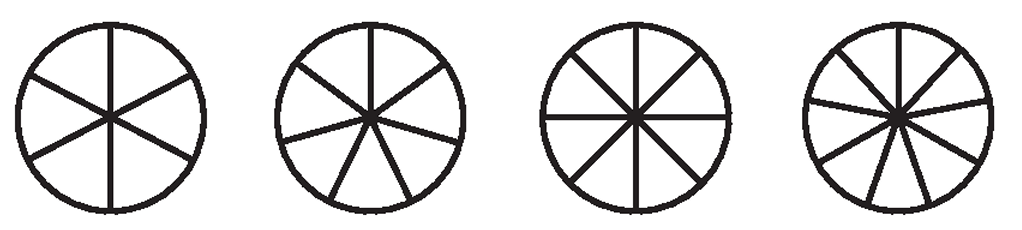
(42.) Fractions: For Cameron’s birthday party, his mom bought 4 pizzas, each the same size but with a different topping.
She cut those pizzas into 6, 7, 8, and 9 equal pieces, respectively, as shown below, giving 5 slices to each of the 6 boys attending.
If each boy ate all 5 of his slices and had at least 3 different kinds of pizza, which of the following expressions gives the largest amount of pizza that 1 boy could have eaten (expressed in fractions of a pizza)?
Number 42

$ F.\;\; \dfrac{1}{7} + \dfrac{1}{8} + \dfrac{3}{9} \\[5ex] G.\;\; \dfrac{1}{6} + \dfrac{1}{7} + \dfrac{1}{8} + \dfrac{2}{9} \\[5ex] H.\;\; \dfrac{2}{6} + \dfrac{1}{7} + \dfrac{1}{8} + \dfrac{1}{9} \\[5ex] J.\;\; \dfrac{2}{6} + \dfrac{2}{7} + \dfrac{1}{8} \\[5ex] K.\;\; \dfrac{3}{6} + \dfrac{1}{7} + \dfrac{1}{8} \\[5ex] $

4 different kinds of pizza
1st, 2nd, 3rd, 4th pizza

1st pizza: 6 slices
Fraction per slice = $\dfrac{1}{6}$

2nd pizza: 7 slices
Fraction per slice = $\dfrac{1}{7}$

3rd pizza: 8 slices
Fraction per slice = $\dfrac{1}{8}$

4th pizza: 9 slices
Fraction per slice = $\dfrac{1}{9}$

5 slices given to each boy
At least 3 different kinds of pizza ⇒ 3 or more (in this case: 3 or 4 different kinds of pizza)

For example:
2 slices of 1st pizza: $\dfrac{2}{6}$, 1 slice of 2nd pizza: $\dfrac{1}{7}$, 1 slice of 3rd pizza: $\dfrac{1}{8}$, 1 slice of 4th pizza: $\dfrac{1}{9}$

Another example: 3 slices of 1st pizza: $\dfrac{3}{6}$, 1 slice of 2nd pizza: $\dfrac{1}{7}$, 1 slice of 3rd pizza: $\dfrac{1}{8}$
... and so on and so forth
We are interested in finding the largest fraction of pizza that any boy ate
1st Approach would be to add the fractions in each option and determine the greatest sum
But this approach may take some time.

So, let us do it this way:
Assume 3 different kinds of pizza
Which is greater: $\dfrac{3}{6}$ OR $\dfrac{3}{9}$?
$\dfrac{3}{6}$ is greater

Assume 4 different kinds of pizza
Which is greater: $\dfrac{2}{6}$ OR $\dfrac{2}{9}$?
$\dfrac{2}{6}$ is greater

Now compare the greater of both options
Which is greater: $\dfrac{3}{6}$ OR $\dfrac{2}{6}$?
$\dfrac{3}{6}$ is greater

So, we shall go with this option because it gives the largest fraction: 3 slices of 1st pizza: $\dfrac{3}{6}$, 1 slice of 2nd pizza: $\dfrac{1}{7}$ and 1 slice of 3rd pizza: $\dfrac{1}{8}$
(43.) Exponents: When x, y, and z are positive integers, which of the following relationships will assure that the product $x^0 y^1 z^{-1}$ will have a value greater than 1?

$ A.\;\; x \lt y \\[3ex] B.\;\; x \gt y \\[3ex] C.\;\; x \gt z \\[3ex] D.\;\; y \lt z \\[3ex] E.\;\; y \gt z \\[3ex] $

$ x^0 = 1 ...Law\;3...Exp \\[3ex] y^1 = y ...Law\;4...Exp \\[3ex] z^{-1} = \dfrac{1}{z^1} = \dfrac{1}{z} ...Law\;6...Exp \\[5ex] \implies \\[3ex] x^0 y^1 z^{-1} \\[5ex] = 1 \cdot y \cdot \dfrac{1}{z} \\[5ex] = \dfrac{y}{z} \\[5ex] For\;\; \dfrac{y}{z} \text{ to be } \gt 1 \\[5ex] y \text{ must be} \gt z $
(44.) Linear Functions (Linear Regression): Sumiko, who works at a restaurant, recorded the amounts of her customers’ checks and the corresponding amounts of her tips, both in dollars, for 25 consecutive customers she served.
She plotted the data in the standard (x, y) coordinate plane below with the amount of the check on the x-axis and the amount of the tip on the y-axis.
Sumiko then performed a linear regression on the data, finding the regression equation to be $y = 0.16x − 0.44$ with a correlation coefficient, r, of 0.81.
She also graphed the regression line.
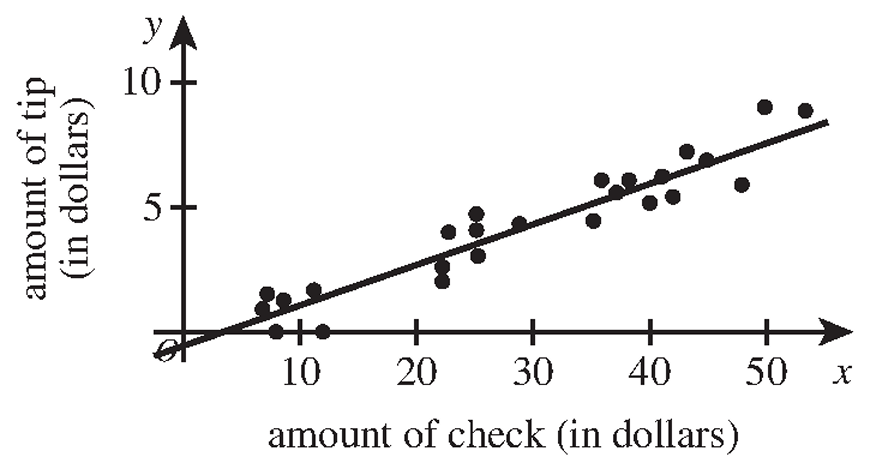
Number 44

From her statistical analysis, Sumiko can correctly conclude that every $1 increase in the total amount of the check will result in approximately:

F. a 16 cent increase in her tip.
G. a 44 cent increase in her tip.
H. an 81 cent increase in her tip.
J. a 16 cent decrease in her tip.
K. a 44 cent decrease in her tip.


Regression Equation: $y = 0.16x − 0.44$
x = amount of check (in dollars)
y = amount of tip (in dollars)
Slope = $0.16 = 16 cents
This is a positive slope. The interpretation for the slope in this context implies that: On average, for every unit change ($1 increase in) in x (the amount of check), the y (amount of tip) increases by the slope (16 cents).

From her statistical analysis, Sumiko can correctly conclude that every $1 increase in the total amount of the check will result in approximately a 16 cent increase in her tip.
(45.) Measurements and Units: The cost of a certain type of carpet is $10 per square yard.
What would be the cost of carpet of this type to cover a rectangular floor 12 feet by 18 feet?

$ A.\;\; \$ 216 \\[3ex] B.\;\; \$ 240 \\[3ex] C.\;\; \$ 600 \\[3ex] D.\;\; \$ 720 \\[3ex] E.\;\; \$2, 160 \\[3ex] $

$ \text{square yard} = yard^2 = yard \cdot yard \\[3ex] \underline{\text{Unity Fraction Method}} \\[3ex] \text{Set up units}: \\[3ex] 12\;feet \cdot 18\;feet \cdot \dfrac{...yard}{...feet} \cdot \dfrac{...yard}{...feet} \cdot \dfrac{...\$}{...yard \cdot yard} \\[5ex] 3\; feet = 1\; yard \\[3ex] \implies \\[3ex] 12\;feet \cdot 18\;feet \cdot \dfrac{1\;yard}{3\;feet} \cdot \dfrac{1\;yard}{3\;feet} \cdot \dfrac{\$10}{1\;yard \cdot yard} \\[5ex] = 4 \cdot 6 \cdot \$10 \\[3ex] = \$240 $
(46.) Inverse Functions: The function $f(x) = x^5$ is defined for all real numbers x.
Which of the following expressions represents $f^{-1}(x)$?

$ F.\;\; x^{-5} \\[4ex] G.\;\; x^{-\dfrac{1}{5}} \\[5ex] H.\;\; x^{\dfrac{1}{5}} \\[5ex] J.\;\; \dfrac{x}{5} \\[5ex] K.\;\; -\dfrac{x}{5} \\[5ex] $

$ f(x) = x^5 \\[3ex] y = x^5 \\[3ex] \text{Interchange x and y} \\[3ex] x = y^5 \\[3ex] y^5 = x \\[3ex] y = \sqrt[5]{x} \\[3ex] \text{This new } y \text{ is the inverse} \\[3ex] f^{-1}(x) = \sqrt[5]{x} $
(47.) Kinematics: A car accelerates at a constant rate from 0 miles per hour to 60 miles per hour in 15 seconds and averages 30 miles per hour over the 15-second period.
The car maintains the constant speed of 60 miles per hour for the next 15 seconds.
What fraction of a mile has the car traveled in these 30 seconds?

$ A.\;\; \dfrac{1}{8} \\[5ex] B.\;\; \dfrac{1}{4} \\[5ex] C.\;\; \dfrac{3}{8} \\[5ex] D.\;\; \dfrac{1}{2} \\[5ex] E.\;\; \dfrac{3}{4} \\[5ex] $

$ s...t...d \\[3ex] speed \cdot time = distance \\[5ex] \text{60 seconds = 1 minute} \\[3ex] \text{60 minutes = 1 hour} \\[5ex] \underline{\text{1st Part}} \\[3ex] \text{average speed} = 30 \text{ miles per hour} \\[3ex] \text{Convert to miles per second} \\[3ex] \underline{\text{Unity Fraction Method}} \\[3ex] \dfrac{30\;miles}{1\;hour} \cdot \dfrac{...hour}{...minute} \cdot \dfrac{...minute}{...second} \\[5ex] \dfrac{30\;miles}{1\;hour} \cdot \dfrac{1\;hour}{60\;minute} \cdot \dfrac{1\;minute}{60\;second} \\[5ex] \dfrac{1}{120}\;\text{miles per second} \\[5ex] \text{time} = 15 \text{ seconds} \\[3ex] \text{distance} = \dfrac{1}{120}\;\text{miles per second} \cdot 15 \text{ seconds} \\[5ex] \text{distance} = \dfrac{1}{8}\;mile \\[5ex] \underline{\text{2nd Part}} \\[3ex] \text{speed} = 60 \text{ miles per hour} \\[3ex] \text{Convert to miles per second} \\[3ex] \underline{\text{Unity Fraction Method}} \\[3ex] \dfrac{60\;miles}{1\;hour} \cdot \dfrac{...hour}{...minute} \cdot \dfrac{...minute}{...second} \\[5ex] \dfrac{60\;miles}{1\;hour} \cdot \dfrac{1\;hour}{60\;minute} \cdot \dfrac{1\;minute}{60\;second} \\[5ex] \dfrac{1}{60}\;\text{miles per second} \\[5ex] \text{time} = 15 \text{ seconds} \\[3ex] \text{distance} = \dfrac{1}{60}\;\text{miles per second} \cdot 15 \text{ seconds} \\[5ex] \text{distance} = \dfrac{1}{4}\;mile \\[5ex] \underline{\text{Entire Trip}} \\[3ex] \text{distance} = \dfrac{1}{8}\;mile + \dfrac{1}{4}\;mile \\[5ex] = \dfrac{1}{8}\;mile + \dfrac{2}{8}\;mile \\[5ex] = \dfrac{3}{8}\;mile $
(48.) Linear Systems: If $a - b = 5$ and $c = 7a - 9 - 7b$, then c = ?

$ F.\;\; 44 \\[3ex] G.\;\; 26 \\[3ex] H.\;\; -2 \\[3ex] J.\;\; -4 \\[3ex] K.\;\; \text{Cannot be determined from the given information} \\[3ex] $

$ a - b = 5 ...eqn.(1) \\[3ex] c = 7a - 9 - 7b ...eqn.(2) \\[5ex] From\;\;eqn.(1) \\[3ex] a = 5 + b ...eqn.(3) \\[5ex] \text{Substitute for a in eqn.(2)} \\[3ex] c = 7(5 + b) - 9 - 7b \\[3ex] c = 35 + 7b - 9 - 7b \\[3ex] c = 26 $
(49.) Trigonometry: If $\sin\theta = \dfrac{1}{2}$ and $\tan\theta = -\dfrac{\sqrt{3}}{3}$, then $\cos\theta$ = ?

$ A.\;\; -\dfrac{2\sqrt{3}}{3} \\[5ex] B.\;\; -\dfrac{\sqrt{3}}{2} \\[5ex] C.\;\; -\dfrac{\sqrt{3}}{6} \\[5ex] D.\;\; \dfrac{1}{2} \\[5ex] E.\;\; \dfrac{\sqrt{3}}{2} \\[5ex] $

$ \tan\theta = \dfrac{\sin\theta}{\cos\theta} \quad\dots\text{SOHCAHTOA} \\[5ex] \cos\theta = \dfrac{\sin\theta}{\tan\theta} \\[5ex] = \dfrac{1}{2} \div -\dfrac{\sqrt{3}}{3} \\[5ex] = \dfrac{1}{2} \cdot -\dfrac{3}{\sqrt{3}} \\[5ex] = -\dfrac{3}{2\sqrt{3}} \\[5ex] \text{Rationalize the denominator} \\[3ex] = -\dfrac{3}{2\sqrt{3}} \cdot \dfrac{\sqrt{3}}{\sqrt{3}} \\[5ex] = -\dfrac{3\sqrt{3}}{2 \cdot 3} \\[5ex] = -\dfrac{\sqrt{3}}{2} $
(50.) Algebra Transformations: The graph in the standard (x, y) coordinate plane of $y = a(x - b)^2$, where |a| ≠ |b|, is reflected across the x-axis.
Which of the following is an equation of the reflection?

$ F.\;\; y = -a(x - b)^2 \\[3ex] G.\;\; y = a(x - b)^2 \\[3ex] H.\;\; y = a(x + b)^2 \\[3ex] J.\;\; x = -b(y - a)^2 \\[3ex] K.\;\; x = b(y + a)^2 \\[3ex] $

Reflected across the x-axis is Vertical Reflection
In Vertical Reflection: y changes, x does not change
y-coordinate is multiplied by −1
The transformed y-coordinate becomes −y

$ y = a(x - b)^2 \\[3ex] -1 \cdot y = -1 \cdot a(x - b)^2 \\[3ex] = -a(x - b)^2 \\[3ex] \text{Transformed } y = -a(x - b)^2 $
(51.) Complex Numbers: For $i^2 = -1$, $\dfrac{2 + 3i}{i} = ?$

$ A.\;\; 5 \\[3ex] B.\;\; 5i \\[3ex] C.\;\; -3 + 2i \\[3ex] D.\;\; 3 - 2i \\[3ex] E.\;\; 3 + 2i \\[3ex] $

$ \dfrac{2 + 3i}{i} \\[5ex] \text{Rationalize the denominator} \\[3ex] = \dfrac{2 + 3i}{i} \cdot \dfrac{i}{i} \\[5ex] = \dfrac{i(2 + 3i)}{i^2} \\[5ex] = \dfrac{2i + 3i^2}{-1} \\[5ex] = -1(2i + 3(-1)) \\[3ex] = -1(2i - 3) \\[3ex] = -2i + 3 \\[3ex] = 3 - 2i $
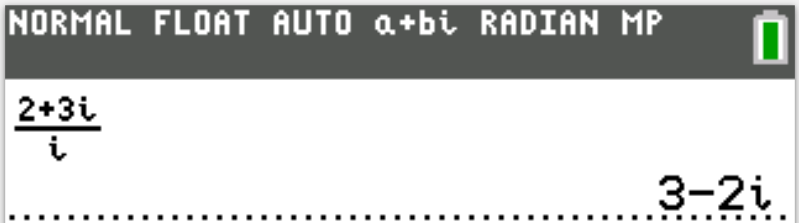
Number 51
(52.) Statistics: Measures of Center: Arithmetic Mean: All 30 of Mr. Gray's algebra students took the midterm test, and Mr. Gray computed the average test score for the class.
Then, one of Mr. Gray's students, Mandy, found that her test should have been scored 5 points higher than it was originally scored.
All other students' scores were correct.
After correcting the scoring error on Mandy's test, the average test score for the class increased by how many points?

$ F.\;\; \dfrac{1}{30} \\[5ex] G.\;\; \dfrac{1}{6} \\[5ex] H.\;\; \dfrac{1}{5} \\[5ex] J.\;\; 5 \\[3ex] K.\;\; \text{Cannot be determined from the given information} \\[3ex] $

Let:
n = number of students
x = score
$\bar{x}$ = average score
Σx = summation of the scores

$ \underline{\text{Initial: Graded Midterm Test}} \\[3ex] n = 30 \\[3ex] \bar{x} = p \\[3ex] \Sigma x = \bar{x} \cdot n \\[3ex] = p \cdot 30 \\[3ex] = 30p \\[5ex] \underline{\text{Corrected Grading}} \\[3ex] n = 30 \\[3ex] \Sigma x = 30p + 5 \quad\dots\text{increase of 5 points} \\[3ex] \bar{x} = \dfrac{\Sigma x}{n} \\[5ex] = \dfrac{30p + 5}{30} \\[5ex] \underline{\text{Change in the Average Score}} \\[3ex] \text{Corrected Average} - \text{Initial Average} \\[3ex] = \dfrac{30p + 5}{30} - p \\[5ex] = \dfrac{30p + 5}{30} - \dfrac{30p}{30} \\[5ex] = \dfrac{30p + 5 - 30p}{30} \\[5ex] = \dfrac{5}{30} \\[5ex] = \dfrac{1}{6} $
(53.) Linear Systems: What is the value of z in the solution to the system of equations below?

$ 2x + y - z = 0 \\[3ex] x - 3y + z = 18 \\[3ex] x + y = 1 \\[5ex] A.\;\; -3 \\[3ex] B.\;\; 1\dfrac{1}{2} \\[5ex] C.\;\; 4 \\[3ex] D.\;\; 5 \\[3ex] E.\;\; 19 \\[3ex] $

$ 2x + y - z = 0 ...eqn.(1) \\[3ex] x - 3y + z = 18 ...eqn.(2) \\[3ex] x + y = 1 ...eqn.(3) \\[5ex] \underline{\text{Elimination Method}} \\[3ex] eqn.(2) - eqn.(3) \rightarrow \\[3ex] x - 3y + z - (x + y) = 18 - 1 \\[3ex] x - 3y + z - x - y = 17 \\[3ex] -4y + z = 17 ...eqn.(4) \\[3ex] 2 \cdot eqn.(2) \rightarrow \\[3ex] 2(x - 3y + z) = 2(18) \\[3ex] 2x - 6y + 2z = 36 ...eqn.(5) \\[3ex] eqn.(1) - eqn.(2) \rightarrow \\[3ex] 2x + y - z - (2x - 6y + 2z) = 0 - 36 \\[3ex] 2x + y - z - 2x + 6y - 2z = -36 \\[3ex] 7y - 3z = -36 ...eqn.(6) \\[3ex] 7 \cdot eqn.(4) + 4 \cdot eqn.(6) \rightarrow \\[3ex] 7(-4y + z) + 4(7y - 3z) = 7(17) + 4(-36) \\[3ex] -28y + 7z + 28y - 12z = 119 - 144 \\[3ex] -5z = -25 \\[3ex] z = \dfrac{-25}{-5} \\[5ex] z = 5 $
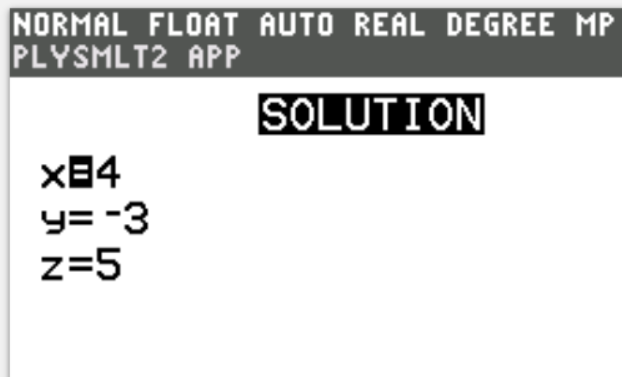
Number 53
(54.) Algebraic Expressions: What is the maximum possible value of $\dfrac{x}{y^2}$ for x in the set $\left\{1, \dfrac{1}{2}, 0\right\}$ and y in the set $\left\{\dfrac{1}{8}, \dfrac{1}{4}, \dfrac{1}{2}\right\}$?

$ F.\;\; 2 \\[3ex] G.\;\; 4 \\[3ex] H.\;\; 8 \\[3ex] J.\;\; 32 \\[3ex] K.\;\; 64 \\[3ex] $

The maximum value of a quotient is when the numerator is the biggest and the denominator is the smallest.
You may try it with some values to confirm.
This implies that we have to use the greatest value of x and the least value of y in the set.

$ \underline{\text{Both Sets}} \\[3ex] \text{greatest value of } x = 1 \\[3ex] \text{least value of } y = \dfrac{1}{8} \\[5ex] \dfrac{x}{y^2} \\[5ex] = \dfrac{1}{\left(\dfrac{1}{8}\right)^2} \\[7ex] = 1 \div \dfrac{1}{64} \\[5ex] = 1 \cdot 64 \\[3ex] = 64 \\[3ex] $ Student: SamDom For Peace, for questions like this, can I just guess that the answer is 64 because it is the greatest number in the options?
Teacher: Yes, you may...only if you do not have much time left
I recommend that you solve it if you have time, but then guess rather than leave any question blank.
Student: I'm not sure you understand my question.
Okay, let me put it this way: is it possible for ACT to include a number greater than 64 in the options?
Teacher: I think it is possible.
But let's attempt more questions like this and see.
Let's solve more past questions and if we notice a trend (where the maximum answer in the option is always the correct answer), then we can decide what to do.
Until then, I recommend you solve it.
(55.) Mensuration: In the figure below, ABEH is a square.
Points C and D are on $\overline{BE}$ such that $\overline{BC}$, $\overline{CD}$, and $\overline{DE}$ all have the same length.
Points F and G are on $\overline{EH}$ such that $\overline{EF}$, $\overline{FG}$, and $\overline{GH}$ all have the same length.
How many of the triangles numbered 1 – 5 ($\triangle ABC$, $\triangle ACD$, $\triangle ADE$, $\triangle AEF$, and $\triangle AFG$ respectively) have the same area as $\triangle AGH$?
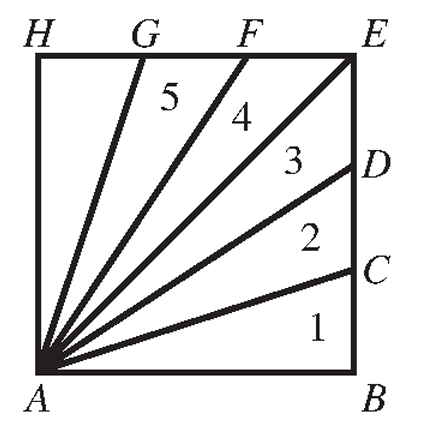
Number 55

$ A.\;\; 1 \\[3ex] B.\;\; 2 \\[3ex] C.\;\; 3 \\[3ex] D.\;\; 4 \\[3ex] E.\;\; 5 \\[3ex] $

Let us analyze this question.

$ \text{Area of a Triangle} = \dfrac{1}{2} \cdot base \cdot \perp height \\[3ex] $ $\triangle ACB$ has the same area as $\triangle AGH$
This is because they have:
(I.) the same base: $\overline{BC} = \overline{GH}$
(II.) the same perpendicular height: because a square has equal sides: $\overline{AB} = \overline{AH}$

The other triangles: $\triangle ACD$, $\triangle ADE$, $\triangle AEF$, and $\triangle AFG$ have:
(III.) the same base: $\overline{CD} = \overline{DE} = \overline{EF} = \overline{FG}$

But what about their perpendicular heights?
How do we calculate the area of a triangle if the triangle does not have a perpendicular height?
One of the ways to calculate the area is to extend the base to the same level as the opposite vertex, then draw a perpendicular height from that vertex to the extension of the base.
This is what I mean.
$\triangle ACD$ does not a perpendicular height
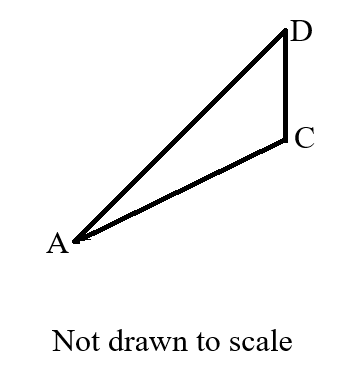
Number 55-1st

One of the ways to calculate the area of the triangle is to draw the perpendicular height $\overline{AB}$ (Please see the red lines)
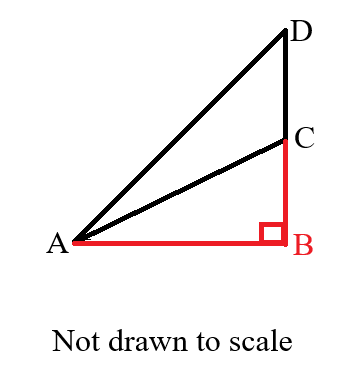
Number 55-2nd

This implies that the perpendicular height is still the same side of the square
(IV.) the same perpendicular height: the side of the square

Therefore all five triangles: $\triangle ACB$, $\triangle ACD$, $\triangle ADE$, $\triangle AEF$, and $\triangle AFG$ have the same area as $\triangle AGH$.
(56.) Mensuration: The midpoints of the sides of square ABCD are the vertices pf square KLMN, shown below.
The side length of square ABCD is 14 meters.
What is the area, in square meters, of the shaded portion?
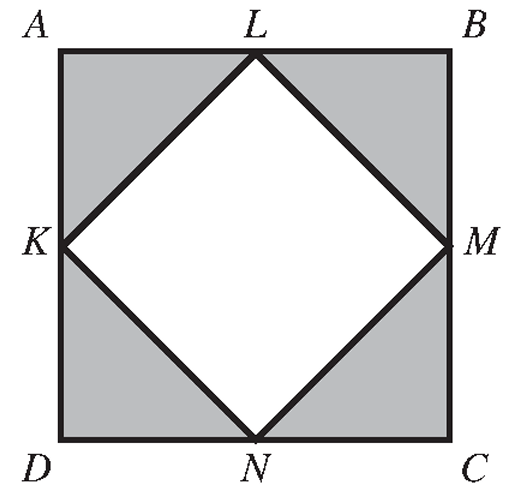
Number 56

$ F.\;\; 7\sqrt{2} \\[3ex] G.\;\; 14\sqrt{2} \\[3ex] H.\;\; 24.5 \\[3ex] J.\;\; 49 \\[3ex] K.\;\; 98 \\[3ex] $

Area of the shaded portion = Area of Square ABCD − Area of Square KLMN
Area of a Square = Side Length²

$ \underline{\text{Square ABCD}} \\[3ex] \text{side length} = 14\;m \\[3ex] \overline{AB} = \overline{BC} = \overline{CD} = \overline{DA} = 14\;m \\[3ex] Area = 14^2 \\[3ex] Area = 196\;m^2 \\[5ex] \underline{\text{Triangle ALK}} \\[3ex] \text{This is a right triangle because a square has 4 right angles} \\[3ex] \overline{AL} = \dfrac{\overline{AB}}{2} \quad\dots\text{Midpoint} \\[5ex] = \dfrac{14}{2} \\[5ex] = 7\;m \\[5ex] \overline{AK} = \dfrac{\overline{DA}}{2} \quad\dots\text{Midpoint} \\[5ex] = \dfrac{14}{2} \\[5ex] = 7\;m \\[5ex] \overline{KL}^2 = \overline{AL}^2 + \overline{AK}^2 \quad\dots\text{Pythagorean Theorem} \\[3ex] \overline{KL}^2 = 7^2 + 7^2 \\[3ex] \overline{KL}^2 = 49 + 49 \\[3ex] \overline{KL}^2 = 98 \\[3ex] \overline{KL} = \sqrt{98} \\[5ex] \underline{\text{Square KLMN}} \\[3ex] \text{side length} = \overline{KL} = \sqrt{98}\;m \\[3ex] Area = \sqrt{98}^2 \\[3ex] Area = 98\;m^2 \\[5ex] \underline{\text{Shaded Portion}} \\[3ex] Area = 196 - 98 \\[3ex] Area = 98\;m^2 $
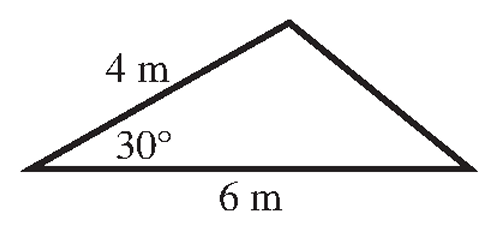
(57.) Trigonometry: Given $\sin 30^\circ = \dfrac{1}{2}$, what is the area, in square meters, of the triangle shown below?

Number 57

$ A.\;\; 6 \\[3ex] B.\;\; 8 \\[3ex] C.\;\; 10 \\[3ex] D.\;\; 12 \\[3ex] E.\;\; 24 \\[3ex] $

$ Area = \dfrac{1}{2}ab\sin C\quad\dots\text{one of the formulas} \\[5ex] Area = \dfrac{1}{2} \cdot 4 \cdot 6 \cdot \sin 30^\circ \\[5ex] = 12 \cdot \dfrac{1}{2} \\[5ex] = 6\;m^2 $
(58.) Conic Sections: The graph of which of the equations below is a hyperbola with the same asymptotes as the graph of $\dfrac{x^2}{9} - \dfrac{y^2}{4} = 1$?

$ F.\;\; \dfrac{x^2}{9} + \dfrac{y^2}{4} = 1 \\[5ex] G.\;\; \dfrac{x^2}{4} - \dfrac{y^2}{9} = 1 \\[5ex] H.\;\; \dfrac{y^2}{9} + \dfrac{x^2}{4} = 1 \\[5ex] J.\;\; \dfrac{y^2}{9} - \dfrac{x^2}{4} = 1 \\[5ex] K.\;\; \dfrac{y^2}{4} - \dfrac{x^2}{9} = 1 \\[5ex] $

1st: Let us determine the asymptotes of the hyperbola

$ Hyperbola:\;\; \dfrac{x^2}{9} - \dfrac{y^2}{4} = 1 \\[5ex] \text{This is a horizontal hyperbola} \\[3ex] \text{Standard Form: center at the origin}: \dfrac{x^2}{a^2} - \dfrac{y^2}{b^2} = 1 \\[5ex] a^2 = 9 \hspace{3em} b^2 = 4 \\[3ex] a = \sqrt{9} \hspace{3em} b = \sqrt{4} \\[3ex] a = 3 \hspace{3em} b = 2 \\[3ex] Asymptotes:\;\; y = \pm \dfrac{b}{a}x \\[5ex] y = \pm \dfrac{2}{3}x \\[5ex] $ Let us analyze each option.

$ F.\;\; \dfrac{x^2}{9} + \dfrac{y^2}{4} = 1 \\[5ex] \text{This is a horizontal ellipse} \\[3ex] \text{Incorrect option} \\[5ex] G.\;\; \dfrac{x^2}{4} - \dfrac{y^2}{9} = 1 \\[5ex] \text{This is a horizontal hyperbola} \\[3ex] a^2 = 4 \hspace{3em} b^2 = 9 \\[3ex] a = \sqrt{4} \hspace{3em} b = \sqrt{9} \\[3ex] a = 2 \hspace{3em} b = 3 \\[3ex] Asymptotes:\;\; y = \pm \dfrac{b}{a}x \\[5ex] y = \pm \dfrac{3}{2}x \\[5ex] \pm \dfrac{3}{2}x \ne \pm \dfrac{2}{3}x \\[5ex] \text{Incorrect option} \\[5ex] H.\;\; \dfrac{y^2}{9} + \dfrac{x^2}{4} = 1 \\[5ex] \text{This is a vertical ellipse} \\[3ex] \text{Incorrect option} \\[5ex] J.\;\; \dfrac{y^2}{9} - \dfrac{x^2}{4} = 1 \\[5ex] \text{This is a vertical hyperbola} \\[3ex] b^2 = 9 \hspace{3em} a^2 = 4 \\[3ex] b = \sqrt{9} \hspace{3em} a = \sqrt{4} \\[3ex] b = 3 \hspace{3em} a = 2 \\[3ex] Asymptotes:\;\; y = \pm \dfrac{b}{a}x \\[5ex] y = \pm \dfrac{3}{2}x \\[5ex] \text{Incorrect option} \\[5ex] K.\;\; \dfrac{y^2}{4} - \dfrac{x^2}{9} = 1 \\[5ex] \text{This is a vertical hyperbola} \\[3ex] b^2 = 4 \hspace{3em} a^2 = 9 \\[3ex] b = \sqrt{4} \hspace{3em} a = \sqrt{9} \\[3ex] b = 2 \hspace{3em} a = 3 \\[3ex] Asymptotes:\;\; y = \pm \dfrac{b}{a}x \\[5ex] y = \pm \dfrac{2}{3}x \\[5ex] \text{This is the correct option} $
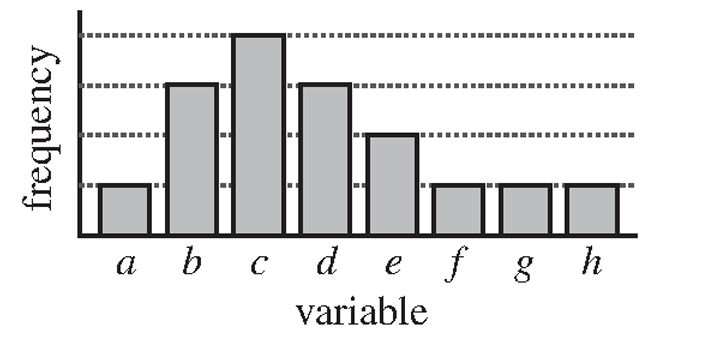
(59.) Statistics: Measures of Center: The graph below shows the distribution of a data set.
The variables ah represent 8 consecutive positive integers in order from least to greatest.
The frequencies of a, f, g, and h are equal; the frequency of e is 2 times the frequency of a; the frequency of b and of d is 3 times the frequency of a; and the frequency of c is 4 times the frequency of a.
Which of the following statements about the mean, median, and mode of the data set is true?
Number 59

A. The mode is less than the median, and the median is less than the mean.
B. The mean is less than the median, and the median is less than the mode.
C. The mode is equal to the mean, and the mean id less than the median.
D. The mode is less than the mean, and the mean is equal to the median.
E. The mean is equal to the median, and the median is equal to the mode.


For a:
Left-skewed distribution (longer tail on the left): Mean < Median < Mode
Symmetric distribution: Mean = Median = Mode
Right-skewed distribution (longer tail on the right): Mean > Median > Mode

The distribution is right-skewed; hence the mean is greater than the median, and the median is greater than the mode.
This implies that:
The mode is less than the median, and the median is less than the mean.
(60.) Mensuration: A solid rectangular block of steel weighs w pounds.
Which of the following expressions gives the weight, in pounds, of a larger solid rectangular block that is made of the same kind of steel and has length, width, and height 4 times those of the smaller block?
(Note: Assume that weight is proportional to volume.)

$ F.\;\; 4w^3 \\[3ex] G.\;\; 4w \\[3ex] H.\;\; 16w \\[3ex] J.\;\; 64w \\[3ex] K.\;\; 64w^3 \\[3ex] $

$ Volume = Length \cdot Width \cdot Height \\[3ex] \underline{\text{Solid Rectangular Block: 1}} \\[3ex] Length = L \\[3ex] Width = W \\[3ex] Height = H \\[3ex] Volume = V_1 \\[3ex] Weight = w ...Given \\[3ex] V_1 = L \cdot W \cdot H \\[3ex] V_1 = LWH \\[5ex] \underline{\text{Larger Solid Rectangular Block: 2}} \\[3ex] Length = 4L \\[3ex] Width = 4W \\[3ex] Height = 4H \\[3ex] Volume = V_2 \\[3ex] Weight = ? \\[5ex] V_2 = 4L \cdot 4W \cdot 4H \\[3ex] V_2 = 64LWH \\[5ex] Volume \alpha Weight\quad\dots\text{Direct Proportion...assumed} \\[3ex] Volume = k \cdot Weight \quad\dots\text{k = constant of proportionality} \\[3ex] k = \dfrac{Volume}{Weight} \\[5ex] \implies \\[3ex] k = \dfrac{V_1}{w} = \dfrac{V_2}{Weight} \\[5ex] \dfrac{LWH}{w} = \dfrac{64LWH}{Weight} \\[5ex] \text{Cross Multiply} \\[3ex] LWH \cdot Weight = w \cdot 64LWH \\[3ex] Weight = \dfrac{w \cdot 64LWH}{LWH} \\[5ex] Weight = 64w\;pounds $